
GCP-190 · Lesson 10 of 12 · 22 min
Finding and closing knowledge gaps
▶ Video coming soon A video version of this lesson is on the way.
Two days after the first timed practice session, Farah asks Owen and Jules to bring their mistakes logs to her desk. She does not look at their scores first. She looks at the pattern. "A score tells you how you did," she says. "The pattern tells you what to do next." Owen's mistakes cluster in two places: AI offerings and cost control. Jules's cluster in databases and compute. Each of them has about three weeks before the exam, and neither has time to restudy everything. This lesson shows how to find your gaps quickly, decide which ones matter most and close them efficiently, using the exam guide as your checklist. The plans in this lesson are for January 2027 and are still ahead as this course is written.
Use the exam guide as a checklist
The exam guide lists every objective the exam can cover. Turn it into a checklist with one row for each objective and three columns: confidence, evidence and action. Rate your confidence honestly on a simple scale, such as red for weak, amber for unsure and green for confident. Then add evidence, which is the result of practice questions on that objective, because confidence and evidence often disagree. Owen rated security green from habit, but his practice results showed several mistakes about shared responsibility under different service models. Evidence wins.
| Objective (summary) | Confidence | Evidence from practice | Action |
|---|---|---|---|
| Why the cloud is changing business | Green | 9 of 10 correct | Light review only |
| Data products for business uses | Amber | 6 of 10 correct | Lesson 8 pairs; flash cards |
| Google Cloud AI offerings | Red | 4 of 10 correct | Revisit GCP-102 AI lessons; lesson 5 ladder |
| Infrastructure offerings | Green | 8 of 10 correct | Light review only |
| Defense in depth | Amber | 7 of 10 correct | Shared responsibility table |
| Controlling cloud costs | Red | 5 of 10 correct | Lesson 7 cost levers; scenarios |
Finding gaps quickly
If you do not yet have enough practice results to fill in the evidence column, run a short diagnostic: about five questions for each of the six sections, mixed and timed, using material you have not seen before. Thirty questions take about forty minutes and give a rough map. Then, for any section where you got two or more wrong, look at the mistakes and sort them by reason, as in lesson 9. Gaps of knowledge, gaps of confusion between neighbors and gaps of reading need different fixes.
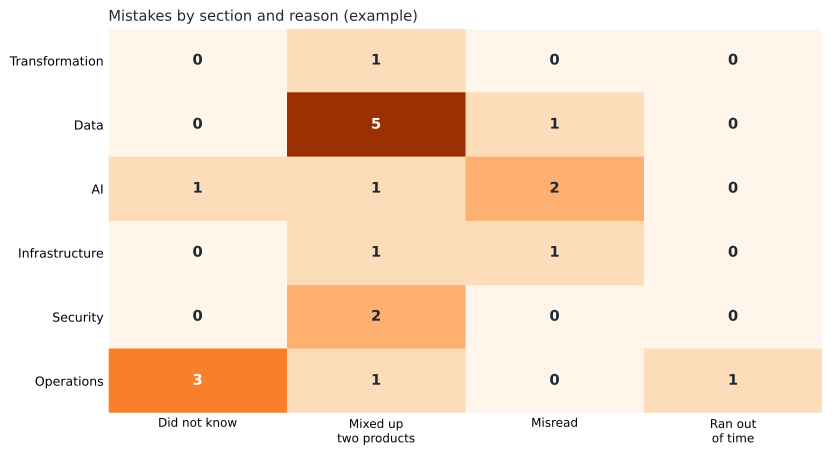
A heat map helps you see the pattern at a glance. Put the six sections down the side and the four reasons for mistakes across the top, and count your mistakes in each cell. The darkest cells are where the work should go first. Jules's heat map shows a dark cell where databases meet confusing neighbors, and a lighter cell where AI meets misreading. That tells Jules to spend the first week on separating data products, not on rereading every lesson.
Deciding what to fix first
With limited time, prioritize by two things: how much a section weighs on the exam and how weak you are in it. In the guide we read, the first five sections had roughly equal weight and the operations section was smaller. A red section with high weight is the top priority. A red section with lower weight comes next. Amber sections follow. Green sections get light review only, mostly through mixed practice, so that they stay green. Avoid the trap of spending most of your time on the sections you enjoy, which are usually the ones you already know.
# A simple priority score: weight times weakness (weights from the guide we read; check the current guide)
sections = {
    "Transformation": (18, 0.1), "Data": (18, 0.4), "AI": (18, 0.6),
    "Infrastructure": (18, 0.2), "Security": (18, 0.3), "Operations": (10, 0.5),
}
scores = {name: round(w * weak, 1) for name, (w, weak) in sections.items()}
for name, s in sorted(scores.items(), key=lambda kv: -kv[1]):
print(name, s)AI 10.8 Data 7.2 Security 5.4 Operations 5.0 Infrastructure 3.6 Transformation 1.8
What this code does
Each exam section is given a priority score by multiplying its weight in the exam guide by how weak the learner feels in it, from 0 to 1. The sections are then sorted from highest to lowest score. AI comes out first (10.8) and Data second (7.2), so those are where study time pays off most.
In the example, weakness is the share of practice questions answered wrongly in each section, written as a decimal. The weights are the approximate figures from the guide we read and may change. The score is only a guide, but it stops you from ignoring a heavy section because it feels dull, or from overworking a light one because it feels hard.
Closing each kind of gap
Knowledge gaps need learning, not more questions. Go back to the relevant lesson in GCP-101 or GCP-102, or to the matching part of Google's own learning path, and work through it actively: write a one-sentence summary of each idea, explain it aloud and then answer a few practice questions. Confusion gaps need contrast. Put the neighboring products side by side, as in lesson 8, name the deciding difference, and practice questions that mix them. Reading gaps need slower, more deliberate practice with the routine from lesson 3, then a gradual return to normal pace. Timing gaps need timed practice with checkpoints.
| Kind of gap | Typical sign | Fix |
|---|---|---|
| Knowledge | You had never heard of the right answer or concept | Relearn from the course lesson or learning path, then practice |
| Confusion | You picked a close neighbor of the right answer | Side-by-side comparison and mixed practice |
| Reading | You knew the answer but missed a constraint or the ask | Slow practice with the reading routine |
| Timing | You ran out of time or rushed the end | Timed sets with checkpoints and a question time cap |
Making it stick
Closing a gap once is not enough; it has to stay closed on exam day. Plan a quick check of each fixed gap a few days later and again the week before the exam, using new questions. If the gap reopens, fix it again with a different approach: if reading the lesson did not work, try explaining the idea to someone else, drawing a diagram or writing a scenario of your own. Writing your own original practice questions is a powerful method, because to write a good wrong option you must understand why it is wrong.
Jules tries this with databases. For each data product, Jules writes one short scenario where it is the best answer and one where it is a tempting but wrong option. The exercise takes an evening and turns the dark cell in the heat map light within a week. Owen does the same for the AI ladder from lesson 5 and for the cost levers from lesson 7.
Keeping perspective
It is normal to find gaps; that is the purpose of practice. A score in the middle of the range two or three weeks before an exam is not a prediction of failure; it is a list of things to do. What matters is whether the pattern improves from one session to the next. Farah tells both candidates that she is less interested in their next score than in whether their heat maps get lighter. If, close to the exam date, several sections remain red despite steady work, rescheduling early is a reasonable choice and costs less than a retake.
Using Google's own resources
Google publishes resources that map closely to the exam guide, and using them alongside this program is sensible. The certification page links to the exam guide, a study guide, sample questions and a learning path of courses and labs. The learning path is particularly useful for closing knowledge gaps, because its modules follow the guide's sections. If a section is red on your checklist, find the matching part of the learning path and work through it actively, then return to practice questions. Product documentation is also useful, but at this level, read the overview pages that explain what a product is for and when to use it, not the configuration guides.
Treat every resource the same way: as a source of understanding, not of answers to memorize. Read actively by writing one-sentence summaries, check your understanding with questions you have not seen, and log what you learn. Owen keeps a short page for each section of the guide, adding a line each time he learns something that changed his understanding. By the end of January, those six pages are the best summary he has.
Studying with someone else
Studying with a partner makes gap-closing faster, because explaining an idea to someone else is one of the best tests of understanding. Owen and Jules meet for half an hour twice a week. Each brings one scenario they have written, and the other answers it aloud, explaining their reasoning. Owen's technical background helps Jules with products and architecture; Jules's business background helps Owen to see when a question is about outcomes rather than technology. Their different strengths make them good partners, because each catches the other's typical mistakes.
A study partner can also keep you honest about evidence. It is easy to tell yourself you understand a topic; it is harder when someone asks you to explain it and then asks a follow-up question. If you do not have a colleague preparing for the same exam, an online study group or a friend willing to read your scenarios aloud can serve the same purpose. The point is to answer questions you did not write, in your own words, and to hear where your explanation breaks down.
A worked heat map
Owen's heat map after his first timed session has the following counts. Transformation: one confusion. Data: one confusion, one misreading. AI: three knowledge gaps, one confusion. Infrastructure: one misreading. Security: two confusions. Operations: two knowledge gaps, one confusion. The darkest cells are AI and operations knowledge gaps. His plan follows directly: relearn the AI ladder and the cost levers first, then separate the security pairs, then practice reading on a mixed set. Two weeks later, the same exercise shows AI down to one mistake and operations to one, and his attention moves to the security pairs.
Keep the scale of the task in view. Six sections, each with two or three objectives, add up to fewer than twenty objectives in total. Even a candidate who starts with half of them red can usually close most gaps in three or four weeks of steady work, because each objective is a manageable piece. Breaking the guide into objectives turns a vague worry, am I ready, into a short list of specific questions, each with a clear way to answer it. That is the real purpose of the checklist: it replaces anxiety with a plan. Jules says that the day the checklist was first filled in, the exam stopped feeling like a cliff and started feeling like a set of steps.
Worked problem
Building a two-week plan
Jules has two weeks before the exam and can study about an hour on weekdays and two hours on Saturdays. The heat map shows databases and compute as red, AI as amber and the other sections as green. Sketch a sensible plan.
Show solution
- Week 1, weekdays: one red topic per evening, alternating databases and compute, using side-by-side comparisons and writing original scenarios.
- Week 1, Saturday: a mixed set of 30 questions, timed, then a log review.
- Week 2, weekdays: two evenings on AI, two on mixed review of the red topics, one on light review of green sections.
- Week 2, Saturday: a full timed practice session, then a final log review. The final days before the exam follow lesson 11.
Answer: Spend most time on the red sections, check progress with timed mixed sets, and keep green sections fresh with light review.
Common mistakes
MistakeTrusting confidence over evidence.
InsteadRate yourself, then check against practice results; evidence wins.
MistakeRestudying everything equally.
InsteadPrioritize by section weight and weakness.
MistakeDoing more questions to fix a knowledge gap.
InsteadRelearn the idea first, then practice.
MistakeFixing a gap once and moving on.
InsteadRecheck fixed gaps after a few days and before the exam.
MistakeTreating a middling practice score as a verdict.
InsteadUse it as a to-do list and watch the pattern improve.
Summary and key terms
- Turn the exam guide into a checklist with confidence, evidence and action for each objective.
- Use a short diagnostic and a mistakes heat map to find gaps quickly.
- Prioritize by section weight and weakness; give green sections light review.
- Knowledge, confusion, reading and timing gaps each need a different fix.
- Recheck fixed gaps later; writing original practice questions deepens understanding.
- Judge progress by the improving pattern, not a single score.
- Diagnostic
- A short mixed set of questions used to map strengths and weaknesses.
- Heat map
- A grid shaded by number of mistakes in each section and reason.
- Evidence
- Results from practice questions that show how well you know an objective.
- Knowledge gap
- A concept or product you do not yet know.
- Confusion gap
- Mixing up two similar products or ideas.
- Prioritization
- Ordering study by section weight and weakness.
Practice problems
Work each problem on paper first, then reveal the answer to check.
What three columns does Farah's checklist use?
Show answer
Confidence, evidence and action.
Which wins when confidence and evidence disagree?
Show answer
Evidence.
How do you fix a confusion gap?
Show answer
Compare the neighbors side by side and practice mixed questions.
What is the top priority in study planning?
Show answer
A weak section with high weight.
Why write your own practice questions?
Show answer
Writing good wrong options requires understanding why they are wrong.
What does a mistakes heat map show?
Show answer
Where mistakes cluster by section and reason.
When might rescheduling be sensible?
Show answer
If several sections remain weak close to the exam date despite steady work.
Lesson quiz · 5 questions
Score 60% or more to complete this lesson.
Create a free account to save your progress, take quizzes and earn a certificate.