
GCP-112 · Lesson 9 of 12 · 19 min
Governance structures and AI policies
▶ Video coming soon A video version of this lesson is on the way.
By November 2026, Birchline has two pilots running, two more planned, an image campaign that taught a hard lesson, and 1,100 staff with varying ideas about what they are allowed to do. The steering committee asks Jules for something that will hold it all together: who decides which AI uses are allowed, what rules everyone follows, and how the company knows the rules are working. Farah calls this AI governance, and she is careful to explain what it is not. "Governance is not a committee that says no," she says. "Done well, it is what lets you say yes faster, because everyone knows the path from idea to approval." This lesson describes the structures and policies that make up AI governance at an organization like Birchline.
What AI governance covers
AI governance is the system of roles, policies, processes and controls that direct how an organization develops, buys and uses AI, so that its use is effective, lawful, safe and aligned with the organization's values. It connects the practices from earlier lessons, such as use-case selection, human review, data readiness, security and responsible AI, into one approach with clear decision rights.
Good AI governance usually answers five questions. Who decides? What rules apply to everyone? How is each use case assessed and approved? What is recorded? How is compliance checked and improved over time? The sections below take them in turn.
Who decides: roles and structures
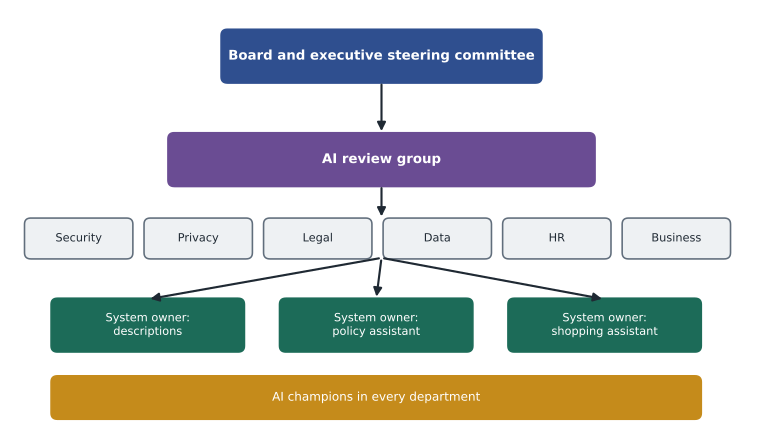
Birchline keeps the structure light, because it is a mid-sized retailer, not a bank. Larger or more regulated organizations add more layers, but the roles are similar.
| Body or role | Responsibilities | At Birchline |
|---|---|---|
| Board and executive steering committee | Set AI strategy and risk appetite; approve high-risk uses; receive regular reports | Quarterly AI report from Jules; CFO and CEO sign off high-risk uses |
| AI review group | Assess use cases, set standards, review incidents, maintain policies | Teresa (chair, security), Jules (program lead), the privacy officer, legal counsel, Ravi (data), an HR partner, and a rotating business representative |
| System owners | Answer for each AI system's purpose, performance and compliance | A business owner and a technical owner per system |
| AI champions | Spread good practice and report problems in each department | One or two per department |
| Internal audit | Independently check that governance works | An AI governance review added to the yearly audit plan from 2027 |
Two design choices matter more than the chart. The review group includes people who can say what the law requires, what security needs and what the business wants, so that one meeting can reach a decision rather than sending a proposal round several departments. And decision rights are written down: the review group can approve low and medium-risk uses itself, while high-risk uses go to the steering committee. That rule is what makes approvals fast for most ideas.
What rules apply: AI policies
A small set of short policies covers most needs. Long policies are not read, so Birchline aims for documents that fit on a few pages, with detail in linked standards.
| Policy | What it covers |
|---|---|
| AI principles | Birchline's commitments: benefit to customers and staff, fairness, transparency, privacy, safety, human accountability |
| Acceptable use | Which tools are approved for which data, what staff must never paste into AI tools, checking and disclosing AI output, how use is monitored |
| AI use-case approval standard | How ideas are assessed and approved, by risk tier, and what each tier requires |
| Data use for AI | Which data may be used for grounding or tuning, permissions, retention, and personal information rules |
| AI procurement | Questions every AI vendor must answer, such as data use, location, security testing and contract terms |
| AI incident response | How AI incidents are reported, assessed, fixed and learned from, linked to the security incident plan |
The acceptable use policy is the one every employee meets. Its central table lists data types against tools. Public information can go into any approved tool. Internal business information goes only into tools licensed under Birchline's enterprise terms, such as the Gemini app under Birchline's Workspace agreement. Customer personal information goes only into systems specifically approved for it, such as the planned email assistant. Payment card data never goes into any generative AI tool. That table is easy to remember, which is why it works.
How each use case is assessed: risk tiers
The approval standard sorts each use case into a risk tier using a few questions, and each tier has a defined path. Lesson 8 introduced the tiers; governance defines the process behind them.
def risk_tier(customer_facing, personal_data, affects_people, takes_actions, consequential_decision):
    if consequential_decision:
        return "Not permitted"
    score = sum([customer_facing, personal_data, affects_people, takes_actions])
    if score >= 3 or (customer_facing and takes_actions):
        return "High"
    if score >= 1:
        return "Medium"
    return "Low"

cases = {
    "Slogan brainstorming":      (False, False, False, False, False),
    "Product description drafts": (True, False, False, False, False),
    "Staff policy assistant":     (False, True, False, False, False),
    "Shopping assistant":         (True, True, False, True, False),
    "Ranking job applicants":     (False, True, True, False, True),
}
for name, answers in cases.items():
print(f"{name:<28} {risk_tier(*answers)}")Slogan brainstorming Low Product description drafts Medium Staff policy assistant Medium Shopping assistant High Ranking job applicants Not permitted
What this code does
A simple rule assigns each AI use case a risk tier from five yes-or-no questions: is it customer facing, does it use personal data, does it affect people, does it take actions, and does it make consequential decisions. Anything making consequential decisions is not permitted, three or more yes answers or a customer-facing tool that takes actions is High, any yes is Medium and none is Low. Slogan brainstorming comes out Low, the shopping assistant High, and ranking job applicants Not permitted.
The function is a simplification, and the real standard includes judgment, but the questions are the ones that matter. Is it customer-facing? Does it use personal information? Does it affect people's opportunities or treatment? Can it take actions? Would it make or recommend a consequential decision about a person? Product description drafts are medium risk because they are published, even though an editor approves each one.
| Tier | Approval path | Required before launch |
|---|---|---|
| Low | Owner registers the use in the AI inventory | Approved tool; acceptable use rules |
| Medium | AI review group approves | Use-case brief; data check; quality and bias tests; human review design; monitoring plan |
| High | Review group recommends; steering committee approves | All of medium, plus impact assessment, privacy assessment, red teaming, disclosure plan and executive sign-off |
| Not permitted | Declined; may be reconsidered only with a policy change | Not applicable |
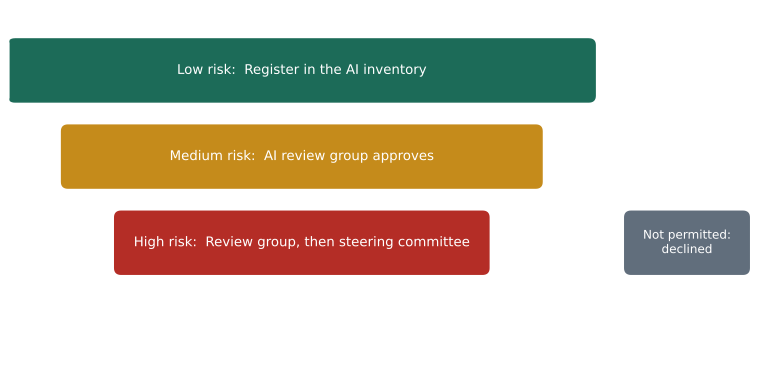
In its first month, October 2026, the review group handled nine requests. Six were low risk and simply registered, two were medium and approved within a week with conditions, and one, the shopping assistant, is high risk and is scheduled to go to the steering committee in December with its red-team results. Jules tracks the time from request to decision, because governance that takes months pushes people back toward shadow AI.
What is recorded: the AI inventory
Every AI system in use at Birchline, built or bought, is listed in an AI inventory: a register with the system's name, purpose, owners, risk tier, model and provider, data sources, users, approval date, review date and links to its assessments and test results. The inventory answers questions that otherwise take days: which systems use customer data, which rely on a model that is being retired, which are due for review. When Google announces a new model version, Farah can see in minutes which Birchline systems will be affected and need retesting.
The inventory also holds the documentation from lesson 8, such as the system record and impact assessment, so an auditor or regulator could see how a decision was reached.
Frameworks and standards
Organizations do not have to invent governance from scratch. Several well-known frameworks provide structure, and Birchline maps its policies to them.
- The NIST AI Risk Management Framework (2023), from the US National Institute of Standards and Technology, organizes AI risk work into four functions: govern, map, measure and manage. It is voluntary and widely used in both countries.
- ISO/IEC 42001 (2023) is an international standard for an AI management system, in the style of other ISO management standards. Organizations can be certified against it, which some customers and partners ask for.
- Google's Secure AI Framework, covered in lesson 7, provides the security part.
- Sector regulators and industry bodies add guidance in regulated fields such as finance and health.
The US legal landscape as of late 2026 combines federal agency enforcement of existing laws, such as consumer protection and anti-discrimination law, with a growing set of state laws, some focused on automated decisions and disclosure; a December 2025 executive order seeks a national framework and challenges some state AI laws, and Colorado replaced its 2024 AI act with a narrower law taking effect in January 2027. Birchline's legal counsel reviews the landscape twice a year.
Customers in the European Union are not part of Birchline's market, but Farah mentions the EU AI Act, which sorts AI systems into risk categories with duties for each, because many international vendors design their products to meet it, which shapes the tools Birchline can buy.
Checking that governance works
Governance is only real if someone checks it. Birchline uses a few simple measures in Jules's quarterly report to the steering committee: the number of systems in the inventory and their tiers, how many reviews are overdue, the median time from request to decision, incidents reported and closed, training completion, and findings from sampled audits of high-risk systems. From 2027, internal audit will test a sample of systems each year against the policies, independently of the team that runs them.
Policies also need updating. The review group revisits them every six months and after any significant incident, regulatory change or new type of AI use, such as the first agent that can take actions on Birchline's behalf.
Governance for bought AI
Not every AI system is built at Birchline. Many software products the company already uses are adding AI features, often switched on in an update. The governance standard covers these too. When a vendor adds generative AI to an existing product, the system owner records it in the inventory, checks whether it changes what data the vendor processes, and asks the procurement questions before the feature is enabled for staff. In the first month this caught a scheduling tool update that would have sent staff availability notes to a new AI service under different terms; the feature stayed off until the vendor confirmed how the data would be handled.
Bought AI also needs exit planning. If a vendor changes its terms or retires a product, the owner should know how to export Birchline's data and configuration and what the fallback would be. That planning is easier at the start of a contract than in the middle of a dispute.
Keeping governance proportionate
Farah warns that governance can fail in two directions. Too little, and risky uses slip through. Too much, and staff stop asking, which pushes work into shadow AI and makes risks invisible. The signs of too much are long queues, forms that ask for information nobody uses, and the same questions asked of a slogan generator and a customer-facing agent. Birchline's review group reviews its own process every six months with the same honesty it asks of system owners.
Worked problem
Is governance slowing work down?
Over a quarter, the review group decided 24 requests. 15 were low risk, decided in a median of 1 day; 7 were medium, decided in a median of 6 days; 2 were high, decided in 21 and 28 days. What is the median decision time across all 24?
Show solution
- Sort all 24 times: the 15 low-risk times come first (1 day each), then the 7 medium (about 6 days), then the 2 high.
- With 24 values, the median is the average of the 12th and 13th values.
- Both the 12th and 13th values fall within the 15 low-risk requests.
- So the median is 1 day.
Answer: The median is 1 day, showing that most requests move quickly; the high-risk cases need separate tracking.
Common mistakes
MistakeTreating governance as a committee whose job is to say no.
InsteadWrite decision rights and fast paths so most low and medium-risk uses are approved quickly.
MistakeWriting long policies nobody reads.
InsteadKeep core policies short, with a simple data-versus-tools table everyone remembers.
MistakeNot knowing which AI systems are in use.
InsteadKeep an AI inventory of every built and bought system, with owners and review dates.
MistakeBuilding governance from scratch.
InsteadMap policies to frameworks such as the NIST AI RMF and ISO/IEC 42001.
MistakeNever checking whether governance works.
InsteadReport a few measures each quarter and add independent audit.
Summary and key terms
- AI governance is the roles, policies, processes and controls that direct how an organization develops, buys and uses AI.
- Structures typically include executive oversight, a cross-functional review group, system owners, champions and internal audit, with written decision rights.
- Core policies cover principles, acceptable use, use-case approval, data use, procurement and incident response; the acceptable use policy's data-versus-tools table is the rule every employee needs.
- Risk tiers decide each use case's approval path and requirements.
- An AI inventory records every system, its owners, tier, model, data and reviews.
- Frameworks such as the NIST AI RMF, ISO/IEC 42001 and SAIF provide structure, while laws differ by jurisdiction.
- Governance must be measured, audited and updated.
- AI governance
- The roles, policies, processes and controls that direct an organization's use of AI.
- Decision rights
- Written rules about who may approve which decisions.
- AI review group
- A cross-functional group that assesses AI use cases and sets standards.
- Acceptable use policy
- Rules for which AI tools staff may use with which data.
- Risk tier
- A category that sets the approval path and requirements for a use case.
- AI inventory
- A register of every AI system in use, with owners, tier, model, data and reviews.
- NIST AI RMF
- A voluntary US framework organizing AI risk work into govern, map, measure and manage.
- ISO/IEC 42001
- An international standard for AI management systems.
Practice problems
Work each problem on paper first, then reveal the answer to check.
Why does Birchline let the review group approve medium-risk uses itself?
Show answer
Written decision rights make approval fast for most ideas, so staff use the official path rather than shadow AI.
Which AI tool may be used with payment card data under Birchline's acceptable use policy?
Show answer
None; payment card data never goes into any generative AI tool.
What question does the AI inventory answer when a model is being retired?
Show answer
Which systems use that model and need retesting or changes.
Lesson quiz · 5 questions
Score 60% or more to complete this lesson.
Create a free account to save your progress, take quizzes and earn a certificate.