
GCP-112 · Lesson 6 of 12 · 16 min
Change management and skills
▶ Video coming soon A video version of this lesson is on the way.
Birchline turned on the Gemini app for its 260 office staff in the spring of 2026, under its existing Google Workspace agreement. By September, the admin console showed something every technology leader eventually sees: about 60 people used it most days, roughly 80 had tried it a few times and stopped, and the rest had never opened it. The tool was the same for everyone. What differed was whether people knew what to use it for, whether their manager encouraged it, and whether anyone had answered their worries. Farah tells Jules that this is the most common pattern in generative AI adoption, and the most fixable. "The technology is the easy part," she says. "The hard part is helping 1,100 people change how they work." This lesson covers the people side of adoption.
Why generative AI adoption is a change challenge
Most technology changes replace one tool with another that does a similar job. Generative AI is different in three ways. It changes how work is done, not just which tool does it: people must learn to give instructions, judge outputs and decide when not to use it. Its value depends on each person's creativity in finding uses, which a training manual cannot fully script. And it touches feelings about skill, identity and job security more directly than a new spreadsheet does. A copywriter who has spent fifteen years learning to write well may reasonably wonder what a drafting tool means for their career.
A change approach that works treats these as real concerns rather than resistance to be overcome. Farah uses a simple frame that many change practitioners use in some form: people move through awareness of why the change matters, desire to take part, knowledge of how, ability to do it in practice, and reinforcement that keeps the new way going. A gap at any stage stalls adoption, and each gap needs a different fix.
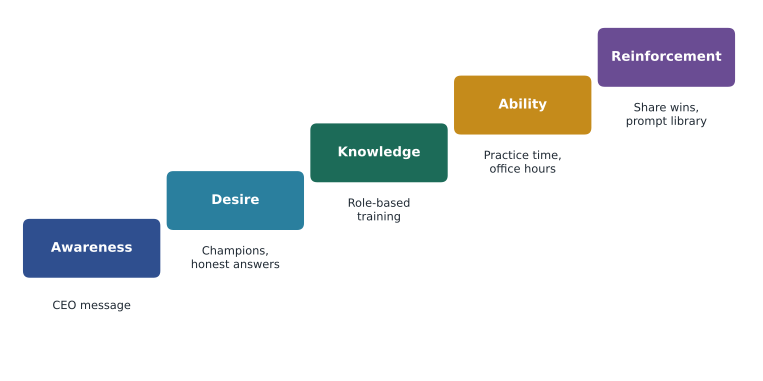
| Stage | Typical gap | Birchline's action |
|---|---|---|
| Awareness | Staff do not know why the company is using AI or what it is for | A short message from the CEO explaining the purpose, the limits, and what will not change |
| Desire | People fear for their jobs or see no benefit for themselves | Honest answers on job impact; champions in each team showing real uses |
| Knowledge | People do not know what to ask or how | Role-based training with examples from their own work |
| Ability | People know in theory but lack time to practice | Protected practice time and office hours with champions |
| Reinforcement | Early enthusiasm fades | Sharing wins, updating the prompt library, recognizing good use |
Leadership and honest communication
Staff watch leaders closely during AI changes. If executives talk only about efficiency, staff hear "fewer jobs". If they say nothing, rumors fill the gap. Birchline's CEO recorded a four-minute video in early October 2026 that Jules helped write. It explained three things plainly: the company is using generative AI to remove repetitive work so staff can spend more time with customers and on work that needs judgment; nobody's job is being cut because of the current pilots, and if that ever changes it will be discussed openly and early; and there are firm rules about customer data and about checking AI output, which every employee will learn.
Honesty matters more than reassurance. Farah warns against promising that generative AI will never affect any role, because that may not be true over the years ahead, and a broken promise destroys trust. Saying what is known, what is not, and how decisions will be made is more credible. In unionized workplaces, or where employment law requires consultation about significant changes to work, that consultation should happen early; Birchline's warehouse staff have a collective agreement, so HR involves the union before any warehouse pilot.
Champions and communities of practice
The most effective adoption lever at Birchline turns out to be people, not training slides. Jules recruits AI champions, one or two per department, who are enthusiastic users but not necessarily technical. Champions get early access to new tools, an extra hour of training a month, and a shared chat space. In return they help colleagues, collect good examples and report problems. Within six weeks, the champions have built a prompt library: tested prompts for common tasks, such as summarizing a supplier meeting or drafting a store newsletter, each with notes on when to use it and what to check.
Champions also give honest feedback that dashboards miss. The store operations champion reports that store managers avoid Gemini on shared back-office computers because they worry about leaving drafts with staff details on screen, which leads to a quick fix in sign-out settings and a short reminder.
Training by role
A single company-wide course teaches everyone a little and nobody enough. Birchline designs training for four groups, each with a different goal.
| Group | What they need | Format |
|---|---|---|
| All staff | What AI is and is not, Birchline's rules, how to check outputs, how to report problems | A 45-minute online module with a short quiz, required once a year |
| Everyday users | Prompting for their own tasks, judging output, using the prompt library | Hands-on workshops by department with their own examples |
| Managers | Leading adoption, setting expectations, spotting misuse, answering staff concerns | A half-day session with case discussions |
| Builders and owners | Evaluation, grounding, security, monitoring and governance | Deeper technical training; certification paths such as Google Cloud's |
The all-staff module includes the habits that matter most for risk: never paste customer personal information into tools that are not approved for it, check facts before sharing AI output, say when content was AI-assisted where policy requires it, and report anything that looks wrong. Jules's own preparation for the Generative AI Leader certification is part of the builders and owners track, and two of the champions decide to take the certification too.
Redesigning work, not just adding a tool
Adoption sticks when the workflow changes, not just the toolbar. In the product description pilot, the copywriters' job changes from writing first drafts to reviewing facts, improving voice and writing the buying guides that the time savings made possible. Their job descriptions are updated, and their performance goals now include quality of reviewed output rather than the number of descriptions written from scratch. Without that, people would be measured on the old work while doing the new, which breeds frustration.
Farah calls the opposite pattern AI as an extra step: the tool is added on top of the existing process, people still do everything they did before, and the AI output becomes one more thing to check. Adoption falls quickly in that situation, and rightly so.
Measuring adoption
Adoption needs its own measures, separate from the business KPIs of each use case. Jules reports a small set each month to the steering committee.
licensed = 260
users_by_week = [58, 61, 70, 84, 97, 111, 120, 128]   # weekly active users after champions started
retained = 102           # of 128 week-8 users, how many were also active in week 4 or earlier
trained = 214            # completed the all-staff module

share = round(100 * users_by_week[-1] / licensed)
print(f"Weekly active users: {users_by_week[0]} -> {users_by_week[-1]} ({share} in every 100 licences)")
print(f"Retention of earlier users: {retained / users_by_week[-1]:.2f}")
print(f"Training completion: {trained} of {licensed}")
growth = [b - a for a, b in zip(users_by_week, users_by_week[1:])]
print("Week-on-week growth:", growth)Weekly active users: 58 -> 128 (49 in every 100 licenses) Retention of earlier users: 0.80 Training completion: 214 of 260 Week-on-week growth: [3, 9, 14, 13, 14, 9, 8]
What this code does
Eight weeks of active user counts are compared with the number of licenses bought. The program reports the growth in weekly users, the share of licenses in use, how many recent users were also active earlier, and how many people completed training. The week-by-week gains show adoption growing fastest in the middle weeks.
Over eight weeks after the champions start, weekly active users rise from 58 to 128, almost half the licenses. Retention matters as much as growth: if most new users drop away after a week, the tool is not yet useful enough or people do not yet know how to use it well. The monthly report also includes a short survey and a few stories, because a number cannot tell Jules why the finance team uses the tool every day while the logistics team barely touches it. The answer, it turns out, is that the logistics team's work happens mostly in a warehouse system that Gemini for Workspace does not reach, so the next step for them is a different solution, not more training.
Responding to concerns
Concerns are useful information. Birchline collects them in an open question form and answers them in a monthly note. The most common concerns in the first round, and the answers given, illustrate the pattern.
| Concern | Birchline's answer |
|---|---|
| "Will this replace my job?" | Current pilots aim to remove repetitive tasks, not roles. Any future change affecting jobs will be discussed early and openly. |
| "Is it safe to put customer details in?" | Only in tools approved for that data, which are listed on the intranet. When unsure, leave personal details out. |
| "What if it gives me a wrong answer?" | It sometimes will. You are responsible for checking facts before using output, and you can report errors through the feedback button. |
| "Do I have to use it?" | You are encouraged, not forced, to try it for suitable tasks. Some workflows, such as the description pilot, now include it by design. |
| "Is the company reading what I type?" | Use is logged for security and audit as described in the acceptable use policy, which explains who can see what and why. |
The last answer matters for trust. Staff are entitled to know how their use of workplace tools is monitored. Birchline's acceptable use policy, part of the governance work in lesson 9, explains what is logged and who may review it, which in Canada must align with privacy expectations for employee information, and in the US with the company's notices to employees and any applicable state rules.
Common mistakes
MistakeLicensing a tool and expecting adoption to follow.
InsteadPlan awareness, desire, knowledge, ability and reinforcement as deliberate steps.
MistakePromising that AI will never affect any job.
InsteadSay what is known and unknown, and commit to early, open discussion.
MistakeOne generic training course for everyone.
InsteadTrain by role, using examples from each group's own work.
MistakeAdding AI on top of the old process.
InsteadRedesign the workflow and update goals so the new way of working is the expected way.
MistakeMeasuring only how many people logged in.
InsteadTrack retention, training, survey results and stories alongside active users.
Summary and key terms
- Generative AI adoption is a change challenge because it alters how work is done, depends on each person finding uses, and touches concerns about skills and jobs.
- Address awareness, desire, knowledge, ability and reinforcement in turn.
- Leaders should communicate the purpose, limits and job implications honestly, and consult where agreements or law require it.
- Champions and a shared prompt library spread practical know-how.
- Train by role: all staff, everyday users, managers, and builders and owners.
- Redesign workflows and goals so AI is part of the work rather than an extra step.
- Measure adoption with active use, retention, training completion, surveys and stories, and answer concerns openly, including how use is monitored.
- Change management
- A structured approach to helping people adopt new ways of working.
- AI champion
- An enthusiastic user who helps colleagues adopt AI tools and reports problems.
- Prompt library
- A shared collection of tested prompts for common tasks, with notes on use and checks.
- Role-based training
- Training designed around what each group needs for its own work.
- Community of practice
- A group of people who share know-how about a practice over time.
- Adoption rate
- The share of intended users who actively use a tool.
- Retention
- The share of users who keep using a tool over time.
- Acceptable use policy
- Rules for how staff may use a tool and how use is monitored.
Practice problems
Work each problem on paper first, then reveal the answer to check.
Why did many Birchline staff stop using Gemini after trying it?
Show answer
They did not know what to use it for, lacked encouragement or time, or had unanswered worries.
What is the risk of "AI as an extra step"?
Show answer
People do all their old work plus checking AI output, so the tool adds effort and adoption falls.
Why did the logistics team barely use the Gemini app?
Show answer
Their work happens mainly in a warehouse system the tool does not reach, so they need a different solution.
Managers make or break adoption
The strongest predictor of adoption in Birchline's first months was not the department, the age of staff or their technical background. It was whether their manager used the tools and talked about them. Teams whose managers shared a prompt in a meeting, asked how people had used the tools that week, or set aside time for practice had roughly twice the weekly use of teams whose managers said nothing. The manager training was redesigned around this finding. It now asks each manager to do three things in the first month: use the tools visibly for one real task and show the result, hold one team session where people share what worked and what did not, and agree with each team member one task where they will try the tool for a fortnight.
Managers also carry a quieter duty: noticing misuse and fear. A manager who sees someone pasting customer details into an unapproved tool should correct it kindly and quickly. A manager who hears that someone is anxious about their role should listen and pass the concern on, so the monthly answers can address it. Change spreads through these everyday conversations far more than through company-wide announcements.
Skills for the longer term
Beyond using today's tools, Birchline expects some skills to matter more over time: judging the quality of AI output, writing clear instructions, checking facts and sources, and designing work that combines people and AI well. Jules adds these to the skills framework that HR uses for development plans, so that people can grow them deliberately rather than by accident.
Lesson quiz · 5 questions
Score 60% or more to complete this lesson.
Create a free account to save your progress, take quizzes and earn a certificate.