
GCP-112 · Lesson 12 of 12 · 19 min
Case study: a generative AI adoption plan
▶ Video coming soon A video version of this lesson is on the way.
On November 10, 2026, after the steering committee voted to expand the product description tool, Dana Leclair asked Jules for one more thing before the December board meeting: a single document that shows the board where Birchline's generative AI work is going over the next eighteen months, what it will cost, what it should return, and how the risks are controlled. "Not a vision statement," she said. "A plan I can hold you to." Jules and Farah are writing it this week, drawing on everything in this course. This final lesson walks through that plan section by section, as a worked example of how the pieces fit together, and ends with the practice the Generative AI Leader exam expects: reading a scenario and choosing the strategy that fits.
1. Purpose and principles
The plan opens with a short statement of purpose that the board can repeat: Birchline will use generative AI to give customers faster, more accurate help and product information, and to free staff from repetitive work so they can spend more time on customers and on work that needs judgment. It lists the principles from Birchline's AI policy: benefit to customers and staff, fairness, transparency, privacy, safety and human accountability. And it states the boundaries: no generative AI in hiring, credit or discipline decisions; no payment card data in any AI tool; human approval for anything published or any action with consequences.
2. Where Birchline is today
An honest starting point builds credibility, so the plan summarizes the position in November 2026.
| Area | Position in November 2026 |
|---|---|
| Use cases | Product description tool approved for production from January; review digests in pilot; staff policy assistant pilot planned for February 2027; shopping assistant in red-team testing; 31 staff ideas assessed |
| Adoption | Gemini app weekly use up from 58 to 128 of 260 office staff since champions started; 214 completed the all-staff module |
| Data | Returns policy merged into one approved version; catalog units and color names standardized; document inventory started |
| Governance | AI policies approved; review group meeting since October; AI inventory with 11 systems; risk tiers in use |
| Security and privacy | Acceptable use table published; Model Armor screening planned for the shopping assistant; privacy assessments for customer-facing uses |
| Lessons learned | Image campaign paused for representation bias, now with a check; reviewer attention improved after redesign |
3. The portfolio
The plan presents use cases as a portfolio across three horizons, so the board sees a balance of quick results and longer bets rather than one big project.
| Horizon | Use cases | Option (lesson 10) | Risk tier (lesson 9) |
|---|---|---|---|
| Now: November 2026 to March 2027 | Product descriptions in production; review digests; Gemini adoption; staff policy assistant pilot | Customize; customize lightly; buy; buy first | Medium; medium; low; medium |
| Next: April to September 2027 | Shopping assistant on the online shop; refresh of 9,000 older descriptions; policy assistant inside store systems if the pilot supports it | Customize with screening; customize; customize | High; medium; medium |
| Later: October 2027 to April 2028 | Customer email assistant with human approval; multilingual product content; supplier contract search | Customize or contact-center product; customize; buy or customize | High; medium; medium |
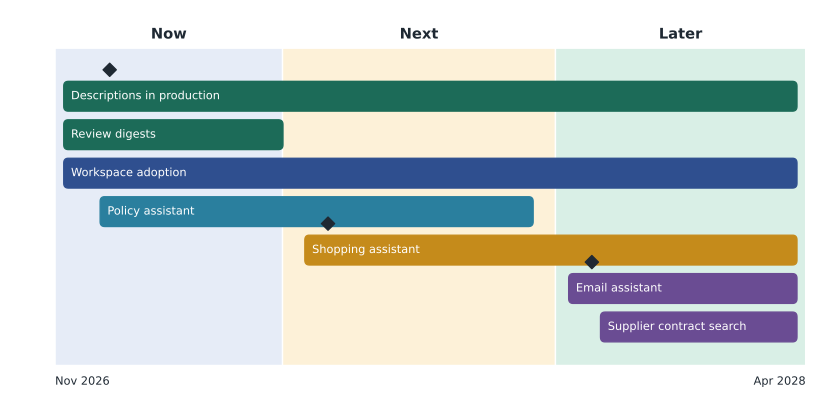
Each later item has a decision point rather than a fixed commitment. The shopping assistant launches in spring 2027 only if red-team findings are fixed and the steering committee approves; the email assistant pilot starts only if the shopping assistant's monitoring shows the review and escalation design works with real customers.
4. Value and cost
The plan's value section uses the method from lesson 2: baselines, measurable targets, ranges and named uses for released time. Its cost section lists one-time and yearly costs, including people's time, with assumptions labeled. All figures in Birchline's plan are its own estimates; the ones below are simplified for this lesson.
# Simplified portfolio view (illustrative estimates, in thousands of dollars per year).
portfolio = [
    # name,                   one_time, yearly_cost, yearly_benefit_low, yearly_benefit_high
    ("Product descriptions",   22,        9,          35,                 55),
    ("Review digests",         10,        4,           8,                 15),
    ("Gemini adoption",      6,        0,          40,                 90),
    ("Policy assistant",       12,       10,          15,                 30),
    ("Shopping assistant",     60,       30,          40,                120),
]
one_time = sum(p[1] for p in portfolio)
yearly = sum(p[2] for p in portfolio)
low = sum(p[3] for p in portfolio); high = sum(p[4] for p in portfolio)
print(f"One-time investment: {one_time}k")
print(f"Yearly running cost: {yearly}k")
print(f"Yearly benefit range: {low}k to {high}k")
print(f"Net yearly value range: {low - yearly}k to {high - yearly}k")
print(f"Simple payback range: {one_time / (high - yearly):.1f} to {one_time / (low - yearly):.1f} years")One-time investment: 110k Yearly running cost: 53k Yearly benefit range: 138k to 310k Net yearly value range: 85k to 257k Simple payback range: 0.4 to 1.3 years
What this code does
Each AI project in the portfolio has a one-time cost, a yearly running cost and a low and high estimate of yearly benefit. The program adds them up across all projects and works out the net yearly value and the payback range. Together the projects would pay back in roughly 0.4 to 1.3 years on these estimates.
The Gemini app is already in the IT budget, so the plan counts only the adoption effort and the January Workspace features pilot as new costs, and notes that the wide benefit range reflects how uncertain it is to value general productivity. The shopping assistant has the widest range of all, which is why it has a decision point and a staged launch. Dana's comment on reading the draft is that she believes the low end and hopes for the middle, and that is exactly how a plan like this should be read.
5. How quality is assured
This section explains, briefly, the techniques from lessons 3 and 4: every factual use case is grounded in approved Birchline sources and cites them where users need to check; prompts are versioned; every published output is approved by a person; high-volume uses combine thresholds, sampling and escalation; and every production system has an evaluation set that runs before any change, with safety-critical measures that may not get worse. The board does not need the detail, but it needs to know these practices exist and who owns them.
6. Data
The data section, from lesson 5, commits to three things: a single approved source for every document used for grounding, with an owner and review date; permission-aware retrieval for every assistant; and removal of personal information from documents and logs where the task does not need it. It names the two biggest data risks for the plan, older supplier spec sheets for the description refresh and scattered order history for the email assistant, and the work scheduled to address them.
7. People
The people section, from lesson 6, sets adoption targets and support: champions in every department, role-based training, protected practice time, a prompt library, and updated job descriptions and goals where workflows change. It repeats the CEO's commitment that any future change affecting jobs will be discussed early and openly, and records that HR will consult the union before any warehouse use. It also sets a skills goal: six staff, including Jules, holding the Generative AI Leader certification by the end of 2027, and two engineers with deeper Google Cloud AI skills.
8. Risk, security and responsible AI
This section brings lessons 7 and 8 together in a single risk register, the format boards are used to.
| Risk | Likelihood | Impact | Main controls | Owner |
|---|---|---|---|---|
| Customer data exposed through an assistant | Low | High | Least privilege; permission-aware retrieval; screening; masked logs; red teaming | Teresa Okonjo |
| Inaccurate product claims published | Medium | Medium | Grounding; claim-by-claim review; evaluation set; sampling | Head of merchandising |
| Biased or stereotyped content | Medium | Medium | Representation checks; balanced examples; reviewer checklist | Marketing lead |
| Shopping assistant misled by prompt injection | Medium | Medium | Model Armor screening; no write permissions; human confirmation for actions | Farah Qureshi |
| Shadow AI with customer data | Medium | High | Approved tools by data type; training; monitoring of risky uploads | Teresa Okonjo |
| Low adoption wastes investment | Medium | Medium | Champions; role-based training; workflow redesign; adoption measures | Jules Baptiste |
| Model change degrades quality | Medium | Medium | Version pinning; evaluation before switching; monitoring for drift | Technical owners |
The register lists the privacy duties that apply, from Quebec's Law 25 for Quebec customers to provincial and federal law elsewhere in Canada, and Birchline's privacy officer signs off each customer-facing use. It also records that the company follows the NIST AI Risk Management Framework as a reference and will consider ISO/IEC 42001 certification in 2028 if partners ask for it.
9. Governance and reporting
The final section describes the structures from lesson 9 and commits to what the board will see: a quarterly report with the AI inventory by risk tier, KPIs for each production system, adoption measures, incidents and their fixes, costs against budget, and decisions due in the next quarter. It ends with the decision points and what evidence the steering committee will need at each one.
Reading scenarios like the exam
The Generative AI Leader exam presents short business scenarios and asks which approach, product type or practice fits best. Farah shows Jules a method that works for most of them, and for real decisions too.
- Find the goal. What outcome does the organization want: speed, accuracy, cost, customer experience, compliance?
- Find the constraint. What rules out options: data that must stay private, a need for current facts, no technical staff, a tight deadline?
- Find the risk. What happens if the output is wrong, and who is affected?
- Choose the simplest option that meets all three. Prefer prompting before tuning, grounding for facts, buying for generic tasks, human review where errors matter, and governance proportionate to risk.
Applied to a scenario such as "a retailer's support assistant gives outdated return policies", the goal is accurate answers, the constraint is that policies change, and the risk is customer harm and complaints, so the best answer is grounding on current, approved policy documents with citations, not fine-tuning the model on today's policies. The method is the same one Jules used for the whole plan, at smaller scale.
| Scenario clue | Likely best answer |
|---|---|
| Answers are outdated or lack company facts | Grounding or retrieval over current approved sources |
| Output format or tone is inconsistent | Better prompts with examples; fine-tuning only if prompting fails at scale |
| Generic productivity need inside existing tools | Buy a finished product and invest in adoption |
| Errors would reach customers or affect people | Human review, escalation and stronger governance |
| Staff are using unapproved tools with sensitive data | Approved tools by data type, clear policy and training |
| A pilot looked good but nobody can show results | Baselines, KPIs and a decision rule before scaling |
| Leaders worry about attacks on an AI app | Layered controls: least privilege, screening, monitoring, red teaming |
What makes a plan credible
Farah reviews the draft with Jules against a short list of signs that a board will trust a plan. Does every number have a source or a labeled assumption? Does every use case have a named owner? Are there points where the plan can be stopped or changed, and is it clear who decides? Does it admit what went wrong so far and what was learned? Does it say what the organization will not do? A plan that passes those tests is believable even when its numbers are uncertain, because the board can see how the uncertainty will be reduced.
Worked problem
Choosing an approach for a scenario
A regional bank wants a tool that helps branch staff answer questions about its 400 internal procedures, which change monthly. Some procedures are restricted to managers. The bank has a small IT team and a strict regulator. Which approach fits best?
Show solution
- Goal: accurate, current answers for branch staff.
- Constraints: procedures change monthly; some are restricted; small IT team.
- Risk: wrong answers could breach procedure and regulation.
- Simplest fitting option: a grounded enterprise search or assistant product that respects document permissions and cites sources, with procedures kept current by owners, staff told to check citations, and the use registered and assessed under governance.
Answer: A grounded, permission-aware assistant, bought or lightly customized, with citations, owned content and governance. Fine-tuning or a custom model would not fit.
Jules will present the plan to the board in December. Farah has suggested two additions the board is likely to want: bringing the shopping assistant decision back to the board rather than leaving it with the steering committee, and a short note each quarter on what Birchline has decided not to do, and why. A board that asks what you chose not to do, she says, understands strategy. Whatever the exam result, Jules will have a plan Dana can hold Jules to.
Common mistakes
MistakePresenting a generative AI vision without numbers or owners.
InsteadPresent a portfolio with value ranges, costs, owners, risks and decision points.
MistakeCommitting to every future use case up front.
InsteadUse horizons and decision points so later work depends on evidence.
MistakeHiding lessons learned from the board.
InsteadInclude incidents and fixes; honesty builds credibility.
MistakeAnswering scenario questions with the most advanced option.
InsteadChoose the simplest option that meets the goal, constraint and risk.
Summary and key terms
- A generative AI adoption plan brings together purpose and principles, an honest current position, a portfolio across horizons with decision points, value ranges and costs, quality assurance, data commitments, people and skills, a risk register covering security, privacy and responsible AI, and governance and reporting.
- Each part draws on the practices in this course: use-case selection, business cases, output techniques, human review, data readiness, change management, security and privacy, responsible AI, governance, build-or-buy decisions and scaling.
- For scenario questions, find the goal, the constraint and the risk, and choose the simplest option that meets all three.
- Adoption plan
- A document setting out an organization's AI use cases, value, costs, risks, people and governance over time.
- Portfolio
- A balanced set of use cases across time horizons and risk levels.
- Horizon
- A time band in a roadmap, such as now, next and later.
- Decision point
- A planned moment to continue, change or stop based on evidence.
- Risk register
- A table of risks with likelihood, impact, controls and owners.
- Scenario method
- Finding the goal, constraint and risk, then choosing the simplest fitting option.
Practice problems
Work each problem on paper first, then reveal the answer to check.
Why does the plan use decision points for later use cases?
Show answer
So later work depends on evidence from earlier stages rather than being committed up front.
Which scenario clue points to grounding?
Show answer
Answers that are outdated or lack the organization's own facts.
What did Farah suggest adding to the quarterly report?
Show answer
A short note on what Birchline decided not to do, and why.
Lesson quiz · 5 questions
Score 60% or more to complete this lesson.
Create a free account to save your progress, take quizzes and earn a certificate.