
GCP-111 · Lesson 5 of 12 · 18 min
Model Garden and choosing a model
▶ Video coming soon A video version of this lesson is on the way.
Before the fifth session Farah sent Owen a link and one instruction: "Spend twenty minutes in Model Garden and come back with three models you would shortlist for the shopping assistant, and why." Owen came back with five, because he could not decide, and a page of questions. "That's the right reaction," Farah said. "There are hundreds of models in there. Nobody should pick one by reputation. You pick one by testing it on your own task."
This lesson covers Model Garden, the model catalog on the AI platform, the kinds of models it offers, and a practical way for a business to choose a model. The exam guide places Model Garden under the platform's developer tools and expects a leader to understand why choice matters and which factors drive it.
What Model Garden is
Model Garden is the catalog of models available on the Gemini Enterprise Agent Platform. It lists Google's own models, models from partner companies and open models, each with a model card describing what the model does, how it was evaluated, its limits and its license. From Model Garden, a team can try a model in a test console, call it through an API, tune it where tuning is supported, or deploy it to its own endpoint. Public descriptions of the catalog put it at more than 200 models; the number keeps changing, so treat it as "a lot" rather than a fixed figure.
| Group | Examples | How they are typically used |
|---|---|---|
| Google first-party models | Gemini (multimodal), Imagen (images), Veo (video), embedding and speech models | Called as fully managed services through APIs |
| Partner models | Models from other AI companies offered through Google Cloud | Called as managed services, billed through Google Cloud |
| Open models | Gemma and other openly available models from various developers | Deployed to endpoints the customer manages, or downloaded and adapted |
| Task-specific models | Models built for one job, such as document parsing or translation | Often behind a dedicated API |
Farah reminded Owen of the exam guide's phrase about Google Cloud's open approach: customers are not limited to Google's own models. A company can choose a partner model for a task where it performs best, or an open model it can run and inspect itself, while keeping the same security, billing and governance on the platform.
Model families and sizes
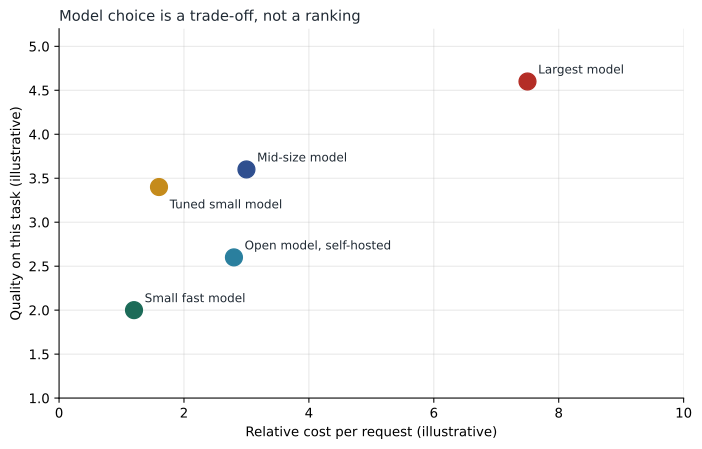
Even within one family, models come in sizes. Larger models are generally more capable at complex reasoning, long documents and difficult instructions; smaller models are faster and cheaper per request and are often good enough for simple, high-volume tasks such as classification, extraction and short answers. Google usually offers several Gemini variants at once, typically a highly capable model, a faster and cheaper one, and sometimes an even lighter one, and it releases new versions regularly. A leader does not need to memorize the current version numbers, which change every few months, but should understand the trade-off between capability, speed and cost.
The factors that decide a model choice
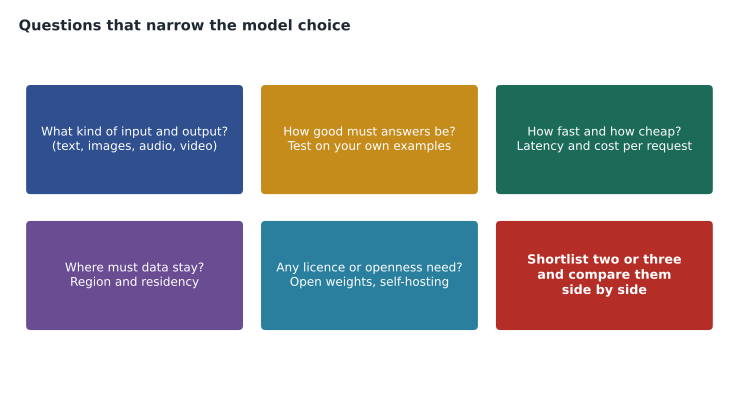
Farah gave Owen a list of factors, in the order she asks about them.
| Factor | Question to ask | Shopping assistant answer |
|---|---|---|
| Modality | What kinds of input and output are needed? | Text in and out; later, customers may upload a photo of their gear |
| Quality on the task | How good must answers be, judged on our own examples? | High: wrong advice could send someone into the backcountry badly equipped |
| Latency | How quickly must it respond? | The first words within about two seconds, or customers leave |
| Cost | What will each request cost at expected volume? | Tens of thousands of conversations a month in peak season |
| Context window | How much text must fit in one request? | Moderate: a question, conversation history and retrieved product details |
| Data location | Where must data be processed? | In approved US regions |
| License and openness | Any need to inspect, self-host or modify the model? | No |
| Tuning support | Will we need to tune it? | Probably not; grounding matters more |
Two factors deserve extra attention. Data location matters because not every model is offered in every region, and some features process data in specific locations; Teresa's organization policy limited Birchline to approved US regions, which immediately ruled out a few options. Cost matters because generative AI is usually billed by the amount of text processed, so a small difference per request becomes a large difference at volume.
# Illustrative monthly cost comparison for three candidate models.
# Prices are invented for the example, per million tokens processed.
conversations_per_month = 40_000
turns_per_conversation = 4
input_tokens_per_turn = 3_000     # question + history + retrieved product details
output_tokens_per_turn = 350

candidates = {
    "Large model":  {"in": 1.25, "out": 10.00},
    "Mid model":    {"in": 0.30, "out": 2.50},
    "Small model":  {"in": 0.10, "out": 0.40},
}
turns = conversations_per_month * turns_per_conversation
for name, price in candidates.items():
    cost = turns * (input_tokens_per_turn * price["in"] + output_tokens_per_turn * price["out"]) / 1_000_000
print(f"{name:12} about {cost:8.0f} a month")Large model about 1160 a month Mid model about 284 a month Small model about 70 a month
What this code does
Monthly token use is worked out from the number of conversations, turns per conversation and input and output tokens per turn. That usage is multiplied by each model's invented price per million tokens for input and output. The large model would cost about 1160 a month, the mid model about 284 and the small model about 70, showing how much model choice drives running cost.
The invented prices show the shape of the problem rather than real figures. Input tokens dominate here because every turn includes the conversation history and retrieved product details. That suggests two cost levers that do not involve changing models at all: retrieving fewer, better product passages, and summarizing long conversations instead of resending every word.
A practical way to choose
Farah's method, which she called shortlist, test, decide, takes about two weeks for a project like the shopping assistant.
- Write the requirements down. Use the factor table above. Anything that is a hard limit, such as region, rules models out immediately.
- Shortlist two or three models. Usually one capable model, one faster and cheaper model, and perhaps one partner or open model if there is a reason.
- Build a test set. Collect real questions, here 200 drawn from customer service emails and store staff, with what a good answer looks like.
- Run the same prompt and grounding on each model. Change only the model, so the comparison is fair.
- Score the results. Use the platform's evaluation tools and a human review of a sample. Measure latency and estimated cost too.
- Decide and record why. Write down the choice and the evidence, so the decision can be revisited when new models appear.
Farah also suggested a common pattern: use different models for different steps. A small, fast model could classify each customer message (product question, order problem, complaint) and route it, while a more capable model handles the complicated product advice. Routing keeps quality high where it matters and cost low where it does not.
# Illustrative routing: a cheap model classifies, an expensive model only answers hard questions.
messages = [
    ("Where is my order 10482?", "order"),
    ("What sleeping bag rating for late September in the mountains?", "advice"),
    ("Do you have size 9 hiking boots at the downtown store?", "stock"),
    ("Compare these two tents for a family of four", "advice"),
    ("I want to complain about a late delivery", "complaint"),
]
route = {"order": "order system lookup", "stock": "inventory lookup",
         "advice": "capable model with product grounding", "complaint": "human agent"}
for text, kind in messages:
    print(f"{kind:9} -> {route[kind]:38} | {text}")
hard = sum(1 for _, k in messages if k == "advice")
print(f"Only {hard} of {len(messages)} messages need the expensive model")order -> order system lookup | Where is my order 10482? advice -> capable model with product grounding | What sleeping bag rating for late September in the mountains? stock -> inventory lookup | Do you have size 9 hiking boots at the downtown store? advice -> capable model with product grounding | Compare these two tents for a family of four complaint -> human agent | I want to complain about a late delivery Only 2 of 5 messages need the expensive model
What this code does
Each customer message has already been sorted into a type, and a lookup table sends each type to a different handler. Order and stock questions go to a system lookup, advice goes to a capable grounded model, and complaints go to a person. Counting the advice messages shows how few need the expensive model.
Open models: when they make sense
Owen's shortlist included Gemma, and he asked when a company should choose an open model. Open models are released with their weights, the learned numbers that make up the model, so a company can run them on infrastructure it controls, inspect them, and adapt them freely within the license. Reasons to choose one include strict requirements to run inside the company's own environment, a need to modify the model deeply, very high volumes where running a small model on dedicated hardware is cheaper, or a desire to avoid dependence on one provider. The trade-off is responsibility: the company, not Google, then manages hosting, scaling, updates and some safety controls. For Birchline's first project, a managed model was the sensible choice.
Model cards and responsible choice
Every model in Model Garden comes with a model card, a short document describing intended uses, known limitations, how the model was evaluated and the license terms. GCP-110 explained why responsible AI starts with understanding a model's limits. Reading the card is the quickest way to spot a mismatch, such as a model that was not evaluated on the languages a company needs, or a license that forbids a planned use. Birchline's shop serves customers in English and Spanish, so language support was on Owen's checklist.
Common mistakes
MistakeChoosing the most famous or largest model by default.
InsteadShortlist by requirements and test on your own examples; smaller models often suffice.
MistakeComparing models with different prompts and data.
InsteadChange only the model so the comparison is fair.
MistakeIgnoring region availability until launch.
InsteadCheck that each candidate is offered where your data must be processed.
MistakeAssuming open models are free to run.
InsteadOpen weights may cost nothing to download, but hosting, scaling and maintenance cost money and effort.
Models change, so plan for change
Model providers release new versions regularly, and older versions are eventually retired. A choice that is right in November 2026 may not be right a year later, either because a better or cheaper model appears or because the chosen version reaches the end of its support. Farah built three habits into Birchline's plan. First, the application refers to the model through a single setting rather than in many places in the code, so switching is a small change. Second, the test set and evaluation scores from the original choice are kept, so any new model can be compared on exactly the same questions. Third, someone on the team watches Google's release notes and model lifecycle pages and reviews the choice at least twice a year.
Owen asked whether a newer model is always better. Usually it is better on average, Farah said, but not necessarily on every task, and its answers may differ in style, length or format in ways that break an application that expects a particular shape of output. That is why a model upgrade is treated as a change to test, not an automatic improvement.
Worked problem
Shortlisting for review tagging
The merchandising team wants to tag 300,000 customer reviews a month as positive, negative or mixed and pull out the product feature mentioned. Speed matters little; cost matters a lot. Which kind of model should be shortlisted first?
Show solution
- The task is short, structured and repeated at high volume: classification and extraction rather than open-ended reasoning.
- Cost per request dominates, so a small, inexpensive model is the natural first candidate.
- The team should test a small model on a few hundred reviews with agreed labels and compare it with a mid-size model; only if the small model falls short on accuracy should the larger one be considered.
Answer: Shortlist a small, low-cost model first and confirm its accuracy on a labeled sample; reserve larger models for tasks that need them.
Owen's final shortlist for the shopping assistant had two Gemini variants and nothing else. "A partner model might be better at something," he said, "but we don't have a reason to think so yet. If the test shows a gap, we'll add one." Farah wrote "good answer" on his notes.
Summary and key terms
- Model Garden is the model catalog on Gemini Enterprise Agent Platform, offering Google models (Gemini, Imagen, Veo, embeddings), partner models and open models such as Gemma, each with a model card.
- Models differ in capability, speed and cost; larger is not always better.
- Choose by modality, quality on your own task, latency, cost at volume, context window, data location, license and tuning needs.
- Shortlist two or three, test them fairly on a real test set, score with evaluation tools and human review, and record the decision.
- Routing different steps to different models balances quality and cost.
- Open models give control in exchange for responsibility.
- Model Garden
- The catalog of Google, partner and open models on the AI platform.
- Model card
- A document describing a model's uses, limits, evaluation and license.
- First-party model
- A model made by Google, such as Gemini.
- Partner model
- A model from another company offered through Google Cloud.
- Open model
- A model whose weights are released for others to run and adapt.
- Context window
- The amount of text a model can consider in one request.
- Routing
- Sending different requests or steps to different models.
Practice problems
Work each problem on paper first, then reveal the answer to check.
Name three factors in choosing a model.
Show answer
Any three of modality, task quality, latency, cost, context window, data location, license and tuning support.
Why should the prompt stay the same when comparing models?
Show answer
So that differences in results come from the model, not the prompt.
What does a company take on when it self-hosts an open model?
Show answer
Hosting, scaling, updating and some safety controls.
Lesson quiz · 5 questions
Score 60% or more to complete this lesson.
Create a free account to save your progress, take quizzes and earn a certificate.