
GCP-111 · Lesson 12 of 12 · 28 min
Matching products to business scenarios
▶ Video coming soon A video version of this lesson is on the way.
The last session before the holidays was a test. Farah had written twelve short scenarios on index cards, each describing a business need at a real or imagined company, and dealt them face down on the table. "The Generative AI Leader exam is mostly scenarios like these," she said. "You read a situation, spot what actually matters, and choose the offering that fits best. Not the most impressive one. The one that fits." Owen turned over the first card, and Jules, who had decided to sit the exam too, took notes.
This lesson pulls the course together. It gives a method for scenario questions, a summary of which products fit which needs, worked scenarios, and the traps that catch candidates. It does not reproduce real exam questions; the scenarios are original and written for practice.
A method for scenario questions
Farah's method had five steps, the same ones she used at work when a team came to her with an idea.
- Find the user. Is the scenario about employees, customers, developers or the platform team? The user often decides the layer of the stack.
- Find the job. Writing, searching, answering customers, building something custom, choosing a model, grounding, securing, or running at scale?
- Find the constraint. Speed to value, data location, privacy, cost, skills available, or the need for control. Scenarios usually include one clue that rules out options.
- Choose the highest layer that fits. Prefer buy over assemble and assemble over build, unless the constraint demands more control.
- Check the controls. Whatever the product, does the answer respect access, data protection and safety? A choice that ignores security is rarely the best answer.
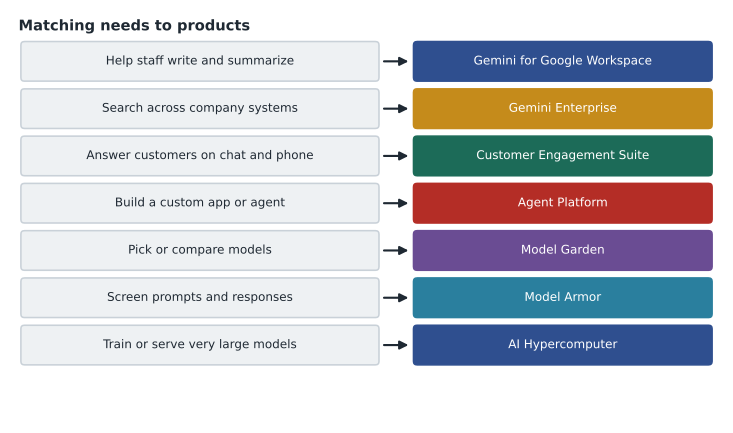
The product map in one table
| If the need is to... | Look first at | Lesson |
|---|---|---|
| Help individuals draft, summarize and brainstorm | Gemini app (business edition), Gems | 2 |
| Help staff inside Gmail, Docs, Sheets, Slides, Meet and Drive | Gemini for Google Workspace | 2 |
| Search and chat across many company systems, with agents | Gemini Enterprise | 3 |
| Let business users build simple internal agents | Agent designer in Gemini Enterprise | 3, 7 |
| Build a custom application or customer-facing agent | Gemini Enterprise Agent Platform (formerly Vertex AI) | 4, 7 |
| Compare or switch models, including partner and open models | Model Garden | 5 |
| Design, test and version prompts in the enterprise | Agent Studio | 6 |
| Prototype quickly with the Gemini API | Google AI Studio | 6 |
| Write agents in code with full control | Agent Development Kit | 7 |
| Add common AI skills such as translation or document reading | Prebuilt AI APIs (Translation, Document AI, Vision and others) | 7 |
| Ground answers in company data, or power site search for customers | Agent Search, RAG APIs | 8 |
| Ground answers in current public information | Grounding with Google Search | 8 |
| Train predictive models with little code | Agent Platform AutoML | 4 |
| Train or serve models at very large scale | AI Hypercomputer, TPUs, GPUs | 9 |
| Screen prompts and responses | Model Armor | 10 |
| Find AI security risks across the cloud | Security Command Center | 10 |
| Automate and assist customer service | Customer Engagement Suite | 11 |
Worked scenarios
Owen worked through Farah's cards aloud. Here are six of them, with the reasoning that led to each answer.
Reading the clue words
Farah taught Owen to look for clue words in scenarios. "Employees", "staff" or "internal" point toward the Gemini app, Workspace or Gemini Enterprise. "Customers", "website" or "mobile app" point toward the Customer Engagement Suite or a custom build on Agent Platform. "No developers" or "quickly" favor prebuilt products. "Custom", "integrate with our systems" or "full control" favor the platform. "Current" or "recent public information" suggests grounding with Google Search, while "our documents" or "our data" suggests Agent Search or Gemini Enterprise. "Sensitive", "regulated" or "in our country" signal that the answer must include security and data controls.
Clue words are a guide, not a rule. A scenario might mention customers but actually ask about the contact center agents who serve them, which points to Agent Assist. Reading the question to the end, and asking what is actually being decided, matters as much as spotting the words.
Owen made a habit of crossing out options on scratch paper as he read. An option that serves the wrong user goes first, then any option that breaks a stated constraint, then any that needs much more building than the scenario calls for. What usually remains is one clear answer, sometimes two, and the final choice comes down to which one meets every requirement with the least effort and risk.
Worked problem
Scenario 1: the law firm's research
A law firm wants its lawyers to ask questions across its internal precedent library, its document management system and its email archive, with answers that cite the source documents and respect matter-level access restrictions. It has no developers. What fits?
Show solution
- The users are employees; the job is search and question answering across several internal systems; the constraints are citations, strict access and no developers.
- Gemini for Google Workspace reaches mainly Workspace content and would not cover the other systems.
- Gemini Enterprise connects multiple sources, answers with citations and filters results by each user's access, without custom development.
Answer: Gemini Enterprise with connectors to the firm's systems.
Worked problem
Scenario 2: the airline's booking assistant
An airline wants an assistant on its website and app that answers questions about baggage rules, checks a traveler's booking and changes seats, following strict business rules. What fits?
Show solution
- The users are customers; the job needs custom interfaces, company data and actions in booking systems; the constraint is strict rules on actions.
- Application-layer products are for employees, not public websites.
- A custom agent built with the Agent Development Kit on Agent Platform, grounded in policy documents through Agent Search, with function tools for bookings whose rules are enforced in code, and Model Armor screening.
Answer: A custom agent on Gemini Enterprise Agent Platform with grounding, function tools and Model Armor.
Worked problem
Scenario 3: the retailer's review tagging
A retailer wants to classify a million product reviews a month by sentiment and topic, as cheaply as possible, in a batch overnight. What should it consider first?
Show solution
- The job is simple, structured classification at high volume; the constraint is cost; speed per item matters little.
- A small, low-cost model chosen through Model Garden, tested on a labeled sample, called in batch from a scheduled job.
- A larger model is only needed if the small model fails the accuracy test.
Answer: A small, low-cost model from Model Garden, validated on a labeled sample and run in batch.
Worked problem
Scenario 4: the hospital's data concerns
A hospital is ready to build a clinical documentation helper but its board asks how patient data will be protected and kept in the country. Which offerings and controls should the answer include?
Show solution
- The question is about controls, not about which model to use.
- Relevant controls include Google's enterprise data commitments, data residency settings and organization policies, customer-managed encryption keys, VPC Service Controls, Sensitive Data Protection, IAM least privilege and audit logs.
- Model Armor can screen prompts and responses for sensitive data, and the Secure AI Framework gives the board a structure for reviewing risks.
Answer: Data commitments, residency, CMEK, VPC Service Controls, Sensitive Data Protection, IAM and logging, with Model Armor and SAIF.
Worked problem
Scenario 5: the contact center overload
A utility company's contact center is overwhelmed by calls about outages and bills. It wants to answer common questions automatically, help human agents with the rest, and understand why customers call. What fits?
Show solution
- The users are customers and contact center agents; the jobs are automated answers, agent help and analysis.
- The Customer Engagement Suite covers all three: Conversational Agents, Agent Assist and Conversational Insights.
- Measures should include containment with satisfaction and repeat calls.
Answer: The Customer Engagement Suite: Conversational Agents, Agent Assist and Conversational Insights.
Worked problem
Scenario 6: the research lab's training run
A research company plans to train its own large foundation model on proprietary data over several weeks. What part of Google Cloud is most relevant?
Show solution
- The job is large-scale training; the constraint is compute at scale and cost.
- This is the infrastructure layer: AI Hypercomputer with TPUs or GPUs, reserved or scheduled capacity, and orchestration.
- Applications and managed APIs do not apply to training a new model.
Answer: AI Hypercomputer, with TPU or GPU capacity chosen and purchased for a long training run.
Traps that catch candidates
After the twelfth card, Farah listed the traps she had seen colleagues fall into.
| Trap | Why it is wrong | Better approach |
|---|---|---|
| Choosing the most powerful option | Power costs time, money and skills | Choose the highest layer that meets the need |
| Confusing employee and customer products | Gemini Enterprise serves staff; customer search and assistants are built on the platform | Identify the user first |
| Treating old and new names as different products | Vertex AI became Gemini Enterprise Agent Platform | Know both names |
| Forgetting grounding | Models alone do not know company facts | Ground in company data or Google Search |
| Forgetting security in a scenario about features | Exam answers favor safe, governed choices | Check access, data protection and screening |
| Tuning first | Prompting and grounding are cheaper and often enough | Prompt, then ground, then tune |
| Confusing Google AI Studio with Agent Studio | One is a quick prototyping tool, the other the enterprise workspace | Match the tool to the environment |
A practice scorer
Owen built a tiny script to quiz himself with the product map. Each run picks needs and checks whether he names the right product first. It is a study aid, not an exam simulator.
# A self-check drill: does each answer match the product map?
product_map = {
    "employees search across many company systems": "Gemini Enterprise",
    "staff help inside Gmail and Docs": "Gemini for Google Workspace",
    "custom customer-facing agent": "Agent Platform",
    "compare partner and open models": "Model Garden",
    "screen prompts and responses": "Model Armor",
    "answer customers on chat and phone": "Customer Engagement Suite",
    "train a huge model from scratch": "AI Hypercomputer",
}
my_answers = {
    "employees search across many company systems": "Gemini Enterprise",
    "staff help inside Gmail and Docs": "Gemini for Google Workspace",
    "custom customer-facing agent": "Gemini Enterprise",
    "compare partner and open models": "Model Garden",
    "screen prompts and responses": "Model Armor",
    "answer customers on chat and phone": "Customer Engagement Suite",
    "train a huge model from scratch": "AI Hypercomputer",
}
right = 0
for need, correct in product_map.items():
    ok = my_answers[need] == correct
    right += ok
    if not ok:
        print(f"Review: '{need}' -> {correct}, not {my_answers[need]}")
print(f"{right} of {len(product_map)} correct")Review: 'custom customer-facing agent' -> Agent Platform, not Gemini Enterprise 6 of 7 correct
What this code does
A product map pairs each business need with the Google offering that fits it, and a set of practice answers is checked against it. Any answer that doesn't match is printed for review with the correct product. Here 6 of 7 answers are right, and the miss is a custom customer-facing agent, which belongs on Agent Platform rather than Gemini Enterprise.
His one wrong answer was the most common trap: putting a customer-facing agent in Gemini Enterprise, which serves employees.
Where Birchline landed
At the end of the session Farah asked Owen to summarize Birchline's decisions for the steering committee in a table. It is a plan for 2027, so every date in it is still ahead.
| Need | Product choice | Layer | Planned start |
|---|---|---|---|
| Writing and summarizing for head office and stores | Gemini for Google Workspace, pilot of 60 people | Application (buy) | January 2027 |
| Returns policy answers for staff | Gemini Enterprise with the policy library connected | Application (assemble) | February 2027 |
| Order status and returns on chat and phone | Customer Engagement Suite | Application (assemble) | Spring 2027 |
| Shopping assistant on the website | Custom agent on Agent Platform, ADK, Agent Search, Model Armor | Platform (build) | Build from January 2027 |
| Review tagging and demand signals | Small model from Model Garden; BigQuery ML forecasts | Platform (build) | Spring 2027 |
Common mistakes
MistakeAnswering from memory of a product demo.
InsteadAnswer from the scenario's user, job and constraint.
MistakePicking an answer that mentions the most products.
InsteadThe best answer is the simplest one that meets every requirement.
MistakeIgnoring a data location or privacy clue.
InsteadTreat such clues as hard constraints that rule options out.
MistakeAssuming a feature exists because it would be useful.
InsteadChoose products for documented capabilities, and check current documentation.
"You're ready for GCP-112," Farah said, collecting the cards. "Knowing what each product does is half of the exam. The other half is knowing how to make a project succeed with people, money and risk. That's next."
Summary and key terms
- Scenario questions are answered by finding the user, the job and the constraint, choosing the highest layer of the stack that fits, and checking security and data controls.
- Employees use the Gemini app, Gemini for Google Workspace and Gemini Enterprise; customers are served by the Customer Engagement Suite or by custom agents built on Gemini Enterprise Agent Platform.
- Model Garden is for choosing models, Agent Studio for enterprise prompt and agent design, Google AI Studio for quick prototypes, the ADK for code-built agents, Agent Search and the RAG APIs for grounding, Google Search for current public facts, Model Armor and Security Command Center for security, and AI Hypercomputer for large-scale training and serving.
- Avoid the common traps: overpowered choices, mixing up employee and customer products, old names, missing grounding and missing security.
- Scenario question
- An exam question that describes a business situation and asks for the best fit.
- Constraint
- A requirement in a scenario, such as data location or cost, that rules options out.
- Buy, assemble, build
- Choosing an application, a configurable product or a custom build, in that order of preference.
- Product map
- A summary linking common needs to the offerings to consider first.
Practice problems
Work each problem on paper first, then reveal the answer to check.
What three things should you find first in a scenario?
Show answer
The user, the job and the constraint.
Which product would you look at first for a customer-facing assistant with custom actions?
Show answer
A custom agent on Gemini Enterprise Agent Platform.
Which product fits employees searching across many company systems?
Show answer
Gemini Enterprise.
Lesson quiz · 5 questions
Score 60% or more to complete this lesson.
Create a free account to save your progress, take quizzes and earn a certificate.