
GCP-102 · Lesson 3 of 12 · 19 min
The value of data and the data lifecycle
▶ Video coming soon A video version of this lesson is on the way.
Ravi Menon, Birchline's data and analytics lead, has a joke he tells new staff: "We have more data than we have ever had, and we know less than we would like." Every till in forty stores records every sale. The online shop logs every search, every basket and every abandoned checkout. The warehouses scan every carton in and out. Yet when the buying team asks a simple question on a Monday morning, such as which tents sold best in the Prairies last weekend compared with the coast, the answer usually arrives on Wednesday, after the old data warehouse has finished loading and someone has built a spreadsheet. Owen joined Ravi for a week to understand why. This lesson follows what he learned about what makes data valuable and how it moves from the moment it is created to the moment someone acts on it.
Data transformation is the second section of the Cloud Digital Leader exam guide, and it begins with ideas rather than products. Before choosing BigQuery or Cloud Storage, a digital leader has to understand what kinds of data an organization has, where it comes from, how it should be stored and who is responsible for it. Lesson 4 then matches those needs to Google Cloud's products.
Why data matters to the business
Data creates value when it changes a decision or an action. The exam guide groups the benefits into a few themes. Real-time insight lets a business react while something is still happening, such as moving stock between stores during a heat wave when sales of fans and coolers jump. Trends emerge when data is collected over time, such as the slow shift of Birchline's customers toward lighter camping gear. Better decisions come from replacing opinion with evidence: the buying team can see which products are profitable after returns rather than which merely sell well. And data increasingly fuels AI, because machine learning models learn from examples, and the quality of those examples sets the limit on how good a model can be.
Ravi's point to Owen was that none of this happens because data exists. It happens because data reaches the right people quickly, in a form they trust. Birchline's problem is not a shortage of data. It is that sales, web and warehouse data sit in separate systems, arrive at different times and use different product codes, so combining them takes days of manual work. Organizations call this a data silo problem, and breaking silos down is one of the main reasons companies move their data to the cloud.
Databases, data warehouses and data lakes
Three kinds of data store appear again and again. A database stores the current data an application needs to do its job, such as the online shop's product catalog, customer accounts and orders. It is optimized for many small, fast reads and writes: look up one product, add one order. A data warehouse stores large amounts of cleaned, structured historical data from many sources, organized for analysis: total sales by region, by week, for the last five years. It is optimized for big queries that scan millions of rows. A data lake stores large amounts of raw data in its original format, structured or not, such as web logs, images, sensor readings and exported files, so that it can be processed later for purposes that may not be known yet.
| Store | Holds | Optimized for | Birchline example |
|---|---|---|---|
| Database | Current operational data | Many small, fast reads and writes | The shop's products, customers and orders |
| Data warehouse | Cleaned, structured history from many sources | Large analytical queries | Five years of sales by store, product and week |
| Data lake | Raw data in original formats | Cheap storage of everything for later processing | Web click logs, product photos, supplier files |
The boundaries have blurred in recent years. Modern cloud data warehouses can query files sitting in a data lake directly, and the term lakehouse describes designs that combine the cheap, flexible storage of a lake with the structure and performance of a warehouse. For the exam, the key is to recognize which job each kind of store does best. A question that describes an application needing fast lookups of individual records points to a database; one that describes analysts running large queries over years of history points to a warehouse; one that describes keeping raw files of many kinds for future use points to a lake.
Kinds of data
Data can be classified by its structure. Structured data fits neatly into rows and columns with a fixed schema, like a sales table with a date, store, product code, quantity and price. Semi-structured data has some organization but no rigid table shape, such as JSON order records from the shop's API, where one order may have two items and another twenty, or an email, which has fixed headers and free text. Unstructured data has no predefined model at all: photos, videos, audio, scanned documents and free-text product reviews. Most of the world's data is unstructured, and until recently it was the hardest to use. AI has changed that, because models can now describe images, transcribe calls and summarize reviews at scale.
Data can also be classified by where it comes from. First-party data is collected directly by the organization from its own customers and operations: Birchline's sales, loyalty accounts and website behavior. Second-party data is another organization's first-party data shared through a direct partnership, such as sell-through figures from a tent manufacturer that sells through Birchline. Third-party data is collected by an outside party that has no direct relationship with the people it describes and is sold or licensed, such as regional weather histories or demographic data. First-party data is usually the most valuable and the most trusted, but it also carries the strongest privacy obligations, because customers gave it to Birchline directly.
The data supply chain
Google's exam guide describes data moving through a data supply chain, a useful way to see where value is added and where it can be lost. Data begins at genesis, the moment it is created: a sale at a till, a click on a product page, a scan at the warehouse dock. It is then collected, gathered from those sources into one place, either in batches or as a continuous stream. It is processed: cleaned, checked, converted to common formats and joined with other data, such as matching store product codes to web product codes. It is stored in the right kind of store for how it will be used. It is analyzed, through queries, dashboards and models, to produce insight. And finally it is activated: the insight is put to work, perhaps as an automatic stock transfer, a personalized email or a change to next season's buying plan.
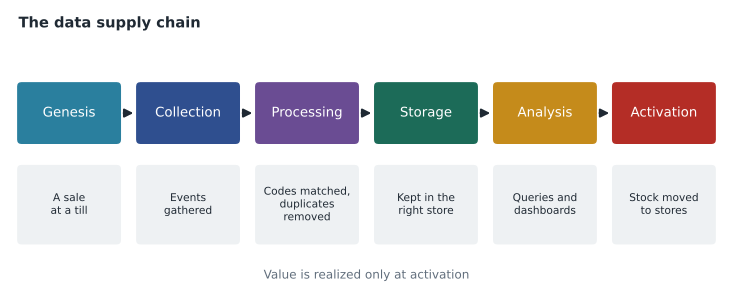
Owen noticed that Birchline's chain breaks in two places. Collection happens once a night, in batch, so nothing is current before the morning. And processing is partly manual, because product codes differ between systems and someone fixes them in spreadsheets. Moving the warehouse to the cloud will not fix either problem by itself. Farah's plan adds streaming collection for sales and web events and an automated processing step that maps product codes once, so that every later report uses the same definitions.
Activation is the step most organizations neglect. A dashboard that shows stock running low in the Prairie stores creates no value until someone moves stock or the system does it automatically. Ravi's goal for the first year is modest: one automated action, a daily stock rebalancing suggestion sent to the regional managers, built on data they trust.
Data quality
Data that is wrong, late or incomplete leads to wrong decisions, and in AI systems it leads to models that confidently repeat the errors. Google's guide lists six dimensions of data quality. Completeness asks whether all the required data is present. Uniqueness asks whether each real thing is recorded once rather than duplicated. Timeliness asks whether the data is available when it is needed. Validity asks whether values follow the expected rules and formats. Accuracy asks whether the values match reality. Consistency asks whether the same fact is recorded the same way across systems.
| Dimension | Question it asks | A Birchline problem |
|---|---|---|
| Completeness | Is anything missing? | Online orders with no postal code |
| Uniqueness | Is each thing recorded once? | The same customer with three loyalty accounts |
| Timeliness | Is it available when needed? | Store sales arriving the next morning |
| Validity | Does it follow the rules? | A price of zero, or a date of 31 February |
| Accuracy | Does it match reality? | Stock counts that differ from what is on the shelf |
| Consistency | Is it the same everywhere? | Different product codes in stores and online |
# Simple quality checks on a few invented online orders.
orders = [
    {"id": "A101", "customer": "C7", "postal": "M5V 2T6", "price": 189.0},
    {"id": "A102", "customer": "C9", "postal": "",        "price": 64.5},
    {"id": "A103", "customer": "C7", "postal": "K1A 0B1", "price": 0.0},
    {"id": "A101", "customer": "C7", "postal": "M5V 2T6", "price": 189.0},
]
ids = [o["id"] for o in orders]
missing_postal = [o["id"] for o in orders if not o["postal"]]
duplicates = sorted({i for i in ids if ids.count(i) > 1})
bad_price = [o["id"] for o in orders if o["price"] <= 0]
print("Completeness - missing postal code:", missing_postal)
print("Uniqueness   - duplicated order IDs:", duplicates)
print("Validity     - impossible prices:   ", bad_price)
print("Orders passing all three checks:", len(orders) - len(set(missing_postal + duplicates + bad_price)), "of", len(orders))Completeness - missing postal code: ['A102'] Uniqueness - duplicated order IDs: ['A101'] Validity - impossible prices: ['A103'] Orders passing all three checks: 1 of 4
What this code does
Four sample orders are checked for three kinds of data quality problem. The program looks for orders missing a postal code, order numbers that appear more than once and prices that are zero or less. Only one of the four orders passes all three checks.
Checks like these run automatically in a modern pipeline, so that problems are caught at the processing step rather than discovered by an annoyed executive looking at a dashboard. Measuring quality also tells a team where to spend effort. Birchline found that most of its consistency problems came from one source, the product codes, which made the case for fixing that one thing first.
Data governance and openness
Data governance is the set of policies, roles and processes that decide how data is collected, stored, protected, used and eventually deleted. It answers questions such as who owns each dataset, who may see customer information, how long sales records are kept, how personal data is handled under federal and state privacy laws, and how quality problems are reported and fixed. Good governance is not a brake on using data; it is what makes people confident enough to use it. Teresa and Ravi now co-chair a small data governance group at Birchline that names an owner for every important dataset.
Governance also covers the risk of lock-in. Data stored in proprietary formats that only one product can read is hard to move, combine or reuse. The exam guide stresses openness and interoperability: open file formats, standard query languages such as SQL, and tools that can read data wherever it sits. Open formats help an organization avoid both data silos inside the company and dependence on a single vendor outside it.
Common mistakes
MistakeAssuming more data automatically means better decisions.
InsteadFocus on whether data reaches the right people quickly and is trusted enough to act on.
MistakeUsing an operational database for heavy analysis.
InsteadRun large analytical queries on a data warehouse so the application's database stays fast.
MistakeStopping at dashboards.
InsteadPlan the activation step: who or what will act on the insight, and how.
MistakeTreating governance as only a security matter.
InsteadGovernance also covers ownership, quality, retention and openness.
Treating important data as a product
Ravi borrowed an idea that many data teams now use: treat each important dataset as a data product, with an owner, a clear description, documented quality checks and promised update times, just like a product sold to customers. The "customers" are the people inside Birchline who rely on it. The daily sales dataset, for example, now has a named owner in finance, a written definition of what counts as a sale (are returns subtracted, and when?), a target of being complete by six in the morning, and a page that shows whether today's checks passed.
The approach changes conversations. Instead of arguing about whose spreadsheet is right, teams point to the agreed definition. Instead of discovering problems in a board meeting, the owner sees a failed check at dawn and fixes it or warns users. And when the AI team wants training data, it starts from datasets that are already documented and trusted. For a digital leader, the lesson is that data value depends as much on clear ownership and agreed meanings as on technology.
Worked problem
Placing data in the right store
Birchline has three needs: the shop must look up a customer's order history in under a second, analysts want five years of sales by store and week, and the marketing team wants to keep every web click log in case it becomes useful. Which kind of store fits each?
Show solution
- Fast lookups of individual records for an application point to an operational database.
- Large queries over years of cleaned history point to a data warehouse.
- Keeping raw files of uncertain future use cheaply points to a data lake.
Answer: Database for the order history, data warehouse for the sales analysis, data lake for the raw click logs. Lesson 4 matches each to a Google Cloud product.
Summary and key terms
- Data creates value when it changes a decision or action: real-time insight, trends, better decisions and fuel for AI.
- Databases serve applications, data warehouses serve analysis of structured history, and data lakes hold raw data of every kind.
- Data is structured, semi-structured or unstructured, and first-, second- or third-party.
- The data supply chain runs from genesis through collection, processing, storage and analysis to activation.
- Quality is measured by completeness, uniqueness, timeliness, validity, accuracy and consistency.
- Governance sets ownership, access, retention and openness so that data can be trusted and reused.
- Data silo
- Data held in one system or team and hard for others to use.
- Data warehouse
- A store of cleaned, structured historical data organized for analysis.
- Data lake
- A store of raw data in its original formats, kept for later processing.
- Semi-structured data
- Data with some organization but no fixed table shape, such as JSON.
- First-party data
- Data an organization collects directly from its own customers and operations.
- Data supply chain
- The path data follows from creation to the action it informs.
- Activation
- Putting an insight to work, by a person or automatically.
- Data governance
- Policies, roles and processes for how data is handled across its life.
Practice problems
Work each problem on paper first, then reveal the answer to check.
What is the difference between first-party and third-party data?
Show answer
First-party data is collected directly by the organization; third-party data is collected by an outside party with no direct relationship to the people it describes.
Which data quality dimension does a customer with three loyalty accounts violate?
Show answer
Uniqueness.
Why is activation the most important step in the data supply chain?
Show answer
Because insight creates no value until someone, or something, acts on it.
Lesson quiz · 5 questions
Score 60% or more to complete this lesson.
Create a free account to save your progress, take quizzes and earn a certificate.