
GCP-102 · Lesson 12 of 12 · 19 min
Building a transformation roadmap
▶ Video coming soon A video version of this lesson is on the way.
In the second week of November 2026, Farah asked Owen to draft the document the steering committee would use for the next two years: Birchline's cloud transformation roadmap. Everything from the previous eleven lessons had to fit on a few pages that the executives could read, argue about and approve. "A roadmap is not a project plan," she told him. "It says where we are going, why, in what order, how we will know we are getting there, and what could stop us. The details change every month. The direction should not." This final lesson follows Owen's draft. It brings together the business view of Google Cloud that the Cloud Digital Leader exam tests, and it gives you a framework for thinking about transformation in any organization.
Start with business outcomes
A transformation roadmap begins with the business outcomes the organization wants, not with technology. Owen's first draft opened with a list of Google Cloud products, and Farah sent it back. The second draft opened with four outcomes the committee had already agreed: an online shop that stays fast through the busiest sales, stock in the right store at the right time, decisions made on yesterday's data by nine in the morning, and a security posture strong enough to survive the kind of attack that hit Birchline's competitor. Every later item in the roadmap had to connect to at least one of these.
Outcomes need measures. For each, the roadmap names a baseline and a target: checkout latency during peak hours, stockouts in the top hundred products, the time daily sales data becomes available, and the share of high-priority security findings closed within a week, expressed as a count out of every hundred findings. Measures make the roadmap testable. If the measures do not move, the committee can ask why, change course or stop spending.
Assess where you are
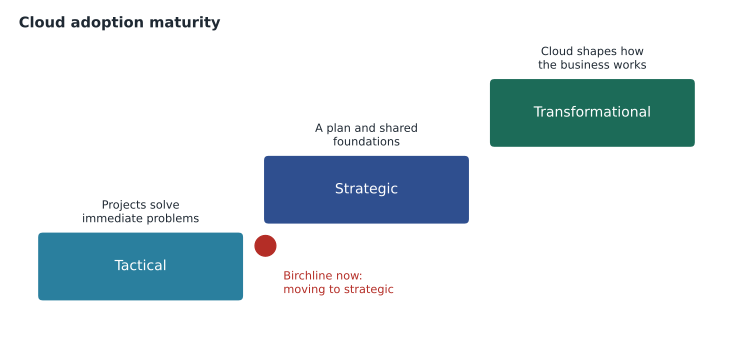
The next step is an honest assessment of the starting point. Owen's discovery work from lesson 6 provided the technical inventory: eighty-three workloads, their dependencies and their owners. Farah added two more views. The first is skills: who on the team already knows cloud, data, security and modern development practices, and where the gaps are. The second is maturity. Google's Cloud Adoption Framework describes an organization's cloud journey across themes such as learning, leading, scaling and securing, and describes maturity in phases, from tactical, where individual workloads are moved to solve immediate problems, through strategic, where a broader plan and shared foundations are in place, to transformational, where cloud is how the organization works and innovates. Birchline, Farah judged, was moving from tactical to strategic.
| Phase | What it looks like | Birchline today |
|---|---|---|
| Tactical | Individual projects solve immediate problems, with little shared planning | Where Birchline was in mid-2026 |
| Strategic | A plan, shared foundations and governance guide adoption | Where Birchline is moving now |
| Transformational | Cloud and data shape how the business works and innovates | The goal for 2028 and beyond |
Lay the foundations first
Before many workloads move, an organization needs a landing zone: the shared foundations every project will rely on. GCP-101 built much of Birchline's: the organization node, the folder structure, the billing account and budgets, central identities and groups, network design, logging and the first organization policies, including the location restriction from lesson 10. Foundations are unglamorous and easy to skip under deadline pressure, but they are far cheaper to build at the start than to retrofit after a hundred projects exist with inconsistent settings.
Owen's roadmap lists the foundations still to finish in the first phase: security keys for all administrators, Security Command Center turned on across the organization, the Cloud Interconnect link, a shared logging project and the FinOps review. None of them delivers a visible feature to customers, so the roadmap explains plainly what each one prevents.
Prioritize the work
With outcomes, an assessment and foundations in view, the next question is order. A common approach is to score each initiative on value (how much it moves the agreed outcomes) and effort or risk (how hard and how risky it is), then start with high-value, lower-effort items that also build skills and confidence. Some low-value items still come early because something else depends on them, and some high-value items wait because the organization is not yet ready for them.
# Scoring candidate initiatives: value and effort from 1 (low) to 5 (high).
initiatives = {
    "Sales history into BigQuery + Looker dashboards": (5, 2),
    "Order API to Cloud Run": (4, 3),
    "Shop database to Cloud SQL": (4, 2),
    "Retire 11 unused servers": (2, 1),
    "AI shopping assistant": (4, 4),
    "Refactor whole shop into microservices": (5, 5),
    "Inventory system rehost to Compute Engine": (3, 2),
}
ranked = sorted(initiatives.items(), key=lambda kv: (-(kv[1][0] - kv[1][1]), -kv[1][0]))
for name, (value, effort) in ranked:
print(f"value {value} effort {effort} net {value - effort:+} {name}")value 5 effort 2 net +3 Sales history into BigQuery + Looker dashboards value 4 effort 2 net +2 Shop database to Cloud SQL value 4 effort 3 net +1 Order API to Cloud Run value 3 effort 2 net +1 Inventory system rehost to Compute Engine value 2 effort 1 net +1 Retire 11 unused servers value 5 effort 5 net +0 Refactor whole shop into microservices value 4 effort 4 net +0 AI shopping assistant
What this code does
Each candidate initiative has a value score and an effort score from 1 to 5, and the script ranks them by value minus effort, most worthwhile first. Moving sales history into BigQuery with Looker dashboards comes out on top (net +3), followed by moving the shop database to Cloud SQL. Big rewrites such as splitting the whole shop into microservices fall to the bottom because their high value is matched by high effort.
The scoring is a conversation starter, not a decision. It put the sales history project and the shop database first, which matched the committee's instincts, and it pushed the full refactoring of the shop down the list, which prompted a useful argument. Jules wanted it sooner. The compromise was the strangler approach from lesson 7: start with the order API and the checkout, and decide on the rest after measuring the results.
A phased roadmap
Owen's roadmap groups the work into three phases, each with a clear purpose. Every date beyond today is a plan, and the roadmap says so.
| Phase | Planned timing | Purpose | Main initiatives |
|---|---|---|---|
| 1. Foundations and quick wins | Late 2026 to spring 2027 | Build safely and show value early | Finish the landing zone; retire unused servers; sales history in BigQuery with Looker; shop database to Cloud SQL |
| 2. Migrate and modernize | Spring to autumn 2027 | Leave the old data center before the lease ends | Migration waves; inventory system rehosted; order API and checkout on Cloud Run; real-time sales pipeline; demand forecasting with BigQuery ML |
| 3. Transform | Late 2027 into 2028 | Use the platform to change the business | AI shopping assistant; partner APIs through Apigee; store pickup service; agentic returns handling |
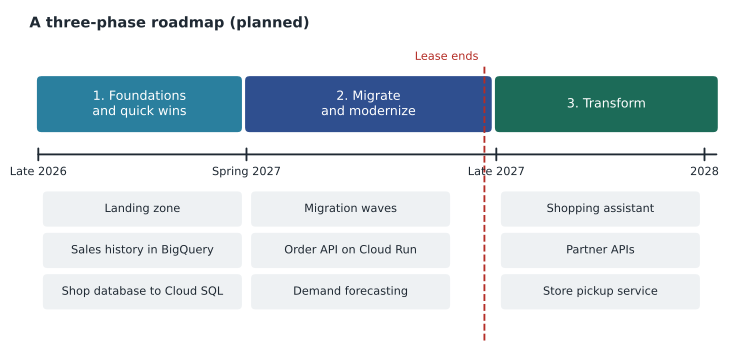
Each phase ends with a review against the outcome measures before the next one is fully funded. This is deliberate: it lets the committee learn from each phase, adjust priorities and stop initiatives that are not delivering, rather than committing two years of spending on day one.
People and change
Technology is the easier half of transformation. The harder half is people. Staff need new skills, and Birchline's roadmap budgets for training and certification, starting with the Cloud Digital Leader exam for managers and project staff and moving to associate and professional certifications for engineers. Roles change: Owen's own job is shifting from looking after servers to designing and running cloud platforms, and several colleagues are anxious about what that means for them. Farah's view is that the roadmap must say clearly how roles will change and how people will be supported, because silence breeds rumors and resistance.
Many organizations create a small cloud center of excellence: a cross-functional team that sets standards, builds shared foundations, coaches other teams and shares what works. Birchline's includes Farah, Owen, someone from Teresa's security team, one of Ravi's analysts and a representative from finance. Executive sponsorship matters too. Dana and the chief executive appear at the monthly progress meetings, which signals that the work is a business priority rather than an IT project. And communication runs throughout: short updates to all staff, demonstrations of early results, and honest reports when something goes wrong.
Risks and how the roadmap handles them
A credible roadmap names its risks. Owen's lists five, each with an owner and a response. Skills gaps could slow the migration, so training starts in phase 1 and a partner provides extra engineers for the busiest waves. Cost overruns are managed through the budgets, alerts and FinOps review from lesson 11. Security mistakes during the rush are reduced by guardrails and Security Command Center from lessons 9 and 10. Disruption to customers is reduced by moving customer-facing systems away from peak seasons and by rehearsing every cutover. Vendor dependence, Dana's long-standing worry, is reduced by preferring open standards and portable containers, as lesson 8 described, and by documenting which dependencies on Google Cloud are deliberate choices.
The roadmap also names the risk of not acting, which lesson 1 introduced. If Birchline stops halfway, it pays for two environments, keeps the old data center's weaknesses and loses the competitive benefits it set out to gain. Stating that risk plainly helped the committee approve the full roadmap rather than only the first phase.
Bringing it together for the exam
The Cloud Digital Leader exam tests exactly this kind of reasoning. Scenario questions describe an organization, its goals and its constraints, and ask which approach, product or principle fits best. The strongest answers connect a business goal to the cloud capability that serves it, choose the simplest option that meets the need, respect the shared responsibility model, protect data and identities, and keep costs and reliability under control. GCP-190 takes you through the exam's format and a structured review of each section. For now, Owen's roadmap is a fair summary of the whole course: start from outcomes, assess honestly, build foundations, prioritize by value, move in phases, invest in people, and measure everything.
Common mistakes
MistakeStarting a roadmap with a list of products.
InsteadStart with business outcomes and measures, then choose the technology that serves them.
MistakeSkipping the landing zone to move faster.
InsteadBuild shared foundations for identity, networking, security, logging and billing before most workloads move.
MistakeCommitting all spending up front.
InsteadFund in phases, with a review against outcome measures before each next phase.
MistakeTreating transformation as only a technology project.
InsteadPlan for skills, changing roles, executive sponsorship and communication.
Questions a digital leader keeps asking
Farah ended her review of Owen's draft with a list of questions she wanted every Birchline manager to keep asking as the roadmap unfolds, because the roadmap will only stay useful if people test it against reality. Each question links back to a lesson in this course.
| Question | Why it matters | Lesson |
|---|---|---|
| Which business outcome does this serve, and how will we measure it? | Keeps technology tied to value | 1 and 12 |
| Which service model fits, and what stays our responsibility? | Avoids gaps in security and operations | 2 |
| Who owns this data, and can people trust it? | Data creates value only when trusted and used | 3 and 4 |
| Is AI the right tool here, and how will we use it responsibly? | Prevents expensive experiments without purpose | 5 |
| What is the least effort that achieves the goal? | Keeps migrations on schedule | 6 and 7 |
| Where must this run, and why? | Keeps hybrid and multicloud deliberate | 8 |
| Who can access it, and how do we know? | Identity is the front door | 9 and 10 |
| What does it cost, who watches, and how reliable must it be? | Avoids surprise bills and silent failures | 11 |
Owen printed the table and pinned it beside Teresa's news story about the competitor's ransomware attack. Between them, he said, they covered most of what could go right and most of what could go wrong. The first phase of the roadmap begins this winter, and the first review is planned for the spring, when the committee will look at the measures and decide whether the plan still makes sense.
For learners preparing for the exam, the same questions work as a method for scenario questions. Read the scenario, identify the business outcome the organization is after, note the constraints such as budget, skills, regulation or timing, and then choose the answer that serves the outcome within those constraints with the least complexity. Answers that add technology for its own sake, ignore shared responsibility or skip security and cost control are usually wrong, however impressive the products they name.
Worked problem
Writing the roadmap's first page
Dana asks for a single page that explains the roadmap to the board. What should it contain?
Show solution
- The four business outcomes and how each will be measured.
- Where Birchline is today: the inventory of workloads, the skills picture and its maturity phase.
- The three phases with their purposes, planned timing and main initiatives, anchored to the lease expiry.
- The main risks with owners and responses, including the risk of stopping halfway, and the plan for people.
Answer: Outcomes and measures, the current state, the phased plan and the risks and people plan, all in business language, with the technology details in appendices.
Summary and key terms
- A transformation roadmap starts from business outcomes with measurable baselines and targets.
- It assesses the current state of workloads, skills and maturity, which Google describes as moving from tactical to strategic to transformational.
- A landing zone of shared foundations comes first.
- Initiatives are prioritized by value against effort and risk, and grouped into phases with reviews between them.
- People and change matter as much as technology: training, changing roles, a cloud center of excellence, executive sponsorship and communication.
- Risks, including the risk of not acting, are named with owners and responses.
- Business outcome
- A result the organization wants, such as faster decisions or fewer stockouts.
- Baseline
- The current value of a measure, against which progress is judged.
- Landing zone
- The shared cloud foundations every project relies on.
- Cloud Adoption Framework
- Google's guide to cloud adoption themes and maturity phases.
- Tactical, strategic, transformational
- Phases of cloud adoption maturity.
- Cloud center of excellence
- A cross-functional team that sets standards and helps others adopt cloud.
- Executive sponsorship
- Visible support and accountability from senior leaders.
- Phased roadmap
- A plan divided into stages with reviews before each next stage.
Practice problems
Work each problem on paper first, then reveal the answer to check.
Why should a roadmap begin with business outcomes rather than products?
Show answer
Because the technology should be chosen to serve the outcomes, and outcomes with measures make progress testable.
What is a landing zone, and why build it early?
Show answer
The shared foundations such as identity, networks, security, logging and billing; it is far cheaper to build at the start than to retrofit.
Why fund a roadmap in phases?
Show answer
So that each phase can be reviewed against outcome measures and the plan adjusted before more is spent.
Lesson quiz · 5 questions
Score 60% or more to complete this lesson.
Create a free account to save your progress, take quizzes and earn a certificate.