
GAS-210 · Lesson 6 of 12 · 23 min
Combination heating and hot water systems
▶ Video coming soon A video version of this lesson is on the way.
On Thursday, November 5, Rosa took Jonah to a 2014 townhouse in Italian Village whose owner had two complaints. The house went cool whenever someone took a long shower, and the hot water had smelled "musty" for a few days in September after the family came back from a month away. The townhouse had no furnace. Its heat came from a combination system: a condensing tankless water heater in the utility closet, piped to a hydronic air handler with a water coil and a blower, which heated the house with hot water from the same appliance that fed the taps. "Two jobs, one burner," Rosa said. "That's the whole idea, and it explains both complaints."
Combination systems use one gas appliance for both space heating and domestic hot water. They save space, a vent and a gas connection, and they are common in townhouses, condominiums and small new houses. This lesson describes the main kinds, how they share their heat between the two jobs, the rules that keep the drinking water safe, and how to size and check them. Commercial boilers and larger hydronic systems are covered in GAS-320.
Kinds of combination system
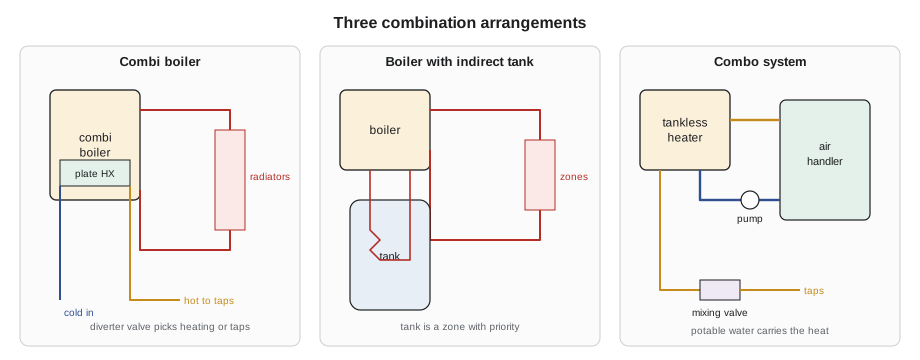
The term covers several arrangements, and a technician needs to know which one is in front of them. A combination boiler, or combi boiler, is a wall-hung condensing boiler with a built-in plate heat exchanger for domestic hot water. Its boiler water circulates through radiators, baseboard or in-floor heating in a closed loop, and when a tap opens, a diverter valve sends the hot boiler water through the plate heat exchanger to heat the domestic water passing the other side. A boiler with an indirect tank heats a separate storage tank through a coil inside it; the tank is just another zone on the boiler, usually with priority over the heating zones.
A combo system, the arrangement at the Italian Village townhouse, pairs a water heater, storage or tankless, with a hydronic air handler. Here there is no separate boiler loop: the potable water itself is pumped from the water heater through the air handler's coil and back. When the thermostat calls for heat, the air handler's pump runs and its blower moves house air across the hot coil. When a tap opens, the water heater supplies it as usual. Finally, in some older houses a storage water heater was piped to heat a small zone of baseboard or a fan coil, sometimes without any of the safeguards described below; these are often found during service and need careful checking.
Priority: who gets the heat
One burner cannot always do both jobs at full output. Most combination systems therefore give domestic hot water priority: when there is a demand for hot water, the appliance serves it first and the space heating waits or runs at reduced output. In a combi boiler, the diverter valve switches all the boiler's output to the plate heat exchanger. In a boiler with an indirect tank, the tank's zone pump or valve runs and the heating zones stop. In a combo system with a tankless heater, a long shower takes most of the heater's output, and the air handler's coil cools.
Priority is a design choice, and it is usually the right one, because a house cools slowly while a shower that runs cold is noticed at once. But it explains the first complaint at the townhouse. On a cold evening, a 20-minute shower left the air handler with lukewarm water, and the house cooled by a degree or so. Rosa checked the tankless unit's input against the heating load and the hot water demand; it was adequate, and the behavior was normal. She explained it to the owner and suggested the family stagger long showers on the coldest nights, and set the air handler's controls so that heating resumed promptly at full fan speed when the shower ended.
Keeping potable water safe
Because a combo system circulates drinking water through the air handler, everything in that loop must be suitable for potable water: lead-free materials, no ferrous parts that rust into the water, and no antifreeze or boiler chemicals. A combo air handler is built for this, and its instructions list the pipe and fittings that may be used. A boiler-type air handler or a used coil from a hydronic system must never be connected to potable water. A backflow preventer or the separation the plumbing rules require protects the city water from the heating loop wherever the two are connected.
The second risk is stagnation. In summer, when there is no call for heat, the water in the air handler's loop sits still, cools to room temperature and can grow bacteria, including Legionella, which then enters the taps when heating resumes. Combo air handlers have a control that runs the pump for a short time at set intervals, often every few hours or once a day, to keep the loop water moving and fresh. That was the cause of the second complaint. During a summer renovation the owner had unplugged the air handler to save power, and when the family returned from holiday the loop had stood stagnant for weeks. Rosa reconnected it, flushed the loop with hot water as the instructions describe, and explained why it must stay powered all year.
In the United States, combo systems are installed under the manufacturers' instructions, the plumbing code for the potable water side and the fuel gas code for the gas side. There is no single US performance rating for a matched pair, so Bayline uses the makers' published matches and the Canadian CSA P.9 performance data where it is available, since many of the same products sell in both countries. The hydronic side of boiler systems follows the mechanical code and the boiler maker's instructions.
Temperature matters in both directions here. The water heater in a combo system is usually set hotter than a stand-alone one, often about 140 °F, so that the coil has enough heat to offer and bacteria are controlled. That makes a thermostatic mixing valve on the tap supply essential, to deliver water to the fixtures at a safe temperature. At the townhouse, the mixing valve was in place and set correctly; Jonah measured 118 °F at the kitchen tap.
Hydronic basics for gas technicians
Whatever the arrangement, the heating side of a combination system moves heat with water. The heat carried depends on the flow rate and the temperature difference between supply and return. Many residential hydronic systems are designed for a drop of about 20 °F across the load. The pump must move enough water for the heat needed, and the pipe sizes, the coil and the pump curve together decide whether it can.
Worked problem
Flow needed by an air handler coil
The townhouse needs 41,000 Btu/h of heat on a design day. The air handler coil is designed for a 20 °F drop between supply and return water. What water flow must the pump deliver? Use flow in gpm = heat ÷ (500 × drop).
Show solution
- Apply the formula:
- \[\text{gpm} = \frac{41\,000}{500 \times 20} = \frac{41\,000}{10\,000} = 4.1 \text{ gpm}\]
Answer: The pump must move about 4.1 gpm through the coil. Rosa checked the air handler's data sheet: its built-in pump could deliver that through the townhouse's short piping run with room to spare.
A closed boiler loop, as in a combi boiler or a boiler with an indirect tank, has its own safety and service parts. A pressure relief valve on the boiler, often set at about 30 psi on residential boilers, protects the loop from overpressure; an expansion tank absorbs the water's expansion as it heats; an air separator and vents remove air that would otherwise cause noise and corrosion; and a pressure-reducing fill valve with a backflow preventer keeps the loop topped up from the city water. Many boilers also have a low-water cutoff or a flow switch that stops the burner if water is lost. A gas technician who services the boiler checks all of these, even though they are not gas parts, because a boiler with no water or no relief is a hazard.
| System | Heating water | Domestic hot water | Key checks |
|---|---|---|---|
| Combi boiler | Closed boiler loop | Plate heat exchanger, on demand | Diverter valve, plate scale, loop pressure, relief valve |
| Boiler with indirect tank | Closed boiler loop | Storage tank heated by a coil | Tank zone priority, tank temperature, mixing valve |
| Combo system | Potable water through the air handler | Water heater supplies taps directly | Anti-stagnation cycle, potable-rated parts, mixing valve |
| Old water heater for heat | Potable water through baseboard or coil | Water heater supplies taps directly | Suitability of parts, stagnation, backflow, scald risk |
Return water temperature and condensing
A condensing boiler, a combi boiler or a condensing tankless heater only condenses, and only reaches its rated efficiency, when the water returning to it is cool enough to bring the flue gas below its dew point, roughly 130 °F for natural gas. A system designed with high supply temperatures and a small temperature drop, such as old cast-iron radiators run hot, may return water too warm to condense for much of the season. Modern controls use outdoor reset, which lowers the supply temperature as the weather warms, so that on mild days the system runs cooler and condenses more. In a combo system, the air handler's coil is sized for a given supply temperature, and turning the water heater down to save gas can leave the coil unable to heat the house on a cold day. A technician who changes a setpoint on a combination system needs to know which job each setting serves.
Sizing a combination appliance
Sizing a combination appliance means checking both jobs. The hot water side decides the maximum input: a combi boiler or tankless heater must deliver the peak hot water flow at the coldest incoming water, exactly as lesson 5 showed. The heating side decides the minimum: on a mild day the house may need only a fraction of the heat the appliance can make, and an appliance that cannot turn down far enough will short-cycle. That is why the turndown ratio, the ratio of maximum to minimum input, matters so much for combination appliances.
Worked problem
Turndown and the heating load
A combi boiler modulates from 12,000 Btu/h to 120,000 Btu/h. The house it serves needs 41,000 Btu/h on a design day and about 14,000 Btu/h on a mild November day. What is the boiler's turndown ratio, and can it run continuously on the mild day?
Show solution
- Turndown ratio is maximum input divided by minimum input:
- \[\frac{120\,000}{12\,000} = 10, \text{ so } 10:1\]
- Compare the mild-day load with the minimum input:
- \[14\,000 \text{ Btu/h} > 12\,000 \text{ Btu/h}\]
Answer: The boiler has a 10:1 turndown, and even on the mild day the house needs a little more than the boiler's minimum, so it can run long, steady cycles. A boiler with only a 3:1 turndown would have cycled on and off many times an hour. The large maximum input is there for the hot water, not the heating.
Servicing combination systems
A service visit to a combination system covers the gas appliance exactly as for any other: pressures, combustion, venting, condensate and safety controls. It adds the water side: the mixing valve setting and the temperature at a tap, the anti-stagnation control, scale in the plate heat exchanger or tankless heat exchanger, the loop pressure and relief valve on a boiler, the expansion tank's charge, air in the loop, and the air handler's filter and blower. Many problems on these systems are water problems that look like gas problems: a scaled plate heat exchanger gives lukewarm showers, and air in a coil gives a cold house, though the burner is fine.
Before leaving the townhouse, Jonah recorded the tankless unit's pressures and combustion readings, the mixing valve outlet temperature, the confirmation that the anti-stagnation cycle ran, the air handler's filter change, and a note that the system was operating normally. He also noted the owner's question for the office: whether a larger tankless unit would end the cool evenings. Hank's answer, after looking at the numbers, was that it would not be worth the cost or the larger gas line; the system was matched and rated, and the behavior was the price of priority.
Common mistakes
MistakeConnecting a boiler-type coil to potable water.
InsteadUse only an air handler built and listed for potable water in a combo system.
MistakeUnplugging a combo air handler for the summer.
InsteadLeave it powered so its anti-stagnation cycle keeps the loop water fresh.
MistakeSetting a combo water heater hot without a mixing valve.
InsteadFit a thermostatic mixing valve on the tap supply.
MistakeSizing a combi boiler only from the heating load.
InsteadCheck both the peak hot water flow and the minimum heating load.
MistakeIgnoring a boiler's relief valve and loop pressure because they are not gas parts.
InsteadCheck them on every service; a boiler without water or relief is a hazard.
Summary and key terms
- Combination systems use one gas appliance for heating and hot water: combi boilers with a plate heat exchanger, boilers with an indirect tank, and combo systems that pump potable water from a water heater through a hydronic air handler.
- Most give domestic hot water priority, so space heating pauses during long draws.
- In combo systems every part of the loop must be potable-rated, a backflow preventer protects the supply, and an anti-stagnation cycle keeps the loop fresh; water is stored hot and mixed down for the taps.
- Combos follow the makers' matched pairs, with plumbing and fuel gas code requirements. Heating flow depends on load and temperature drop.
- Size combination appliances for peak hot water and check their turndown against the minimum heating load.
- Combination boiler
- A boiler that heats a closed heating loop and also heats domestic water on demand through a plate heat exchanger.
- Indirect tank
- A storage tank whose water is heated by boiler water passing through a coil inside it.
- Combo system
- A water heater paired with a hydronic air handler that circulates potable water through its coil.
- Diverter valve
- A valve that sends a combi boiler's hot water to either the heating loop or the domestic heat exchanger.
- Domestic hot water priority
- A control strategy that serves hot water demand before space heating.
- Anti-stagnation cycle
- A timed pump run that keeps water from standing still in a combo loop.
- Turndown ratio
- The ratio of an appliance's maximum input to its minimum input.
Practice problems
Work each problem on paper first, then reveal the answer to check.
Why did the townhouse cool during long showers?
Show answer
The system gives hot water priority, so most of the heater's output went to the shower.
Why must a combo air handler stay powered in summer?
Show answer
Its anti-stagnation cycle keeps the potable water in the loop from standing still.
What flow carries 30,000 Btu/h through a coil with a 20 °F drop?
Show answer
30,000 ÷ (500 × 20) = 3.0 gpm.
Which side of a combination appliance sets its maximum input?
Show answer
The domestic hot water side.
Name two non-gas parts checked on a combi boiler service.
Show answer
The relief valve, loop pressure, expansion tank, air separator or low-water cutoff.
Lesson quiz · 5 questions
Score 60% or more to complete this lesson.
Create a free account to save your progress, take quizzes and earn a certificate.