
GAS-210 · Lesson 5 of 12 · 24 min
Storage and tankless water heaters
▶ Video coming soon A video version of this lesson is on the way.
Three days after the carbon monoxide incident at the duplex on Parsons Avenue described in GAS-110, Bayline went back to replace the water heater whose vent connector had come apart. The old unit was an atmospheric 40-gallon tank sharing a chimney with nothing else; the new one, as Rosa had recommended to the landlord, was a power-vent storage water heater with its own fan and a sealed plastic vent through the basement wall. On Friday, October 30, Jonah carried in the new tank with Luis Ferreira, and Rosa ran the job. "Two tenants went to hospital because of a water heater," she said as they set it on the pad. "So this one is going to be the best-installed water heater in Columbus. Every relief line, every clearance, every connection."
Water heaters are the second largest gas load in most homes and the appliance a gas technician installs most often. This lesson covers how storage and tankless water heaters work, their venting options, their safety devices, the rules around water temperature, and how to size them. Combination systems that use one appliance for both heating and hot water follow in lesson 6.
How a storage water heater works
A storage water heater keeps a tank of water hot and ready. The tank is steel, lined inside with glass-like enamel to slow corrosion, and wrapped in foam insulation inside an outer jacket. Cold water enters through a dip tube that carries it to the bottom of the tank, so the hottest water stays at the top, where the hot outlet draws from. A burner under the tank fires into a combustion chamber, and the hot flue gas rises through a flue tube up the center of the tank, with a twisted baffle inside it that slows the gas and makes it give up more heat to the water. An anode rod, usually magnesium or aluminum, corrodes in place of the tank's steel wherever the lining has gaps, and must be inspected and replaced as it is used up.
The gas control, mounted on the front of the tank, combines a thermostat, which senses the water temperature through a probe in the tank, with a gas valve and a pilot or ignition control. Older and simpler models use a standing pilot and a thermocouple, the millivolt system GAS-130 introduced. Many newer models use electronic controls with hot surface or spark ignition, which need a power supply. The gas control's dial sets the water temperature; the factory setting is usually moderate, and the instructions say which mark corresponds to which temperature.

Flammable vapor ignition resistance
Water heaters sit in basements, garages and utility rooms where gasoline, solvents and paint thinner may be spilled or stored, and an open burner at floor level can ignite their vapors. Since the early 2000s, most residential gas storage water heaters have been built to be flammable vapor ignition resistant (FVIR) under their product standard. The combustion chamber is sealed, and air enters through a flame arrestor, a plate or screen at the bottom of the tank that lets air through but stops a flame from passing out of it. A thermal cutoff shuts the gas off if the chamber overheats, as it would if vapors burned inside it.
The flame arrestor has a cost: lint, dust and pet hair gradually block it, starving the burner of air. The result is poor combustion, carbon monoxide and sooting, and eventually the thermal cutoff trips. Cleaning the air inlet screen is part of the annual service (lesson 11), and a water heater in a dusty laundry room may need it more often. Some thermal cutoffs reset; others are one-shot devices that require a part, or the whole control, to be replaced. The instructions say which, and say what to check before restarting.
Venting a storage water heater
Storage water heaters come in several vent types. An atmospheric water heater has a draft hood on top and vents by natural draft into a B-vent or a lined chimney; it is a Category I appliance and depends on the house not being depressurized, which is exactly what failed at the duplex. A power-vent water heater has a blower on top that pushes the flue gas, diluted with room air, through a plastic vent; it can run horizontally to a sidewall and does not need a chimney, but it still takes its combustion air from the room. A direct-vent water heater draws its combustion air from outdoors through a concentric or two-pipe vent. A power direct-vent model combines a blower with outdoor air. A condensing storage water heater has a heat exchanger that cools the flue gas below its dew point, like a condensing furnace, and needs a condensate drain.
Each type has its own vent material, length limits and clearances, given in the instructions. A power-vent model's plastic vent is limited by equivalent length, like a condensing furnace's, and its blower needs a 120-volt receptacle. GAS-130's Barton Street story told what happened to this one in November, when condensate dripping from the vent corroded a connector in the pressure-switch circuit; the lesson there was that even a non-condensing power vent can form condensate in a cold vent, so the instructions' slope and drain rules matter. GAS-230 covers vent design in depth.
Water temperature, scalding and bacteria
Hot water presents two opposite hazards. Water that is too hot scalds: at around 140 °F a serious burn can happen in a few seconds, especially to young children and older people, while at around 120 °F it takes minutes. Water that is not hot enough can let Legionella bacteria, the cause of Legionnaires' disease, grow in the tank, particularly at its cool bottom; they multiply fastest in lukewarm water and are killed by sustained high temperatures. Public health guidance commonly recommends storing water at about 140 °F and delivering it to fixtures at a lower temperature through a mixing device.
The plumbing codes require showers and tub-showers to have valves that limit the outlet temperature, commonly to a maximum of 120 °F, and many jurisdictions limit the temperature delivered to bathtubs and fixtures in certain buildings. The usual way to store water hot while delivering it safely is a thermostatic mixing valve at the water heater, or limiting valves at the fixtures, installed by the plumbing trade under the plumbing code. A gas technician setting the gas control should know what the house has: a water heater turned up to its hottest mark in a house with no mixing valve is a scald hazard.
Relief valves and expansion
Every storage water heater must have a temperature and pressure relief valve (T&P valve), set to open if the water temperature reaches about 210 °F or the pressure reaches the tank's rated working pressure, often 150 psi. Without it, a failed thermostat could heat the water until the tank burst, and water far above its normal boiling point flashes violently into steam when the tank fails. The T&P valve must be the rating the instructions specify, with its sensing element in the hot water at the top of the tank, and nothing may be installed between it and the tank.
Its discharge line must be the full size of the valve outlet, run downhill without valves, traps or reductions, and end where hot water and steam will not injure anyone or cause damage, usually close above the floor or over a drain, with a plain, unthreaded end so it cannot be capped. These are plumbing requirements, but a gas technician who installs a water heater is responsible for seeing that they are met. On the duplex job, the old discharge line had been cut short and pointed at the wall; Jonah ran a new full-size line down to 6 inches above the floor drain.
Heating water makes it expand. In a house with a check valve or pressure-reducing valve on the water service, that expansion has nowhere to go, the pressure in the tank rises each time it heats, and the T&P valve may drip or the tank may be stressed. A thermal expansion tank on the cold water line absorbs the extra volume. Many water heater instructions require one on a closed system, and the plumbing code may too.
| Device | What it protects against | What to check |
|---|---|---|
| Gas control thermostat | Overheating in normal operation | Setting, response, any error codes |
| Energy cutoff or high limit | Thermostat failure | Part of the gas control; replaced with it |
| T&P relief valve | Excess temperature or pressure in the tank | Rating, discharge line, operation by lifting the lever |
| Flame arrestor and air inlet | Ignition of flammable vapors outside the tank | Clean, unblocked screen |
| Thermal cutoff | Burning inside the sealed combustion chamber | Tripped or not, and why |
| Expansion tank | Pressure rise in a closed water system | Pre-charge pressure, waterlogging |
Sizing a storage water heater
A storage water heater is sized by its first-hour rating, compared with the household's busiest hour of hot water use, such as a morning with two showers, a dishwasher and a washing machine. The tank volume alone does not tell the whole story: a tank with a larger burner recovers faster and can have a higher FHR than a larger tank with a small burner. The recovery rate is the volume of water the burner can heat through a given temperature rise in an hour.
Worked problem
Recovery rate of the duplex water heater
The new 40-gallon duplex water heater has an input of 36,000 Btu/h and a recovery efficiency of 0.80. How many gallons per hour can it heat from 50 °F to 140 °F? Use 8.33 Btu per gallon per °F.
Show solution
- Heat delivered to the water:
- \[36\,000 \times 0.80 = 28\,800 \text{ Btu/h}\]
- Heat needed per gallon for a 90 °F rise:
- \[8.33 \times 90 = 749.7 \text{ Btu/gal}\]
- Gallons per hour:
- \[\frac{28\,800}{749.7} \approx 38.4 \text{ gal/h}\]
Answer: The burner can heat about 38 gallons an hour. Added to the usable part of the stored water, that gives the tank's first-hour rating, which the plate shows as about 66 gallons.
How a tankless water heater works
A tankless, or instantaneous, water heater stores no hot water. When a tap opens and water flows through the unit above a minimum activation flow, typically around half a gallon per minute, a flow sensor tells the control board, which starts the fan, lights the burner and modulates the gas input to heat the water to the set temperature as it passes through a compact heat exchanger. Most residential units are condensing, with a secondary heat exchanger and a condensate drain like a condensing furnace, and vent in plastic pipe; non-condensing units vent in stainless steel.
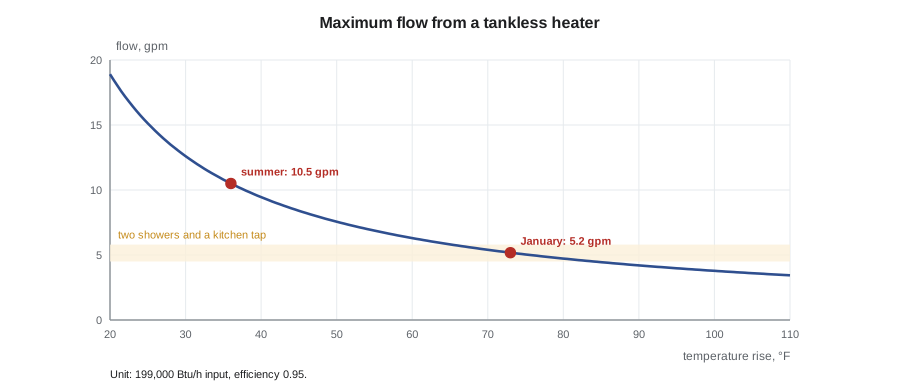
Because it heats water only as it flows, a tankless heater never runs out of hot water, but it can only heat a certain flow through a certain rise. Its input has to be large: residential units commonly reach 199,000 Btu/h, many times a storage tank's input, which means the gas piping must be sized for it, as GAS-120's Fairhaven case study found when the 1-inch main proved too small. In winter, when the incoming water is coldest, the rise is largest and the available flow smallest.
Worked problem
Tankless flow in January
The Fairhaven tankless heater has a maximum input of 199,000 Btu/h and an efficiency of 0.95. In January the incoming water is 42 °F and the set temperature is 115 °F. What is the maximum flow it can heat to setpoint? Use flow in gpm = output ÷ (500 × rise).
Show solution
- Output to the water:
- \[199\,000 \times 0.95 = 189\,050 \text{ Btu/h}\]
- Rise:
- \[115 - 42 = 73 \ ^\circ\text{F}\]
- Flow:
- \[\frac{189\,050}{500 \times 73} = \frac{189\,050}{36\,500} \approx 5.2 \text{ gpm}\]
Answer: About 5.2 gpm: enough for two showers at about 2 gpm each and a kitchen faucet, but not much more at once. In summer, with warmer incoming water, the same unit delivers more.
Installing and maintaining tankless heaters
A tankless heater is installed to its instructions: on a wall with the clearances they give, with gas piping sized for its full input, a manual shut-off valve and union, the vent and intake they list within their length limits, a condensate drain and neutralizer for a condensing unit, and usually isolation valves on the water connections so the heat exchanger can be flushed. In hard water areas, scale builds up in the heat exchanger and reduces flow and efficiency; the instructions give a flushing interval and some require a scale-reducing filter. Many units show an error code when scale is detected. Freeze protection matters too: a unit on an outside wall must be protected as its instructions say, especially if power may fail in winter.
By noon on October 30, the duplex's new power-vent water heater was running. Jonah had leak-tested the gas connection, purged the line, checked the vent's slope and clearances, measured the inlet and manifold pressures, watched it light and run, tested for CO at the vent and in the room, and checked the new CO alarm in the basement. Rosa had him lift the T&P valve's lever briefly to prove it opened and reseated. The landlord's copy of the start-up sheet went in the mail that afternoon.
Common mistakes
MistakeCapping or shortening a T&P discharge line.
InsteadRun it full size, downhill, unvalved, to a safe point near the floor with a plain end.
MistakeIgnoring a dusty flame arrestor.
InsteadClean the air inlet screen at every service; more often in dusty rooms.
MistakeTurning a water heater up to its hottest setting to get more hot water.
InsteadCheck for a mixing valve first; size for demand rather than raising the temperature.
MistakeFeeding a tankless heater from the old storage tank's gas line.
InsteadSize the piping for the tankless unit's full input.
MistakeSizing a tankless unit for summer incoming water.
InsteadSize it for the coldest incoming water temperature.
Summary and key terms
- A storage water heater keeps a lined, insulated tank hot; cold water enters through a dip tube, flue gas rises through a baffled flue tube, and an anode protects the tank.
- FVIR models seal the combustion chamber behind a flame arrestor with a thermal cutoff.
- Venting may be atmospheric, power vent, direct vent, power direct vent or condensing, each to its instructions.
- Store water hot enough to control Legionella and deliver it through a mixing device to prevent scalds within the plumbing code's limits at showers and tubs.
- The T&P valve and its full-size, open discharge line protect against overheating; an expansion tank handles closed systems.
- Size storage tanks by first-hour rating and tankless units by flow at the coldest rise, with piping sized for their large input.
- Dip tube
- A tube that carries incoming cold water to the bottom of a storage tank.
- Anode rod
- A sacrificial metal rod that corrodes in place of the tank steel.
- FVIR
- Flammable vapor ignition resistant: a sealed combustion chamber design with a flame arrestor.
- Flame arrestor
- A plate or screen that admits air to a sealed combustion chamber but stops flame from passing out.
- T&P relief valve
- A valve that opens on excessive temperature or pressure in a water heater tank.
- Recovery rate
- The volume of water a water heater can heat through a stated rise in one hour.
- Minimum activation flow
- The smallest water flow at which a tankless heater will fire.
Practice problems
Work each problem on paper first, then reveal the answer to check.
Why does a storage water heater have a dip tube?
Show answer
To deliver cold water to the bottom so the hottest water stays at the top outlet.
What does a blocked flame arrestor cause?
Show answer
Air starvation, poor combustion, CO and sooting, and eventually a tripped thermal cutoff.
Name two requirements for a T&P discharge line.
Show answer
Full size and downhill with no valves or traps, ending near the floor with a plain end.
A tankless unit delivers 175,000 Btu/h to the water. What flow can it heat through a 70 °F rise?
Show answer
175,000 ÷ (500 × 70) = 5.0 gpm.
Why does a tankless heater need larger gas piping than a storage tank?
Show answer
Its input is several times larger because it heats water as it flows.
Lesson quiz · 5 questions
Score 60% or more to complete this lesson.
Create a free account to save your progress, take quizzes and earn a certificate.