
FILM-310 · Lesson 8 of 12 · 26 min
Sound effects editing and sound design
Sound effects give a film its physical world. They tell us what objects weigh, how fast things move, how far away the storm is and how dangerous the creature might be. Effects work divides into several overlapping crafts: cutting hard effects in sync with picture, building backgrounds that place each scene in a time and space, and sound design, the creation of sounds that do not exist or that must be heightened far beyond reality. This lesson covers how effects editors find, record, edit and layer sounds, how designers create new ones, and how effects are organized for the mix. Foley, the performed movement sounds, has its own lesson next.
Categories of effects
Effects editors use a shared vocabulary for different kinds of sound. Hard effects, also called spot effects, are sounds tied to specific on-screen events: a door slam, a gunshot, a car pass, a phone ring. Backgrounds, or ambiences, are continuous sounds that establish place: a city street, a forest at dawn, an office hum. Designed effects are created or heavily processed sounds for things that do not exist or need to feel extraordinary: spaceships, magic, creatures, transitions into memories. Foley covers human movement and is usually handled separately. Production effects are useful sounds kept from the production recording.
| Category | Examples | Typical sources |
|---|---|---|
| Hard effects | Doors, guns, vehicles, impacts, phones | Libraries, custom recording, production |
| Backgrounds | Room tones, city, nature, crowds | Location recordings, libraries |
| Designed effects | Creatures, sci-fi devices, magic, whooshes | Layered and processed recordings, synthesis |
| Foley | Footsteps, cloth, handled props | Performed on a Foley stage (lesson 9) |
| Production effects | In-sync doors, cups, keys from set | Production dialogue tracks |
Sources: libraries and custom recording
Most effects begin as recordings. Commercial libraries contain hundreds of thousands of categorized sounds, licensed for use in productions under the terms of each library's license. Effects editors search them by keyword and metadata, often using a standard naming system such as the Universal Category System, which gives each sound a category, subcategory and descriptive name so libraries from different vendors can be searched together. Libraries are fast and affordable, but heavily used sounds can be recognizable, and a film that relies only on libraries can sound generic.
Custom recording gives a film its own identity. Effects recordists capture specific vehicles, weapons, locations and props, often at high sample rates such as 96 or 192 kHz so the sounds can later be slowed down or pitched down without losing high-frequency detail. Recording sessions require planning, permissions and safety: recording firearms needs licensed armorers and range permission; recording vehicles needs closed roads or tracks; recording in public places may need permits.
Licensing matters. A sound effect from a library is usually licensed for synchronization in your production but not for resale as a sound effect. Sounds recorded from television, films or other people's recordings are not free to use. Even sounds that seem generic, such as a famous scream, may be owned. Keep records of library sources and licenses with the project files.
Cutting hard effects
Cutting hard effects means placing sounds precisely in sync with their visual events and choosing sounds that match the size, material, distance and story weight of each event. A car door on a luxury sedan should sound solid and expensive; on a rusty pickup, rattly and tired. A door slammed in anger should feel louder and heavier than the same door closed gently. Effects editors usually cut each event from several elements and place them on separate tracks so the mixer can balance them.
Sync is usually frame-accurate, but perception guides small adjustments. Impacts often sound better a frame early, landing on the frame where the hand or object makes contact, because the eye anticipates contact. Distant events in wide shots may be slipped late to suggest the time sound takes to travel, though film convention rarely uses the full physical delay: a lightning strike 1.7 km away would produce thunder 5 seconds later, which audiences accept, but a cannon 300 m away would be about 1 second late, which can feel like a sync error unless the film has established the convention.
Layering: building a sound from elements
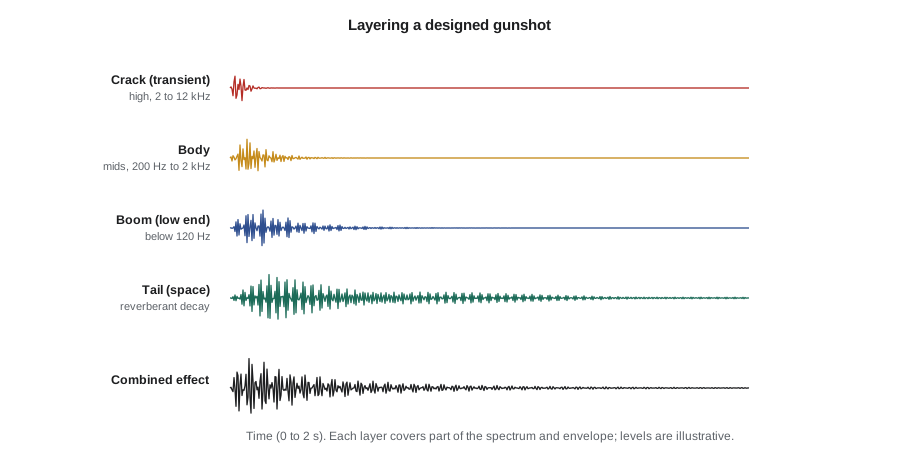
Few powerful film sounds come from a single recording. Designers build them in layers, each contributing part of the frequency range and envelope: a sharp transient for the attack, a body for weight, a low-frequency element for size and impact, a tail for space and decay, and sometimes a sweetener, a subtle element such as an animal growl inside an engine, that gives the sound character.
Worked problem
Designing a heavy security door
A thriller needs the sound of a heavy steel security door closing in an underground bunker. Plan the layers.
Show solution
- Attack: a metal latch or bolt snap recorded close, giving a sharp, precise transient in sync with the visual closure.
- Body: a large metal door impact, such as a shipping container door, for weight in the low mids.
- Low end: a pitched-down impact or a sub-bass hit for size, kept short so it does not muddy dialogue that follows.
- Tail: a long reverberant decay from a concrete space, or an impulse response of a car park, to place the door in the bunker.
- Sweetener: a faint hydraulic hiss before the impact to suggest the mechanism.
Answer: Five layers on separate tracks give the mixer control. The low-end and tail layers can be pulled back if dialogue follows quickly, while the attack keeps the sync crisp.
Processing tools of the sound designer
Sound designers transform recordings with a toolkit of processes. Pitch shifting changes pitch, often with time-stretching to keep duration constant or by simple speed change, which changes both. Slowing a recording down by half lowers its pitch by an octave; this is why recording at high sample rates helps, because the high-frequency content that drops into the audible range after slowing must have been captured in the first place. Equalization shapes tone; reverberation and convolution place sounds in spaces; distortion and saturation add aggression; granular synthesis breaks sounds into tiny grains and reassembles them into textures; and synthesis creates tones from scratch.
The equation gives the frequency ratio \( r \) for a pitch shift of \( n \) semitones: 12 semitones is an octave and doubles or halves the frequency. A sound shifted down 7 semitones plays at about 0.67 times its original frequency.
The Doppler effect, the change in pitch of a sound from a moving source, is essential for vehicle passes and fly-bys. As a source approaches, waves are compressed and the pitch rises; as it recedes, the pitch falls. For a source moving at speed \( v \) directly toward or away from a listener:
where the minus sign applies when the source approaches and the plus sign when it recedes. Plug-ins can simulate Doppler, but real recordings of passes often sound more convincing because they also capture changing distance, reflections and engine load.
import math
for n in [-12, -7, -5, 5, 12]:
    print(f'{n:+3d} semitones: frequency ratio {2 ** (n / 12):.3f}')
recorded_fs, playback_fs = 192000, 48000
print(f'192 kHz file played as 48 kHz: speed {playback_fs / recorded_fs:.2f}x, pitch {12 * math.log2(playback_fs / recorded_fs):+.0f} semitones')
print(f'highest original frequency that lands at 20 kHz after that change: {20000 * recorded_fs / playback_fs / 1000:.0f} kHz')
c, f = 343.0, 120.0      # engine note at 120 Hz
for kmh in [50, 100, 200]:
    v = kmh / 3.6
    up, down = f * c / (c - v), f * c / (c + v)
print(f'{kmh:3d} km/h: approaching {up:5.1f} Hz, receding {down:5.1f} Hz, drop {12 * math.log2(up / down):4.1f} semitones')-12 semitones: frequency ratio 0.500 -7 semitones: frequency ratio 0.667 -5 semitones: frequency ratio 0.749 +5 semitones: frequency ratio 1.335 +12 semitones: frequency ratio 2.000 192 kHz file played as 48 kHz: speed 0.25x, pitch -24 semitones highest original frequency that lands at 20 kHz after that change: 80 kHz 50 km/h: approaching 125.1 Hz, receding 115.3 Hz, drop 1.4 semitones 100 km/h: approaching 130.6 Hz, receding 111.0 Hz, drop 2.8 semitones 200 km/h: approaching 143.2 Hz, receding 103.3 Hz, drop 5.7 semitones
Backgrounds and ambiences
Backgrounds are often the most underrated part of a sound track. A carefully built background tells the audience where and when they are, sets the emotional temperature, and smooths the edit by providing continuous sound across cuts. Effects editors build backgrounds from several layers: a base room tone or air, a mid layer such as distant traffic or wind in trees, and specific details such as birds, distant sirens, a television through a wall. Stereo or surround recordings give width and immersion.
Backgrounds should support dialogue, not compete with it. Busy, attention-grabbing elements such as a dog barking or a car horn are placed in gaps between lines. Backgrounds also follow the story: a scene may begin with a full city soundscape and gradually thin to near silence as two characters become absorbed in conversation, then return when they are interrupted. Changing background density is a subtle way to direct attention.
| Layer | Content | Placement |
|---|---|---|
| Base | Apartment room tone, fridge hum (quiet) | Continuous, center and surrounds |
| Mid | Distant traffic wash, occasional bus | Continuous, front left and right, surrounds |
| Detail | Siren far away, muffled music from next door, wind gust on window | In gaps between lines |
| Story element | Elevator ding down the hall | Cued to a character's reaction |
Sound design: inventing new sounds
When a film needs sounds that do not exist, designers combine recordings and synthesis in imaginative ways. Classic examples include building creature voices from blends of animal recordings, making futuristic weapons from processed recordings of real objects such as cables struck under tension, and creating the sense of a vast spacecraft from low-frequency rumbles and layered machinery. The design process usually starts with the story: what should this sound make the audience feel, and what does it need to communicate about the object or creature? Designers then experiment, iterate with the director, and refine.
Designed sounds must also work in the mix. A creature roar that is thrilling on its own may mask dialogue or clash with the score's key. Designers often deliver designed effects in stems or layers so the mixer can balance them, and they work with the composer to decide where the sound design ends and the music begins. In some films, such as horror and science fiction, the line between music and sound design is deliberately blurred.
Organization and track layout
Effects sessions can contain hundreds of tracks. A consistent track layout lets the mixer find material and lets several editors work on different reels without confusion. A typical layout groups tracks by category: hard effects, designed effects, backgrounds, production effects, Foley (from the Foley team), and low-frequency effects intended for the separate subwoofer channel in surround mixes. Within each group, editors use consistent naming, color coding and clip names that describe the sound.
Effects editors deliver their tracks to the premix with notes on what each layer does, which elements are optional and where alternatives exist. Many supervisors ask editors to over-cover, providing more elements than will be used, because the mixer can always lower or mute a layer but cannot add what was never cut.
Working with the director and the composer
Effects and music share the same frequency space and the same emotional territory. When both are busy, the mix becomes cluttered, and the mixer must choose. Good communication early in post-production prevents conflict: the supervising sound editor and composer discuss which moments will be led by music, which by effects, and which by silence. Temp tracks matter too: if the director has lived with a temp mix for months, unfamiliar sounds can feel wrong at first. Presenting new design in context, with the score, helps the director judge it fairly.
In the United States, sound effects editors and sound designers on many studio and network productions are members of the Motion Picture Editors Guild, IATSE Local 700, which covers post-production sound editors. Check the production's agreements.
Common mistakes
MistakeUsing a single recording for a big on-screen event
InsteadBuild the sound from layers covering attack, body, low end, tail and character.
MistakeRecording effects only at 48 kHz when they will be heavily pitched down
InsteadRecord at 96 or 192 kHz so high-frequency detail survives slowing down.
MistakeFilling backgrounds with attention-grabbing details under dialogue
InsteadPlace busy details in gaps and thin backgrounds to direct attention.
MistakeUsing sounds lifted from other films or television
InsteadUse licensed libraries or custom recordings and keep license records.
MistakeDelivering effects as a few combined tracks
InsteadDeliver organized layers on separate tracks with notes so the mixer has control.
Summary and key terms
- Effects include hard effects, backgrounds, designed effects, Foley and production effects.
- Libraries are fast; custom recordings give a film its identity; licenses must be tracked.
- Hard effects need frame-accurate sync and choices that match size, material, distance and story weight.
- Powerful sounds are layered: attack, body, low end, tail and sweeteners.
- Pitch ratios follow 2 to the power n over 12; the Doppler effect raises pitch on approach and lowers it on retreat.
- Backgrounds place scenes in time and space and should support dialogue.
- Consistent track layouts, over-coverage and early coordination with the composer make the mix work.
- Hard effect
- A sound tied to a specific on-screen event, also called a spot effect.
- Background
- A continuous ambient sound that establishes place, also called an ambience.
- Sound design
- Creating or heavily processing sounds to serve the story, especially sounds that do not exist.
- Layering
- Combining several recordings into one effect, each covering part of the sound.
- Sweetener
- A subtle layer that adds character to an effect.
- Transient
- The sharp initial attack of a sound.
- Doppler effect
- The change in pitch of a sound from a moving source.
- Granular synthesis
- Breaking sounds into tiny grains and reassembling them into new textures.
- Universal Category System
- A shared naming and category system for sound effects libraries.
- Over-coverage
- Cutting more effects elements than will be used so the mixer has options.
Practice problems
Work each problem on paper first, then reveal the answer to check.
Name the five effects categories used in this lesson.
Show answer
Hard effects, backgrounds, designed effects, Foley and production effects.
Why record effects at 192 kHz?
Show answer
So they can be slowed or pitched down without losing high-frequency detail.
Why are impacts often cut a frame early?
Show answer
The eye anticipates contact, so the sound lands on the contact frame.
List four layers of a typical designed impact.
Show answer
Attack, body, low end and tail (plus sweeteners).
What frequency ratio does a 12-semitone shift produce?
Show answer
A factor of 2.
Does a source's pitch rise or fall as it approaches?
Show answer
It rises.
Where should attention-grabbing background details be placed?
Show answer
In gaps between lines of dialogue.
Why keep records of library sources?
Show answer
To prove the sounds are licensed for the production.
Why do supervisors ask effects editors to over-cover?
Show answer
The mixer can remove layers but cannot add elements that were never cut.
Why coordinate effects with the composer early?
Show answer
Effects and music compete for the same frequencies and emotional space.
Lesson quiz · 5 questions
Score 60% or more to complete this lesson.
Create a free account to save your progress, take quizzes and earn a certificate.