
FILM-310 · Lesson 12 of 12 · 26 min
Capstone: designing and mixing a short-film scene
This capstone brings the whole course together. You will plan, build and mix the complete sound track for a short scene, working through every stage a professional sound team follows: reading the script for sound, planning production recording, receiving a turnover, editing dialogue, planning ADR and loop group, cutting effects and backgrounds, spotting and recording Foley, placing music, mixing to a delivery specification, and preparing stems and documentation. The scene is invented, but the workflow, the paperwork and the standards are real. Your instructor may supply picture and production sound for the scene, or you may shoot your own version.
The scene: The Night Bus
The scene runs about two and a half minutes. It is late at night in winter. Mara, a nurse in her thirties, finishes a hospital shift and waits at a bus shelter in light snow. Dev, her younger brother, arrives unexpectedly; they have not spoken in a year. They argue quietly, then less quietly, about their father's illness. A city bus approaches; Mara must decide whether to get on. She does not. The bus pulls away, its sound fading into the snow, and the two sit in silence before Dev finally speaks. The final line is almost whispered.
The sound challenges are typical of independent drama: exterior dialogue at night with traffic and wind, a mix of intimate and raised voices, a large vehicle that must arrive, stop, open its doors and leave, snow underfoot, winter clothing, and an emotional ending that depends on near-silence. The story asks sound to isolate the two characters, build pressure during the argument, use the bus as a turning point, and leave space for the final line.
Stage 1: script breakdown and production sound plan
Begin with a breakdown that lists every sound element the script implies and the production approach for each. Decide where the boom will work, where lavaliers are needed, what wild sound to record and what risks to flag to the producers.
| Element | Plan | Risk and mitigation |
|---|---|---|
| Dialogue, wide shots | Lavaliers on both actors under scarves, plus boom | Wind and scarf rustle: furry covers, careful placement |
| Dialogue, close-ups | Boom with shotgun and full windshield | Traffic: shoot late, ask police for traffic control if possible |
| Final whispered line | Boom close, quiet set, extra takes | Plan a wild line immediately after |
| Bus arrival and departure | Record the real bus as wild sound, several passes | Bus schedule: book a bus or record a city bus with permission |
| Snow footsteps | Note surface; plan Foley | Production steps likely noisy; Foley will replace |
| Room tone | Exterior tone at each set-up, 60 s | Traffic pattern changes; record tone often |
Exterior shooting on public streets needs a city film permit, and recording a city bus may require permission from the transit agency. If the production is unionized, the sound crew's working hours and meal breaks follow the applicable IATSE agreement, and winter night work raises OSHA general duty obligations for cold stress.
Stage 2: turnover and session set-up
When picture is locked, request a proper turnover: an AAF with at least 5 seconds of handles, a reference video with burned-in timecode starting at 01:00:00:00, all original production files with metadata, sound reports and the editor's temp music list. Confirm the frame rate (23.976 fps for this project) and sample rate (48 kHz, 24-bit) in writing.
Build your session with a consistent track layout. Group tracks by category, color them consistently, and name them clearly. A modest session for a scene like this might have around 40 to 60 tracks before the mix.
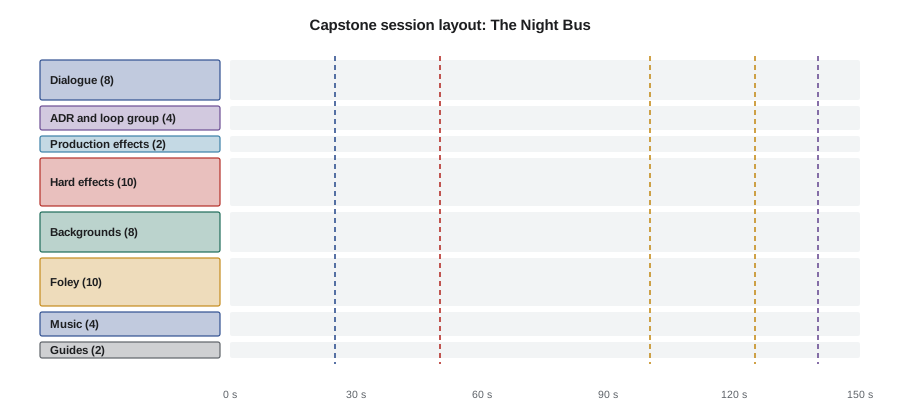
| Group | Tracks | Contents |
|---|---|---|
| Dialogue | 8 | Checkerboarded boom and lavalier clips, fill |
| ADR and loop group | 4 | Replacement lines, distant voices at the hospital entrance |
| Production effects | 2 | Usable bench creaks and bag sounds from production |
| Hard effects | 10 | Bus approach, brakes, doors, kneel hiss, pull-away, passing cars |
| Backgrounds | 8 | City night bed, distant highway, wind, snow ambience, hospital ventilation |
| Foley | 10 | Feet per character, cloth per character, props (bag, phone, gloves) |
| Music | 4 | Score stems: strings, piano, pads, low pulse |
| Reference and guides | 2 | Editor's guide track, temp music (muted) |
import numpy as np
fs, bits, seconds = 48000, 24, 150
tracks = 8 + 4 + 2 + 10 + 8 + 10 + 4
print(f'session: {tracks} tracks, about {fs * bits / 8 * tracks * seconds / 1e9:.2f} GB of audio at full length')
deliverables = {'printmaster 5.1': 6, 'printmaster stereo': 2, 'DME stems 5.1': 18, 'M and E 5.1': 6, 'M and E stereo': 2}
total = 0
for name, ch in deliverables.items():
    size = fs * bits / 8 * ch * seconds / 1e6
    total += size
    print(f'{name:18s} {ch:2d} channels {size:7.1f} MB')
print(f'total deliverables about {total:.0f} MB')
rng = np.random.default_rng(12)
d, m, e = (rng.standard_normal(fs) * a for a in (0.05, 0.03, 0.04))
printmaster = d + m + e
print('stems sum to printmaster:', np.allclose(d + m + e, printmaster), '| max error', float(np.max(np.abs(d + m + e - printmaster))))session: 46 tracks, about 0.99 GB of audio at full length printmaster 5.1 6 channels 129.6 MB printmaster stereo 2 channels 43.2 MB DME stems 5.1 18 channels 388.8 MB M and E 5.1 6 channels 129.6 MB M and E stereo 2 channels 43.2 MB total deliverables about 734 MB stems sum to printmaster: True | max error 0.0
Stage 3: spotting and the sound plan
Hold a spotting session with your director, real or role-played, and write spotting notes for each department. For this scene, the key moments are the opening isolation, the rising argument, the bus as interruption and decision, and the silence before the final line. Describe each by intention.
| Timecode | Moment | Intention and plan |
|---|---|---|
| 01:00:00:00 to 01:00:25:00 | Mara alone in the shelter | Isolation: thin city bed, wind, snow ticks on plexiglass, distant ventilation |
| 01:00:25:00 | Dev arrives | Footsteps in snow approach from off-screen left; slight tension in score pad |
| 01:00:50:00 to 01:01:40:00 | The argument | Pressure: backgrounds thin further as voices rise; low pulse enters |
| 01:01:40:00 | Bus arrives | Interruption: loud, physical, in surround; music drops out entirely |
| 01:01:55:00 | Doors open, Mara stays | Decision: door hiss and the driver's waiting idle; hold silence in music |
| 01:02:05:00 | Bus leaves | Release: long Doppler fade into wind; backgrounds return softer |
| 01:02:20:00 | Final line | Near-silence: dialogue anchored, only wind and snow; score returns after the line |
Stage 4: dialogue, ADR and loop group
Edit the dialogue: choose the boom where it is clean, switch to lavaliers when wind or traffic intrudes, checkerboard by character and angle, smooth backgrounds with fills from the exterior room tone, and remove scarf rustle and crew noise. Build an ADR list for any line you cannot repair. For this scene, plan two loop group elements: distant voices of hospital staff leaving work at the start, and a muffled bus announcement.
Worked problem
Deciding on the final whispered line
The final line was recorded close on the boom, but a car passes during the best take. A wild line recorded immediately after is clean but slightly less emotional. ADR is possible but the actor is on another production. What should you do?
Show solution
- Try spectral repair on the best take to reduce the car; check whether a word or two from the wild line can replace the most damaged words.
- If the repaired take holds up in the mix, keep it: the performance matters most for this line.
- If not, use the wild line, which matches the location and microphone, and add the original take's breath before it to keep continuity.
- Keep remote ADR as a last resort, with the original take as a reference for the actor.
Answer: Prefer the original performance with careful repair, then the wild line, then ADR. Document the decision and keep alternatives on muted tracks for the director.
Stage 5: effects, backgrounds and design
Cut hard effects for the bus from your wild recordings and libraries: a distant approach with Doppler, tire hiss on wet snow, air brakes, the hydraulic kneel, door open and close, an idle that the audience can feel in the low end, and the pull-away. Build backgrounds in layers: a city bed, wind that changes with the shot, snow touching the shelter, and a faint ventilation hum from the hospital. Use backgrounds to support the story: thin them as the argument rises and let them return softer after the bus leaves. Cover generously and organize layers so the mixer can control them.
Consider one designed element: a subtle low tone hidden in the wind during the argument that rises imperceptibly, then disappears when the bus arrives. Work with your composer, or with the music you are using, so that this element and the score do not compete.
Stage 6: Foley
Spot and record Foley in passes: footsteps for each character in snow (cornstarch in a pouch or real snow if available, plus gritty sidewalk at the shelter), cloth for heavy winter coats and scarves, and props such as Mara's bag strap, gloves, phone and a coffee cup. Remember that the music and effects version will need complete Foley, so cover every movement, including movements partly hidden by dialogue.
Stage 7: music
Decide where music begins and ends, and where silence is better. For this scene, a sparse score works well: a quiet pad that enters with Dev, a low pulse during the argument, nothing during the bus, and a simple piano phrase after the final line. If you use existing music, secure both the synchronization and master use licenses, or use a production music library with clear terms. Prepare a cue sheet listing every cue with titles, writers, publishers, affiliations, usage and duration.
If the film will be submitted to US festivals or distributors, provide the cue sheet to the composers' performing rights organizations, such as ASCAP or BMI, and keep licenses with the delivery documents.
Stage 8: mixing and delivery
Calibrate your room, then premix dialogue, effects, Foley and music. In the final mix, keep dialogue as the anchor, balance music and effects around it, and use the bus as the scene's dynamic peak. Pan dialogue to the center, place the bus moving across the front and into the surrounds if you are mixing in 5.1, and wrap backgrounds around the listener. Measure loudness against your chosen specification, for example −24 LKFS for a broadcast-style delivery or −27 LKFS dialogue-gated for a streaming-style specification, and keep true peaks within limits.
Print stems (dialogue, music, effects) and confirm that they sum to the printmaster, then create a music and effects version and check that it plays completely without gaps. Run quality control: listen in real time for clicks, dropouts and sync errors, check channel order and file naming, and keep the loudness report.
| Item | Check |
|---|---|
| Spotting notes | Written intentions and plans for each moment |
| Production sound plan or report | Microphone approach, wild sound and room tone documented |
| Dialogue session | Checkerboarded, filled, noise-free, ADR list included |
| Effects and backgrounds | Layered, organized, Doppler and perspective handled |
| Foley | Feet, cloth and props complete for M and E |
| Music | Cues placed, licenses or composer agreement, cue sheet |
| Mix | Calibrated room, dialogue anchor, loudness and true peak within spec |
| Stems and versions | DME stems sum to printmaster; M and E complete; stereo version |
| Reflection | Short written review of decisions and what you would change |
Assessment and reflection
Your capstone will be assessed on story service (does every sound support the scene's intentions?), dialogue clarity and consistency, technical quality (sync, noise, artifacts, loudness), organization and documentation, and professional judgment, such as choosing repair over ADR when appropriate and avoiding uncleared music. Write a short reflection explaining three decisions you made and why, one problem you solved, and one thing you would do differently on a real production.
Finally, play your mix for listeners who have not seen the scene. Ask them what they felt at the bus, whether they understood every line, and whether they noticed any sound at all. If they talk about the story and not the sound, your sound track is doing its job.
Careers in US film sound often begin as a sound utility or in post-production facilities in Los Angeles, New York, Atlanta or other production centers; union membership, where applicable, typically follows a roster or hours process with the relevant IATSE local.
Common mistakes
MistakeStarting the edit without confirming frame rate, sample rate and handles
InsteadConfirm specifications in writing and request a complete turnover.
MistakeFilling every second of the scene with music
InsteadUse silence and sparse music where the story needs space.
MistakeReplacing a key emotional line with ADR without trying repair or wild lines
InsteadPrefer the original performance, then wild lines, then ADR.
MistakeDelivering stems without checking that they sum to the mix
InsteadVerify stem summing and M and E completeness before delivery.
MistakeUsing a commercial song without both licenses
InsteadObtain sync and master licenses, or use original or library music with clear terms.
Summary and key terms
- The capstone follows the full professional workflow from script to delivery.
- Plan production sound around the scene's challenges and record wild sound and room tone.
- Request a complete turnover and build an organized session layout.
- Spot by intention and give every element a story job.
- Edit dialogue with repair first, wild lines second and ADR last.
- Build effects, backgrounds, Foley and music so the M and E is complete and the mix has control.
- Mix to a calibrated level and a delivery specification, then check stems, loudness and quality.
- Script breakdown
- A list of every sound element the script implies, with a plan for each.
- Delivery specification
- A distributor's document listing required formats, loudness and naming.
- Wild sound
- Effects recorded on set without picture, such as the real bus.
- Track layout
- The organized arrangement of tracks in a session by category.
- Spotting notes
- Written plans describing what each moment of the scene needs.
- Dynamic peak
- The loudest, most intense moment of a scene's sound track.
- Quality control (QC)
- Checks for technical errors and compliance before delivery.
- Loudness report
- A record of measured loudness and true peak for a deliverable.
- Printmaster
- The final full mix.
- Reflection
- A written review of creative and technical decisions after a project.
Practice problems
Work each problem on paper first, then reveal the answer to check.
Name three sound challenges in The Night Bus.
Show answer
Exterior night dialogue in wind and traffic, the bus, snow footsteps (also winter clothing, a whispered final line).
What should a turnover include?
Show answer
An AAF with handles, timecoded reference video, original files, reports and temp music list.
Why thin the backgrounds as the argument rises?
Show answer
To isolate the characters and build pressure.
What order of solutions applies to a damaged key line?
Show answer
Repair, then wild line, then ADR.
Why record the real bus as wild sound?
Show answer
It matches the picture exactly and gives effects editors authentic material.
Why must Foley cover movements hidden by dialogue?
Show answer
The M and E version removes dialogue and needs complete movement sound.
Which licenses does an existing commercial recording need?
Show answer
Synchronization and master use licenses.
Name a loudness target you could deliver to.
Show answer
−24 LKFS for broadcast or −27 LKFS dialogue-gated for some streaming specifications.
What must be true of the DME stems?
Show answer
They must sum exactly to the printmaster.
What is the best sign that a sound track works?
Show answer
Listeners talk about the story, not the sound.
Lesson quiz · 5 questions
Score 60% or more to complete this lesson.
Create a free account to save your progress, take quizzes and earn a certificate.