
FILM-310 · Lesson 4 of 12 · 27 min
Production sound on set
The production sound team has one overriding job: to capture clean, intelligible dialogue that matches the performance the director wants, take after take, without slowing the shoot. Everything else, from wild lines and room tone to sound effects of props and vehicles, is valuable but secondary. Dialogue recorded well on set preserves the actors' performances; dialogue that has to be replaced later in ADR costs money and often loses something that can never be recovered. This lesson covers how a sound team prepares, how the boom and lavaliers are used on a working set, how to manage noise and wireless frequencies, and how to work with the other departments.
The production sound team
On a feature or series, the production sound team usually has three people. The production sound mixer leads the department, chooses equipment, mixes and records, and communicates with the director and first assistant director. The boom operator stands closest to the action, places the boom for every shot and learns every line and move. The sound utility, also called the second assistant sound, fits lavaliers, runs a second boom when needed, manages cables, batteries, wireless and timecode, and keeps the sound cart running. On small productions one person may mix and boom at once, which is possible for interviews and simple scenes but difficult for dramatic scenes with movement.
Preparation: script, scout and meetings
Preparation starts with the script. The mixer reads it for sound challenges: scenes in cars, crowds, rain, music playback, loud effects, long walking shots, overlapping dialogue and quiet emotional moments. Each scene gets a plan: boom only, boom plus lavaliers, plant microphones, or a decision that ADR is likely and the production track will serve only as a guide.
Location scouts are where sound battles are won or lost. A beautiful location next to a highway, under a flight path, beside a hospital helipad or with a loud air handling system on the roof may be impossible for dialogue. The mixer listens at the time of day the scene will shoot, notes refrigerators, ice machines, ventilation, buzzing lights, traffic patterns and nearby businesses, and reports to the producers with options: shoot somewhere else, negotiate to switch off equipment, schedule around noise, or accept ADR. A short audio recording of each location's background helps the producers hear the problem.
Before the shoot, the mixer meets the director, the director of photography, the costume designer and the first assistant director. The director of photography's lighting and lens choices determine where the boom can go. Costume decisions determine where lavaliers can hide and how noisy fabrics will be: silk, taffeta, nylon jackets and stiff leather are notoriously noisy. The first assistant director controls the set and can enforce quiet.
The boom: craft and positioning
The boom microphone is the preferred dialogue source on most film sets because it records the voice with natural perspective: close shots sound close, wider shots sound slightly more distant, and the voice sits in the space the camera sees. The boom operator holds the microphone on a lightweight pole, usually above the actors, pointed at the mouth, just outside the top edge of the frame.
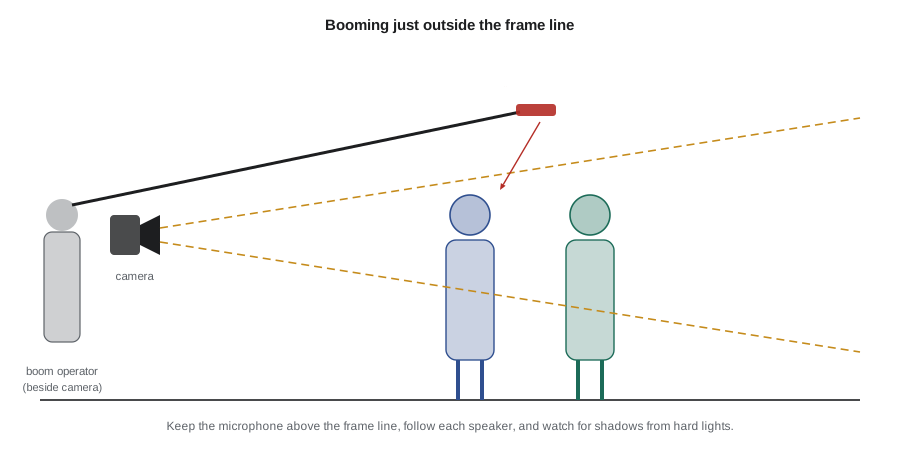
Good booming depends on knowing the frame. The operator asks the camera operator for the frame line on each set-up, often by placing the microphone in the frame during rehearsal and raising it until the operator says it is clear. Distance to the mouth is typically 30 to 90 cm depending on the shot size. The microphone must follow the speaking actor, swinging between characters as lines alternate, timed so that the microphone arrives just before each line begins. The operator memorizes the dialogue and the blocking, which is why the boom operator is often found at rehearsals reading the script.
Shadows are a constant battle. A boom under a hard light casts a shadow on the actors or the wall, and the director of photography will rightly object. Solutions include moving the boom to a different angle, booming from below, flagging the light, or adjusting the light itself. Cooperation with the camera and lighting departments, rather than conflict, makes the set work.
| Situation | Preferred approach | Why |
|---|---|---|
| Interior dialogue, controlled set | Boom with hypercardioid | Natural perspective, good rejection of reflections |
| Exterior dialogue | Boom with shotgun, plus lavaliers if wind or traffic | Reach and rejection; lavaliers protect against wind |
| Wide shots with no boom access | Lavaliers or plant microphones | Boom cannot get close without entering the frame |
| Moving vehicles | Plant microphones and lavaliers | No boom access, high noise |
| Large overlapping group scenes | Multiple lavaliers plus boom | Each actor on an isolated track for editing |
| Loud action and effects | Boom plus separate effects recording | Dialogue may need ADR; capture effects as wild sound |
Lavaliers on set
Lavaliers rescue wide shots and noisy scenes, but they bring problems. Clothing rustle is the most common: fabric rubbing on the capsule or cable produces scraping noises that are almost impossible to remove. Utility technicians fight rustle with careful placement, tape, adhesive pads, foam or fur covers, and by building small air pockets around the capsule. Placement varies with costume: the center of the chest under a shirt, the knot of a tie, the hairline under a hat or wig for period costumes, or a collar. Each placement changes the tone, and the dialogue editor will need to match lavalier and boom sound later.
Fitting lavaliers is personal. The utility explains what they are doing, asks permission, and offers the actor the option to place the microphone themselves under guidance. Productions increasingly have protocols for respectful fitting, such as having a costume team member present and checking that the performer is comfortable. Treat this as part of the job, not an afterthought.
Mixers usually record every lavalier and boom on separate isolated tracks, known as isos, alongside a mix track. The mix track is for the picture editor; the isos are for the dialogue editor, who will choose the best microphone for each line.
Controlling noise on set
Background noise that changes between takes is the dialogue editor's worst enemy. If one take has an air conditioner running and the next does not, the background will jump at every cut. Production sound teams therefore aim for consistent, low backgrounds: switching off refrigerators (with a key or a note left in the fridge so it is turned back on), ventilation and noisy lights; asking for quiet from crew; placing the generator far away, behind buildings or behind sound barriers; and using carpets or padding on noisy floors when feet are out of frame.
Some noises cannot be controlled, such as distant traffic or aircraft. The mixer's job then is to keep the noise consistent and to flag takes where intermittent noises, such as a passing truck, overlap important lines. Calling "hold for sound" or asking to go again for an aircraft is part of the job, but the mixer must balance sound quality against the schedule and the performance. A director may decide that a great performance is worth keeping with noise and replacing words in ADR.
Room tone, wild lines and wild sound
Room tone is a recording of the location's ambient sound with everyone on set silent and in place, usually 30 to 60 seconds after the scene is shot and before anyone moves equipment. Dialogue editors use room tone to fill the gaps created when they remove noises or tighten lines. Without it, they must hunt for tiny gaps between words, which is slow and often unsuccessful.
Wild lines are lines of dialogue recorded without picture, usually immediately after a take, with the actor still in character and in the same space. They can replace a line ruined by noise without going to ADR, because the voice is recorded in the same place with the same microphone. Wild sound refers to sound effects recorded on set without picture: the specific door of the location, the car used in the scene, a period telephone ringing. These are valuable to effects editors because they match the picture exactly.
Wireless frequencies and the law
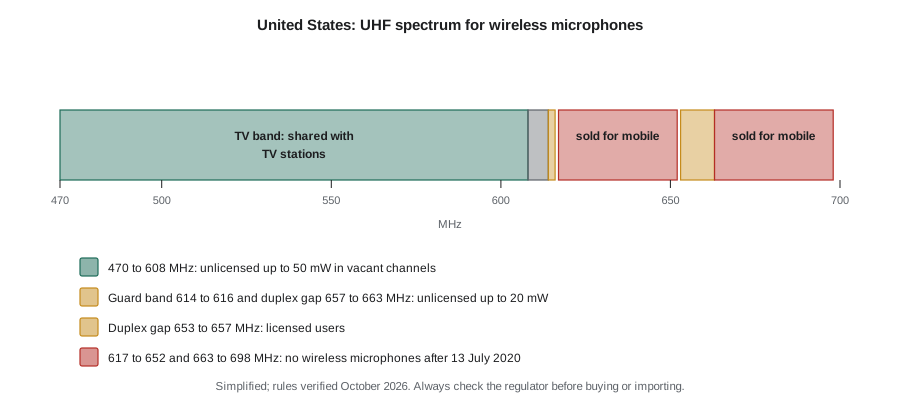
Wireless microphones, in-ear monitors and intercoms all compete for radio spectrum. Since the 600 MHz band was sold to mobile carriers in both countries, the space available to wireless microphones in the UHF television band has shrunk, and sets in cities may struggle to find clean channels. Mixers scan for clear frequencies, coordinate with other departments using radios and video links, and keep a written frequency plan.
In the United States, the Federal Communications Commission (FCC) regulates wireless microphones. Unlicensed operation at up to 50 mW is permitted in vacant television channels below 608 MHz, and at up to 20 mW in the 614 to 616 MHz guard band and the 657 to 663 MHz part of the duplex gap. The 653 to 657 MHz part of the duplex gap, portions of the 900 MHz band, 1435 to 1525 MHz and 6875 to 7125 MHz are available to licensed users. Wireless microphones had to stop operating in the 600 MHz service band (617 to 652 and 663 to 698 MHz) by 13 July 2020. Part 74 licenses are available to broadcasters, cable operators and to venues and professional sound companies that routinely use 50 or more wireless microphones. Check the FCC's current rules before buying used equipment (rules verified October 2026).
In both countries, interference between your own transmitters is as big a problem as outside signals. When two transmitters operate at once, their frequencies combine inside receivers to create intermodulation products at predictable frequencies, such as \( 2f_1 - f_2 \). Frequency coordination software and manufacturers' compatible channel groups avoid placing a transmitter on one of these products.
Worked problem
Checking a pair of frequencies for intermodulation
A mixer plans transmitters at 520.000 MHz and 522.500 MHz and wants to add a third at 517.500 MHz. Is the third frequency safe?
Show solution
- Third-order products of the first two: \( 2 \times 520.000 - 522.500 = 517.500 \) MHz and \( 2 \times 522.500 - 520.000 = 525.000 \) MHz.
- The proposed 517.500 MHz falls exactly on a third-order product.
- Choose another frequency, for example 516.100 MHz, and recheck all combinations of the three.
Answer: The third transmitter would suffer interference whenever the first two are on. Using coordinated groups or software avoids this trap, especially with eight or more channels.
Storage, file sizes and redundancy
Production sound files are large but manageable. Uncompressed audio size depends only on sample rate, bit depth, number of tracks and duration. A day of polyphonic broadcast WAV files, which store several isolated tracks in one file per take, can be estimated before the shoot to choose card sizes and plan backups.
fs = 48000            # samples per second
bits = 24
tracks = 8            # mix L and R plus boom and five lavalier isos
rolling_hours = 3.5   # time actually recording during a 12-hour day
bytes_per_s = fs * bits / 8 * tracks
gb = bytes_per_s * rolling_hours * 3600 / 1e9
print(f'{bytes_per_s / 1e6:.2f} MB per second, about {gb:.1f} GB per day')
for b, name in [(32, '32-bit float')]:
print(f'{name}: about {fs * b / 8 * tracks * rolling_hours * 3600 / 1e9:.1f} GB per day')1.15 MB per second, about 14.5 GB per day 32-bit float: about 19.4 GB per day
Recorders write to two cards at once. At the end of the day, files are copied to drives for editorial, and the mixer keeps the cards or a backup until editorial confirms the files are safe. A sound report, either on paper or exported from the recorder, lists every take with scene, take, track names, timecode, and notes such as "aircraft on line 4" or "wild line recorded after take 6".
Working with the set
Production sound succeeds through relationships. The mixer works with the first assistant director to get rehearsals, quiet and time for room tone; with the camera team on frame lines and timecode; with the lighting team on boom shadows and noisy fixtures; with costume on lavalier placement and fabrics; with props on quiet versions of noisy objects, such as rubber cutlery or foam-backed plates; and with special effects on rain, wind and explosions. Clear, early communication avoids surprises, and offering solutions instead of complaints earns the cooperation the sound team needs.
Common set phrases include "roll sound", "speed" (the recorder is running), "mark it" (the slate is called), "hold for sound" and "room tone, everybody please". On many sets the first assistant director calls for room tone, and the whole crew stops to record it.
Production sound crews on US sets also follow OSHA rules and industry safety bulletins, such as those published by the Industry-Wide Labor-Management Safety Committee, for noise, electrical safety, water and heights (see HSE courses).
Common mistakes
MistakeRecording with background noise that changes between takes
InsteadKeep backgrounds low and consistent; switch off intermittent noise sources.
MistakeBooming without checking the frame line on each set-up
InsteadAsk the camera operator for the frame line and rehearse the moves.
MistakeRelying on lavaliers only and skipping the boom
InsteadUse the boom for natural perspective and lavaliers as isolated backup.
MistakeForgetting room tone before the crew moves
InsteadCall for 30 to 60 seconds of room tone at every set-up.
MistakeChoosing wireless frequencies by trial and error
InsteadScan, coordinate, check intermodulation and follow the regulator's rules.
Summary and key terms
- Production sound's main job is clean, consistent dialogue that preserves the performance.
- Scout locations at shooting time and report noise problems with options.
- The boom gives natural perspective and should sit just outside the frame, aimed at the mouth.
- Lavaliers rescue wide and noisy shots but need careful, respectful fitting to avoid rustle.
- Record isolated tracks plus a mix track, and capture room tone, wild lines and wild sound.
- Wireless microphones must follow ISED or FCC rules and avoid intermodulation products.
- Plan storage from sample rate, bit depth, tracks and rolling time, record to two cards and keep sound reports.
- Production sound mixer
- The head of the production sound team, who records and mixes on set.
- Boom operator
- The crew member who places the boom microphone for each shot.
- Sound utility
- The assistant who fits lavaliers, manages wireless and runs a second boom.
- Frame line
- The edge of the camera's frame that the boom must stay outside.
- Iso track
- An isolated recording of a single microphone.
- Wild line
- A line of dialogue recorded without picture on set.
- Wild sound
- Sound effects recorded on set without picture.
- Plant microphone
- A microphone hidden in the set to cover dialogue the boom cannot reach.
- Intermodulation
- Interference created when transmitter frequencies combine inside receivers.
- Sound report
- A log of every take with scene, take, tracks, timecode and notes.
Practice problems
Work each problem on paper first, then reveal the answer to check.
What is the production sound team's main job?
Show answer
To record clean, consistent dialogue that preserves the performance.
Why scout locations at the time of day the scene will shoot?
Show answer
Noise from traffic, businesses and equipment changes during the day.
Typical boom distance from the mouth?
Show answer
About 30 to 90 cm depending on shot size.
Name two noisy costume fabrics for lavaliers.
Show answer
Silk, taffeta, nylon or stiff leather (any two).
Why record isos as well as a mix track?
Show answer
The dialogue editor needs each microphone separately to choose the best one per line.
What is a wild line?
Show answer
A line recorded without picture on set to replace a noisy line.
Which third-order intermodulation products do two transmitters at f1 and f2 create?
Show answer
2f1 minus f2 and 2f2 minus f1.
Estimate the data rate of eight tracks of 48 kHz, 24-bit audio.
Show answer
About 1.15 MB per second.
Why leave a note in a fridge that has been switched off?
Show answer
So it is turned back on before food spoils.
Who on set usually calls for room tone?
Show answer
The first assistant director, at the mixer's request.
Lesson quiz · 5 questions
Score 60% or more to complete this lesson.
Create a free account to save your progress, take quizzes and earn a certificate.