
FILM-310 · Lesson 11 of 12 · 26 min
Mixing and re-recording
Re-recording is the stage where every element of the sound track, dialogue, ADR, loop group, effects, backgrounds, Foley and music, comes together and is balanced into the final mix. The name comes from the early sound era, when separate recordings were played back and re-recorded together onto a new film track. Today the re-recording mixer works on a large digital console in a calibrated mix stage, but the job is the same: to make the audience hear the story, scene by scene, with every element in its right place. This lesson covers mix stages and calibration, the premix and final mix, panning and immersive formats, loudness and dynamic range, and the stems and versions that make up the deliverables. CINE-430 lesson 7 covered streaming audio specifications from the delivery side; here we work from inside the mix room.
The mix stage and its team
A feature mix stage is a room built like a small cinema, with a screen, theatrical loudspeakers behind the screen and around the room, and a mixing console placed where the audience's best seats would be. On larger films two or three re-recording mixers work side by side: one on dialogue and music, another on effects and Foley, with the supervising sound editor, the director and often the picture editor and composer present. Smaller productions mix in near-field rooms: smaller studios with loudspeakers closer to the mixer, suitable for television, streaming and independent features.
The mix process usually runs in two phases. In the premix, also called predubs, each element is prepared on its own: dialogue is cleaned, equalized and leveled; effects and Foley are balanced; music is placed. In the final mix, all premixed elements play together and are balanced against each other scene by scene, with the director giving notes. Final mixes are followed by playbacks, fixes, and the creation of stems and versions.
Calibration: hearing at a known level
A mix is only as good as the room it is made in. If the loudspeakers are too loud, the mixer will make the mix too quiet; if the room exaggerates bass, the mixer will cut too much. Mix rooms are therefore calibrated: each loudspeaker is set so that a reference pink noise signal, a random signal with equal energy per octave, at −20 dBFS produces a specified sound pressure level at the mixing position.
The traditional cinema standard is 85 dB SPL, C-weighted with a slow meter, per screen channel for pink noise at −20 dBFS, with surround channels set slightly lower in some systems so that the total matches. Because loudness perception depends on room size, smaller rooms are commonly calibrated lower so that mixes translate: about 82 dB for mid-sized rooms and about 79 dB for small near-field television and streaming rooms are widely used figures, and some streamers recommend specific levels in their mix specifications. Whatever the level, the key is consistency: mixers listen at the calibrated level so their judgments of loudness and balance match the intended playback environment.
Worked problem
Checking a calibration
A near-field room is calibrated so pink noise at −20 dBFS reads 79 dB SPL (C-weighted) at the mixing position from the center speaker. What level would a full-scale tone produce from that speaker, ignoring speaker and amplifier limits?
Show solution
- Full scale is 20 dB above −20 dBFS.
- \( 79 + 20 = 99 \) dB SPL.
- In a cinema calibrated at 85 dB, the same full-scale signal would reach \( 85 + 20 = 105 \) dB SPL per screen channel.
Answer: About 99 dB SPL in the near-field room and 105 dB SPL in a cinema. This is why the same mix sounds louder in a cinema and why theatrical mixes are often too dynamic for home viewing without adjustment.
Balancing dialogue, music and effects
The core skill of mixing is balance. Dialogue is almost always the priority: if the audience cannot follow what is being said, nothing else matters. Mixers use equalization to give dialogue clarity, compression to keep it consistent, and automation to ride levels line by line. Music and effects are then balanced around dialogue, often dipping under lines and rising in gaps. The balance also tells the story: in a chase scene effects may lead with music supporting; in an emotional reunion music may lead while effects drop away almost entirely.
| Tool | Purpose in the film mix | Watch for |
|---|---|---|
| Equalization | Clarity, matching tones, reducing masking | Over-brightening, thin dialogue |
| Compression | Consistent dialogue level, controlled dynamics | Pumping, loss of natural dynamics |
| Limiting | Preventing peaks above limits | Audible squashing |
| Reverberation | Placing ADR and effects in the scene's space | Washy dialogue, too much room |
| Noise reduction | Cleaning backgrounds in context | Artifacts |
| Panning and spatial tools | Placing sounds in the stereo or surround field | Dialogue moving off the screen distractingly |
| Automation | Changing levels and settings over time | Unnatural rides, missed transitions |
Film mixers develop a sense of scene-by-scene level, sometimes called the reference level or anchor. Normal conversational dialogue usually sits at a consistent perceived level across the film, so audiences do not have to adjust their volume. Louder moments such as explosions and climaxes rise above this anchor for impact, and quiet moments fall below it, but the dialogue anchor keeps the film coherent.
Panning, surround and immersive formats
Film sound has used multichannel formats since the 1940s. A stereo mix has left and right channels. A 5.1 mix adds a center channel, left and right surround channels and a low-frequency effects channel (the ".1") for deep bass, played through a subwoofer. A 7.1 mix splits the surrounds into side and rear pairs. Immersive formats such as Dolby Atmos add overhead loudspeakers and treat individual sounds as objects with positions in three-dimensional space, which the playback system renders to whatever loudspeakers are available, from a large cinema with dozens of speakers to a home system or headphones with binaural rendering.
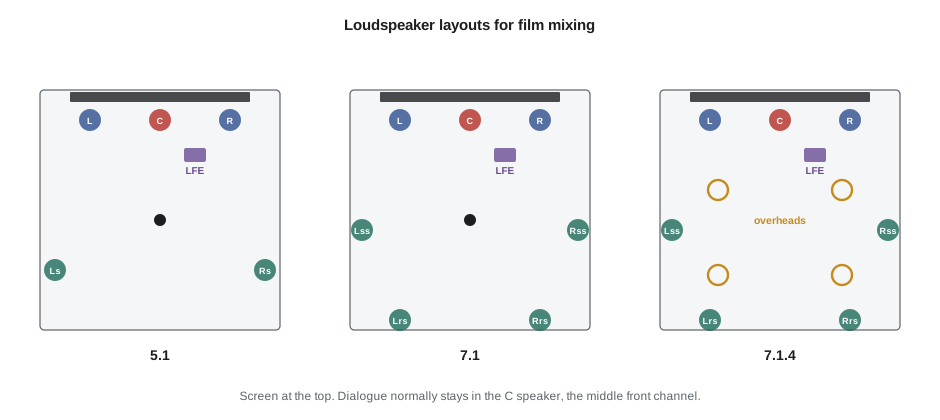
Conventions guide placement. Dialogue is anchored in the center channel so it stays locked to the screen for every seat in the cinema. Music usually spreads across left, center and right with some reverberation in the surrounds. Effects follow the action on screen and move into the surrounds for off-screen sounds and fly-bys. Backgrounds wrap around the audience. Moving dialogue to follow characters across the screen is used sparingly, because it can distract or sound unnatural for viewers sitting off-center.
| Format | Channels | Notes |
|---|---|---|
| Stereo (2.0) | 2 | Left and right; required for many streaming and broadcast versions |
| 5.1 | 6 | L, C, R, Ls, Rs, LFE |
| 7.1 | 8 | Adds separate side and rear surrounds |
| 7.1.4 (immersive bed) | 12 | Adds four overhead channels; objects rendered on top |
| Dolby Atmos cinema | Up to 128 tracks (bed plus objects) | Rendered to up to 64 loudspeaker feeds in cinemas |
Loudness and dynamic range
Loudness standards were introduced because audiences complained about sudden jumps in volume, especially between programs and advertisements on television. Loudness is measured with algorithms defined in ITU-R BS.1770, which apply a frequency weighting (K-weighting) that roughly matches hearing, measure the energy in short blocks, discard very quiet blocks with gates, and average the rest. The result is expressed in LUFS (loudness units relative to full scale) or the equivalent LKFS. True peak measurement estimates the highest level between digital samples, which matters because peaks between samples can distort after conversion or encoding.
| Context | Target | Measurement |
|---|---|---|
| North American broadcast | −24 LKFS ± 2 LU | Whole program, ATSC A/85 |
| European broadcast | −23 LUFS | Whole program, EBU R 128 |
| Netflix and some other streamers | −27 LKFS ± 2 LU | Dialogue-gated measurement; true peak no higher than −2 dBTP |
| Theatrical feature | No integrated target | Calibrated playback; dialogue anchor and peak limits by format |
In the United States, the Commercial Advertisement Loudness Mitigation (CALM) Act, passed in 2010 and implemented by FCC rules that took effect in December 2012, requires broadcasters and pay-TV operators to keep commercials at the same average loudness as programming by following ATSC A/85. Networks and streamers specify program loudness in their technical delivery requirements, usually −24 LKFS for broadcast (checked October 2026).
import numpy as np
rng = np.random.default_rng(1770)
fs = 4800                                   # low rate keeps this demonstration fast
def section(seconds, rms):
    return rms * rng.standard_normal(int(seconds * fs))
scene = np.concatenate([section(20, 0.02), section(5, 0.0003), section(15, 0.10), section(20, 0.025)])
block, hop = int(0.4 * fs), int(0.1 * fs)   # 400 ms blocks, 75% overlap
ms = np.array([np.mean(scene[i:i + block] ** 2) for i in range(0, len(scene) - block, hop)])
lk = -0.691 + 10 * np.log10(ms)             # unweighted stand-in for BS.1770 block loudness
abs_gated = ms[lk > -70]
rel_threshold = -0.691 + 10 * np.log10(abs_gated.mean()) - 10
final = ms[lk > max(-70, rel_threshold)]
integrated = -0.691 + 10 * np.log10(final.mean())
print(f'blocks {len(ms)}, kept after gating {len(final)}')
print(f'integrated loudness about {integrated:.1f} LUFS (unweighted illustration)')
print(f'gain to reach -24: {-24 - integrated:+.1f} dB; to reach -27: {-27 - integrated:+.1f} dB')blocks 596, kept after gating 546 integrated loudness about -25.8 LUFS (unweighted illustration) gain to reach -24: +1.8 dB; to reach -27: -1.2 dB
The code illustrates the gating idea: quiet passages below the relative gate do not drag the measurement down, so the integrated figure reflects the parts of the program that carry content. Real meters apply K-weighting first and measure all channels with specific weightings, so always use a compliant meter for delivery. Dialogue-gated measurement, used by Netflix, goes further and measures only the portions where dialogue is detected, anchoring loudness to speech rather than to explosions or music.
Dynamic range, the difference between quiet and loud moments, is a creative choice constrained by delivery. A theatrical mix can have very wide dynamics because the cinema is quiet and calibrated. The same mix played on a television in a noisy living room may have whispered dialogue that cannot be heard and explosions that wake the whole household. Near-field mixes for home viewing therefore usually have narrower dynamic range, and distributors often require separate home or broadcast versions with controlled dynamics.
Stems, the printmaster and versions
A stem is a sub-mix of one category of sound in the final mix format. The standard set is dialogue, music and effects, often abbreviated DME, each in the full channel format, such as 5.1 or 7.1. When the three stems are played together at unity gain, they must sum exactly to the full mix, called the printmaster. Stems let distributors create versions without returning to the mix stage: replacing dialogue for foreign-language versions, replacing music for territories where a song is not licensed, or creating trailers.
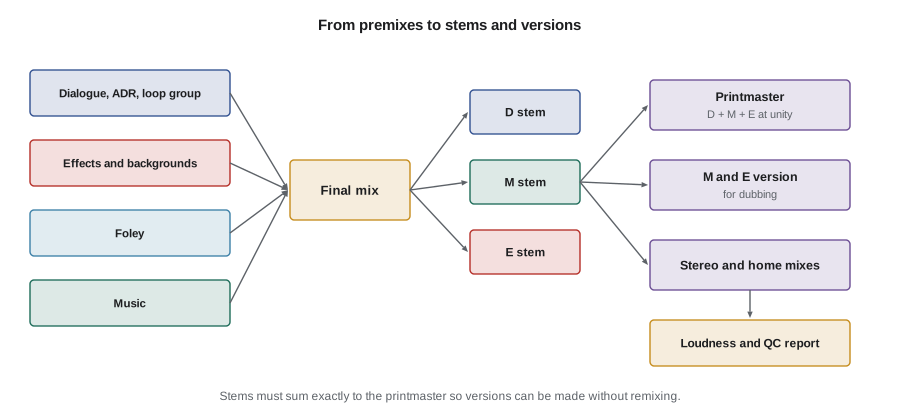
The music and effects version, M and E, contains everything except the original dialogue, with any sounds that were only in the dialogue tracks, such as production Foley or effects, filled in so the version is complete. Other common deliverables include a stereo fold-down or a separately mixed stereo version, a near-field home version for streaming, versions with alternative lines for broadcast standards, and separate dialogue stems for audio description and accessibility. Each distributor publishes a specification that lists formats, loudness targets, track layouts, file types and naming conventions.
| Deliverable | Format | Purpose |
|---|---|---|
| Printmaster | 5.1 or 7.1, plus stereo | The main mix for exhibition and distribution |
| DME stems | Same channel format as printmaster | Versioning, trailers and repairs |
| Music and effects (M and E) | 5.1 and stereo | Foreign-language dubbing |
| Dialogue-only stem | Mono or 5.1 | Dubbing reference, subtitling, accessibility |
| Loudness reports | Measurement logs | Proof of compliance with the specification |
| Immersive master (if required) | Atmos ADM BWF or IMF | Premium streaming and cinema |
Quality control and final playback
Before delivery, the mix is checked in quality control (QC): listening for clicks, dropouts, sync errors, missing elements and distortion, checking that stems sum correctly, measuring loudness and true peak, and confirming that file names, channel orders and metadata follow the specification. Many facilities run automated QC software and then a full real-time listen. A final playback with the director, sometimes in a cinema and on a home system, confirms the mix translates. Errors caught here are cheap; errors caught by the distributor's QC can delay release and incur fees.
Common mistakes
MistakeMixing at an uncalibrated, variable listening level
InsteadCalibrate with pink noise and mix at a consistent level suited to the room.
MistakeLetting music and effects mask dialogue
InsteadKeep dialogue as the anchor; carve space with equalization and level.
MistakePanning dialogue around the room to follow characters
InsteadAnchor dialogue in the center channel and use movement sparingly.
MistakeDelivering stems that do not sum to the printmaster
InsteadCheck that DME stems at unity gain recreate the full mix exactly.
MistakeUsing a theatrical mix unchanged for home streaming
InsteadCreate a near-field version with controlled dynamics and the specified loudness.
Summary and key terms
- Re-recording balances all sound elements into the final mix, after premixes of each element.
- Rooms are calibrated with pink noise at −20 dBFS, traditionally 85 dB SPL in cinemas and lower in smaller rooms.
- Dialogue is the anchor; music and effects are balanced around it scene by scene.
- 5.1, 7.1 and immersive formats add channels; dialogue usually stays in the center.
- Loudness is measured in LUFS or LKFS with gating; broadcast targets are −24 or −23, Netflix −27 dialogue-gated.
- Stems for dialogue, music and effects must sum to the printmaster; the M and E supports dubbing.
- Quality control checks sync, artifacts, loudness, true peak and specification compliance.
- Re-recording
- Combining all sound elements into the final mix.
- Premix
- Preparing each sound element on its own before the final mix, also called a predub.
- Calibration
- Setting monitor levels so a reference signal produces a specified sound pressure level.
- Pink noise
- A random signal with equal energy per octave, used for calibration.
- LFE
- Low-frequency effects channel, the .1 in 5.1, played through a subwoofer.
- Object-based audio
- Sounds stored with positions in space and rendered to the available loudspeakers.
- LUFS
- Loudness units relative to full scale, the measure of program loudness (also LKFS).
- True peak
- An estimate of the highest level between digital samples.
- Stem
- A sub-mix of one category of sound, such as dialogue, music or effects.
- Printmaster
- The final full mix from which versions and deliverables are made.
Practice problems
Work each problem on paper first, then reveal the answer to check.
What happens in a premix?
Show answer
Each element is prepared and balanced on its own before the final mix.
What is the traditional cinema calibration level?
Show answer
85 dB SPL, C-weighted, for pink noise at −20 dBFS per screen channel.
Why are small rooms calibrated lower?
Show answer
So mixes made in them translate to the intended playback environment.
Why is dialogue anchored in the center channel?
Show answer
So it stays locked to the screen for every seat.
How many channels in a 5.1 mix?
Show answer
Six.
What does gating do in a loudness measurement?
Show answer
Excludes very quiet blocks so they do not lower the integrated loudness.
What is the North American broadcast loudness target?
Show answer
−24 LKFS.
What does DME stand for?
Show answer
Dialogue, music and effects stems.
What must stems do when played together at unity gain?
Show answer
Sum exactly to the printmaster.
Name two checks in audio quality control.
Show answer
Sync and loudness (also clicks, dropouts, true peak, stem summing, naming).
Lesson quiz · 5 questions
Score 60% or more to complete this lesson.
Create a free account to save your progress, take quizzes and earn a certificate.