
FILM-210 · Lesson 6 of 12 · 31 min
Writing scenes
The scene is the basic building block of a screenplay. A scene is action that takes place in one location over continuous time. When the location or time changes, a new scene begins. Scenes are where structure becomes experience: the beats on your outline turn into people in rooms wanting things from each other. This lesson covers the anatomy of a scene, how to give each scene a goal, conflict and turn, how to enter late and leave early, how subtext works, and how to judge whether a scene earns its place.
What a scene must do
Every scene should change something. At its start, the characters are in one situation; at its end, the situation has shifted, even slightly. The change can be in plot (new information, a decision, an event), in relationships (trust gained or lost) or in emotion (hope turning to fear). Scenes that change nothing are usually cut in the edit, so experienced writers cut them on the page first.
- Advance the plot: the story must be further along when the scene ends.
- Reveal character: we learn something new about someone through action or choice.
- Raise or change the stakes: the cost of failure grows or shifts.
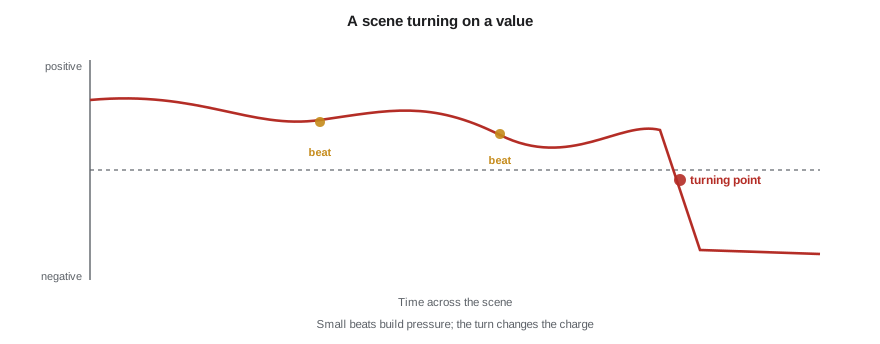
- Change a value: the emotional charge moves, for example from safe to threatened, trust to doubt, hope to despair.
The story consultant Robert McKee describes this last idea in terms of values: each scene turns a value from positive to negative or the reverse. A scene that begins with a couple happy and ends with them still happy has not turned. A scene that begins with them happy and ends with one discovering the other's lie has turned sharply.
Goal, conflict and turn
A reliable way to build a scene is to ask three questions. What does the point-of-view character want in this scene? What stands in the way? How does it turn out? The scene goal should be specific and immediate: to get a signature, to avoid a question, to borrow a car, to get someone to leave. The obstacle might be another character with an opposing goal, an internal fear, or the environment.
The outcome is often best when it is not a simple yes or no. Writers sometimes describe four possible outcomes: "yes," "no," "yes, but," and "no, and furthermore." "Yes, but" (she gets the signature, but her boss now suspects her) and "no, and furthermore" (she fails, and the client now refuses to deal with her company) push the story forward more strongly than a clean success or failure.
Worked problem
Building a scene from a goal
Plan a two-page scene in which Nadia, the debate student from lesson 2, asks her father to reschedule his citizenship interview. Give the goal, obstacle, beats and outcome.
Show solution
- Goal: get her father to agree to ask for a new interview date.
- Obstacle: he believes rescheduling will look suspicious and has waited three years for the date.
- Beats: she brings him tea and avoids the topic; she mentions the debate casually; he praises her and says he wishes he could attend; she asks; he refuses gently; she pushes; he reveals his fear of being sent back.
- Outcome: "no, and furthermore": he refuses, and she now understands the stakes for him, which makes her dilemma harder.
Answer: The scene has a clear goal, a sympathetic obstacle and a turn that deepens the conflict rather than solving it. Her external want is blocked, and her internal need, to speak up for herself without abandoning her family, becomes sharper.
Enter late, leave early
The screenwriter William Goldman is often credited with popularizing the advice to enter a scene as late as possible and leave as early as possible. Real conversations begin with greetings and small talk and end with goodbyes. Films usually skip both. Enter when the conflict is already under way; leave as soon as the scene has turned. The audience fills in the rest.
Worked problem
Trimming a scene's entry and exit
A draft scene is 3 pages: the first page shows a character arriving at an office, greeting a receptionist and waiting; the middle page holds the confrontation with her boss; the last half page shows her leaving, saying goodbye and walking to her car. What could be cut, and what does it save?
Show solution
- Entry: the arrival and greeting take about 1 page; the confrontation can start with her already in the boss's office.
- Exit: the goodbye and the walk take about half a page; the scene can end on the boss's final line or her reaction.
- Remaining: about 1.5 pages, or 50 % of the original.
- Screen time saved: about 1.5 minutes using the page-a-minute rule.
Answer: Cutting the entry and exit saves about 1.5 pages and keeps the scene's turn. Over a feature with many scenes, this habit can save 10 to 20 pages and transform the pace.
Subtext
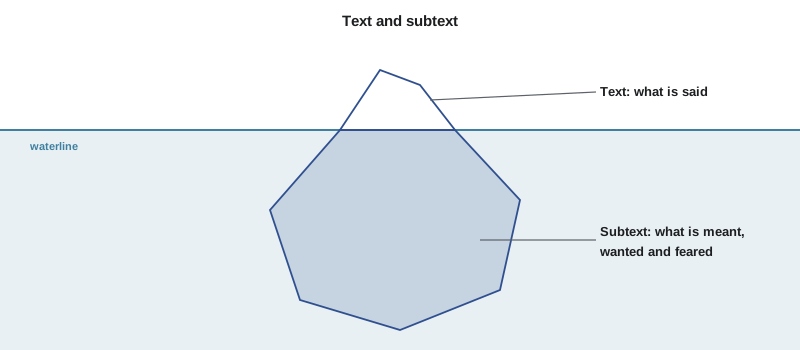
Subtext is the meaning beneath the surface of a scene: what characters really want, feel or mean but do not say directly. People rarely state their feelings outright, especially in conflict. They talk about the dishes when they are angry about the marriage. Scenes with strong subtext feel truthful and engage the audience, who enjoy working out what is really going on.
Writers create subtext by giving characters reasons not to say what they mean: fear, pride, politeness, power differences or self-deception. They also use objects and actions to carry meaning. A character who keeps straightening a photo while another talks about moving out is telling us something no dialogue needs to state.
| Line | What is said | What is meant |
|---|---|---|
| "You've had the car serviced." | An observation | "You're getting ready to leave me." |
| "It was making a noise." | A practical reason | "Yes, and I don't want to talk about it." |
| "Long drive to your sister's." | Small talk | "I know where you're going." |
Point of view and information
Every scene has a point of view, usually the character whose goal we follow. Choosing that character shapes how the audience experiences the scene. Information also matters. Alfred Hitchcock famously distinguished surprise from suspense: if a bomb under a table explodes without warning, the audience gets a few seconds of surprise; if the audience knows the bomb is there and the characters do not, every ordinary line of dialogue becomes unbearably tense. Writers manage what the audience knows compared with the characters.
- Dramatic irony: the audience knows more than the characters, creating suspense or comedy.
- Mystery: the characters know more than the audience, creating curiosity.
- Shared discovery: audience and characters learn together, creating surprise.
Scene length and rhythm
Scenes in modern features are often short, typically one to three pages, with longer scenes reserved for key confrontations. Varying scene length creates rhythm: a run of short scenes feels fast, while a long scene slows the film and focuses attention. A script with every scene the same length feels monotonous.
Worked problem
Average scene length
A 102-page feature script has 68 scenes. What is the average scene length in pages and approximate minutes? If a short of 11 pages has 9 scenes, how does it compare?
Show solution
- Feature: \( 102 \div 68 = 1.5 \) pages per scene, about 1.5 minutes.
- Short: \( 11 \div 9 \approx 1.2 \) pages per scene, about 1.2 minutes.
- Both averages hide variety; some scenes are an eighth of a page, others four pages.
Answer: About 1.5 pages per scene in the feature and 1.2 in the short. Averages are useful for comparing drafts, but rhythm comes from varying length, not from making every scene the same.
Scene transitions and connections
How scenes connect matters as much as what happens in them. A strong cut juxtaposes two scenes so that the second comments on or contrasts with the first. Writers can link scenes through sound, image, dialogue or action: a question at the end of one scene answered by the first image of the next; a door slamming in one scene and a gavel striking in the next. These links make the film feel designed, and they can carry meaning without words. You will learn how to signal such connections without overusing transitions in lesson 8.
- Contrast cuts: a lavish dinner followed by an empty fridge.
- Question and answer: "Who would do this?" followed by a shot of the culprit.
- Sound bridges: a sound from the next scene begins before the cut.
- Match cuts: a similar shape or movement links two places or times.
Testing your scenes
Before moving on, test each scene in your outline or draft with a short checklist.
- Whose scene is it, and what do they want?
- What is the obstacle, and is there real conflict?
- What value turns between the beginning and the end?
- Could the scene start later or end earlier?
- Is there subtext, or does everyone say exactly what they mean?
- If the scene were cut, would the story still make sense? If yes, cut or merge it.
Studio and network executives in the United States often request a beat outline or scene breakdown at each development step, and writers are paid in stages for outlines and drafts under guild agreements.
Scenes of reaction and transition
Not every scene is a confrontation. Films also need quieter moments where characters, and the audience, absorb what has happened: a character sitting in a car after bad news, a walk home after a fight. These reaction scenes, sometimes called sequel scenes, let emotion land and set up the next decision. They are usually short, often visual and sometimes wordless. A reaction scene still changes something, even if only a decision forming. A useful pattern is action, reaction, decision: a confrontation turns the situation, a brief reaction scene shows its impact, and the character decides what to do next, which launches the following action.
Worked problem
Pacing action and reaction
A 12-page short has four confrontation scenes of about 2 pages each and wants a brief reaction beat after each of the first three. If each reaction beat is about a third of a page, how many pages remain for the opening and the ending?
Show solution
- Confrontations: \( 4 \times 2 = 8 \) pages.
- Reactions: \( 3 \times \tfrac{1}{3} = 1 \) page.
- Remaining: \( 12 - 8 - 1 = 3 \) pages for the opening and the final image.
Answer: Three pages remain. Short reaction beats cost little screen time but give the audience room to feel each turn before the story pushes on.
Checking a scene in revision
When you revise a scene, ask four quick questions. Whose scene is it? What do they want? What stands in the way? What is different when it ends? If you cannot answer all four in a sentence each, the scene probably needs work, or it may belong inside another scene.
Common mistakes
MistakeScenes in which nothing changes
InsteadMake every scene turn a value, reveal character or advance the plot
MistakeStarting with greetings and ending with goodbyes
InsteadEnter late, once conflict is under way, and leave as soon as the scene turns
MistakeCharacters saying exactly what they feel
InsteadBuild subtext by giving characters reasons to hide or deflect
MistakeClean yes or no outcomes every time
InsteadUse "yes, but" and "no, and furthermore" outcomes to push the story forward
MistakeEvery scene the same length
InsteadVary scene length to create rhythm and emphasis
Summary and key terms
- A scene is action in one location over continuous time, and every scene should change something.
- Strong scenes have a point-of-view character with a specific goal, an obstacle and a turning point.
- "Yes, but" and "no, and furthermore" outcomes drive the story more than clean success or failure.
- Enter late and leave early: skip arrivals, greetings and goodbyes.
- Subtext, the meaning beneath what is said, makes scenes truthful and engaging.
- Managing information creates dramatic irony, mystery or surprise.
- Varying scene length and designing transitions create rhythm and meaning between scenes.
- Scene
- Action in one location over continuous time
- Scene goal
- What the point-of-view character wants in a specific scene
- Turning point
- The moment a scene's value or situation changes
- Value
- An emotional or dramatic charge, such as trust or danger, that a scene turns
- Subtext
- The meaning beneath what characters say and do
- Dramatic irony
- When the audience knows more than the characters
- Suspense
- Tension from anticipating what may happen, often from knowing more than the characters
- Point of view
- The character through whom the audience experiences a scene
- Scene breakdown
- A numbered list of scenes with brief descriptions
- Match cut
- A cut linking two shots through similar shape, movement or composition
Practice problems
Work each problem on paper first, then reveal the answer to check.
What makes something a new scene?
Show answer
A change of location or a break in continuous time.
What three questions build a scene?
Show answer
What does the character want, what stands in the way, and how does it turn out?
Give an example of a "yes, but" outcome.
Show answer
She gets the job, but her new boss is the man she accused of fraud.
Why enter scenes late?
Show answer
Arrivals and small talk add little; starting in conflict keeps pace.
What is subtext?
Show answer
The real meaning under what characters say.
Explain Hitchcock's bomb example.
Show answer
Knowing the bomb is there creates suspense; not knowing creates only a moment of surprise.
What is the average scene length of a 90-page script with 60 scenes?
Show answer
1.5 pages.
What is a sound bridge?
Show answer
A sound from the next scene starting before the cut.
How can you test whether a scene is needed?
Show answer
Imagine cutting it; if the story still works, cut or merge it.
What is dramatic irony?
Show answer
The audience knowing more than the characters.
Lesson quiz · 5 questions
Score 60% or more to complete this lesson.
Create a free account to save your progress, take quizzes and earn a certificate.