
FILM-210 · Lesson 12 of 12 · 28 min
The business of screenwriting and capstone: writing and boarding a short film
Writing a strong script is only part of a screenwriter's work. Writers also need to protect their work, understand the contracts that turn scripts into films, know how guilds set minimum terms, and find the money and programs that support development. This final lesson covers copyright and registration, options and purchase agreements, chain of title, writers' guilds, development funding and the new rules on artificial intelligence, with the details that differ between Canada and the United States. It ends with your capstone: writing, polishing and boarding a short film.
Copyright in scripts
Copyright protects original expression, not ideas. A screenplay is protected as soon as it is written down, without any registration. That protection covers the specific characters, scenes, dialogue and structure the writer created, but not the general idea, a stock situation or historical facts. Two writers can independently write films about a lighthouse keeper and a smuggler; what matters legally is whether one copied the other's specific expression.
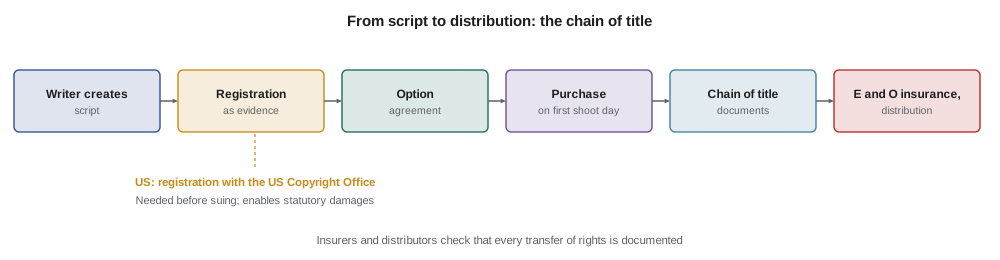
In the United States, copyright also arises automatically, and for works created today it generally lasts for the life of the author plus 70 years, or 95 years from publication for works made for hire. Registration with the US Copyright Office is optional but important: for US works, registration is generally required before a writer can sue for infringement, and timely registration makes statutory damages and attorney's fees available.
Many US writers also register scripts with the Writers Guild of America's registry, which records that a script existed on a certain date. This is evidence, not a substitute for copyright registration.
Options and purchase agreements
Producers rarely buy a script outright at the start. Instead, they option it: they pay an option fee for the exclusive right to buy the script within a set period, often 12 to 18 months, sometimes with a right to extend for an additional fee. If the producer raises financing, they exercise the option and pay the purchase price, often on or before the first day of principal photography. If not, the rights revert to the writer, who keeps the option fee.
- Option fee: often a small percentage of the purchase price, or a nominal amount for independent films.
- Option period and extensions: how long the producer has, and what extending costs.
- Purchase price: the amount paid when the option is exercised, sometimes tied to the film's budget.
- Rewrites: whether the writer is guaranteed the first rewrite or a polish.
- Credit and bonuses: credit terms and bonuses for sole or shared credit.
- Reversion: when unproduced rights return to the writer.
Worked problem
An illustrative option deal
A producer options a feature script for 18 months. The purchase price is set at 2 % of the film's final budget, with a floor of 50,000 dollars and a ceiling of 150,000 dollars. The option fee is 10 % of the floor, applicable against the price. What does the writer receive if the film is made for 4 million dollars, and if it is made for 1.5 million dollars?
Show solution
- Option fee: \( 0.10 \times 50000 = 5000 \) dollars, paid up front.
- At 4 million: \( 0.02 \times 4000000 = 80000 \), within the floor and ceiling, so the price is 80,000 dollars.
- Balance at 4 million: \( 80000 - 5000 = 75000 \) dollars on exercise, since the fee is applicable.
- At 1.5 million: \( 0.02 \times 1500000 = 30000 \), below the floor, so the price is 50,000 dollars and the balance is \( 50000 - 5000 = 45000 \) dollars.
Answer: The writer receives 5,000 dollars up front, then 75,000 dollars more at a 4 million budget or 45,000 dollars more at a 1.5 million budget. These numbers are illustrative; guild minimums, budgets and negotiation shape real deals.
Chain of title and adaptation rights
Chain of title is the set of documents proving that the producer owns or controls all the rights needed to make and distribute the film: the writer's contract, any option and purchase agreements, rights to underlying material such as a novel or article, and releases for life stories. Distributors and insurers will not accept a film without clear chain of title, and errors and omissions insurance, which covers claims such as copyright or defamation, depends on it.
If your script adapts someone else's work, you need the rights first. Writing an unauthorized adaptation of a novel may waste months on a script nobody can legally produce. True stories raise other issues: facts are free, but portraying real people can raise privacy and defamation concerns, and producers often secure life-rights agreements.
Writers' guilds
Guilds are unions that bargain collectively for writers. They set minimum fees, payment schedules, credit rules, residuals and benefits for work done for producers who sign their agreements. Writers usually join after selling work to a signatory producer.
The Writers Guild of America (WGA), made up of WGA West and WGA East, bargains with the Alliance of Motion Picture and Television Producers. Its Minimum Basic Agreement (MBA) sets minimums for features, television and streaming. After a strike in 2023, the 2023 MBA added rules on artificial intelligence: AI cannot be a writer, AI-generated material cannot be treated as literary or source material that reduces a writer's pay or credit, companies must disclose AI material given to writers, and companies cannot require writers to use AI. A new MBA ratified in April 2026 runs from 2 May 2026 to 1 May 2030, with minimum increases adding up to about 10.5 % over its term.
| Function | What it means for writers |
|---|---|
| Minimum terms | Floors for fees and payment schedules |
| Credits | Rules for "written by," "story by" and shared credit, decided by the guild |
| Residuals | Payments when work is reused, such as on streaming or television |
| Benefits | Pension and health contributions |
| Grievances | Help enforcing contracts when producers do not pay |
Development funding and programs
Most scripts never get produced, and development money helps writers survive the long process. Funding sources and programs differ greatly between the two countries.
The United States relies mainly on private and nonprofit programs. The Sundance Institute runs screenwriting labs, the Academy of Motion Picture Arts and Sciences runs the Nicholl Fellowships in Screenwriting, and studios and networks run writing fellowships and staffing programs. State film offices mainly offer production incentives rather than writing grants, and federal arts funding for individual screenwriters is limited. Writers often rely on fellowships, competitions with strong industry ties and fiscal sponsorship for nonprofit projects.
Worked problem
Budgeting a development year
A writer receives a 15,000 dollar development grant to write a feature over 10 months. She budgets 900 dollars a month for living costs covered by the grant, 1,200 dollars for a story consultant, 400 dollars for software and registration, and keeps the rest for a table read with actors. How much is left for the table read?
Show solution
- Living costs: \( 900 \times 10 = 9000 \) dollars.
- Other costs: \( 1200 + 400 = 1600 \) dollars.
- Total committed: \( 9000 + 1600 = 10600 \) dollars.
- Remaining: \( 15000 - 10600 = 4400 \) dollars.
Answer: About 4,400 dollars for the table read. Development grants rarely cover a full income, so many writers combine them with other work, but a well-planned budget can fund the steps that most improve a script.
AI and the screenwriter
Generative AI tools can produce text, and studios, writers and guilds are still working out how they should be used. The guild agreements described above protect writers' credit and compensation when AI material is involved. Copyright offices have taken the position that purely machine-generated material lacks human authorship. Practically, writers who use AI for research or brainstorming should keep records, follow any producer policy, avoid feeding other people's unpublished scripts into AI tools, and remember that their value lies in judgment, voice and lived experience. CRE-410 explores AI tools for creators in more depth.
Capstone: writing and boarding a short film
Your capstone brings the course together. You will write, revise and board an original short film script of 8 to 12 pages.
- Logline and premise: a one-sentence logline and a half-page premise with protagonist, want, need and stakes.
- Outline: a scene-by-scene outline marking the inciting incident, midpoint turn, low point and climax.
- Draft: a script in standard format, 8 to 12 pages, with at least one visual motif and one plant and payoff.
- Revision: a second draft after a table read, with a one-page note on what changed and why.
- Breakdown and shot list: a breakdown of the key scene and a shot list grouped by set-ups.
- Storyboard: boards for the key scene, in the film's aspect ratio, with camera notation.
- Rights note: a short paragraph confirming the work is original, listing any music or material needing clearance, and naming how you would register the script in your country.
Worked problem
Planning the capstone timeline
You have 6 weeks. You plan 1 week for logline and outline, 2 weeks for the first draft, 1 week for the table read and revision, 1 week for breakdown and shot list, and the rest for boarding and the rights note. If your draft is 10 pages, how many pages a day must you write during the drafting weeks, writing 5 days a week?
Show solution
- Drafting days: \( 2 \times 5 = 10 \) days.
- Pages per day: \( 10 \div 10 = 1 \) page.
- Boarding and rights note: \( 6 - 1 - 2 - 1 - 1 = 1 \) week.
Answer: One page a day for two weeks, with one week left for boards and the rights note. A page a day is a realistic pace that leaves time to rewrite, which is where most of the craft happens.
Assessment and next steps
Your capstone is assessed on clarity of story, character and structure, quality of scenes and dialogue, visual storytelling, correct format, and the usefulness of your production documents. Beyond the course, consider entering your script in competitions with strong reputations, applying to labs and development programs, finding collaborators to produce it, and building a body of work. Writers who sustain careers usually write constantly, finish drafts, seek feedback and keep learning.
Keeping records
Keep dated copies of every draft, your outlines and correspondence with producers. If a dispute arises over authorship or credit, these records help show who wrote what and when. Cloud storage with version history makes this easy, but keep your own backups as well.
Common mistakes
MistakeThinking registration is required for copyright
InsteadCopyright is automatic; registration is optional evidence, and in the US it matters for lawsuits
MistakeWriting an adaptation without the rights
InsteadSecure rights to underlying material before investing months in a script
MistakeSigning an option without checking reversion terms
InsteadKnow when rights revert and what extensions cost, and get advice
MistakeAssuming guild rules apply to every production
InsteadGuild minimums apply only to signatory producers and covered work
MistakeFeeding unpublished scripts into AI tools
InsteadProtect confidential material and follow guild and producer policies on AI
Summary and key terms
- Copyright protects expression, not ideas, and arises automatically when a script is written down.
- Registration with CIPO in Canada or the US Copyright Office provides evidence, and US registration is generally required before suing.
- Producers usually option scripts before buying them, with fees, periods, purchase prices and reversion terms.
- Chain of title documents every right needed to make and distribute a film and underpins errors and omissions insurance.
- The WGC in Canada and the WGA in the United States set minimum terms, credits and AI protections for covered work.
- Canada offers substantial public development funding; the US relies more on labs, fellowships and private programs.
- The capstone combines a polished short script, revisions, breakdown, shot list, storyboard and a rights note.
- Copyright
- The legal right protecting original expression such as scripts
- Moral rights
- An author's rights of attribution and integrity, which can be waived in Canada
- Option
- An exclusive right to buy a script within a set period, paid for by an option fee
- Purchase price
- The amount paid when an option is exercised
- Reversion
- The return of rights to the writer when a project is not produced
- Chain of title
- The documents proving a producer owns or controls all rights in a film
- Errors and omissions insurance
- Insurance covering claims such as copyright infringement or defamation
- Writers' guild
- A union that bargains minimum terms and credits for screenwriters
- Residuals
- Payments to writers when their work is reused
- Life rights
- Rights obtained from a real person to portray their story
Practice problems
Work each problem on paper first, then reveal the answer to check.
Does copyright require registration?
Show answer
No; it arises automatically, though registration provides evidence.
What is an option?
Show answer
A paid exclusive right to buy a script within a set period.
What does chain of title prove?
Show answer
That the producer owns or controls all rights needed for the film.
Which guild represents English-language screenwriters in Canada?
Show answer
The Writers Guild of Canada.
Name one AI protection in the WGA's 2023 agreement.
Show answer
For example, companies cannot require writers to use AI.
What is 2 % of a 3 million dollar budget?
Show answer
60,000 dollars.
Why secure adaptation rights first?
Show answer
Without them, the script cannot legally be produced.
Name one Canadian and one US development program.
Show answer
For example, Telefilm's Talent to Watch and the Sundance Institute's screenwriting labs.
What is reversion?
Show answer
The return of rights to the writer when the option lapses or the film is not made.
How many pages a day finishes a 12-page draft in 3 weeks of 5 days?
Show answer
0.8 pages a day.
Lesson quiz · 5 questions
Score 60% or more to complete this lesson.
Create a free account to save your progress, take quizzes and earn a certificate.