
FILM-210 · Lesson 4 of 12 · 28 min
Structure I: three acts, sequences and beats
Structure is the order and shape of events in a story. It decides when the audience learns things, when tension rises, when the protagonist changes and when the story ends. Good structure is mostly invisible: audiences simply feel that the story is gripping and that the ending is satisfying. Poor structure shows up as boredom in the middle, confusion about what is at stake, or an ending that feels unearned. This lesson introduces the three-act model that dominates screenwriting teaching, the sequences and beats that subdivide it, and several popular structure systems. It also looks critically at their limits and at alternative structures from other traditions.
Why structure matters
Audiences come to a film with expectations about how stories unfold, shaped by thousands of stories they have already absorbed. Structure works with those expectations, sometimes satisfying them and sometimes surprising them. Structure also helps writers. A feature film is long; knowing where the major turning points fall stops a draft from wandering. Producers, story editors and directors use structural vocabulary to give notes: "the inciting incident comes too late," "the second act sags," "the climax doesn't resolve the protagonist's need."
Think of structure as a set of tools, not rules. Many great films break conventional structure deliberately. But most writers who break the conventions understand them first.
The three-act structure
The most widely taught model divides a story into three parts. Its roots go back to Aristotle's observation that a whole story has a beginning, a middle and an end. In modern screenwriting it was popularized in the 1970s and 1980s by teachers such as Syd Field, who gave approximate page counts to each act.
- Act one, the setup: introduces the protagonist, their world and the dramatic situation. An inciting incident disrupts the world, and by the end of the act the protagonist commits to a goal.
- Act two, the confrontation: the protagonist pursues the goal against rising obstacles. A midpoint often raises the stakes or changes the direction. The act usually ends at a low point, when the goal seems lost.
- Act three, the resolution: the protagonist makes a final push. The climax resolves the main conflict, often forcing the protagonist to face their need, and a short resolution shows the new normal.
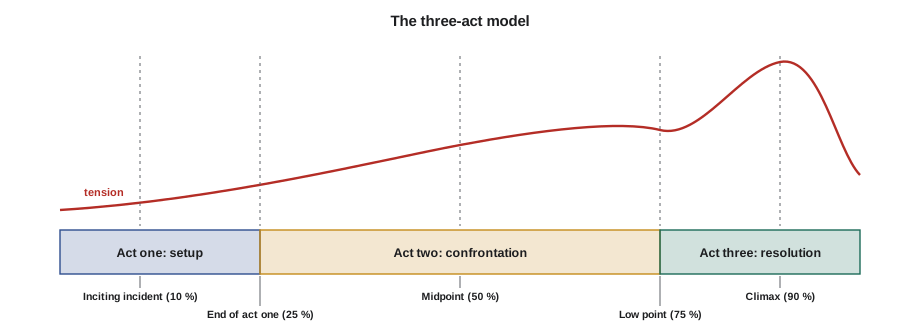
In a feature of about 100 to 110 pages, the traditional proportions are roughly 25 percent, 50 percent and 25 percent, though modern films often have a shorter act one and a longer act two.
Worked problem
Act-break page targets for a feature
A feature script is 108 pages. Using proportions of 25 %, 50 % and 25 %, and placing the inciting incident at about 11 %, the midpoint at 50 % and the climax at about 90 %, find the target pages.
Show solution
- Inciting incident: \( 0.11 \times 108 \approx 12 \).
- End of act one: \( 0.25 \times 108 = 27 \).
- Midpoint: \( 0.50 \times 108 = 54 \).
- End of act two (low point): \( 0.75 \times 108 = 81 \).
- Climax: \( 0.90 \times 108 \approx 97 \).
Answer: Roughly pages 12, 27, 54, 81 and 97. These are targets for checking a draft, not rules; a story event that lands a few pages early or late is fine, but a first-act break on page 45 usually means a slow start.
Sequences
Within the acts, many writers think in sequences: groups of scenes, often 10 to 15 pages long in a feature, organized around a mini-goal with its own beginning, middle and end. The sequence approach, associated with screenwriting teaching at the University of Southern California and with the writer and teacher Paul Gulino, divides a feature into about eight sequences. It grew partly from the era of film reels, when a feature was shown on several reels of roughly equal length. Thinking in sequences makes the long second act easier to manage: instead of 50 pages of "obstacles," the writer plans four sequences, each with a distinct mini-goal and turn.
Beats and the beat sheet
A beat is a single unit of story change, from the size of a moment in a scene to a major turning point. A beat sheet lists the key beats of a whole story in order. Blake Snyder's book Save the Cat, published in 2005, popularized a 15-beat sheet with names such as the opening image, the catalyst, the break into two, the midpoint, all is lost, the dark night of the soul and the final image. Each beat comes with a suggested page position.
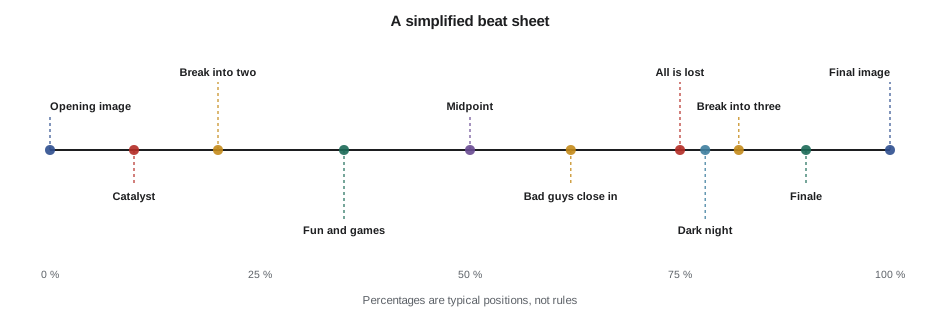
Beat sheets are useful for outlining and diagnosing drafts. Their danger is formula. When every studio film follows the same beats at the same pages, audiences start predicting the story. Use beat sheets to check that your story turns and escalates, not to force it into a template.
Worked problem
Converting beat percentages to minutes for a short
A 12-page short follows a compressed structure: inciting incident at about 12 %, a midpoint turn at 50 %, a low point at about 75 % and a climax at about 90 %. Where do these fall in pages and approximate minutes?
Show solution
- Inciting incident: \( 0.12 \times 12 \approx 1.4 \) pages, about the 1.5 minute mark.
- Midpoint: \( 0.5 \times 12 = 6 \) pages, about 6 minutes.
- Low point: \( 0.75 \times 12 = 9 \) pages, about 9 minutes.
- Climax: \( 0.9 \times 12 \approx 10.8 \) pages, about 11 minutes.
Answer: Roughly pages 1.5, 6, 9 and 11. In a short the inciting incident must arrive almost immediately, often on the first page, because there is no time for a long setup.
The story circle and the hero's journey
Two other influential models describe structure as a circle rather than a line. The mythologist Joseph Campbell described a monomyth or hero's journey, in which a hero leaves the ordinary world, faces trials in a special world and returns transformed. The story consultant Christopher Vogler adapted Campbell's ideas for Hollywood in the 1990s. Dan Harmon, a television writer, simplified the circle into eight steps: a character in a zone of comfort wants something, enters an unfamiliar situation, adapts to it, gets what they wanted, pays a heavy price, returns to their familiar situation and has changed.
These models emphasize transformation and are useful for character arcs, especially in genre and family films. Critics argue that the hero's journey reflects one cultural tradition and centers a single individual's triumph, which does not fit every story or culture.
| Model | Main idea | Best used for | Caution |
|---|---|---|---|
| Three acts | Setup, confrontation, resolution | Almost any narrative film | Can be too vague to guide a draft |
| Sequences | About eight mini-stories with mini-goals | Managing long second acts | Can feel episodic if sequences don't build |
| Beat sheets | Named beats at set positions | Outlining and diagnosing drafts | Formulaic if followed rigidly |
| Hero's journey | A circular journey out and back | Adventure, fantasy and coming-of-age stories | Centers individual heroism; one tradition |
| Story circle | Eight steps of want, price and change | Series episodes and short stories | Simplifies complex stories |
Beyond the three acts
Not all stories follow a Western three-act shape. Writers working in many traditions have used different structures, and studying them expands your options.
- Kishōtenketsu: a four-part structure from Chinese and Japanese poetry and storytelling (introduction, development, twist and reconciliation), which can build interest through contrast and surprise rather than direct conflict.
- Episodic and picaresque structure: a series of loosely connected episodes, often unified by a character or journey.
- Multi-protagonist and ensemble structures: several characters with interwoven stories, common in films that explore a community or a city.
- Nonlinear structure: events told out of chronological order, through flashbacks, parallel timelines or reverse chronology.
- Circular structure: the story ends where it began, changed by what has happened.
- Oral and Indigenous storytelling traditions: many Indigenous filmmakers in Canada and the United States draw on storytelling forms that emphasize relationships, land and community over a single hero's triumph.
These structures are not exotic exceptions; they are tools. A short film might borrow kishōtenketsu's twist without conflict. A family drama might use an ensemble structure. The key question is always what shape serves this story.
Outlining your story
Most professional writers outline before drafting. An outline lists the scenes or sequences in order, with a sentence or two about what happens and what changes in each. Outlines can be written on index cards, in a spreadsheet, on a wall or in screenwriting software. Cards are popular because you can move them around easily.
- Write one scene or beat per card: where, who and what changes.
- Lay cards out in three rows for the three acts, or in eight columns for sequences.
- Mark where the major turns fall and check proportions.
- Look for gaps: long stretches with no turn, or a midpoint that changes nothing.
- Test cause and effect: each scene should lead to the next with "therefore" or "but," not just "and then."
The "therefore or but" test, popularized by television writers, is a quick diagnostic. If your outline reads "this happens, and then this happens, and then this happens," it is a list. If it reads "this happens, therefore she does this, but then that happens," it is a story.
Worked problem
Diagnosing a sagging second act
In a 104-page draft, the major events fall at pages 30 (end of act one), 41 (a new obstacle), 79 (the next major turn) and 86 (low point). Readers say the middle is slow. What does the page map suggest?
Show solution
- Gap between turns: \( 79 - 41 = 38 \) pages with no major turn.
- A typical sequence is 10 to 15 pages, so about \( 38 \div 12.5 \approx 3 \) sequences are missing clear mini-goals and turns.
- The midpoint target is \( 0.5 \times 104 = 52 \); nothing major happens there.
Answer: A 38-page gap suggests the middle lacks a midpoint and about three sequences' worth of escalation. The writer should add a clear midpoint turn near page 52 and give each sequence of the second act its own mini-goal and reversal.
Structure in revision
Structure is often easier to see after a first draft than before it. Once a draft exists, list every scene with its page number and mark where each major turn actually falls. Compare those pages with your targets. Many writers discover that their inciting incident arrives late, that their midpoint is weak, or that two sequences do the same job. Fixing structure in revision usually means cutting, merging and moving scenes rather than writing new ones, which is why outlines and scene lists remain useful long after drafting begins.
Common mistakes
MistakeTreating structure models as rigid formulas
InsteadUse them as diagnostic tools and choose the shape that serves the story
MistakeStarting the inciting incident too late
InsteadIn features aim for roughly the first 10 to 15 pages; in shorts, the first page or two
MistakeA second act that repeats the same obstacle
InsteadPlan sequences with distinct mini-goals and escalating stakes
MistakeOutlines that read "and then, and then"
InsteadLink scenes with "therefore" and "but" so each causes the next
MistakeAssuming the three-act shape is universal
InsteadStudy alternative structures such as kishōtenketsu, ensemble and nonlinear stories
Summary and key terms
- Structure is the shape and order of events; good structure is felt rather than noticed.
- The three-act model divides a story into setup, confrontation and resolution, roughly 25, 50 and 25 percent.
- Key turns include the inciting incident, the end of act one, the midpoint, the low point and the climax.
- Sequences break a feature into about eight mini-stories, each with its own mini-goal and turn.
- Beat sheets name typical beats and positions; they help outline and diagnose but can become formula.
- The hero's journey and the story circle emphasize transformation but reflect particular traditions.
- Outlines and the "therefore or but" test reveal gaps in cause and effect before drafting.
- Three-act structure
- A model dividing a story into setup, confrontation and resolution
- Inciting incident
- The event that disrupts the protagonist's world and starts the main story
- Midpoint
- A turn near the middle that raises stakes or changes direction
- Low point
- The moment near the end of act two when the goal seems lost
- Climax
- The decisive confrontation that resolves the main conflict
- Sequence
- A group of scenes organized around a mini-goal, often 10 to 15 pages in a feature
- Beat
- A single unit of story change
- Beat sheet
- An ordered list of a story's key beats
- Hero's journey
- A circular story model in which a hero leaves home, is tested and returns transformed
- Kishōtenketsu
- A four-part structure of introduction, development, twist and reconciliation
Practice problems
Work each problem on paper first, then reveal the answer to check.
In a 100-page script, where would a 25 % act-one break fall?
Show answer
Around page 25.
What is a sequence?
Show answer
A group of scenes with its own mini-goal and turn, often 10 to 15 pages in a feature.
Why does a short need an early inciting incident?
Show answer
There is no time for a long setup; the story must begin almost immediately.
Where is the midpoint of a 96-page script?
Show answer
About page 48.
What does the "therefore or but" test check?
Show answer
Whether scenes are linked by cause and effect rather than just listed.
Name one criticism of the hero's journey.
Show answer
It reflects one cultural tradition and centers individual heroism.
What are the four parts of kishōtenketsu?
Show answer
Introduction, development, twist and reconciliation.
Why are index cards useful for outlining?
Show answer
Scenes can be moved and rearranged easily to test order.
In a 12-page short, where would a climax at 90 % fall?
Show answer
About page 10.8.
What does a 35-page gap between turns in act two suggest?
Show answer
The middle lacks escalation; it needs a midpoint and more sequences with mini-goals.
Lesson quiz · 5 questions
Score 60% or more to complete this lesson.
Create a free account to save your progress, take quizzes and earn a certificate.