
FILM-120 · Lesson 8 of 12 · 27 min
The new waves of the 1950s and 1960s
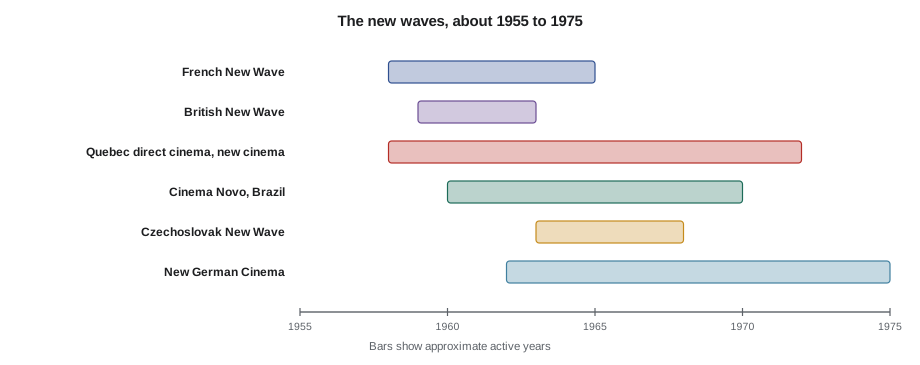
From the late 1950s, young filmmakers in many countries broke with established film industries. Lighter cameras, faster film stocks, portable synchronized sound and new sources of funding made it possible to shoot quickly on the streets with small crews. Critics turned directors, film schools, state funds and festivals supported new talent, and audiences of the postwar generation wanted films that spoke to their lives. This lesson surveys the French New Wave, British, Brazilian, Czechoslovak and German new waves, and the direct cinema and new cinema of Quebec, which grew from the National Film Board's French unit during the Quiet Revolution.
The conditions for change
Several developments came together around 1958 to 1962:
- Technology: lightweight 16 mm and 35 mm cameras that could be handheld, faster film stocks that worked in available light, and portable magnetic tape recorders, such as the Nagra introduced in the late 1950s, which made synchronized location sound practical.
- Funding: governments in several countries began offering grants, loans and advances for first features and for films of artistic or cultural value.
- Film culture: archives, film societies, film magazines and festivals created informed audiences and gave young critics a platform.
- Generational change: postwar young people rejected the conventions of what they saw as an outdated "cinema of quality" and wanted films about modern life, sexuality, politics and youth.
These conditions produced remarkably similar movements in different countries within a few years.
The French New Wave
In France, critics writing for the magazine Cahiers du cinéma in the 1950s, including François Truffaut, Jean-Luc Godard, Claude Chabrol, Éric Rohmer and Jacques Rivette, attacked the polished literary adaptations of mainstream French cinema and championed directors, including Hollywood genre filmmakers such as Alfred Hitchcock and Howard Hawks, whom they saw as true authors of their films. This "politique des auteurs", later called auteur theory in English, held that a director's personal vision could be traced across their films regardless of studio or genre.
Many of these critics learned cinema by watching films at the Cinémathèque française in Paris, run by Henri Langlois. Then they began making their own films. Truffaut's The 400 Blows (1959), about a troubled boy in Paris, won the directing award at Cannes. Godard's Breathless (1960), about a small-time criminal and his American girlfriend, shocked audiences with jump cuts, handheld camera, direct address and casual, improvised-seeming performances. Agnès Varda, whose La Pointe Courte (1955) is often seen as a precursor of the movement, made Cléo from 5 to 7 (1962), following a singer through two hours of Paris in nearly real time.
Typical features of New Wave films include:
- Location shooting with small crews and available light.
- Handheld cameras and long takes alongside sudden jump cuts.
- Loose narratives, open endings and digressions.
- References to other films and to the act of filmmaking itself.
- Young protagonists and contemporary urban life.
The French New Wave's direct influence lasted only a few years as a group movement, but its techniques and its idea of the director as author spread worldwide and shaped film criticism, film schools and independent filmmaking for decades.
The British New Wave
In Britain, the "Free Cinema" documentaries of the mid-1950s and the "angry young men" of theater and literature fed a wave of social-realist features from about 1959 to 1963. Films such as Room at the Top (1959), Saturday Night and Sunday Morning (1960) and A Taste of Honey (1961) were shot partly on location in industrial northern England, featured working-class characters and dealt frankly with class, sexuality and frustration. These "kitchen sink" dramas, filmed in black and white, influenced British television drama and later social-realist filmmakers.
Cinema Novo in Brazil
Brazilian Cinema Novo emerged in the early 1960s, led by filmmakers such as Glauber Rocha and Nelson Pereira dos Santos. Inspired by Neorealism and the French New Wave but rooted in Brazilian politics and culture, Cinema Novo addressed poverty, hunger, land and colonialism. Rocha's manifesto, often translated as "An Aesthetic of Hunger" (1965), argued that films from poor countries should not imitate Hollywood polish but make poverty and violence visible. Its slogan was often summarized as "a camera in the hand and an idea in the head." After the 1964 military coup and especially from 1968, censorship and repression pushed filmmakers toward allegory or exile. Cinema Novo influenced the broader "Third Cinema" movement in Latin America, which called for politically committed film outside both Hollywood and European art cinema.
The Czechoslovak New Wave
In Czechoslovakia, graduates of the Prague film school, FAMU, made bold, often satirical and absurdist films in the mid-1960s as censorship relaxed. Directors such as Miloš Forman, Věra Chytilová and Jiří Menzel used non-professional actors, improvisation and experimental styles. Chytilová's Daisies (1966) follows two young women in an anarchic, colorful revolt; Menzel's Closely Watched Trains (1966) won the Academy Award for foreign language film. After the Soviet-led invasion of August 1968 ended the Prague Spring reforms, many films were banned, and some directors, including Forman, emigrated; Forman later won Academy Awards for American films.
New German Cinema
In West Germany, 26 young filmmakers signed the Oberhausen Manifesto in 1962, declaring "Papa's cinema is dead" and demanding a new, independent cinema. Government funding bodies and television co-productions eventually supported directors such as Rainer Werner Fassbinder, Werner Herzog, Wim Wenders and Margarethe von Trotta, whose films in the 1970s confronted Germany's Nazi past, postwar prosperity and alienation. New German Cinema showed how public funding and television partnerships could sustain a national art cinema, a model relevant to Canada.
Direct cinema and the NFB
In North America, new lightweight equipment transformed documentary. At the National Film Board, the English-language Unit B produced the Candid Eye television series (1958–1961), observing everyday life with portable cameras. In the United States, Robert Drew's team, including Richard Leacock, D. A. Pennebaker and Albert and David Maysles, made Primary (1960), following John F. Kennedy and Hubert Humphrey during a Wisconsin primary election with handheld camera and synchronized sound. This observational approach, without narration or interviews, became known as direct cinema.
In France, Jean Rouch and Edgar Morin's Chronicle of a Summer (1961) took a different path, called cinéma vérité, in which filmmakers openly provoked and interviewed their subjects and appeared on camera. Rouch credited the Quebec filmmakers he worked with, and the NFB's French unit was at the center of these developments.
Quebec cinema and the Quiet Revolution
Quebec's Quiet Revolution, the period of rapid social, political and cultural change that began around 1960, transformed Quebec society and its cinema. At the NFB, which moved its headquarters from Ottawa to Montreal in 1956, French-speaking filmmakers gained more independence and created a cinema about Quebec life in Quebec French. Michel Brault, a pioneering camera operator, developed handheld techniques that moved the camera among people rather than observing from a distance. Les Raquetteurs (1958), a short film by Brault and Gilles Groulx about a snowshoe convention, is often cited as a founding work of this style.
Brault and Pierre Perrault's Pour la suite du monde (1963) followed the people of Île-aux-Coudres as they revived a traditional beluga whale hunt, giving voice to their language and memories; it was the first Canadian film selected for competition at Cannes. Groulx's Le chat dans le sac (1964), about a young Montrealer questioning his identity and politics, blended fiction and documentary techniques and became a landmark of Quebec's new cinema. Claude Jutra's Mon oncle Antoine (1971), about a boy coming of age in a small mining town, is often ranked among the greatest Canadian films; later revelations about Jutra's sexual abuse of minors, made public in 2016, led institutions to remove his name from awards and places, an example of how film history and its honors are reassessed.
For American audiences, direct cinema became a defining American documentary style through Drew Associates, the Maysles brothers, Pennebaker and Frederick Wiseman, whose observational films about institutions began with Titicut Follies (1967), while the New American Cinema Group of independent and experimental filmmakers in New York published a manifesto in 1961 calling for personal, low-budget filmmaking.
| Movement | Country | Peak years | Signature traits |
|---|---|---|---|
| French New Wave | France | 1959–about 1965 | Critics turned directors, jump cuts, location shooting, auteur theory |
| British New Wave | United Kingdom | 1959–1963 | Working-class realism in industrial cities |
| Cinema Novo | Brazil | 1960s | Politics of poverty and colonialism, "aesthetic of hunger" |
| Czechoslovak New Wave | Czechoslovakia | 1963–1968 | Satire, absurdism, film school graduates |
| Quebec direct cinema and new cinema | Canada (Quebec) | late 1950s–early 1970s | Handheld camera, Quebec French, national identity |
| New German Cinema | West Germany | 1962 manifesto, peak 1970s | Public funding, confronting the Nazi past |
Worked problem
Counting jump cuts and average shot length
A student logs a 3-minute scene from a 1960 New Wave film and counts 64 shots, of which 22 begin with a jump cut within the same camera angle. Calculate the average shot length and the share of cuts that are jump cuts. (There is one fewer cut than shots.)
Show solution
- Duration in seconds: \( 3 \times 60 = 180 \).
- Average shot length: \( 180 \div 64 \approx 2.8 \) seconds.
- Number of cuts: \( 64 - 1 = 63 \).
- Jump cut share: \( 22 \div 63 \approx 0.35 \), about 35 %.
Answer: The scene averages about 2.8 seconds per shot, and about a third of its cuts are jump cuts. Quantifying a technique this way helps you compare films and support claims in an essay, as long as you describe how you counted.
Worked problem
Lighter equipment and smaller crews
A described 1950s studio sync-sound camera package weighed about 110 kilograms with its blimp, while a late-1960s portable 16 mm sync rig weighed about 9 kilograms with its recorder. How many times lighter was the portable rig, and how might this change filming?
Show solution
- Ratio: \( 110 \div 9 \approx 12 \) times lighter (about 240 pounds versus about 20 pounds).
- A single operator and a sound recordist could carry the portable rig.
- Filmmakers could follow people through crowds, homes and streets, often without lighting.
Answer: The portable rig was roughly twelve times lighter in this illustrative comparison, making two-person crews possible. That change in technology made direct cinema and many New Wave techniques practical.
Legacies of the new waves
The new waves changed more than style. They helped establish the idea that a national cinema could be built around personal, low-budget films supported by public money, festivals and film culture rather than by a commercial studio system. Film schools expanded in many countries during and after the 1960s, often teaching the history and techniques of the new waves as models. Critics adopted auteur theory as a standard way to write about films, sometimes overlooking the collaborative work of cinematographers, editors, writers and actors. Later movements in many countries, from the Taiwanese New Cinema of the 1980s to independent filmmakers in North America, explicitly described themselves as heirs of the new waves. When you watch a contemporary film shot handheld on location with a small crew and non-professional actors, you are seeing techniques that became widely available and celebrated around 1960.
Common mistakes
MistakeTreating the French New Wave as the only new wave
InsteadRecognize parallel movements in Britain, Brazil, Czechoslovakia, Germany and Quebec
MistakeUsing cinéma vérité and direct cinema as exact synonyms
InsteadDistinguish observation without intervention from filmmakers openly provoking and interviewing subjects
MistakeAssuming New Wave films were made with no planning
InsteadNote that many were carefully structured even when they looked spontaneous
MistakeIgnoring Quebec's role in documentary innovation
InsteadCredit Brault, Perrault, Groulx and the NFB French unit
MistakeTreating honors given to filmmakers as permanent
InsteadNote how institutions reassess honors when harms come to light, as with Jutra
Summary and key terms
- Lighter cameras, faster stocks, portable sync sound, new funding and generational change produced new waves around 1958 to 1962.
- The French New Wave grew from Cahiers du cinéma critics and auteur theory, with films such as The 400 Blows and Breathless.
- British, Brazilian, Czechoslovak and German new waves addressed class, poverty, politics and history in their own ways.
- Direct cinema observed without narration, while cinéma vérité openly involved filmmakers with subjects.
- The NFB's Candid Eye and French unit, and Drew Associates in the United States, pioneered observational documentary.
- Quebec's Quiet Revolution produced a new cinema led by Brault, Perrault, Groulx and others.
- Pour la suite du monde (1963) was the first Canadian film selected for competition at Cannes.
- New Wave
- A movement of young filmmakers breaking with established industry conventions
- Cahiers du cinéma
- The French film magazine whose critics launched the New Wave
- Auteur theory
- The idea that a director's personal vision can be traced across their films
- Jump cut
- A cut that skips forward within the same shot or angle, creating a jolt
- Cinema Novo
- A Brazilian movement of the 1960s addressing poverty and colonialism
- Oberhausen Manifesto
- The 1962 declaration by young West German filmmakers that launched New German Cinema
- Direct cinema
- Observational documentary without narration or staged interviews
- Cinéma vérité
- Documentary in which filmmakers openly interact with and provoke subjects
- Quiet Revolution
- The period of rapid social and cultural change in Quebec from about 1960
- Candid Eye
- An NFB English-language observational television series, 1958 to 1961
Practice problems
Work each problem on paper first, then reveal the answer to check.
What new equipment made the new waves possible?
Show answer
Lightweight handheld cameras, faster film stocks and portable sync sound recorders.
What is auteur theory?
Show answer
The idea that a director's personal vision runs through their films.
Name two French New Wave directors.
Show answer
Any two of: Truffaut, Godard, Chabrol, Rohmer, Rivette, Varda.
What did Cinema Novo address?
Show answer
Poverty, hunger, land and colonialism in Brazil.
What was the Oberhausen Manifesto?
Show answer
A 1962 declaration by young West German filmmakers demanding a new cinema.
How does direct cinema differ from cinéma vérité?
Show answer
Direct cinema observes without intervening; vérité involves filmmakers openly with subjects.
Which 1963 film was the first Canadian film in competition at Cannes?
Show answer
Pour la suite du monde.
Who made Le chat dans le sac?
Show answer
Gilles Groulx.
A 4-minute scene has 80 shots. What is the ASL?
Show answer
\( 240 \div 80 = 3 \) seconds.
Why was a 9-kilogram sync rig important?
Show answer
A two-person crew could carry it and follow people anywhere.
Lesson quiz · 5 questions
Score 60% or more to complete this lesson.
Create a free account to save your progress, take quizzes and earn a certificate.