
FILM-120 · Lesson 3 of 12 · 27 min
Early cinema and the silent era
Between about 1900 and the late 1920s, films grew from one-minute curiosities into feature-length stories watched by millions every week. Filmmakers developed editing, camera placement and acting styles that made complex narratives clear without spoken dialogue. Cinemas evolved from storefront nickelodeons to grand picture palaces, the star system turned performers into celebrities, and Hollywood rose to global dominance. This lesson follows those changes, looks critically at D. W. Griffith and the racism of his most famous film, and traces the beginnings of filmmaking and film exhibition in Canada.
From single shots to editing
The earliest films were usually single shots. Within a few years filmmakers began joining shots to show events across different spaces and times. British filmmakers around 1900, sometimes called the Brighton school, experimented with close-ups inserted into scenes and with chase films that followed characters from one location to the next. In the United States, Edwin S. Porter at the Edison company made Life of an American Fireman (1903) and The Great Train Robbery (1903). The second, about eleven minutes long, followed a robbery, an escape and a pursuit through more than a dozen shots and became one of the most popular films of its decade. Its final shot, a bandit firing directly at the camera, could be shown at the beginning or end of the film, a reminder that early films were still partly a collection of attractions.
Over the next decade, filmmakers developed a set of techniques that made stories easy to follow:
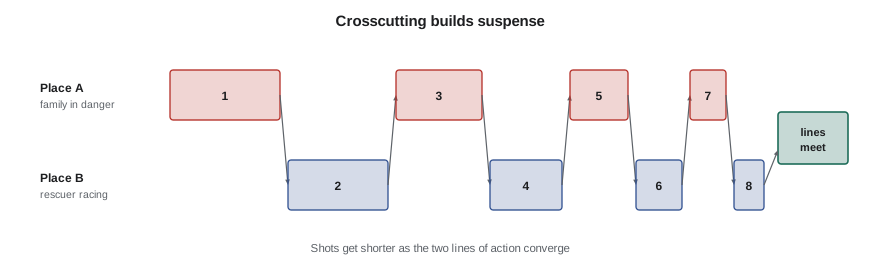
- Crosscutting (parallel editing): alternating between actions in different places to suggest that they happen at the same time, often building suspense toward a last-minute rescue.
- Analytical editing: breaking a scene into closer shots of important details or faces.
- Matches on action and eyeline matches: cuts that preserve the sense of continuous space and movement.
- Intertitles: printed cards giving dialogue, narration, time and place.
By about 1917 these techniques had settled into what historians call the classical continuity system, which remains the basis of mainstream filmmaking today.
Nickelodeons and the first boom
Around 1905, small storefront cinemas called nickelodeons spread rapidly across the United States. The name combined the five-cent admission price, a nickel, with the Greek word for theater. Seats were cheap, programs lasted 15 to 30 minutes and ran continuously, and audiences could drop in at any time. By the end of the decade, there were thousands of nickelodeons, and millions of people, many of them working-class and immigrant families, went to the movies every week.
The boom created demand for a steady supply of new films, which pushed production toward regular schedules, standard lengths of one reel (about 1,000 feet, roughly 10 to 15 minutes at the speeds of the time) and recognizable genres such as comedies, westerns and melodramas. It also prompted moral campaigns: reformers worried about dark rooms, fire risks and the influence of films on children, and cities introduced licensing and censorship boards.
The feature film and the picture palace
In the early 1910s, longer films of several reels appeared, often imported from Italy and France, where epics such as the Italian historical spectacles drew huge audiences. Feature-length films of an hour or more became standard in the United States by the mid-1910s. To show them, exhibitors built large, comfortable cinemas, and by the 1920s the grandest picture palaces in major cities seated thousands of people, with orchestras, organs, ushers and lavish decoration. Silent films were rarely silent: they were accompanied by live music ranging from a single pianist to a full orchestra, and sometimes by sound effects and narrators.
Worked problem
How a program filled an evening
In 1912 a cinema showed a program of four one-reel films, each 1,000 feet long, projected at about 16 frames per second (60 feet per minute), with 5 minutes of song slides and announcements. How long was the program? How long would a later seven-reel feature run at 20 frames per second?
Show solution
- One reel at 60 feet per minute: \( 1000 \div 60 \approx 16.7 \) minutes.
- Four reels: \( 4 \times 16.7 \approx 66.7 \) minutes, plus 5 minutes, about 72 minutes.
- At 20 fps, film runs \( 20 \div 16 \times 60 = 75 \) feet per minute.
- Seven reels: \( 7000 \div 75 \approx 93.3 \) minutes.
Answer: The mixed program ran about 72 minutes, while a seven-reel feature at 20 fps ran about 93 minutes, roughly the length audiences still expect from a feature film. Projection speed changes running time, which is why silent running times are often given as ranges.
D. W. Griffith and The Birth of a Nation
D. W. Griffith directed hundreds of short films for the Biograph company from 1908 to 1913, refining crosscutting, varied camera distances and restrained acting. His three-hour feature The Birth of a Nation (1915) was a huge commercial success and is often credited with demonstrating the scale and power of the feature film. It is also profoundly racist. Set during and after the American Civil War, it presents Black people as threats, uses white actors in blackface, and glorifies the Ku Klux Klan, whose revival in 1915 the film helped inspire.
The film was protested at the time. The National Association for the Advancement of Colored People (NAACP) campaigned against it, and some cities and states banned or cut it. Black filmmakers responded with their own films, and Oscar Micheaux's Within Our Gates (1920) offered a direct counter-portrait of racial violence.
Historians today reject the old habit of praising The Birth of a Nation's technique while setting aside its content. Its technique served its message; its success shows how cinema's new power could spread harmful ideas to mass audiences. Studying it is a way to understand both film form and the history of racism in popular culture, not a celebration.
The star system and the studios
Early film companies often did not name their actors. Audiences nevertheless developed favorites, and by about 1910 companies began promoting performers by name. The star system turned actors into valuable brands whose names sold tickets. Mary Pickford, born in Toronto in 1892, became one of the most powerful figures in the industry, known as "America's Sweetheart" while being Canadian. Charlie Chaplin, Douglas Fairbanks and Pickford founded United Artists with Griffith in 1919 to control their own work.
At the same time, production companies consolidated in Los Angeles. By the 1920s a small number of large companies controlled production, distribution and many cinemas, the basis of the studio system discussed in lesson 5. American films dominated world markets, helped by the disruption of European production during the First World War from 1914 to 1918.
Hollywood drew talent from across the country and the world. Immigrant entrepreneurs, many from Jewish families in central and eastern Europe, founded or led most of the major studios, and performers and technicians came from Canada, Britain, Germany, Sweden and elsewhere. The concentration of production in Los Angeles made the city the center of the American industry by the late 1910s.
Silent comedy and silent acting
Silent comedy reached a high point in the 1920s. Charlie Chaplin, Buster Keaton and Harold Lloyd developed distinct screen personas and elaborate physical comedy, often performing their own dangerous stunts. Keaton's deadpan expression and precise, large-scale gags, and Chaplin's mix of comedy and pathos, are still studied by filmmakers. Comedy shorts by Mack Sennett's studio, slapstick teams and animated cartoons were staples of every program.
Acting styles changed across the silent era. Early films often used broad, theatrical gestures that could be read from a distance in wide shots. As closer shots became common, performers learned smaller, more naturalistic movements, letting the camera catch a glance or a hesitation. The idea that silent acting was always exaggerated is a myth based partly on films projected too fast and on a few famous melodramas.
Women filmmakers in the silent era
Women held more creative power in the early film industry than in the decades that followed. In France, Alice Guy directed narrative films from 1896 and later founded the Solax studio in the United States. Lois Weber became one of the highest-paid directors in Hollywood in the mid-1910s, making films on social issues such as poverty and birth control. Screenwriters such as Frances Marion and June Mathis wrote many of the era's biggest successes, and women edited many films. As the industry became bigger business in the 1920s and sound arrived, women were largely pushed out of directing for decades. Recovering their work is one of the major projects of recent film history.
Canadian early cinema
Canada's first permanent cinemas opened in the early 1900s. Ernest Ouimet opened the Ouimetoscope in Montreal on 1 January 1906, often described as the first permanent cinema in Canada; in 1907 he built a larger, more luxurious version. Ouimet also filmed local events and newsreels. Across the country, traveling showmen, then storefront theaters and finally large cinemas brought films to towns and cities.
Canadian fiction production in the silent era was modest and often short-lived. Evangeline (1913), adapted from Longfellow's poem about the Acadian expulsion, is often cited as the first Canadian-produced fiction feature; no copy is known to survive. In the late 1910s, the actor and writer Nell Shipman made Back to God's Country (1919) in the northern wilderness, a box office success known for its outdoor scenes and its strong female lead. The Canadian Pacific Railway and federal and provincial governments sponsored films promoting immigration, settlement and tourism, and in 1917 Ontario created a government film bureau to produce educational and promotional films.
For American audiences, Canada in the silent era was often a setting rather than a source of films. Hollywood studios made many "Northern" adventure films about Mounties, trappers and the wilderness, usually shot in California or the American West, while Canadian theaters became, in practice, part of the American distribution market.
| Year | Development |
|---|---|
| 1903 | The Great Train Robbery popularizes multi-shot narrative and the western |
| about 1905 | Nickelodeons spread across the United States |
| 1906 | Ouimetoscope opens in Montreal |
| 1908–1913 | Griffith refines crosscutting and camera placement at Biograph |
| about 1910 | Studios begin promoting stars by name |
| 1915 | The Birth of a Nation shows the feature's commercial power and provokes protest |
| about 1917 | The classical continuity system is largely established |
| 1919 | United Artists founded; Back to God's Country released |
| 1920s | Picture palaces, silent comedy's peak and Hollywood's global dominance |
Worked problem
Adjusting a silent-era gross for inflation
A 1920s film reportedly grossed 3 million dollars in North America. If an illustrative price index stands at 17.4 in 1925 and 320 in 2025, what is that gross in 2025 dollars? What else should we remember?
Show solution
- Inflation factor: \( 320 \div 17.4 \approx 18.4 \).
- Adjusted gross: \( 3 \times 18.4 \approx 55 \) million dollars.
- Caution: ticket prices, population and the number of cinemas were very different, and reported grosses from the period are often unreliable estimates.
Answer: In 2025 dollars, about 55 million, but such comparisons are rough. Admissions, the number of tickets sold, are often a better guide to popularity across eras than dollar grosses, and early figures should be treated with caution.
Common mistakes
MistakeTreating The Birth of a Nation as a technical milestone only
InsteadAnalyze how its technique served a racist message and how it was protested at the time
MistakeAssuming silent films were shown in silence
InsteadRemember that live music, effects and sometimes narrators accompanied screenings
MistakeThinking silent acting was always exaggerated
InsteadNote that styles became more restrained as closer shots became common
MistakeForgetting women's roles in early cinema
InsteadInclude directors, writers and editors such as Alice Guy, Lois Weber and Frances Marion
MistakeAssuming Canada had no early film history
InsteadRecognize exhibitors such as Ouimet, early features and government-sponsored film
Summary and key terms
- Between 1900 and about 1917, filmmakers developed crosscutting, analytical editing and other techniques of the continuity system.
- Nickelodeons from about 1905 created a mass audience and demand for regular production.
- Feature films and picture palaces made cinema a respectable mass entertainment by the 1920s, accompanied by live music.
- The Birth of a Nation (1915) was a commercial landmark and a racist film that was protested at the time.
- The star system and consolidating studios built Hollywood's global dominance, with many Canadians in key roles.
- Women directors and writers held significant power in the early industry before being pushed out.
- Canadian early cinema included the Ouimetoscope (1906), Evangeline (1913) and Back to God's Country (1919), within an industry dominated by American distribution.
- Crosscutting
- Alternating between actions in different places, implying simultaneity
- Continuity system
- The set of editing and staging conventions that keeps space, time and action clear
- Intertitle
- A printed card in a silent film giving dialogue or narration
- Nickelodeon
- A small, cheap storefront cinema of the early 1900s
- Picture palace
- A large, lavish cinema of the 1910s and 1920s
- Feature film
- A film long enough to be the main attraction, usually an hour or more
- Star system
- The practice of promoting performers as celebrities to sell films
- One-reel film
- A film about 1,000 feet long, roughly 10 to 15 minutes at silent speeds
- Ouimetoscope
- Ernest Ouimet's Montreal cinema, opened in 1906
- Admissions
- The number of tickets sold, a better guide to popularity across eras than dollar grosses
Practice problems
Work each problem on paper first, then reveal the answer to check.
What does crosscutting suggest?
Show answer
That actions in different places are happening at the same time.
Why were early cinemas called nickelodeons?
Show answer
They charged a nickel and the name combined it with a word for theater.
How long does a 1,000-foot reel run at 75 feet per minute?
Show answer
\( 1000 \div 75 \approx 13.3 \) minutes.
Why is The Birth of a Nation studied critically today?
Show answer
Because its powerful technique served a racist message that glorified the Ku Klux Klan.
Name a Canadian-born star of early Hollywood.
Show answer
Mary Pickford or Marie Dressler.
What was the Ouimetoscope?
Show answer
Ernest Ouimet's Montreal cinema, opened in 1906.
Name one woman who directed silent films.
Show answer
Alice Guy or Lois Weber.
Who founded United Artists in 1919?
Show answer
Chaplin, Pickford, Fairbanks and Griffith.
With an index of 10 in 1915 and 320 in 2025, what is 1 million dollars from 1915 worth in 2025?
Show answer
\( 1 \times 320 \div 10 = 32 \) million dollars.
Why are admissions better than dollar grosses for comparing eras?
Show answer
Ticket prices and inflation change dollar values, while admissions count viewers.
Lesson quiz · 5 questions
Score 60% or more to complete this lesson.
Create a free account to save your progress, take quizzes and earn a certificate.