
FILM-120 · Lesson 6 of 12 · 27 min
World War II, propaganda and the documentary tradition
In the 1930s and 1940s, governments around the world recognized cinema as a powerful tool for persuasion. Fascist, communist and democratic states all used films to shape public opinion, and the Second World War turned film industries into instruments of national mobilization. The same period saw documentary emerge as a distinct form with its own ideals, especially in Britain and Canada, where John Grierson's ideas led to the creation of the National Film Board of Canada in 1939. This lesson examines propaganda, wartime filmmaking, the documentary movement and the NFB, and asks how to study persuasive films responsibly.
What is propaganda?
Propaganda is communication designed to shape attitudes and behavior in support of a cause, usually by appealing to emotion, simplifying issues and repeating messages. Film propaganda can be obvious, such as a speech or slogan, or subtle, such as a heroic story, a choice of music or the way a crowd is framed. All governments in this period made films to inform and persuade; what differed was the purpose, the truthfulness, and whether audiences could see alternatives.
Historians distinguish several overlapping kinds of persuasive film:
- State propaganda that glorifies a regime or leader and demonizes enemies.
- Information films that explain policies, health measures or wartime rules.
- Morale films that build unity and resolve, often through fiction featuring ordinary people.
- Social documentaries that argue for reforms such as better housing or public health.
Analyzing propaganda means asking who made a film, for whom, with what message, using which techniques, and what it leaves out.
Film in Nazi Germany and fascist Italy
After the Nazis took power in 1933, Joseph Goebbels's propaganda ministry took control of the German film industry. Jewish filmmakers and workers were expelled, and many talents fled abroad, enriching Hollywood and British cinema. Most Nazi-era films were escapist entertainment, but the regime also produced openly antisemitic films designed to prepare the public for persecution and genocide, and spectacular records of party events.
Leni Riefenstahl's Triumph of the Will (1935), about the 1934 Nazi party rally in Nuremberg, used dozens of camera operators, tracking shots, aerial views and monumental staging to present Hitler as a godlike leader and the party as a unified mass. The film is often cited in discussions of cinematic technique, but it was made to glorify a regime that committed genocide, and it cannot be separated from that purpose. Studying it is a lesson in how film form can serve propaganda.
In Italy, Mussolini's government supported the industry, built the large Cinecittà studios in Rome in 1937, and founded one of the world's first film festivals at Venice in 1932. Much Italian production of the period was popular comedy and melodrama, sometimes called "white telephone" films after their glamorous sets.
Hollywood and the war
Before the United States entered the war in December 1941, Hollywood was cautious about criticizing Nazi Germany, partly to protect European markets. Some films and filmmakers spoke out earlier, and Charlie Chaplin's satire of a dictator was released in 1940. After Pearl Harbor, the industry joined the war effort. The government's Office of War Information reviewed scripts and encouraged films that supported the war, and studios produced combat films, home-front dramas, musicals for morale and training films. Stars sold war bonds and entertained troops.
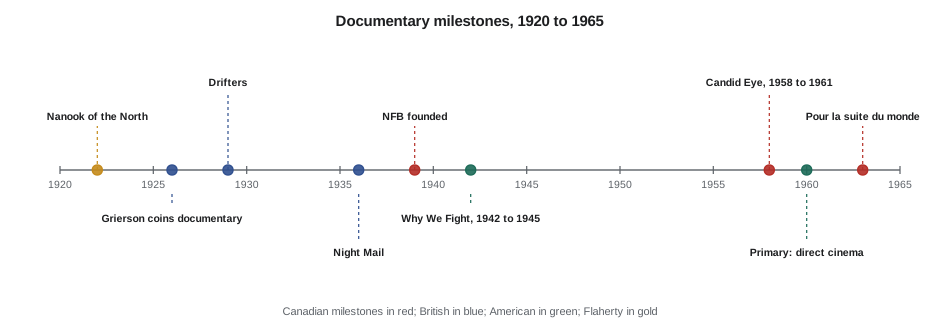
Major Hollywood directors made documentaries for the armed forces. Frank Capra supervised the Why We Fight series (1942–1945), which explained the war to American soldiers and civilians, using captured enemy footage and animated maps. John Ford filmed the Battle of Midway, and other directors recorded campaigns in North Africa, Europe and the Pacific. Wartime films also reinforced stereotypes, especially racist caricatures of Japanese people, and the US government incarcerated Japanese Americans while some films justified that policy. Critical study of wartime cinema includes these harms.
John Grierson and the documentary movement
The Scottish filmmaker and theorist John Grierson is credited with first using the word "documentary" in English, in a 1926 review, and later defined it as "the creative treatment of actuality." In Britain, he led film units at the Empire Marketing Board and then the General Post Office from the late 1920s to the mid-1930s. Grierson's units made films about work, industry and communication, such as Drifters (1929) about herring fishermen and Night Mail (1936) about a mail train, which combined images with rhythmic verse and music. Grierson saw documentary as public education for citizenship in a democracy, a way to help people understand the complex society they lived in.
Grierson admired Soviet montage and American documentaries such as Robert Flaherty's Nanook of the North (1922), which portrayed an Inuit family in northern Quebec. Nanook was hugely influential, but much of it was staged: Flaherty asked his subjects to use older hunting methods and arranged scenes for the camera. Today the film is studied both as a landmark and as an example of the ethical problems of representing Indigenous peoples through an outsider's lens.
The National Film Board of Canada
In 1938 the Canadian government invited Grierson to study its film production. His report led to the National Film Act of 1939, which created the National Film Commission, later called the National Film Board, with Grierson as its first Government Film Commissioner. Its mandate was to make and distribute films "to help Canadians in all parts of Canada to understand the ways of living and the problems of Canadians in other parts." The NFB began operating as the Second World War started and grew rapidly.
During the war, the NFB produced two major newsreel-style series, Canada Carries On and The World in Action, shown in cinemas across Canada and abroad. Stuart Legg and other filmmakers compiled footage, maps and commentary into short films on the war effort and world affairs; Churchill's Island (1941) won the first Academy Award given for a documentary. The Board also organized traveling projectionists who brought films to rural communities, factories and community halls with discussion afterwards, an early form of community screening.
Grierson also recruited the Scottish animator Norman McLaren in 1941. McLaren founded the NFB's animation unit and experimented with drawing and scratching directly on film, abstract animation and pixilation. His anti-war film Neighbors (1952) won an Academy Award, and the NFB became internationally known for experimental animation.
For comparison, the United States had no permanent national film board. New Deal agencies sponsored documentaries in the 1930s, notably Pare Lorentz's The Plow That Broke the Plains (1936) and The River (1938), and wartime agencies produced films, but American documentary mostly developed through independent filmmakers, foundations, television networks and later public broadcasting.
Worked problem
Reaching an audience without cinemas
Suppose an NFB rural circuit had 30 traveling projectionists, each giving 20 screenings a month to an average audience of 120 people. How many attendances would the circuits record in a year?
Show solution
- Screenings per projectionist per year: \( 20 \times 12 = 240 \).
- Total screenings: \( 30 \times 240 = 7200 \).
- Total attendances: \( 7200 \times 120 = 864000 \).
Answer: About 864,000 attendances a year in this illustrative case, a substantial audience in a country of about 11 to 12 million people in the early 1940s. The figure counts attendances, not individuals, since many people came to several screenings.
Documentary techniques
Wartime and social documentaries developed techniques still used today:
- Voice-of-God narration: an authoritative, unseen narrator explaining the images, common in the 1930s and 1940s.
- Compilation: assembling footage from many sources, including newsreels and captured enemy film, with maps, titles and music.
- Reconstruction: restaging events for the camera, a common and accepted practice at the time.
- Animated maps and diagrams to explain strategy, geography or statistics.
- Rhythmic editing and music, influenced by Soviet montage, to create emotional momentum.
| Approach | Typical features | Ethical questions |
|---|---|---|
| Griersonian public documentary | Narration, social purpose, sponsored by government or industry | Who decides the message, and whose voices are left out? |
| Wartime compilation | Newsreel footage, maps, persuasive commentary | How truthful is the selection and framing? |
| Ethnographic film | Outsider filmmaker records another culture | Consent, staging and representation of Indigenous and colonized peoples |
| Propaganda spectacle | Monumental staging, crowds, heroic leaders | How form glorifies power and hides violence |
Studying propaganda responsibly
Propaganda films are important historical sources: they show what governments wanted citizens to believe, how they used images and sound, and how audiences were addressed. Studying them does not mean endorsing them. Good practice includes:
- Placing each film in its historical context and naming the harms its makers caused or supported.
- Analyzing techniques without praising them in isolation from their purpose.
- Comparing official films with other evidence, including the experiences of those the films excluded or attacked.
- Being aware that clips taken out of context can still spread hateful messages today.
Some archives and platforms restrict access to the most hateful propaganda or present it with educational framing. Researchers should follow archive rules and consider carefully how they quote or excerpt such material.
Worked problem
Measuring the share of wartime production
Suppose that in an illustrative wartime year, the American studios released 440 features, of which 110 dealt directly with the war, and the NFB released 80 films, of which 52 dealt with the war effort. Compare the shares.
Show solution
- Hollywood share: \( 110 \div 440 = 0.25 \), or 25 %.
- NFB share: \( 52 \div 80 = 0.65 \), or 65 %.
- Difference: \( 65 - 25 = 40 \) percentage points.
Answer: In this illustrative comparison, a quarter of Hollywood's output addressed the war directly, while nearly two-thirds of the NFB's films did. A commercial industry balanced war films with escapist entertainment, while a public agency created to inform citizens concentrated on the war effort.
After the war
The end of the war in 1945 left European film industries damaged and American films flooding back into European markets. Countries responded with quotas and subsidies, and new movements, especially Italian Neorealism, emerged from the ruins, as the next lesson describes. Documentary continued to evolve: lighter cameras and synchronized sound recording in the late 1950s and 1960s would transform it again, and the NFB's French and English units would play a leading part in that transformation.
Reading a wartime short today
When you watch a wartime documentary short, try a simple three-pass method. On the first pass, watch without notes and record your emotional response: what did the film make you feel, and when? On the second pass, log the structure: how the film opens, where the narration makes its main claims, which images support each claim, and how the music rises toward the ending. On the third pass, look for absences: which people, places or points of view never appear, and whose voices are heard only through the narrator? Compare the film with a written source from the same year, such as a newspaper report or government document, and note where they agree and differ. This method turns a persuasive film into evidence about how a government wanted its citizens to see the war, rather than a window onto the war itself.
Common mistakes
MistakeTreating propaganda films as neutral records
InsteadAnalyze who made them, for whom, with what message and what they hide
MistakePraising Triumph of the Will's technique in isolation
InsteadConnect its techniques to its purpose of glorifying a genocidal regime
MistakeAssuming Nanook of the North is pure observation
InsteadNote Flaherty's staging and the ethics of representing Inuit people
MistakeThinking documentary has always meant unstaged recording
InsteadRecognize that reconstruction was common and accepted in early documentary
MistakeAssuming the United States had a body like the NFB
InsteadExplain that American documentary developed through agencies, independents, networks and foundations
Summary and key terms
- Governments of all kinds used film for propaganda in the 1930s and 1940s.
- Nazi Germany controlled its film industry, expelled Jewish workers and made films such as Triumph of the Will to glorify the regime.
- Hollywood joined the war effort after 1941, producing combat, home-front and training films, along with harmful stereotypes.
- John Grierson defined documentary as the creative treatment of actuality and led British documentary units.
- The National Film Board of Canada was created in 1939 with Grierson as commissioner, and won the first documentary Academy Award with Churchill's Island.
- Norman McLaren made the NFB internationally known for experimental animation.
- Studying propaganda responsibly means analyzing form and purpose together and naming the harms involved.
- Propaganda
- Communication designed to shape attitudes in support of a cause, often through emotion and simplification
- Documentary
- In Grierson's phrase, the creative treatment of actuality
- National Film Board of Canada
- The federal film agency created by the National Film Act of 1939
- Canada Carries On
- An NFB wartime series of short documentary films
- Compilation film
- A film assembled from existing footage from many sources
- Voice-of-God narration
- Authoritative, unseen narration explaining the images
- Reconstruction
- Restaging real events for the camera
- Office of War Information
- The US agency that guided wartime media, including reviewing Hollywood scripts
- Ethnographic film
- A film documenting a culture, often made by outsiders
- Studio D
- The NFB's women's studio founded in 1974
Practice problems
Work each problem on paper first, then reveal the answer to check.
What three questions help analyze a propaganda film?
Show answer
Who made it and for whom, what message it sends, and what it leaves out.
Who was the first Government Film Commissioner of the NFB?
Show answer
John Grierson.
Which NFB film won the first documentary Academy Award?
Show answer
Churchill's Island (1941).
Why is Nanook of the North ethically debated?
Show answer
Much of it was staged, and it represents Inuit people through an outsider's lens.
What did the Office of War Information do?
Show answer
It guided wartime media and reviewed Hollywood scripts.
Name two documentary techniques of the 1940s.
Show answer
Any two of: voice-of-God narration, compilation, reconstruction, animated maps, rhythmic editing.
Who founded the NFB's animation unit?
Show answer
Norman McLaren, in 1941.
25 projectionists each give 15 screenings a month to 100 people. How many attendances a year?
Show answer
\( 25 \times 15 \times 12 \times 100 = 450000 \).
Why did Hollywood avoid criticizing Nazi Germany before 1941?
Show answer
Partly to protect its European markets.
What was Studio D?
Show answer
The NFB's women's studio, founded in 1974.
Lesson quiz · 5 questions
Score 60% or more to complete this lesson.
Create a free account to save your progress, take quizzes and earn a certificate.