
FILM-120 · Lesson 4 of 12 · 27 min
International silent cinema
While Hollywood built a powerful industry in the 1910s and 1920s, filmmakers in Europe and Asia developed strikingly different ideas about what cinema could be. German Expressionism turned sets and lighting into images of inner states. Soviet filmmakers made editing the core of their art and their politics. French Impressionist and avant-garde filmmakers explored subjective experience and rhythm. Scandinavian cinema drew poetry from landscape, and Japanese cinema developed its own traditions, including live narrators. This lesson surveys these movements, explains what made each distinct, and traces their influence on cinema ever since.
Why national cinemas diverged
Several forces pushed national cinemas in different directions after the First World War. Europe's industries had been disrupted by the war while American films flooded their markets. Governments and producers responded by supporting films that offered something Hollywood did not: artistic ambition, national culture or political purpose. Intellectual and artistic movements in painting, theater, literature and architecture, such as Expressionism, Cubism, Futurism and Constructivism, shaped how filmmakers thought about images. And different economic systems, from private companies in Germany and France to state-run production in the Soviet Union, encouraged different kinds of experimentation.
Silent film also traveled easily across languages. Intertitles could be translated and replaced, so films from one country could be shown almost anywhere. This made the silent era unusually international: filmmakers saw and borrowed from one another's work, and many moved between countries.
German Expressionism
German Expressionist cinema emerged in the years after the First World War. Its best-known film, The Cabinet of Dr. Caligari (1920), directed by Robert Wiene, tells of a sinister showman and a sleepwalker who commits murders. Its painted sets are made of sharp angles, tilted walls, distorted windows and painted shadows. Nothing looks natural; the world itself appears to express madness and fear.
Characteristic features of Expressionist films include:
- Stylized, often painted or exaggerated sets with distorted perspective.
- Strong contrasts of light and shadow, including shadows used as characters.
- Stylized, sometimes mechanical acting.
- Themes of madness, doubles, tyranny, fate and the supernatural.
Other key films include F. W. Murnau's Nosferatu (1922), an unauthorized adaptation of Dracula shot partly on real locations, and Fritz Lang's Metropolis (1927), a vast science-fiction spectacle of a city divided between rich rulers and underground workers. Metropolis was heavily cut after its premiere; a print found in Buenos Aires in 2008 allowed restorers to recover most of the missing footage, a good example of how film history changes when lost material resurfaces.
German cinema of the 1920s also developed the "unchained camera": moving the camera freely through space, as in Murnau's The Last Laugh (1924), which tells its story almost entirely without intertitles. Studios such as Ufa had well-equipped facilities and technicians who became famous for lighting and effects.
The influence of Expressionism spread widely. Many German filmmakers and technicians moved to Hollywood in the 1920s and especially after the Nazis took power in 1933, carrying Expressionist lighting and design into American horror films of the 1930s and, later, into film noir.
Soviet montage
After the Russian Revolution of 1917, the new Soviet state nationalized the film industry in 1919 and saw cinema as a powerful tool for education and propaganda. Lenin is often quoted as calling cinema the most important of the arts for the new society. A shortage of film stock in the early years encouraged experiments in re-editing existing footage, and young filmmakers developed theories of montage, from the French word for assembly or editing.
Lev Kuleshov's workshop explored how the meaning of a shot depends on the shots around it. In the experiment now called the Kuleshov effect, the same neutral close-up of an actor was said to read as hunger, grief or desire depending on whether it was intercut with a bowl of soup, a coffin or a woman. Historians debate exactly how the original experiment was done, but the principle that viewers create meaning from the juxtaposition of shots became central to Soviet film theory.
Sergei Eisenstein argued that montage should create collision and conflict between shots, producing new ideas in the viewer's mind. His film Battleship Potemkin (1925), about a 1905 mutiny, contains the famous Odessa Steps sequence, in which soldiers fire on civilians. Eisenstein expands and fragments time through rapid cutting between marching soldiers, fleeing crowds, close-ups of faces and a runaway baby carriage, creating an overwhelming emotional and political effect. Other Soviet filmmakers developed their own approaches: Vsevolod Pudovkin emphasized linkage of shots to build narrative and character, and Dziga Vertov rejected fiction in favor of the "kino-eye", recording and rearranging real life, as in Man with a Movie Camera (1929), a dazzling city symphony that shows its own making.
Worked problem
Measuring the pace of montage
A described sequence from a 1925 Soviet film lasts about 6 minutes and contains about 170 shots. A described 1920s Hollywood dramatic scene of 6 minutes contains about 40 shots. Calculate the average shot length of each.
Show solution
- Convert to seconds: \( 6 \times 60 = 360 \) seconds.
- Montage sequence: \( 360 \div 170 \approx 2.1 \) seconds per shot.
- Hollywood scene: \( 360 \div 40 = 9 \) seconds per shot.
- Ratio: \( 9 \div 2.1 \approx 4.3 \).
Answer: The montage sequence averages about 2 seconds per shot, more than four times faster than the illustrative Hollywood scene at 9 seconds. Fast cutting was one of the tools Soviet filmmakers used to create intensity, though shot counts for particular films vary between sources and should be treated as estimates.
The Soviet experiment was cut short. From the late 1920s, Stalin's government demanded films in the doctrine later called socialist realism, which favored clear stories, positive heroes and official messages. Formal experimentation was condemned as "formalism", and several filmmakers faced censorship or worse. Montage theory nevertheless spread worldwide and shaped documentary, advertising, music videos and action cinema.
French Impressionism and the avant-garde
In France, a group of filmmakers and critics in the 1920s, including Louis Delluc, Germaine Dulac, Abel Gance and Jean Epstein, explored how cinema could convey subjective experience: memories, dreams, emotions and perceptions. Historians call them French Impressionists, by loose analogy with the painters. They used superimpositions, soft focus, distorting lenses, rhythmic editing and camera movement to show a character's inner state. Dulac's The Smiling Madame Beudet (1923) depicts a woman's frustrated imagination; Gance's Napoléon (1927) used multiple-camera widescreen sequences and rapid cutting on an epic scale.
Alongside them, avant-garde artists made experimental films outside the commercial industry. Dadaist and Surrealist artists such as Man Ray, Marcel Duchamp, Fernand Léger and Luis Buñuel with Salvador Dalí made short films that rejected conventional narrative, used shocking images and explored dreams and chance. Un Chien Andalou (1929) by Buñuel and Dalí remains one of the most famous examples, built on dream logic and disturbing imagery. These films laid foundations for experimental cinema throughout the century.
French cinema also produced Carl Theodor Dreyer's The Passion of Joan of Arc (1928), directed by a Danish filmmaker, which tells the story of Joan's trial largely in intense close-ups of faces. Long thought to exist only in incomplete versions, an original print was discovered in 1981 in a closet of a Norwegian psychiatric hospital.
Scandinavian and other European cinemas
In the 1910s and early 1920s, Swedish and Danish films were admired internationally. Swedish directors Victor Sjöström and Mauritz Stiller made films that used landscape, weather and natural light to express human emotion, for example Sjöström's The Phantom Carriage (1921), notable for its multiple-exposure ghost effects and flashback structure. Both directors were later recruited by Hollywood, as was the actress Greta Garbo, discovered by Stiller.
Italian cinema had led the world in historical spectacle before the First World War, with large-scale epics that influenced Griffith and others. British cinema in the 1920s produced the early films of Alfred Hitchcock, who learned from German techniques while working at the Ufa studios. Each European cinema negotiated between national traditions, artistic ambition and competition with Hollywood.
Japanese silent cinema
Japanese cinema developed distinct conventions rooted in Japanese theater and storytelling. Through the silent era and into the 1930s, screenings were accompanied by benshi, live narrators who stood beside the screen, explained the action, voiced characters and commented on the story. Popular benshi were stars in their own right, and their presence helped silent film remain commercially strong in Japan well after Hollywood converted to sound; many Japanese films were still made silent in the early 1930s.
Early Japanese films often featured onnagata, male actors playing female roles as in kabuki theater, until actresses became common in the 1920s. Genres split between jidaigeki, period dramas often featuring samurai, and gendaigeki, stories of contemporary life. Directors such as Yasujirō Ozu and Kenji Mizoguchi began their careers in the silent era, and Teinosuke Kinugasa's A Page of Madness (1926), set in a mental hospital and influenced by European avant-garde film, is one of the most experimental films of the decade anywhere. Many Japanese silent films were lost in the 1923 Great Kantō earthquake, in fires and in wartime bombing.
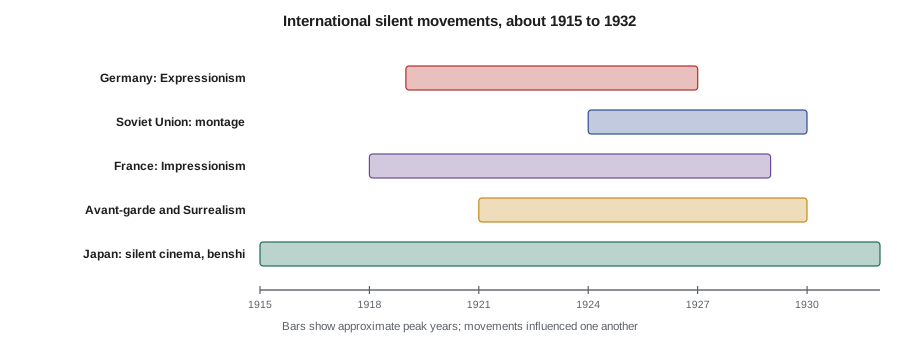
| Movement | Key years | Core idea | Representative films (described in this lesson) |
|---|---|---|---|
| German Expressionism | about 1919–1927 | Sets, lighting and acting express inner states and fears | The Cabinet of Dr. Caligari, Nosferatu, Metropolis |
| Soviet montage | about 1924–1930 | Meaning and emotion come from the juxtaposition of shots | Battleship Potemkin, Man with a Movie Camera |
| French Impressionism | about 1918–1929 | Camera and editing render subjective experience | The Smiling Madame Beudet, Napoléon |
| Avant-garde and Surrealism | 1920s | Rejecting narrative for dreams, chance and shock | Un Chien Andalou |
| Japanese silent cinema | 1910s–early 1930s | Benshi narration, theatrical roots, period and modern genres | A Page of Madness |
Influence and exchange
None of these movements stayed inside national borders. Hollywood hired European directors, cinematographers and stars and absorbed their techniques; Soviet montage influenced documentary makers in Britain and Canada, including John Grierson, who would found the National Film Board of Canada; Surrealism shaped experimental film across the Americas; and Japanese filmmakers studied both Hollywood continuity and European art cinema. Film societies and specialized cinemas in Europe and North America in the 1920s screened foreign and experimental films for enthusiasts, laying the groundwork for later film clubs, archives and festivals.
In the United States, art theaters and film societies in New York and other cities screened European films in the 1920s, and the Museum of Modern Art founded its Film Library in 1935, collecting and circulating Soviet, German and French films that shaped generations of American filmmakers and critics.
Worked problem
Running times and projection speed for a silent restoration
A restored silent feature contains about 118,000 frames. What is its running time at 18 frames per second and at 24 frames per second? Why might restorers choose a speed carefully?
Show solution
- At 18 fps: \( 118000 \div 18 \approx 6556 \) seconds, about 109 minutes.
- At 24 fps: \( 118000 \div 24 \approx 4917 \) seconds, about 82 minutes.
- Difference: about 27 minutes for the same frames.
- Restorers use evidence such as original music cues, censorship records listing film length, and the natural pace of movement to choose a speed.
Answer: The same restoration runs about 109 minutes at 18 fps but only about 82 minutes at 24 fps. Choosing the wrong speed makes movement look unnatural and changes the film's rhythm, so restorers research the original projection speed.
Common mistakes
MistakeThinking all silent cinema followed Hollywood's model
InsteadRecognize distinct movements in Germany, the Soviet Union, France, Scandinavia and Japan
MistakeDescribing the Kuleshov effect as a precisely documented experiment
InsteadTreat it as an influential principle whose original details are debated
MistakeAssuming Expressionism means only horror films
InsteadNote its broader themes of madness, power, cities and fate and its later influence on noir
MistakeIgnoring live narration in Japanese cinema
InsteadRemember that benshi shaped how Japanese audiences experienced silent films
MistakeTreating these movements as isolated
InsteadTrace how filmmakers, films and ideas moved between countries
Summary and key terms
- After the First World War, national cinemas diverged as producers and artists sought alternatives to Hollywood.
- German Expressionism used stylized sets, strong shadows and stylized acting to express inner states.
- Soviet filmmakers developed montage theory, using juxtaposition and rapid cutting to create meaning and emotion.
- French Impressionists rendered subjective experience, and avant-garde artists made non-narrative and Surrealist films.
- Scandinavian cinema drew on landscape and natural light, and many of its talents moved to Hollywood.
- Japanese silent cinema featured benshi narrators and continued making silent films into the early 1930s.
- Ideas moved across borders through emigration, film societies, archives and later festivals.
- German Expressionism
- A 1920s style using distorted sets and strong shadows to express inner states
- Montage
- Editing; in Soviet theory, the creation of meaning by juxtaposing shots
- Kuleshov effect
- The principle that viewers read a shot's meaning from the shots around it
- Odessa Steps sequence
- The massacre sequence in Battleship Potemkin, a famous example of montage
- Kino-eye
- Dziga Vertov's idea of using the camera to record and reorganize real life
- Socialist realism
- The Soviet doctrine from the 1930s requiring clear, optimistic and politically approved art
- French Impressionism
- A 1920s French movement rendering subjective experience through camera and editing
- Surrealism
- An art movement exploring dreams and the unconscious, influential in experimental film
- Benshi
- Live narrators who accompanied silent films in Japan
- Unchained camera
- The freely moving camera of 1920s German cinema
Practice problems
Work each problem on paper first, then reveal the answer to check.
What makes the sets of The Cabinet of Dr. Caligari Expressionist?
Show answer
Painted, distorted angles and shadows make the world express madness and fear.
What does the Kuleshov effect suggest?
Show answer
The same shot can mean different things depending on the shots around it.
A 4-minute sequence has 120 shots. What is its average shot length?
Show answer
\( 240 \div 120 = 2 \) seconds.
Why did Soviet experimentation decline in the 1930s?
Show answer
The government imposed socialist realism and condemned formal experiment.
What did French Impressionist filmmakers try to show?
Show answer
Characters' subjective experiences such as memories, dreams and emotions.
What role did benshi play?
Show answer
They narrated, voiced characters and explained films live during screenings.
How did German Expressionism reach Hollywood?
Show answer
German filmmakers and technicians moved to Hollywood, influencing horror and later film noir.
How long do 90,000 frames run at 20 fps?
Show answer
\( 90000 \div 20 = 4500 \) seconds, or 75 minutes.
What was discovered in Buenos Aires in 2008?
Show answer
A print of Metropolis containing most of the footage cut after its premiere.
Name a Surrealist film of 1929.
Show answer
Un Chien Andalou by Buñuel and Dalí.
Lesson quiz · 5 questions
Score 60% or more to complete this lesson.
Create a free account to save your progress, take quizzes and earn a certificate.