
FAT-330 · Lesson 8 of 12 · 20 min
Notification and voice verification
A fire alarm that detects a fire perfectly and then can't be heard has failed at its main job. The notification verification on the north wing happens on a Saturday, when the general contractor has agreed to keep the building quiet. Sasha, Nadia and Gerry each carry a sound level meter and a clipboard of rooms. 'Today we find out whether a patient behind a closed door hears the signal,' Gerry says. 'The drawings say they will. The meter will tell us.' This lesson covers verification of audible and visible notification appliances, the measurements that prove them, and how voice systems are verified.
Every appliance, every circuit
Before anything is measured, every notification appliance is operated and checked. The tester activates each circuit and walks it, confirming for each appliance that it sounds and flashes, that it is the type and setting the drawings call for, and that it is mounted as the installation standard requires. Selectable appliances, which can be set to several candela values or sound levels, are the most common source of faults: an appliance set at the factory default instead of the design value works perfectly and is wrong.
The installation review in FAT-220 found strobes in two patient lounges set to 15 candela where the design called for 75. Sasha checks the setting on every selectable strobe in the wing, not only those two rooms, and finds four more at the wrong value in the staff areas of the sixth floor. Each is recorded as a failure, reset and retested.
# Check strobe settings against the design, appliance by appliance
design = {"corridor": 75, "patient room": 30, "lounge": 75, "staff room": 30, "washroom": 15}
found = [("4-L1", "lounge", 75), ("4-L2", "lounge", 75), ("6-S3", "staff room", 15), ("6-S4", "staff room", 15),
         ("6-S7", "staff room", 15), ("6-S8", "staff room", 15), ("5-R12", "patient room", 30), ("2-W1", "washroom", 15)]
wrong = [(tag, room, cd) for tag, room, cd in found if cd != design[room]]
for tag, room, cd in wrong:
    print(f"{tag}: set to {cd} cd, design {design[room]} cd for a {room} -> reset and retest")
print(f"{len(found) - len(wrong)} of {len(found)} checked appliances match the design")6-S3: set to 15 cd, design 30 cd for a staff room -> reset and retest 6-S4: set to 15 cd, design 30 cd for a staff room -> reset and retest 6-S7: set to 15 cd, design 30 cd for a staff room -> reset and retest 6-S8: set to 15 cd, design 30 cd for a staff room -> reset and retest 4 of 8 checked appliances match the design
Synchronization
Strobes that flash out of step can, in large numbers, produce a combined flash rate that is uncomfortable and may affect people with photosensitive conditions. The standards therefore require strobes visible from one place to flash in synchronization. The tester stands where several strobes are in view, such as a long corridor, a lobby or an open nursing area, and confirms that they flash together. Strobes on different circuits or different power supplies must be synchronized through the panel or the supplies; this is where faults are found, because each circuit synchronizes within itself but not always with the next.
At the north wing's fourth-floor corridor, strobes from RPS-3 and RPS-4 meet at the cross-corridor doors. With the doors held open, Nadia can see both sets, and they drift out of step after a few seconds. The two supplies' synchronization link was never connected. Kyle's crew connects it, and the retest shows every strobe in view flashing together.
Measuring audibility
Audibility is proven by measurement, not calculation. The tester measures the ambient sound level in each space with the building in its normal condition (ventilation running, normal occupied noise where it can be simulated) and then the sound level with the alarm signal operating. The difference, and the absolute level, are compared with the requirement for that kind of space. Measurements are taken with a sound level meter set to A-weighting, at the height where people's ears will be, and with doors in the position they will normally be in.
NFPA 72 sets the targets. In public mode, the signal must be at least 15 dB above the average ambient sound level, or 5 dB above the maximum level lasting 60 seconds, whichever is greater, measured 5 ft above the floor, and must not exceed 110 dBA. In private mode, used where staff respond, such as the nurse stations in a hospital, the signal must be at least 10 dB above the average ambient level. The approved design shows which areas use which mode, and the acceptance test measures against those values.
# Audibility log: ambient and alarm levels by room, compared with the target
rule = "NFPA 72: public mode +15 dB, private mode +10 dB over average ambient"
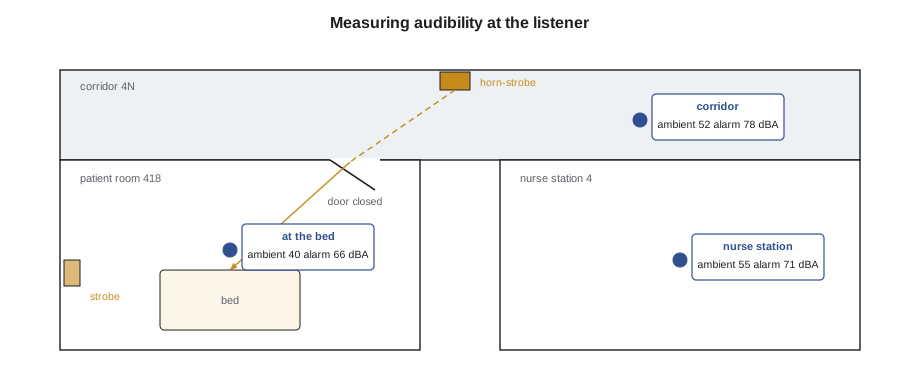
rooms = [("corridor 4N", "public", 52, 78), ("nurse station 4", "private", 55, 71), ("patient room 412 door shut", "private", 38, 63), ("patient room 418 door shut", "private", 40, 66), ("lounge 4L", "public", 54, 63)]
def target(amb, kind):
    return amb + (15 if kind == "public" else 10)
for room, kind, amb, alarm in rooms:
    need = target(amb, kind)
    ok = need <= alarm <= 110
    print(f"{room:22s} ambient {amb:3d} dBA, alarm {alarm:3d} dBA, need {need:3d}  {'ok' if ok else 'FAIL'}")
print("rule used:", rule)corridor 4N ambient 52 dBA, alarm 78 dBA, need 67 ok nurse station 4 ambient 55 dBA, alarm 71 dBA, need 65 ok patient room 412 door shut ambient 38 dBA, alarm 63 dBA, need 48 ok patient room 418 door shut ambient 40 dBA, alarm 66 dBA, need 50 ok lounge 4L ambient 54 dBA, alarm 63 dBA, need 69 FAIL rule used: NFPA 72: public mode +15 dB, private mode +10 dB over average ambient
Room 412 passes the private-mode requirement with its door shut, but the public lounge at 4L fails because its horn-strobe is behind a column and the lounge needs public mode. Ravi moves the lounge appliance on a revised drawing, and the battery and voltage drop calculations are rechecked. The patient rooms rely on private mode because nursing staff respond, as the approved design states.
Taking good measurements
The meter must be calibrated, within the time the manufacturer specifies, usually yearly, and its calibration is recorded in the report. The tester records the meter's make, model and serial number, the weighting and the response setting used. Ambient readings are taken first, with the alarm off, over long enough to be representative; a single reading taken while a cart rolls past is useless. Alarm readings are taken at the same points. Every reading is written down by room or zone, with the door position noted. Gerry also writes the time, because a reading taken at 11 a.m. on a Saturday with the air handlers in unoccupied mode may be quieter than the building will ever be on a Monday.
Measurements are taken in a representative sample of identical rooms and in every room that is different: a different size, a different door, a different ceiling, a room far from any appliance. On the north wing that means every patient room on one floor, then a sample on the floors above, plus every room that differs from the standard layout.
Voice systems
The north wing doesn't have a voice system; the hospital uses a two-stage system with horns in this wing. But Bramwell's crews verify voice systems on most high buildings, and Gerry uses a Saturday lunch to show Sasha the verification records of Riverlight Tower, the 18-story apartment building she inspected in FAT-230, from the year it was built. Voice verification adds three things to everything above.
- Every speaker is checked for its wattage tap against the design, and every speaker circuit is tested in each zone, with live voice from the fire department's microphone and with every prerecorded message.
- Zoning is proven: an evacuation message sent to the fire floor and the floors above and below reaches only those floors, an alert message reaches the rest, and the manual selection switches at the central alarm and control facility select the right zones.
- Intelligibility is measured, not only loudness: the message must be understood, in every acoustically distinguishable space where the design requires intelligibility.
Intelligibility is usually measured with the speech transmission index, STI, using a test signal and a meter that reports a value from 0 to 1. The NFPA 72 annex suggests an average of at least 0.50 in each acoustically distinguishable space, with at least 90 percent of measurement points at 0.45 or more. Riverlight's original records show every floor passing except the 15th-floor lobby, where a glass wall was added after design. The same lobby failed again at last year's annual inspection, which is why records from the acceptance test are so useful: they showed the problem was there from the start.
# Intelligibility log for a voice space: average STI and share of points below 0.45
points = {"lobby 15": [0.47, 0.43, 0.41, 0.49, 0.44, 0.46],
          "corridor 15": [0.58, 0.55, 0.61, 0.57, 0.54, 0.59]}
for space, vals in points.items():
    avg = sum(vals) / len(vals)
    low = sum(1 for v in vals if v < 0.45) / len(vals)
    ok = avg >= 0.50 and low <= 0.10
print(f"{space:12s} average {avg:.2f}, points below 0.45: {100 * low:.0f} % {'ok' if ok else 'FAIL'}")lobby 15 average 0.45, points below 0.45: 50 % FAIL corridor 15 average 0.57, points below 0.45: 0 % ok
Voice systems also need two-way communication checked where the building has it: firefighter telephones or radio enhancement, and the two-way call points at elevator lobbies and areas of refuge. FAT-310 covers voice and two-way systems in depth.
Worked problem
A room that passes on paper
The design shows patient room 418 receiving 67 dBA from the corridor horn. Nadia measures 66 dBA with the door closed and an ambient of 40 dBA. The target for the room is 65 dBA. She also notices that the door has a new acoustic seal the drawings don't show. Is the room acceptable, and is anything else needed?
Show solution
- 66 dBA meets the 65 dBA minimum and is more than 10 dBA above the 40 dBA ambient, so the room passes.
- The margin is only 1 dBA. If the hospital adds seals to other doors, other rooms may fail.
- Nadia records the reading, the door position and the seal, and adds a remark to the report.
- Gerry asks Dana whether more doors will get seals; if so, the designer should review the rooms before handover.
Answer: A pass with a small margin is worth a remark; the record should explain what the next technician will see.
Visible signals: what to look for
Strobe verification is partly about settings and partly about coverage. In each room Nadia stands at the far corners and the places people will actually be, such as beds, desks and treatment chairs, and confirms that the strobe's flash is visible, directly or by its reflection on walls and ceiling, as the design intends. Furniture and equipment moved in after design can block a strobe that was perfectly placed on the drawings; a tall medication cabinet in room 4.108 now hides the room's strobe from the doorway, and Sasha records it as a remark for the designer to review before the room is occupied.
In patient rooms and washrooms the strobe's candela setting must match the design for that room size. In corridors, the spacing between strobes and their distance from the corridor ends are checked against the design and the installation standard. And wherever strobes from more than one circuit or supply can be seen together, synchronization is checked.
Low-frequency and special signals
Some spaces need signals other than standard horns: low-frequency sounders where people sleep, as the codes increasingly require; special tones in operating rooms where a loud horn could startle a surgeon; visual-only signals in rooms where the design and the authority have accepted them. Each special case has a written basis in the design, and the verification checks that the device installed is the one specified and that it produces the signal intended. In the north wing's operating suite, the design uses a distinct chime at reduced level inside the theaters, with full signals in the suite's corridors, and both are verified against the sequence of operation.
Common mistakes
MistakeCalculating audibility instead of measuring it.
InsteadMeasure ambient and alarm levels at the listener's position.
MistakeMeasuring with doors open in rooms where they are normally closed.
InsteadMeasure with doors in their normal position.
MistakeChecking the strobe settings only in rooms where a problem was reported.
InsteadCheck every selectable appliance's setting against the design.
MistakeAssuming strobes on different supplies are synchronized.
InsteadWatch them where both are in view.
MistakeUsing an uncalibrated meter.
InsteadUse a meter calibrated within the manufacturer's interval and record it.
Summary and key terms
- Operate every appliance and check its type, setting and mounting.
- Strobes in view of one another must flash in synchronization, across circuits and supplies.
- Audibility is measured: ambient, then alarm, at the listener's position, with doors as normal.
- Compare each reading with the public or private mode target for that space.
- Voice systems add speaker taps, zoning, message and intelligibility tests.
- Record the meter, its calibration and every reading by location.
- Ambient sound level
- The normal sound level in a space without the alarm.
- A-weighting
- A meter setting that adjusts readings to match human hearing.
- Synchronization
- Strobes flashing at the same moment, so the combined flash rate stays low.
- Speech transmission index
- A measure of speech intelligibility from 0 to 1.
- Acoustically distinguishable space
- An area whose acoustics differ enough to need its own intelligibility assessment.
Practice problems
Work each problem on paper first, then reveal the answer to check.
Why must each selectable appliance's setting be checked?
Show answer
A factory default setting works but doesn't match the design.
How is strobe synchronization verified?
Show answer
By watching strobes from different circuits and supplies where they are in view together.
Why are ambient levels measured first?
Show answer
The alarm target depends on the ambient level.
What does a voice system's zoning test prove?
Show answer
That messages reach only the zones selected.
What does STI measure?
Show answer
How well speech can be understood.
Lesson quiz · 5 questions
Score 60% or more to complete this lesson.
Create a free account to save your progress, take quizzes and earn a certificate.