
FAT-330 · Lesson 2 of 12 · 20 min
NFPA 72 acceptance testing and the record of completion
Before the north wing acceptance test starts, Gerry hands Sasha and Nadia the acceptance testing sections of NFPA 72 and a blank record of completion. 'Read the record first,' he says. 'Chapter 14 tells you what to test. The record of completion tells the owner and the fire marshal what was built and that it was tested. If you understand both, you understand what the inspector will ask for.' This lesson walks through where acceptance testing sits in NFPA 72, how it connects to the fire code, and what the finished record must contain.
Where the requirement comes from
The requirement to test starts in the fire code. The International Fire Code, as adopted in North Carolina, requires fire alarm systems to be installed to NFPA 72 and requires acceptance tests before the system is approved (its section on acceptance tests and completion, 907.7 in recent editions). The edition of NFPA 72 that applies is the one referenced by the adopted code, not the newest one on the shelf. In Charlotte the fire marshal's office reviews the fire alarm plans, inspects the installation and witnesses the final acceptance test before the building can be occupied.
Within NFPA 72, acceptance testing isn't a separate document. The installation rules are spread through the chapters on fundamentals, circuits, initiating devices, notification appliances and emergency communications. Chapter 14 covers inspection, testing and maintenance, and it applies to new systems through its acceptance testing requirements and to changed systems through reacceptance testing. The same test methods table used for annual tests is used for acceptance tests; the difference is that an acceptance test covers 100 percent of the system, once, before it is relied on.
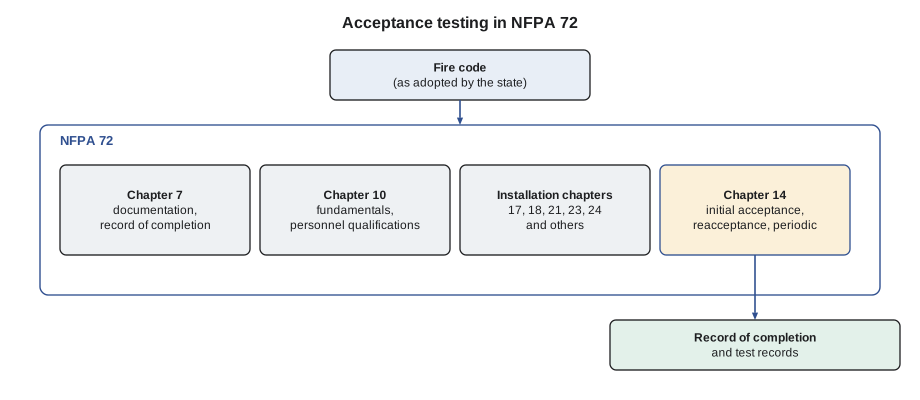
The parts of NFPA 72 that govern acceptance
Acceptance testing draws on several chapters of NFPA 72, and the technician needs to know which part answers which question:
- Chapter 10, fundamentals: the qualifications of the people who design, install, inspect and test, and the general rules for documentation and impairments.
- Chapter 7, documentation: the documents that must exist for a new system, including the record of completion, as-built drawings, the sequence of operation and site-specific software.
- The installation chapters: circuits and pathways, initiating devices, notification appliances, emergency communications and supervising station systems, which set what correct looks like.
- Chapter 14, inspection, testing and maintenance: initial acceptance testing, reacceptance testing after changes, and the test methods table that says how each device is tested.
- The annex: explanatory material, sample forms and guidance on testing voice intelligibility, which isn't mandatory unless the adopted code says so.
The record of completion has sections for every kind of system and equipment. Sections that don't apply are marked not applicable rather than left blank, because an inspector reviewing a record with empty sections can't tell whether they didn't apply or were forgotten.
Who may test
NFPA 72 Chapter 10 requires that inspection, testing and maintenance be done by qualified people, and lists ways to show qualification: factory training and certification by the equipment manufacturer, NICET certification in fire alarm systems at an appropriate level, a state or local license, or employment by an organization listed for this work. North Carolina licenses fire alarm and low-voltage contractors, and the fire marshal's office expects the responsible technician on the record of completion to hold the qualifications the code requires.
On the north wing, Bramwell's own installation crew installed the system, and Bramwell's test team does the acceptance test. NFPA 72 doesn't require the tester to be independent of the installer; it relies on qualification and on the authority witnessing the test. Gerry, who holds NICET Level III, signs as the responsible technician, with Ravi Menon, NICET Level IV, signing for the design.
What must be in place before testing starts
Both countries expect certain conditions before the formal test begins. The installation must be complete, not nearly complete: every device mounted and connected, every cover on, ceilings closed where detectors are mounted on them, and the area clean enough that construction dust won't contaminate smoke detectors. The installer must have pre-tested and corrected the faults found. The panel must be programmed with the final sequence of operation. And the documents must be on site: the approved drawings, the sequence of operation, battery calculations, voltage drop calculations and data sheets for the equipment.
NFPA 72 Chapter 7 lists the documents that must exist for a new system. The fire marshal's inspector usually asks for the approved drawings and the sequence of operation on site at the acceptance test, and checks devices against them during the walk.
The record of completion
The finished record of completion describes the installed system: the property, the type of system, the equipment and its software version, the circuits and their classes, the power supplies and batteries, the notification appliances, the connections to other systems and the supervising station, and statements by the installer and the tester. Test records support it, showing each device tested and the result. The responsible technician signs it, and a copy goes to the owner and the authority. NFPA 72 requires the record to be updated when the system is changed.
A failure found during an acceptance test must be corrected and retested before the authority accepts the system. Most inspectors won't sign off a system with open failures, though some allow minor items to be closed by a letter before occupancy.
# Which edition applies? Look up the project's code edition and the referenced standard
adopted = [(2019, "IFC 2018 as adopted", "NFPA 72-2016"), (2025, "IFC 2021 as adopted", "NFPA 72-2019")]
permit_year = 2025
code = None
for start, ed, std in adopted:
    if permit_year >= start:
        code, standard = ed, std
print("permit issued:", permit_year)
print("code in force:", code)
print("test standard referenced:", standard)
print("use that edition, even if a newer one has been published")permit issued: 2025 code in force: IFC 2021 as adopted test standard referenced: NFPA 72-2019 use that edition, even if a newer one has been published
The table in the code is illustrative; the real dates come from the state's adoption. The point is that the permit date fixes the edition. The north wing's permit was issued under the code in force at the time, and the acceptance test follows the NFPA 72 edition it references, even if Bramwell's service crews already work to a newer edition on other buildings where the code has moved on.
Worked problem
Reading a rejected record
A record of completion from another firm arrives on Gerry's desk with the fire marshal's note: not accepted. It contains the cover page, the device list and the contractor's signature. What is likely missing?
Show solution
- The tester's statement and signature, separate from the installer's.
- Power supply and battery details, circuit classes and the software version.
- Test records for every device, including notification appliances and interface outputs.
- Sections that don't apply marked not applicable rather than left blank.
Answer: An authority can only accept what the paperwork proves.
Reading Chapter 14 alongside the code
Chapter 14 doesn't stand alone. Many of its tests point back to a requirement elsewhere in NFPA 72 or in the building and fire codes: the audibility levels come from the notification appliance chapter, the mounting heights from the initiating device and notification chapters, the secondary power durations from the fundamentals chapter, and the requirement for a fire alarm at all from the building code. A tester who knows only Chapter 14 can follow its methods but can't always tell whether a result is acceptable. That is why Bramwell's test technicians carry the whole standard, the adopted fire and building codes' fire alarm sections, and the project's approved drawings on every job.
The same applies to local rules. Many authorities publish their own requirements or guidelines for fire alarm testing: forms they want used, items they want witnessed, the notice they need before a test, and how reports must be submitted. These don't replace the standard, but an authority will reject a report or postpone a test that ignores them. Before the north wing verification, Sasha downloads the current guidance from the authority's website and adds its requirements to her plan.
| Question | Where the answer usually is |
|---|---|
| Must the system be tested before approval? | Fire code, acceptance tests section |
| How is each device tested? | NFPA 72 Chapter 14 test methods table |
| Is the device installed correctly? | NFPA 72 installation chapters and the approved drawings |
| Is the sound level enough? | NFPA 72 notification chapter and the approved design |
| What goes in the record? | NFPA 72 documentation chapter forms |
| What does this authority want submitted? | The authority's own guidance |
Editions and transitions
New editions of NFPA 72 are published every three years, and states and cities adopt them on their own timetables. During a transition a technician may test one building to one edition in the morning and inspect another to a different edition in the afternoon. The differences are usually small but real: a new item on the record of completion, a changed battery margin, a new rule for a type of device. Gerry keeps a one-page summary of the differences between the editions in use and reviews it with the crew whenever a new edition comes into force.
When the edition that applies is unclear, for example where a permit was issued under one code and the work continued after a new one came into force, the answer comes from the authority, in writing, before testing starts. The report then states the edition used.
What the forms teach a new technician
Gerry's advice to read the forms first has a practical side. The forms are the standard's checklist in condensed form: every row on a device record is a question the standard expects the tester to answer, and every blank on the summary page is a statement the signer must be able to make. A trainee who fills in a set of forms for a small building, even as an exercise, learns more about what the standard requires than one who reads it cover to cover. Nadia's first assignment on the north wing is to fill in the summary and documentation pages from the project files, before a single device is tested, and to list every document she couldn't find.
What the authority looks for first
Captain Strand reviews many acceptance tests every year, and she has a routine. She reads the record of completion first, then checks that the drawings on site are the approved revision, because a test against superseded drawings can't be accepted however good the testing was. She looks at the audibility records for the rooms most likely to fail: rooms far from appliances, rooms with heavy doors, sleeping rooms. She checks that the number of device records matches the number of devices on the drawings. And she picks a few devices from the drawings and asks to see them operated, to confirm they were really tested and described correctly. A tester who knows this routine prepares records that pass it.
The lesson for a new technician is that the paperwork is read by someone who knows exactly where problems hide. Writing it carefully isn't a formality; it is the part of the job the authority actually sees.
Reading the standard as a working tool
Gerry keeps a tabbed copy of NFPA 72 in the truck, with the testing tables in Chapter 14 and the record of completion form marked. When a question comes up on site, such as how a particular appliance is to be tested or what the record must say about a monitored interface, he opens the code rather than relying on memory. He also checks the installation chapters, because many acceptance test questions are really questions about whether the installation met the code in the first place. A trainee who learns to find the answer in the section, rather than asking someone who remembers it, becomes a tester who can defend every line of a record.
Common mistakes
MistakeUsing the newest NFPA 72 because it is on the shelf.
InsteadUse the edition referenced by the code in force when the permit was issued.
MistakeStarting without approved drawings and the sequence of operation.
InsteadGet the documents first; without them you can test function but not compliance.
MistakeLeaving out report sections that don't apply.
InsteadKeep them and mark them not applicable.
MistakeLetting the installer sign the tester's statement without testing.
InsteadThe tester's statement certifies tests actually performed by qualified people.
MistakeIssuing the record with open failures on a new system.
InsteadCorrect and retest first; open items block acceptance.
Summary and key terms
- The fire code requires installation to NFPA 72 and an acceptance test before approval.
- The edition that applies is the one referenced by the code in force when the permit was issued.
- Chapter 14 covers initial acceptance and reacceptance testing; Chapter 7 covers the record of completion.
- Testing starts only when installation is complete, pre-tested and documented.
- The record of completion and test records describe the system and prove it was tested.
- Sections that don't apply are marked not applicable, not left out.
- Acceptance test
- The initial 100 percent test of a new system required by NFPA 72 Chapter 14.
- Record of completion
- The NFPA 72 document describing the installed system, signed by the responsible parties.
- Reacceptance test
- Testing after a change, covering the change and everything it affects.
- Test methods table
- The NFPA 72 Chapter 14 table describing how each device and function is tested.
- Supervising station
- The off-site station that receives fire alarm signals.
Practice problems
Work each problem on paper first, then reveal the answer to check.
Which code section requires acceptance tests?
Show answer
The fire code's acceptance tests and completion section, 907.7 in recent IFC editions.
How do you know which edition of the standard to use?
Show answer
Use the one referenced by the code in force when the permit was issued.
Who may perform an acceptance test?
Show answer
Qualified technicians as Chapter 10 describes, such as NICET-certified or factory-certified people.
What documents must be on site before testing?
Show answer
Approved drawings, the sequence of operation, battery and voltage drop calculations and equipment data sheets.
What happens to a failure found on a new system?
Show answer
It is corrected and retested before the system is accepted.
Lesson quiz · 5 questions
Score 60% or more to complete this lesson.
Create a free account to save your progress, take quizzes and earn a certificate.