
FAT-130 · Lesson 7 of 12 · 19 min
Secondary power: batteries and standby
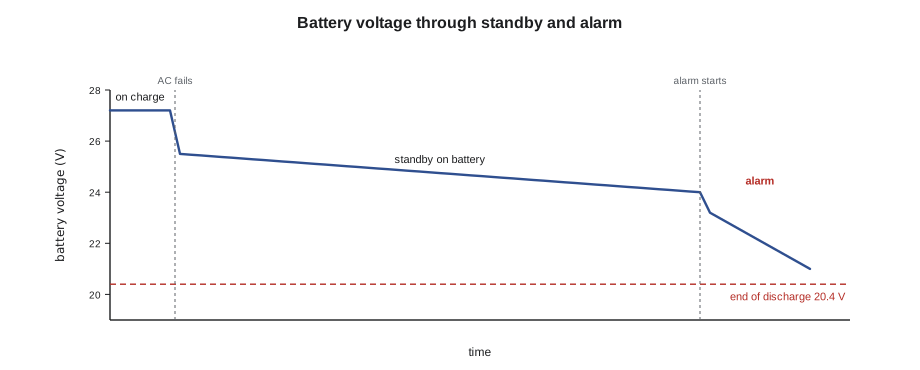
The call comes in to Bramwell's service desk at 7:40 on a Monday morning: Willowbank School's fire alarm panel is showing a battery trouble, and the custodian says the panel was beeping all weekend. Donna Achebe sends Sasha and Gerry. At the panel, the batteries read 25.8 volts on charge, which looks fine, but the moment Gerry switches off the AC breaker, the voltage collapses to 21 volts and the panel reports low battery within a minute. 'These are dead,' he says, reading the date on the label. 'Six years old. They'd have carried the panel for about twenty minutes in a blackout.' This lesson covers the batteries that keep fire alarm systems running when the power fails: how they work, how they age, how they are charged and tested, and what the standards require of them.
What secondary power must do
The secondary supply has to take over the instant the primary supply fails, with no interruption to the system's operation, carry the system in standby for a long period, and then still have enough energy left to sound every alarm for the required time. It also has to do this at the end of its service life, not just when new. In almost every fire alarm system, the secondary supply is a set of sealed lead-acid batteries in the panel cabinet or in an adjacent battery cabinet, charged continuously by the panel's charger.
NFPA 72 sets the durations for secondary power. For a protected premises system, the secondary supply must carry the system in standby, with the maximum normal load, for 24 hours, then operate all alarm notification appliances for 5 minutes. For an emergency voice/alarm communication system, the alarm period is 15 minutes of evacuation alarm at maximum load. Some supervising station and other systems have longer standby requirements, and where a listed standby generator supplies the system, the battery period can be shorter, as NFPA 72 permits. The capacity calculation must be documented in the system's records.
Sealed lead-acid batteries
Fire alarm batteries are valve-regulated lead-acid batteries, often called sealed lead-acid or SLA batteries. Each 12-volt battery contains six cells of about 2 volts each, with the electrolyte absorbed in glass-mat separators, so the battery can be mounted upright without spilling and needs no water. A valve releases gas if the internal pressure rises from overcharging. They are rated by their capacity in amp-hours at a stated discharge rate, commonly the 20-hour rate: a 12 Ah battery can deliver 0.6 amps for 20 hours. At higher currents, the usable capacity is lower, because the chemistry can't keep up with a fast discharge; the same battery might deliver only 8 or 9 Ah if discharged in a couple of hours.
This matters for fire alarm calculations because the alarm period is a high-current discharge at the end of a long, low-current standby period. The standby is close to the 20-hour rate and uses most of the capacity in a predictable way; the alarm load draws several amps for minutes or hours, and the battery's ability to deliver that depends on its condition and temperature. The panel maker's battery calculation method, and the derating factor it uses, account for this.
Temperature, age and capacity
A lead-acid battery's capacity falls in the cold. At 32 °F it may deliver only 80 to 85 percent of its rated capacity, and at −4 °F much less. Its life falls in the heat: a battery kept at 86 °F instead of 68 °F may last half as long. Fire alarm batteries are usually inside heated buildings, but batteries in unheated parking structures, outbuildings, or panels mounted near boilers and in electrical rooms that run hot need extra attention.
All lead-acid batteries lose capacity as they age, even when properly charged. A battery is usually considered at the end of its life when its capacity has fallen to 80 percent of its rating. Fire alarm batteries typically reach that point in three to five years in normal conditions. This is why the capacity calculation includes a safety margin, and why the batteries are marked with their date of manufacture or installation so that their age is visible during inspections.
# Usable capacity of an 18 Ah battery as it ages and cools (illustrative factors)
rated_Ah = 18.0
age_factor = {0: 1.00, 2: 0.95, 4: 0.85, 6: 0.65}
temp_factor = {20: 1.00, 10: 0.92, 0: 0.84}
for years, a in age_factor.items():
    row = [f"{rated_Ah * a * t:5.1f}" for t in temp_factor.values()]
print(f"{years} years old: " + " ".join(f"{c} C {v} Ah" for c, v in zip(temp_factor, row)))0 years old: 20 C 18.0 Ah 10 C 16.6 Ah 0 C 15.1 Ah 2 years old: 20 C 17.1 Ah 10 C 15.7 Ah 0 C 14.4 Ah 4 years old: 20 C 15.3 Ah 10 C 14.1 Ah 0 C 12.9 Ah 6 years old: 20 C 11.7 Ah 10 C 10.8 Ah 0 C 9.8 Ah
Charging
The panel's charger keeps the batteries at a float voltage, about 2.25 to 2.30 volts per cell, which is 27.0 to 27.6 volts for a 24-volt battery, and supplies enough current to recharge them after a power failure. Charging current is limited, often to 1 or 2 amps on a panel's built-in charger, so the charger can only recharge batteries up to a certain size in the required time.
NFPA 72 requires the charger to be able to recharge the batteries within 48 hours after they have been fully discharged, which is why each panel's listing states the largest battery its built-in charger can serve. Larger batteries need a listed external charger.
Overcharging at too high a float voltage dries out a sealed battery and shortens its life; undercharging lets the plates sulfate, which also shortens its life. A technician checks the float voltage at each inspection and compares it with the maker's range. Some chargers compensate the float voltage for temperature, raising it in the cold and lowering it in the heat.
Installing batteries
Batteries are installed in the panel cabinet or in a listed battery cabinet next to it, with the interconnecting leads supplied by the maker. In a series pair, the leads connect the positive terminal of one battery to the negative of the other, and the outer terminals go to the panel's battery connection. Polarity matters: most panels are protected against reversed battery leads by a fuse, but a reversed connection can still damage equipment. Terminals are tightened to the maker's torque and kept clean.
Each battery is marked with its date of manufacture, and many technicians add the installation date in permanent marker. Inspection checklists record both. Batteries must be the type, capacity and voltage listed for the panel, and a series pair must be matched. Batteries are heavy, often 6 to 15 kilograms each, and are lifted with proper technique; they also contain acid and lead, and spent batteries are recycled, never put in household waste.
Testing batteries
Batteries are tested at installation and at every periodic inspection. The common tests are a visual inspection for swelling, cracking, leaks and corrosion; a check of the date and of the terminals; a float voltage measurement with the charger connected; a charger test, confirming the charger supplies current after a discharge; and a load test, which confirms that the battery can deliver its rated load. A load test can be done with a load tester that applies a known current and records how the voltage falls, or by running the system on battery and measuring the voltage under standby and alarm loads. Some test instruments measure the battery's internal conductance or resistance, which rises as a battery ages and gives a quick indication of its condition.
NFPA 72 Chapter 14 sets the inspection and test frequencies and methods for batteries, including a semiannual or annual load or capacity test depending on the battery type, and requires batteries that fail to be replaced. FAT-230 covers the test procedures.
# Battery voltage readings during a test (24 V lead-acid pair, illustrative thresholds)
readings = [("on charge", 27.2), ("AC off, standby 1 min", 25.6), ("alarm load 5 min", 24.1)]
limits = {"on charge": (26.8, 27.8), "AC off, standby 1 min": (24.6, 27.0), "alarm load 5 min": (23.0, 27.0)}
for name, v in readings:
    lo, hi = limits[name]
print(f"{name:24s} {v:5.1f} V {'ok' if lo <= v <= hi else 'check'}")on charge 27.2 V ok AC off, standby 1 min 25.6 V ok alarm load 5 min 24.1 V ok
Other secondary supplies
Some larger systems use an engine-driven generator as part of the secondary supply. Where the standards allow it, a listed standby generator can reduce the required battery standby period, because the batteries only need to carry the system until the generator starts and takes the load, and to cover the time if it fails to start. The generator itself must meet the standards for emergency or standby power and be tested regularly. Even with a generator, the fire alarm system keeps batteries, because the switch from utility to generator takes several seconds, and the system must not lose power for even that long.
Worked problem
New batteries for Willowbank
Willowbank's panel needs new batteries. The panel's record shows a calculated capacity requirement of 15.2 Ah, including the derating factor, and the panel's charger is listed for batteries up to 26 Ah. What should Sasha install?
Show solution
- The next standard size at or above 15.2 Ah is 18 Ah.
- 18 Ah is within the charger's 26 Ah limit.
- Both batteries in the pair must be new, the same make, model and date code.
- After installation, she records the date, measures the float voltage, and runs a load test once the batteries are fully charged.
Answer: Sasha installs a matched pair of 12 V, 18 Ah batteries, writes the installation date on both, and schedules the load test for the next visit, after the batteries have been on charge for 48 hours. The old batteries go back to Bramwell's shop for recycling.
Battery records and replacement planning
Batteries fail on a schedule that can be predicted, which makes them one of the few fire alarm components that can be replaced before they fail. Bramwell's inspection reports record each battery set's date code, its float voltage, its voltage under load and, where an internal resistance tester is used, its internal resistance. Year over year, these readings show a battery's decline: the voltage under load falls a little each year, and the internal resistance rises. When the trend shows a battery approaching its limit, the report recommends replacement in the next budget year, and the owner can plan for it instead of reacting to a failure.
Many owners and inspection authorities set a maximum service life regardless of test results, often four or five years for sealed lead-acid batteries in fire alarm service, because the cost of replacing a battery early is small compared with the consequences of a battery failing during an emergency. Where the batteries are hard to reach, or the building's occupants are especially vulnerable, as at Eastview General Hospital, a shorter replacement cycle is common.
Swollen or leaking batteries are replaced immediately. A swollen case shows that the battery has been overcharged or has overheated, often because the charger's voltage is too high or the cabinet is too hot, so the charger and the location are checked before the new batteries go in. A leaking battery is handled with gloves and eye protection, the cabinet is cleaned of acid residue, and corroded terminals and leads are replaced.
When new batteries are installed, the technician confirms the panel recognizes them: the battery trouble clears, the charger current rises and then tapers as the batteries charge, and the float voltage settles into its normal range within a day or two. A load test is done after the batteries have had time to reach full charge, not on the day they are installed, because a new battery straight from storage may not deliver its full capacity until it has been charged.
Common mistakes
MistakeJudging a battery by its voltage on charge.
InsteadTest it under load with the AC off.
MistakeReplacing only the failed battery of a series pair.
InsteadReplace both with a matched pair.
MistakeInstalling batteries larger than the panel's charger is listed for.
InsteadUse an external listed charger for large batteries.
MistakeLeaving batteries undated.
InsteadMark the installation date so their age is visible at inspection.
MistakeDiscarding old batteries in general waste.
InsteadRecycle lead-acid batteries.
Summary and key terms
- NFPA 72 requires 24 hours of standby, then 5 minutes of alarm, or 15 minutes for voice systems.
- Fire alarm batteries are sealed lead-acid, rated in amp-hours at the 20-hour rate.
- Capacity falls with age, cold and high discharge rates; life falls with heat.
- Chargers float the battery at about 27.0 to 27.6 V and must recharge it in the required time.
- Batteries are dated, matched in pairs, load tested and replaced when they fail.
- Secondary power supply
- The supply that takes over automatically when primary power fails.
- Sealed lead-acid battery
- A valve-regulated lead-acid battery with absorbed electrolyte.
- Amp-hour
- A battery capacity unit: current multiplied by time.
- Float voltage
- The steady charging voltage that keeps a battery full.
- Load test
- A test that checks whether a battery can deliver its rated current.
- End of life
- The point, usually 80 percent of rated capacity, when a battery should be replaced.
Practice problems
Work each problem on paper first, then reveal the answer to check.
How long must an emergency voice system run in alarm after 24 hours of standby?
Show answer
15 minutes.
A 12 Ah battery is rated at the 20-hour rate. What current can it supply for 20 hours?
Show answer
0.6 A.
What float voltage would you expect on a charged 24 V battery pair?
Show answer
About 27.0 to 27.6 V.
A battery at 32 °F delivers 84 percent of its capacity. What does an 18 Ah battery deliver?
Show answer
About 15.1 Ah.
Lesson quiz · 5 questions
Score 60% or more to complete this lesson.
Create a free account to save your progress, take quizzes and earn a certificate.