
ENGG-401 · Lesson 6 of 12 · 26 min
Rate of return analysis
Managers and investors often prefer to hear that a project "earns 18 %" rather than that it "has a present worth of $21,460 at a MARR of 10 %". The rate of return expresses an investment's profitability as an interest rate, which is easy to compare with borrowing costs, the MARR and returns on other investments. Rate of return analysis is powerful but has subtleties: some cash flow patterns have several rates of return or none, and rates of return cannot simply be ranked to choose among mutually exclusive alternatives. This lesson defines the internal rate of return, shows how to calculate it, explains its relationship to present worth, discusses multiple rates of return and how to detect them, introduces the modified and external rates of return, and covers rates of return on loans and bonds.
The internal rate of return
The internal rate of return (IRR), written \(i^*\), is the interest rate at which the present worth of an investment's cash flows equals zero:
Equivalently, it is the rate at which the present worth of the inflows equals the present worth of the outflows, or the rate at which annual worth is zero. It is called internal because it depends only on the project's own cash flows, not on any external rate. For a conventional investment, with an initial outflow followed by inflows, the IRR has an intuitive meaning: it is the interest rate earned on the unrecovered balance of the investment over its life. The decision rule for a single conventional investment is to accept it if \(i^* \ge \text{MARR}\), which gives the same answer as the present worth rule.
Calculating the rate of return
Except in simple cases, the IRR equation cannot be solved algebraically, because it is a polynomial in \(1/(1 + i)\). Practical methods include:
- Trial and error with interpolation: compute present worth at two rates that bracket zero, then interpolate linearly. Repeat with a narrower bracket for more accuracy.
- Spreadsheet functions: IRR(range) for regular periodic cash flows, XIRR for cash flows on specific dates, and RATE for uniform series.
- Graphing present worth against interest rate and reading where the curve crosses zero, which also reveals multiple roots.
Worked problem
Finding the IRR by interpolation
Find the rate of return of the inspection system: −$80,000 at year 0, +$22,000 in years 1–5 and +$32,000 in year 6.
Show solution
- At 15 %: \(PW = -80{,}000 + 22{,}000\,(P/A, 15\,\%, 6) + 10{,}000\,(P/F, 15\,\%, 6) = 7{,}582\).
- At 20 %: \(PW = -3{,}490\).
- Interpolate: \(i^* \approx 15\,\% + 5\,\% \times \dfrac{7{,}582}{7{,}582 + 3{,}490} = 18.4\,\%\).
- A spreadsheet IRR gives 18.3 %; interpolation slightly overestimates because the curve is convex.
Answer: About 18.3 %, well above the 10 % MARR, consistent with the positive present worth.
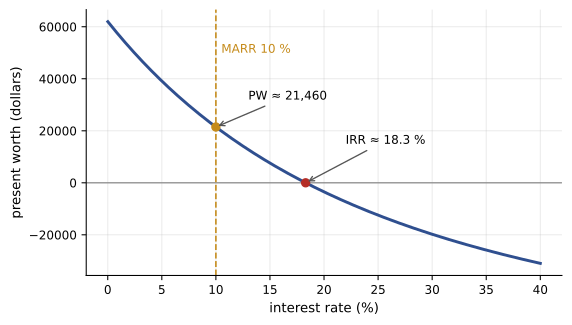
The present worth curve
Plotting present worth against interest rate gives the present worth profile. For a conventional investment, the curve starts at the undiscounted sum of the cash flows at \(i = 0\), declines as the interest rate rises, and crosses zero once, at the IRR. To the left of the IRR, present worth is positive; to the right, negative. This shows why the IRR and present worth rules agree for a single conventional investment: if the MARR is below the IRR, present worth at the MARR is positive. The slope of the curve shows how sensitive present worth is to the discount rate: projects with long lives and benefits far in the future have steep curves, so their value depends heavily on the MARR.
What the rate of return means
For a conventional investment, the IRR is the rate earned on the investment balance that remains unrecovered each year. Consider a loan of $1,000 repaid with $1,100 one year later: the lender earns 10 % on the $1,000 outstanding. For a project, an investment balance table shows the unrecovered balance at the start of each year, the interest at \(i^*\) on that balance, the cash flow received, and the balance at the end. At the IRR, the final balance is exactly zero: the project has recovered its investment and paid interest at \(i^*\) on the outstanding amount throughout. A common misunderstanding is that the IRR assumes cash flows are reinvested at the IRR; strictly, the IRR describes the return on the money that remains invested in the project, and the reinvestment of released cash is a separate question that the modified rate of return addresses.
| Year | Balance at start | Interest at 18.3 % | Cash flow | Balance at end |
|---|---|---|---|---|
| 1 | −80,000 | −14,640 | +22,000 | −72,640 |
| 2 | −72,640 | −13,293 | +22,000 | −63,933 |
| 3 | −63,933 | −11,700 | +22,000 | −53,633 |
| 4 | −53,633 | −9,815 | +22,000 | −41,448 |
| 5 | −41,448 | −7,585 | +22,000 | −27,033 |
| 6 | −27,033 | −4,947 | +32,000 | ≈ 0 |
Multiple rates of return
The IRR equation is a polynomial, and a polynomial of degree \(n\) can have up to \(n\) real roots. For conventional cash flows, with one sign change from negative to positive, there is exactly one positive IRR. But non-conventional cash flows, with more than one change of sign, may have several IRRs or none. Such patterns arise in practice: mining and oil projects with large reclamation costs at the end, nuclear plants with decommissioning costs, projects requiring a major mid-life overhaul, and leases or contracts with payments in both directions. Two rules help detect multiple roots:
- Descartes' rule of signs: the number of positive real roots is at most the number of sign changes in the cash flow sequence.
- Norstrom's criterion: if the cumulative cash flow series starts negative and changes sign only once, there is a single positive IRR.
Worked problem
A project with two rates of return
A pump installation in a mining operation has cash flows of −$1,600 at year 0, +$10,000 at year 1 and −$10,000 at year 2 (in thousands), the last being a site restoration cost. Find the rates of return.
Show solution
- Set \(x = 1 + i\). Then \(-1{,}600 + 10{,}000/x - 10{,}000/x^2 = 0\), or \(1{,}600x^2 - 10{,}000x + 10{,}000 = 0\).
- Solve: \(x = \dfrac{10{,}000 \pm \sqrt{10{,}000^2 - 4 \times 1{,}600 \times 10{,}000}}{2 \times 1{,}600} = 1.25\) or \(5\).
- So \(i^* = 25\,\%\) or \(i^* = 400\,\%\).
- Present worth is positive between 25 % and 400 % and negative outside that range, so neither rate is a meaningful measure of return.
Answer: Two IRRs, 25 % and 400 %; use present worth at the MARR, or an external rate of return, to decide.
When multiple rates exist, the IRR is not a reliable decision measure. The safest approach is to use present worth or annual worth at the MARR, which always gives a unique answer. If a rate of return is needed for communication, use the modified or external rate of return.
Modified and external rates of return
The modified internal rate of return (MIRR) avoids multiple roots by separating financing and reinvestment. Negative cash flows are discounted to time 0 at a finance rate, positive cash flows are compounded to the end of the life at a reinvestment rate, often the MARR, and the MIRR is the rate that makes the two equivalent:
For the inspection system, with both rates at 10 %, the future worth of inflows is about $179,700 at year 6, and the MIRR is \((179{,}700/80{,}000)^{1/6} - 1 = 14.4\,\%\), lower than the IRR because released cash is assumed to earn only 10 %. The MIRR is always unique, and its comparison with the MARR gives the same accept or reject decision as present worth when the reinvestment rate equals the MARR. The external rate of return (ERR) is a closely related measure used in some engineering economics texts. Spreadsheets provide an MIRR function.
Rates of return on loans and bonds
The same mathematics finds the effective cost of borrowing and the yield on bonds. The true cost of a loan includes fees: a loan of $100,000 with a 2 % arrangement fee, repaid in equal payments at a stated 7 %, has an effective rate higher than 7 % because the borrower receives only $98,000. A bond pays periodic coupon interest and repays its face value at maturity; its yield to maturity is the IRR of buying it at the market price and receiving the coupons and face value. A 10-year bond with a 5 % annual coupon and a face value of $1,000 bought for $950 has cash flows of −950, then +50 for nine years and +1,050 in year 10, giving a yield of about 5.7 %, above the coupon rate because it was bought at a discount. Engineers encounter these calculations in project finance, municipal bond-funded infrastructure and lease analysis.
Strengths and limitations
The rate of return is intuitive and widely used, and it does not require choosing a MARR to compute, only to interpret. But it has important limitations: multiple or no roots for non-conventional cash flows; misleading rankings of mutually exclusive alternatives of different sizes or timings, which Lesson 7 resolves with incremental analysis; insensitivity to scale, since a project earning 50 % on $1,000 adds far less value than one earning 20 % on $1 million; and potential confusion when cash flows include financing. Many organizations report both present worth and IRR, relying on present worth for decisions and IRR for communication.
Rates of return in practice
Many organizations state investment policies in terms of rates of return: a utility may require projects to earn at least its allowed return on equity, a manufacturer may set a hurdle rate of 15 % for cost reductions, and venture investors may target 30 % or more. When reporting rates of return, specify whether they are before or after tax, real or nominal, and project or equity returns. Project IRR considers all cash flows regardless of financing; equity IRR considers only the cash flows to equity holders after debt payments, and is higher when debt is cheaper than the project return, the effect of financial leverage. Confusing these measures is a common source of misunderstanding between engineers and finance teams.
Rate of return on incremental investment in design
Designers often face choices between a basic design and an enhanced version that costs more but saves money, such as thicker insulation, larger pipes with lower pumping costs, or premium-efficiency equipment. The rate of return on the extra investment, found by setting the present worth of the savings equal to the extra first cost, tells the owner whether the upgrade is worthwhile at their MARR. Optimization problems, such as the economic thickness of insulation or the economic diameter of a pipe, apply the same idea continuously: increase the investment until the marginal return on the last increment equals the MARR.
Rate of return and the payback reciprocal
For a long-lived investment with uniform annual returns, the IRR approaches the reciprocal of the simple payback period: a project with a five-year payback and a very long life earns close to 20 %. For shorter lives, the IRR is much lower than the payback reciprocal, and for lives close to the payback period it approaches zero. This rule of thumb helps explain why short paybacks demanded by some firms imply very high required returns.
Common mistakes
MistakeRanking mutually exclusive alternatives by IRR.
InsteadUse incremental analysis or present worth (Lesson 7).
MistakeReporting one IRR for non-conventional cash flows.
InsteadCheck sign changes and use PW or MIRR.
MistakeIgnoring fees when calculating loan costs.
InsteadInclude all cash flows in the IRR.
MistakeAssuming a higher IRR means more value.
InsteadConsider scale; PW measures value added.
MistakeTrusting linear interpolation over wide brackets.
InsteadNarrow the bracket or use a spreadsheet.
Summary and key terms
- The IRR is the rate at which present worth equals zero.
- Accept a conventional investment if IRR ≥ MARR.
- The PW curve crosses zero at the IRR.
- The IRR is the return earned on the unrecovered investment balance.
- Non-conventional cash flows may have several IRRs or none.
- MIRR uses explicit finance and reinvestment rates and is unique.
- IRR is useful for communication but PW is safer for decisions.
- Internal rate of return
- Rate at which PW equals zero.
- Conventional cash flow
- One sign change from outflow to inflows.
- Present worth profile
- Graph of PW against interest rate.
- Investment balance
- Unrecovered amount of an investment over time.
- Descartes' rule of signs
- Limit on the number of positive roots.
- Norstrom's criterion
- Test for a unique IRR using cumulative cash flows.
- MIRR
- Modified internal rate of return.
- Reinvestment rate
- Rate assumed for released cash flows.
- Yield to maturity
- IRR of holding a bond to maturity.
- XIRR
- Spreadsheet IRR for dated cash flows.
Practice problems
Work each problem on paper first, then reveal the answer to check.
Define the IRR.
Show answer
The interest rate at which PW of all cash flows is zero.
IRR of investing $1,000 and receiving $1,210 in two years?
Show answer
10 %.
IRR of −$10,000 then $2,638 a year for 5 years?
Show answer
About 10 %.
What does IRR above the MARR imply?
Show answer
PW at the MARR is positive.
Maximum number of IRRs for cash flows −, +, −, +?
Show answer
Three.
What does Norstrom's criterion test?
Show answer
Cumulative cash flows with one sign change give a unique IRR.
Why is MIRR lower than IRR for the inspection system?
Show answer
Released cash is reinvested at 10 %, below the IRR.
Yield of a bond bought at a discount compared with coupon rate?
Show answer
Higher.
Why include loan fees in the IRR?
Show answer
They reduce cash received and raise the true cost.
Why is IRR insensitive to scale a problem?
Show answer
A small high-return project can add less value than a large lower-return one.
Lesson quiz · 5 questions
Score 60% or more to complete this lesson.
Create a free account to save your progress, take quizzes and earn a certificate.