
ENGG-130 · Lesson 6 of 12 · 39 min
Centroids and centers of gravity
Up to now, every body's weight has been treated as a single force acting at a known point: the middle of a uniform beam, the center of a crate. Real objects are rarely so simple. A crane with its boom, counterweight and cab, a T-shaped concrete beam, a truck with a load, a ship, a dam: each has weight spread through it, and to write its equilibrium equations you must know where the resultant of all that weight acts. That point is the center of gravity. For areas and shapes, the corresponding geometric point is the centroid, and it appears again and again in later engineering courses: the neutral axis of a beam passes through the centroid of its cross-section (Lesson 11), the resultant of a distributed load acts at the centroid of the load diagram (Lesson 7), and the stability of vehicles, cranes and structures depends on the height of their center of gravity. This lesson defines these points, shows how to find them by integration and, much more often in practice, by dividing a shape into simple parts, and introduces the theorems of Pappus for areas and volumes of revolution.
Center of gravity, center of mass and centroid
A body is made of a huge number of particles, each pulled down by its own small weight. These parallel forces can be replaced by one resultant equal to the total weight W, acting at the center of gravity G, the point about which the weights of all the particles produce zero net moment. Applying the moment equivalence of Lesson 3 gives:
Three related points are worth distinguishing:
- The center of gravity uses weight. In a uniform gravity field, which is accurate for anything smaller than a mountain range, it coincides with the center of mass, which uses mass (dm instead of dW).
- The center of mass matters in dynamics, where it is the point whose motion follows Newton's second law for the whole body.
- The centroid is purely geometric: the average position of a line, area or volume. For a body made of one uniform material, the center of gravity is at the centroid of its volume.
For an area A in the x-y plane, the centroid C is at:
The integrals ∫x dA and ∫y dA are the first moments of the area about the y and x axes. If an area has an axis of symmetry, the centroid lies on it, because every element on one side is matched by one on the other with an equal and opposite moment. A rectangle's centroid is at its center, a circle's at its center, and a symmetric I-beam's at mid-depth.
Centroids by integration
For shapes bounded by simple curves, choose a convenient element dA, usually a thin strip, write its area and the coordinates of its own centroid, and integrate.
Worked problem
Centroid of a triangle
Find the height of the centroid of a triangle with base b and height h, measured from the base.
Show solution
- Use horizontal strips of thickness dy at height y. By similar triangles, the strip's width is \(b(h - y)/h\), so \(dA = b(h - y)\,dy/h\).
- \[\int y\,dA = \int_0^h y\,\frac{b(h-y)}{h}\,dy = \frac{b}{h}\left[\frac{hy^2}{2}-\frac{y^3}{3}\right]_0^h = \frac{bh^2}{6}\]
- Area: \(A = bh/2\). So \(\bar{y} = (bh^2/6)/(bh/2) = h/3\).
Answer: The centroid is one-third of the height above the base (two-thirds of the way down from the apex). This result is used constantly: the resultant of a triangular distributed load acts at one-third of its length from the larger end (Lesson 7).
Worked problem
Centroid of a quarter circle
Find the centroid of a quarter-circle area of radius r in the first quadrant.
Show solution
- Use thin triangular wedges from the origin, each of angle dθ. A wedge has area \(\tfrac{1}{2}r^2\,d\theta\), and its centroid is two-thirds of the way out, at \((\tfrac{2}{3}r\cos\theta, \tfrac{2}{3}r\sin\theta)\).
- \[\int x\,dA = \int_0^{\pi/2}\tfrac{2}{3}r\cos\theta\cdot\tfrac{1}{2}r^2\,d\theta = \frac{r^3}{3}\]
- Area: \(\pi r^2/4\). So \(\bar{x} = (r^3/3)/(\pi r^2/4) = 4r/(3\pi)\); by symmetry \(\bar{y}\) is the same.
Answer: Both coordinates equal 4r/(3π) ≈ 0.424r. The same distance locates the centroid of a semicircle from its diameter, used for the hydrostatic force on curved gates and for arched culverts.
Composite areas
Most engineering shapes are made of rectangles, triangles, circles and other simple pieces whose centroids are known. Then the integrals become sums. Divide the shape into parts, find each part's area and centroid, and combine:
A hole or cut-out is treated as a part with negative area. Working in a table, with columns for each part's area, centroid coordinates and first moments, keeps the arithmetic organized and easy to check.
| Shape | Area | Centroid location |
|---|---|---|
| Rectangle b × h | bh | Center: b/2, h/2 |
| Triangle, base b, height h | bh/2 | h/3 above the base |
| Circle, radius r | πr² | Center |
| Semicircle, radius r | πr²/2 | 4r/(3π) from the diameter |
| Quarter circle, radius r | πr²/4 | 4r/(3π) from each straight edge |
| Parabolic spandrel (y = kx², width a, height h) | ah/3 | 3a/4 from the vertex, 3h/10 above the base |
Worked problem
A T-section
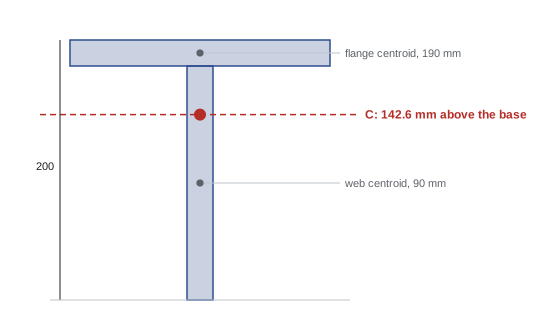
A steel T-section has a flange 200 mm wide and 20 mm thick on top of a web 20 mm thick and 180 mm deep, for a total depth of 200 mm. Find the height of its centroid above the bottom of the web.
Show solution
- Flange: \(A_1 = 200 \times 20 = 4000\) mm², centroid at \(y_1 = 180 + 10 = 190\) mm.
- Web: \(A_2 = 20 \times 180 = 3600\) mm², centroid at \(y_2 = 90\) mm.
- \[\bar{y} = \frac{4000(190) + 3600(90)}{4000 + 3600} = \frac{760\,000 + 324\,000}{7600} = 142.6 \text{ mm}\]
- By symmetry, the centroid lies on the vertical centerline.
Answer: The centroid is 142.6 mm above the bottom, only 57.4 mm below the top, pulled up toward the wide flange. When the T bends as a beam, its neutral axis passes through this point (Lesson 11), so the bottom of the web is much farther from it and carries the highest bending stress.
Worked problem
A plate with a hole
A 400 mm × 300 mm steel plate (x from 0 to 400, y from 0 to 300) has a 100 mm diameter hole centered at (300, 200). Find the centroid of the plate.
Show solution
- Plate: \(A_1 = 120\,000\) mm² at (200, 150).
- Hole: \(A_2 = -\pi(50)^2 = -7854\) mm² at (300, 200).
- \[\bar{x} = \frac{120\,000(200) - 7854(300)}{120\,000 - 7854} = \frac{24\,000\,000 - 2\,356\,000}{112\,146} = 193.0 \text{ mm}\]
- \[\bar{y} = \frac{120\,000(150) - 7854(200)}{112\,146} = \frac{18\,000\,000 - 1\,571\,000}{112\,146} = 146.5 \text{ mm}\]
Answer: (193.0, 146.5) mm. Removing material from the upper right moves the centroid down and to the left, as expected. A quick check like this, asking which way the answer should move, catches sign errors.
Centers of gravity of composite bodies
The same method works in three dimensions and for bodies made of different materials: replace the areas by weights (or masses) and the centroids by each part's center of gravity.
This is how engineers locate the center of gravity of a loaded truck, a crane, an aircraft or a ship. Aircraft are loaded to keep the center of gravity within a certified envelope on every flight, because a center of gravity outside it can make an aircraft uncontrollable; incorrect loading has caused fatal crashes.
Worked problem
A mobile crane
A mobile crane has a carrier weighing 300 kN with its center of gravity 2.0 m in front of the slewing center (x = 2.0 m), an upper works and counterweight weighing 200 kN at x = −2.5 m, and a boom weighing 40 kN at x = 6.0 m. It lifts a 60 kN load at x = 14 m. The front outriggers are at x = 4.0 m. Where is the combined center of gravity, and is the crane stable?
Show solution
- Total weight: \(300 + 200 + 40 + 60 = 600\) kN.
- First moment: \(300(2.0) + 200(-2.5) + 40(6.0) + 60(14) = 600 - 500 + 240 + 840 = 1180\) kN·m.
- \(\bar{x} = 1180/600 = 1.97\) m.
- The crane tips about the front outriggers if the combined center of gravity moves beyond x = 4.0 m.
Answer: The center of gravity is at 1.97 m, inside the outrigger line, so the crane is stable. The load that would bring it to the tipping line follows from (340 + 14P)/(540 + P) = 4.0, giving P = 182 kN at 14 m. Crane load charts limit the rated load to a fraction of the tipping load (for mobile cranes on outriggers, typically 85 % or less, depending on the standard), and the rated load falls quickly as the radius grows. This is the tipping check of Lesson 3, organized by center of gravity.
Stability and the height of the center of gravity
The higher a body's center of gravity, the smaller the tilt or sideways force needed to tip it. A simple measure for vehicles is the static stability factor, SSF = T/(2h), where T is the track width (the distance between the left and right wheels) and h is the height of the center of gravity. It is the sideways acceleration, in g, at which a rigid vehicle would begin to tip on a flat surface.
Worked problem
Rollover risk
A car has a track width of 1.55 m and a center of gravity 0.55 m high. A tall SUV has a track of 1.65 m and a center of gravity 0.75 m high. Compare their static stability factors.
Show solution
- Car: SSF = 1.55/(2 × 0.55) = 1.41.
- SUV: SSF = 1.65/(2 × 0.75) = 1.10.
Answer: The car would need a sideways acceleration of 1.41 g to tip, more than its tires can generate on dry pavement, so it slides rather than rolls. The SUV's threshold, 1.10 g, is within reach if it trips on a curb or soft shoulder. Transport safety agencies use the SSF in rollover ratings; electronic stability control and lower centers of gravity (as in electric vehicles with floor-mounted batteries) have cut rollover deaths substantially. Loading a roof rack or a pickup bed raises the center of gravity and lowers the SSF.
The same idea governs ships, where the center of gravity must stay below a point called the metacentre; cranes and aerial work platforms, which are tested on slopes; tall storage racks and shelving, which must be anchored; and precast concrete panels and steel beams during lifting, where the lifting points must be placed relative to the center of gravity so the piece hangs level.
The theorems of Pappus–Guldinus
Two theorems, known since Pappus of Alexandria in the fourth century, give areas and volumes of bodies of revolution from centroids. When a plane curve or area is rotated about an axis in its plane that does not cross it:
- The surface area generated by rotating a curve equals the curve's length times the distance traveled by its centroid: \(A = 2\pi\bar{r}L\).
- The volume generated by rotating an area equals the area times the distance traveled by its centroid: \(V = 2\pi\bar{r}A\).
Here \(\bar{r}\) is the distance from the axis to the centroid of the curve or area. The theorems save integration for tanks, domes, pipes, rings, pulleys and other axisymmetric parts.
Worked problem
Concrete in a ring-wall foundation
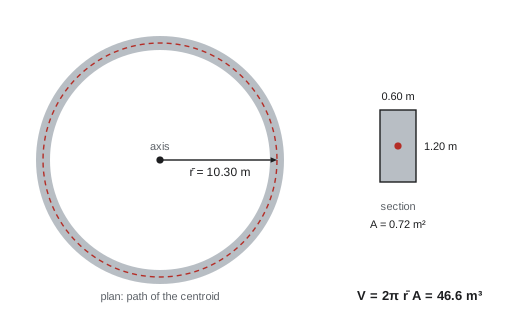
A circular storage tank sits on a concrete ring wall with a rectangular cross-section 0.60 m wide and 1.20 m deep. The inner face of the wall is at a radius of 10.0 m. Find the volume of concrete.
Show solution
- Cross-section area: \(A = 0.60 \times 1.20 = 0.72\) m².
- Centroid radius: \(\bar{r} = 10.0 + 0.30 = 10.30\) m.
- \(V = 2\pi(10.30)(0.72) = 46.6\) m³.
Answer: About 46.6 m³ of concrete, roughly six truckloads. The theorem gives the exact answer without integration, provided you use the radius to the centroid, not to the inner or outer face.
Practical notes
Finding centroids by hand is mostly an exercise in organization. Steel section tables list the centroid (and the moments of inertia of Lesson 11) of every standard shape, and CAD programs report the centroid and mass properties of any modeled part. Engineers still need the hand method to check software, to deal with built-up sections and unusual shapes, and to understand what the numbers mean. Always ask which way a result should move when part of a body is added or removed, and confirm that the centroid lies within the body's overall extent and on any axis of symmetry.
Lesson 7 uses centroids to replace distributed loads and fluid pressures by single resultant forces, and Lesson 11 builds on the same first moments to find second moments, the moments of inertia that control how beams bend.
Common mistakes
MistakeMeasuring each part's centroid from a different reference.
InsteadMeasure every part's centroid from the same origin and axes.
MistakeAdding a hole's area instead of subtracting it.
InsteadTreat holes and cut-outs as negative areas.
MistakePutting a triangle's centroid at h/2.
InsteadIt lies at h/3 from the base.
MistakeUsing the inner or outer radius in Pappus's theorems.
InsteadUse the radius to the centroid of the curve or area.
MistakeIgnoring the height of the center of gravity in stability checks.
InsteadA higher center of gravity reduces the force needed to tip a body.
Summary and key terms
- The center of gravity is where the resultant weight acts; in uniform gravity it coincides with the center of mass.
- The centroid is the geometric center of a line, area or volume; it lies on any axis of symmetry.
- The centroid is the first moment divided by the area; integrate with strips or wedges for curved shapes.
- For composite shapes, sum each part's area times its centroid coordinate and divide by the total area; holes are negative.
- Composite bodies use weights in place of areas.
- Stability depends on the center of gravity's position and height: SSF = T/(2h) for vehicles.
- Pappus: area of revolution = 2πr̄L; volume of revolution = 2πr̄A.
- Center of gravity
- The point where the resultant weight of a body acts.
- Center of mass
- The mass-weighted average position of a body's particles.
- Centroid
- The geometric center of a line, area or volume.
- First moment of area
- The integral of distance times area, ∫x dA or ∫y dA.
- Composite area
- An area made of simple shapes whose centroids are known.
- Negative area
- A hole or cut-out subtracted in a composite calculation.
- Tipping load
- The load at which a body's center of gravity reaches its tipping line.
- Static stability factor
- T/(2h): the sideways acceleration in g at which a rigid vehicle would tip.
- Metacentre
- For a floating body, the point the center of gravity must stay below for stability.
- Pappus–Guldinus theorems
- Area and volume of revolution equal length or area times the centroid's path.
Practice problems
Work each problem on paper first, then reveal the answer to check.
Where is the centroid of a 300 mm wide, 120 mm high rectangle with its lower-left corner at the origin?
Show answer
(150, 60) mm.
A right triangle has its right angle at the origin, a 90 mm leg along x and a 60 mm leg along y. Find its centroid.
Show answer
(30, 20) mm.
Find the centroid of a semicircle of radius 150 mm from its diameter.
Show answer
4(150)/(3π) = 63.7 mm.
An L-shape is a 100 × 20 mm horizontal leg (bottom) and a 20 × 80 mm vertical leg above its left end. Find \(\bar{y}\) from the bottom.
Show answer
(2000 × 10 + 1600 × 60)/3600 = 32.2 mm.
For the same L-shape, find \(\bar{x}\) from the left edge.
Show answer
(2000 × 50 + 1600 × 10)/3600 = 32.2 mm.
A 200 mm square plate has a 50 mm diameter hole at its center. Where is its centroid?
Show answer
At the center; the hole is symmetric.
In the crane example, what is \(\bar{x}\) if the load is 100 kN?
Show answer
(340 + 1400)/640 = 2.72 m; still stable.
A van has a track of 1.70 m and its center of gravity is 0.90 m high when loaded. Find its SSF.
Show answer
1.70/1.80 = 0.94.
Find the volume of a solid formed by rotating a 0.2 m × 0.4 m rectangle about an axis 1.0 m from its centroid.
Show answer
2π(1.0)(0.08) = 0.503 m³.
Find the surface area of a sphere of radius r using Pappus (a semicircular arc has length πr and its centroid is 2r/π from the diameter).
Show answer
2π(2r/π)(πr) = 4πr².
Lesson quiz · 5 questions
Score 60% or more to complete this lesson.
Create a free account to save your progress, take quizzes and earn a certificate.