
ENGG-130 · Lesson 10 of 12 · 35 min
Friction
Until now, surfaces in contact have mostly been treated as smooth, able to push only perpendicular to themselves. Real surfaces also resist sliding, and that resistance, friction, is everywhere in engineering. Sometimes it is wanted: brakes, clutches, belt drives, bolted joints that grip by friction, nails and screws, tires on roads, footings that must not slide, and workers who must not slip. Sometimes it is a loss to be minimized: in bearings, gears and machine slides. And sometimes it decides whether a system works at all: whether a wedge stays in place, whether a screw jack holds its load, whether a ladder slips. This lesson covers the laws of dry friction, problems in which an object may slide or tip, wedges, screws and belt friction, and the practical uses of each.
The laws of dry friction
When one dry surface rests on another, the contact force has two components: the normal force N, perpendicular to the surfaces, and the friction force F, along them, which opposes any tendency to slide. Experiments, first systematized by Leonardo da Vinci and later by Guillaume Amontons and Charles-Augustin de Coulomb, show that:
- While there is no sliding, the friction force is whatever is needed for equilibrium, up to a limit: \(F \le \mu_s N\), where \(\mu_s\) is the coefficient of static friction.
- When sliding is about to start (impending motion), \(F = \mu_s N\).
- Once sliding occurs, the friction force drops to \(F = \mu_k N\), where the coefficient of kinetic friction \(\mu_k\) is usually 20 to 25 % lower than \(\mu_s\).
- To a good approximation, the friction force does not depend on the apparent contact area or the sliding speed.
These rules, often called Coulomb friction, are empirical approximations. Coefficients depend on the materials, surface finish, contamination, moisture and temperature, and vary widely; published values are guides, and safety-critical designs use conservative values or tests.
| Surfaces | Typical μ_s |
|---|---|
| Steel on steel, dry | 0.5–0.8 |
| Steel on steel, lubricated | 0.1–0.2 |
| Rubber tire on dry asphalt | 0.7–0.9 |
| Rubber tire on wet asphalt | 0.4–0.6 |
| Rubber tire on ice | 0.05–0.15 |
| Concrete on soil or rock | 0.4–0.6 |
| Wood on wood | 0.3–0.5 |
| PTFE (Teflon) on steel | 0.04 |
The resultant of N and the maximum friction force makes an angle φ with the normal, where \(\tan\phi_s = \mu_s\). This angle of friction gives a useful geometric test: a block on an incline is on the verge of sliding when the incline angle equals φ_s. For dry sand or gravel, the angle of repose, the steepest stable slope of a pile, is closely related.
Worked problem
Will the crate slide down the ramp?
A crate rests on a ramp inclined at 20°. The coefficient of static friction is 0.30. Does it slide? What is the steepest safe ramp angle?
Show solution
- On an incline with no other forces, equilibrium needs \(F = W\sin\theta\) and \(N = W\cos\theta\), so the required ratio is \(F/N = \tan\theta = \tan 20° = 0.364\).
- Available: \(\mu_s = 0.30 < 0.364\). The friction needed exceeds what is available.
- Steepest safe angle: \(\theta = \tan^{-1}(0.30) = 16.7°\).
Answer: The crate slides; ramps for this crate must be flatter than about 16.7°, with a margin for wet or dusty surfaces. The same reasoning sets maximum slopes for conveyors, chutes and loading ramps.
Solving friction problems
Friction problems fall into three types. In the first, the loads are known and the question is whether the body stays put: solve for the friction force needed for equilibrium and compare it with μ_s N. In the second, motion is impending at every contact where slip could occur: set F = μ_s N there and solve for the unknown load. In the third, there are several possible ways for motion to start (slipping at one contact or another, or tipping instead of sliding), and each must be checked to see which happens first, at the smallest load.
Friction always acts to oppose the motion or impending motion of each surface relative to the other. Decide the direction of impending motion first, then draw the friction force on each body in the opposite direction. Lesson 4's ladder example is a classic case: the ladder can slip only at both ends at once, so friction must be at its limit at both contacts (or at the floor only, if the wall is smooth).
Worked problem
Slide or tip?
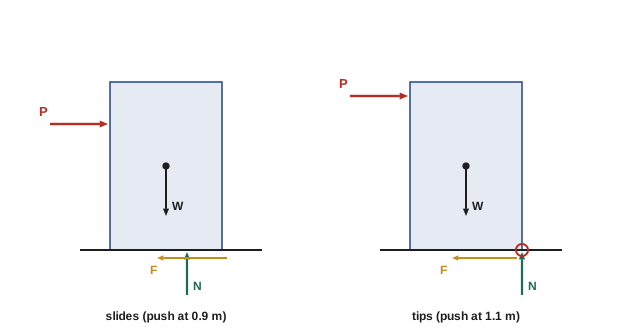
A cabinet 1.2 m tall and 0.8 m deep weighs 500 N, with its center of gravity at its center. It is pushed horizontally with force P at a height of 0.9 m. The coefficient of static friction with the floor is 0.40. Will it slide or tip first? What if it is pushed at 1.1 m?
Show solution
- Sliding: requires \(P = \mu_s W = 0.40 \times 500 = 200\) N.
- Tipping about the front bottom edge: the floor reaction moves to that edge, and moments about it give \(P \times 0.9 = 500 \times 0.4\), so \(P = 222\) N.
- Sliding needs less force (200 N < 222 N), so the cabinet slides.
- Pushed at 1.1 m: tipping needs \(P = 500 \times 0.4/1.1 = 182\) N, less than 200 N, so it tips.
Answer: Pushed at 0.9 m it slides; pushed at 1.1 m it tips over. Tipping happens when the push is high or the base narrow relative to the friction: in general, the body tips first if the push height exceeds \(b/(2\mu_s)\), here 1.0 m. Movers push low for this reason, and tall cabinets and shelving are anchored to walls because a person climbing or pulling near the top can tip them.
Wedges
A wedge is a simple machine that converts a small force pushing it in into a large force perpendicular to its faces. Wedges are used to lift heavy machinery and structures a few millimeters for leveling, to split materials, to shim and align equipment, and to hold things in place. Because the wedge slides on two or more surfaces at once, friction at every surface must be considered, and in most applications friction is large compared with the useful work, which is what makes a wedge stay put after it is driven: it is self-locking.
Worked problem
Lifting a machine with a wedge
A 20 kN machine base is to be raised by driving a 10° wedge under it. The base is guided by rollers against a wall, so it can move only vertically without friction there. The coefficient of friction is 0.25 at both faces of the wedge. Find the force needed to drive the wedge in, and the force needed to pull it out.
Show solution
- Angle of friction: \(\phi = \tan^{-1}0.25 = 14.0°\).
- At impending upward motion, the resultant force on the base from the wedge leans back at \(\alpha + \phi = 24.0°\) from vertical. Its vertical component must equal W = 20 kN, so its horizontal component is \(20\tan 24.0° = 8.92\) kN, taken by the rollers.
- On the wedge, the base pushes back with 20 kN down and 8.92 kN horizontally; the floor reaction leans at φ from vertical, adding \(20\tan 14.0° = 5.00\) kN horizontally.
- Driving force: \(P = 8.92 + 5.00 = 13.9\) kN, that is, \(P = W[\tan(\alpha+\phi) + \tan\phi]\).
- Removing the wedge reverses the friction: \(P = W[\tan(\phi-\alpha) + \tan\phi] = 20[\tan 4.0° + 0.25] = 6.4\) kN of pull.
Answer: About 13.9 kN to drive the wedge in, and 6.4 kN of pull to remove it. Because pulling is required to remove it, the wedge is self-locking and will hold the machine without any applied force; this is true for this arrangement whenever the wedge angle is less than about 2φ. Hydraulic jacks have largely replaced wedges for lifting, but steel shims and wedges remain standard for final leveling and grouting of machinery bases.
Screws
A screw thread is a wedge wrapped around a cylinder. Turning the screw slides the load up an incline whose slope is the lead angle θ, given by \(\tan\theta = \ell/(2\pi r)\), where ℓ is the lead (the distance the screw advances in one turn) and r is the mean radius of the thread. For a square thread, the moment needed to raise a load W is:
If θ < φ, the screw is self-locking: it holds its load without a brake, and a positive moment is needed to lower it. If θ > φ, the load drives the screw backward on its own, which is useful in some mechanisms but dangerous in a jack.
Worked problem
A screw jack
A screw jack with a square thread has a mean radius of 12 mm and a lead of 5 mm. The coefficient of friction is 0.15. Find the moment needed to raise and to lower a 20 kN load, and the jack's efficiency.
Show solution
- Lead angle: \(\theta = \tan^{-1}[5/(2\pi \times 12)] = 3.79°\). Friction angle: \(\phi = \tan^{-1}0.15 = 8.53°\).
- Raising: \(M = 20\,000 \times 0.012 \times \tan 12.32° = 52.4\) N·m.
- Lowering: \(M = 20\,000 \times 0.012 \times \tan 4.74° = 19.9\) N·m, in the lowering direction: the jack is self-locking.
- Efficiency: work out / work in = \(\tan\theta/\tan(\theta+\phi) = 0.0663/0.2184 = 30\) %.
Answer: About 52 N·m to raise (a 40 N push on a 1.3 m handle) and 20 N·m to lower. Only 30 % of the input work lifts the load; the rest is lost to friction. That is the price of self-locking: any screw that holds its load by friction is less than 50 % efficient. Ball screws, with rolling elements, reach 90 % but need a brake to hold a load. Bolt tightening is the same calculation, with thread and under-head friction absorbing most of the torque; that is why torque is an imprecise measure of bolt tension and why critical bolts are tensioned by other methods.
Belt and rope friction
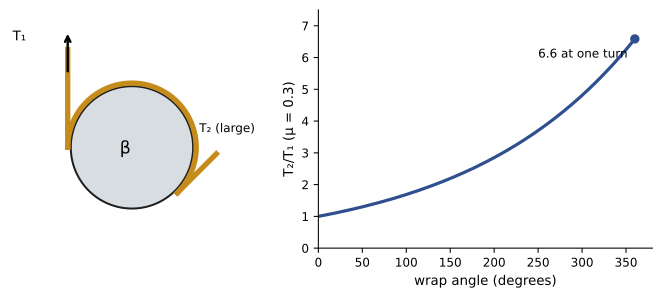
When a flexible belt, rope or band wraps around a fixed drum, friction acting all around the contact allows a small force on one end to hold a much larger force on the other. Considering a small element of the belt in equilibrium and integrating around the angle of contact β gives the capstan equation:
where T₂ is the larger tension, on the side toward which slip would occur, T₁ the smaller, μ the coefficient of friction and β the wrap angle in radians. The exponential makes the effect powerful: each extra turn multiplies the holding capacity.
Worked problem
A rope on a bollard
A dock worker holds a ship's mooring line with 200 N after taking three full turns around a steel bollard (μ = 0.30). What is the largest pull from the ship that the line can hold? How much with one turn?
Show solution
- Three turns: \(\beta = 3 \times 2\pi = 18.85\) rad; \(e^{0.30 \times 18.85} = e^{5.65} = 285\).
- Holding capacity: \(285 \times 200 = 57\,000\) N = 57 kN.
- One turn: \(e^{0.30 \times 2\pi} = 6.6\); capacity 1.3 kN.
Answer: Three turns let a 200 N pull hold 57 kN; one turn only 1.3 kN. This is why sailors, arborists, rescuers and climbers wrap ropes around bollards, posts and friction devices to control large loads, and why a few extra wraps on a winch drum keep a hoist rope from slipping.
Belt drives use the same principle to transmit power: the difference between the tight-side and slack-side tensions, times the pulley radius, is the torque transmitted, and the belt slips if the tension ratio exceeds \(e^{\mu\beta}\). A flat belt with μ = 0.35 and 180° of wrap can sustain a tension ratio of 3.0. V-belts, wedged into a grooved pulley, behave as if μ were increased by a factor of 1/sin(groove half-angle), about 3 for a typical groove, which lets them transmit more power at lower tension. Band brakes on winches and some vehicles work the same way in reverse, using friction to absorb energy.
Friction in engineering practice
Friction appears in many design checks beyond the classic problems:
- Sliding of foundations and retaining walls. The base friction μN must exceed the horizontal load by a safety factor, typically 1.5, as in Lesson 7's wall, whose 192 kN/m weight on soil with μ = 0.5 resists 96 kN/m of sliding against a water force of 78.5 kN/m, a factor of only 1.22: the wall would need a key or more width.
- Slip-critical bolted joints. In some steel connections, high-strength bolts are tensioned so strongly that the clamped plates transfer load by friction rather than by bearing on the bolts, preventing slip under fatigue or reversing loads. The design slip resistance is the clamping force times a slip coefficient that depends on the surface preparation.
- Vehicle braking and traction. The maximum deceleration of a vehicle is about μg, so stopping distance from speed V is about \(V^2/(2\mu g)\): from 100 km/h, about 50 m on dry pavement (μ = 0.8) but over 300 m on ice (μ = 0.1), not counting reaction time. Highway designers use these values, with margins, to set stopping sight distances.
- Slips and falls. Floor slip resistance is measured and specified for walking surfaces, and falls on the same level are among the commonest workplace injuries, especially in winter.
- Bearings. Rolling-element bearings have effective friction coefficients around 0.001 to 0.005, a hundred times less than sliding, which is why they are used wherever shafts turn.
Common mistakes
MistakeSetting F = μN whenever friction acts.
InsteadF = μN only when slip is impending or occurring; otherwise F is found from equilibrium.
MistakeDrawing friction in the wrong direction.
InsteadFriction opposes the relative motion or impending motion of each surface.
MistakeChecking only sliding.
InsteadCheck every way the body could start to move, including tipping, and take the smallest load.
MistakeUsing the wrap angle in degrees in the capstan equation.
InsteadUse radians.
MistakeTreating published friction coefficients as exact.
InsteadUse conservative values and test when safety depends on friction.
Summary and key terms
- Static friction F ≤ μ_s N; at impending motion F = μ_s N; during sliding F = μ_k N.
- The angle of friction φ satisfies tan φ = μ_s; a block on an incline slips when the slope exceeds φ.
- Check all possible modes of motion, including tipping, and find which needs the least force.
- Wedges and screws are self-locking when their angle is small compared with the friction angle.
- Screw moment: M = W r tan(θ ± φ); self-locking screws are less than 50 % efficient.
- Belt friction: T₂ = T₁ e^{μβ}, with β in radians.
- Friction governs sliding of foundations, slip-critical bolts, braking distance and bearing losses.
- Coefficient of static friction
- The ratio of maximum friction force to normal force before sliding.
- Coefficient of kinetic friction
- The ratio of friction force to normal force during sliding.
- Impending motion
- The condition at which sliding is just about to start.
- Angle of friction
- The angle φ whose tangent equals the coefficient of friction.
- Angle of repose
- The steepest stable slope of a pile of loose material.
- Wedge
- A simple machine that converts a driving force into large forces on its faces.
- Self-locking
- Holding a load by friction without an applied force.
- Lead angle
- The slope angle of a screw thread.
- Capstan equation
- T₂ = T₁e^{μβ}, relating tensions in a belt or rope on a drum.
- Slip-critical joint
- A bolted connection designed to transfer load by friction without slip.
Practice problems
Work each problem on paper first, then reveal the answer to check.
A 400 N box on a level floor has μ_s = 0.5. What horizontal force starts it moving?
Show answer
200 N.
The same box is pushed with 150 N. What is the friction force?
Show answer
150 N (less than the 200 N limit; no sliding).
What is the angle of friction for μ_s = 0.6?
Show answer
tan⁻¹ 0.6 = 31°.
In the cabinet example, at what push height do sliding and tipping occur together?
Show answer
b/(2μ_s) = 0.8/0.8 = 1.0 m.
A 5° wedge with μ = 0.2 on both faces lifts a 10 kN roller-guided load. Find the driving force.
Show answer
φ = 11.3°: 10[tan 16.3° + 0.2] = 4.93 kN.
Is a screw with lead angle 4° and μ = 0.1 self-locking?
Show answer
Yes: φ = 5.7° > 4°.
Find the efficiency of that screw when raising.
Show answer
tan 4°/tan 9.7° = 0.0699/0.171 = 41 %.
A rope makes a half turn (180°) on a post with μ = 0.25. Find the tension ratio.
Show answer
e^{0.25π} = 2.19.
How many full turns with μ = 0.25 does it take to hold 50 kN with 250 N?
Show answer
ln 200/(0.25 × 2π) = 3.37, so 4 turns.
Estimate the braking distance from 80 km/h on wet pavement with μ = 0.5.
Show answer
22.2²/(2 × 0.5 × 9.81) = 50 m.
Lesson quiz · 5 questions
Score 60% or more to complete this lesson.
Create a free account to save your progress, take quizzes and earn a certificate.