
ELEC-110 · Lesson 3 of 12 · 40 min
Ohm's law and power
Two short equations do most of the everyday arithmetic of the electrical trade. Ohm's law ties voltage, current and resistance together; the power equation ties them to watts. With them you can find the current a heater will draw, check whether a circuit is overloaded, work out what happens when equipment runs on the wrong voltage, and troubleshoot a circuit from a few meter readings. Every later course in this program uses them, so this chapter practices them until they are automatic.
Ohm's law
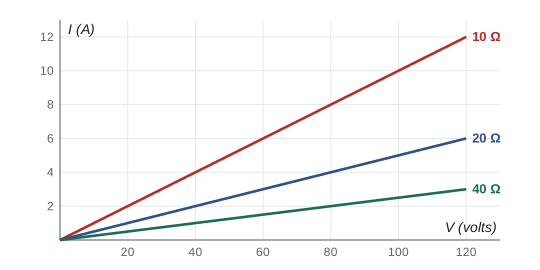
In 1827 the German physicist Georg Ohm showed that, for many materials, the current through a conductor is proportional to the voltage across it. The constant of proportionality is the resistance:
Rearranged, it gives the other two forms:
In words: more voltage pushes more current; more resistance allows less current. Double the voltage across a resistor and the current doubles; double the resistance at the same voltage and the current halves.
Worked problem
Current through a heater
A heater element has a resistance of 9.6 Ω and is connected to 120 V. What current does it draw?
Show solution
- \(I = V/R = 120/9.6 = 12.5\) A.
Answer: 12.5 A. That is too much for a 15 A circuit carrying a continuous load, as we will see below
Worked problem
Finding resistance from measurements
An electrician measures 240 V across a water heater element and 18.75 A through it. What is the element's resistance?
Show solution
- \(R = V/I = 240/18.75 = 12.8\) Ω.
Answer: 12.8 Ω. Measuring resistance this way, with the element hot and working, gives its operating resistance, which can differ from a cold ohmmeter reading
Worked problem
Voltage across a resistor
A 2 A current flows through a 47 Ω resistor. What voltage is across it?
Show solution
- \(V = IR = 2 \times 47 = 94\) V.
Answer: 94 V
Power
Electrical power is the product of voltage and current:
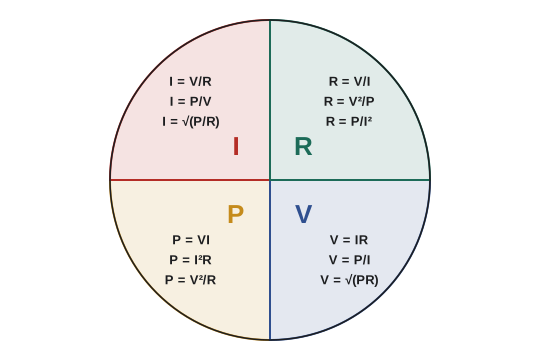
Substituting Ohm's law gives two more forms that are useful when you know only two of the three quantities:
These three equations together with Ohm's law make up the "power wheel" that many electricians keep in their head or on a card. Pick the equation that uses the two quantities you know.
Worked problem
Current from a nameplate
A water heater is rated 4500 W at 240 V. What current does it draw, and what is its resistance?
Show solution
- \(I = P/V = 4500/240 = 18.75\) A.
- \(R = V^2/P = 240^2/4500 = 57\,600/4500 = 12.8\) Ω.
Answer: 18.75 A and 12.8 Ω, the same element as the earlier example
Worked problem
Running on the wrong voltage
The 4500 W, 240 V water heater is installed in an apartment building whose supply is 120/208 V, so the element receives 208 V. Assuming its resistance stays 12.8 Ω, what power does it produce and what current does it draw?
Show solution
- \(P = V^2/R = 208^2/12.8 = 43\,264/12.8 = 3380\) W.
- \(I = V/R = 208/12.8 = 16.25\) A.
Answer: About 3380 W, only 75% of its rating, because power goes with voltage squared: \((208/240)^2 = 0.75\). The tenants get slower hot-water recovery. Heaters, elements and motors must be matched to the supply voltage, and manufacturers often sell 208 V versions of 240 V equipment for this reason
Power lost in conductors
Wires have resistance too, and every ampere flowing through them produces heat at a rate \(I^2R\). Because the current is squared, doubling the current quadruples the heating. That is the basic reason conductors have ampacity limits and why overloaded circuits get hot.
Worked problem
Heat in a cord
An extension cord has a total conductor resistance (both wires) of 0.15 Ω. How much power is wasted as heat in the cord when it carries 12.5 A? At 25 A?
Show solution
- At 12.5 A: \(P = I^2R = 12.5^2 \times 0.15 = 156.25 \times 0.15 = 23.4\) W.
- At 25 A: \(P = 25^2 \times 0.15 = 625 \times 0.15 = 93.75\) W, four times as much.
Answer: About 23 W at 12.5 A and 94 W at 25 A. Ninety-four watts concentrated along a coiled cord can melt insulation, which is why cords are rated for a maximum current and must never be used beyond it
Continuous loads and the 80% rule
The National Electrical Code defines a continuous load as one whose maximum current is expected to continue for three hours or more. Standard circuit breakers are tested to carry their rated current in open air, not inside a warm panel for hours, so the NEC requires the overcurrent device to be rated at least 125% of the continuous load, which means a continuous load can use only 80% of a standard breaker's rating.
Worked problem
How much can a 15 A circuit carry continuously?
What is the maximum continuous load on a 120 V circuit protected by a standard 15 A breaker? Can the 12.5 A heater from the first example run on it?
Show solution
- Continuous limit: 0.8 × 15 = 12 A.
- In watts: 12 × 120 = 1440 W.
- The heater draws 12.5 A (1500 W), which is more than 12 A.
Answer: 12 A or 1440 W continuous. A 1500 W heater should not be on a 15 A circuit as a continuous load; it needs a 20 A circuit (16 A continuous). This is why portable heaters so often trip breakers or overheat receptacles when they share a circuit with other loads
Efficiency
No device converts all its input power into useful output. Efficiency is the ratio:
The difference, \(P_\text{in} - P_\text{out}\), becomes heat. Motor nameplates give output power in horsepower (1 hp = 746 W) and often the efficiency.
Worked problem
Current drawn by a motor
A 1 hp, 120 V single-phase motor is 85% efficient. Ignoring power factor (ELEC-210 adds it), estimate its input power and current at full load.
Show solution
- Output: 1 hp = 746 W.
- Input: \(P_\text{in} = 746/0.85 = 878\) W.
- Current: \(I = 878/120 = 7.3\) A.
Answer: About 878 W and 7.3 A. The real current is higher because motors also have a power factor below 1, which is why motor circuits are sized from code tables of full-load current rather than from nameplate horsepower alone
Resistance changes with temperature
The resistance of metals rises as they get hotter (Lesson 4 explains why, and how resistors are built to resist this). For copper, resistance increases by about 0.393% per degree Celsius near room temperature. The relationship is
where \(\alpha\) is the temperature coefficient (0.00393 per °C for copper, 0.00403 for aluminum).
Worked problem
A warm motor winding
A copper motor winding measures 2.00 Ω at 20 °C. What is its resistance at its operating temperature of 75 °C?
Show solution
- \(R_2 = 2.00[1 + 0.00393 \times (75 - 20)] = 2.00 \times 1.216 = 2.43\) Ω.
Answer: 2.43 Ω, about 22% higher. When you compare a resistance reading with a manufacturer's value, note the temperature: a winding measured hot will read higher than the cold specification
Lamp filaments show the effect dramatically: a 60 W, 120 V incandescent filament has a hot resistance of \(120^2/60 = 240\) Ω, but measures only about 20 Ω cold. At the instant it is switched on, it draws about 6 A, ten or more times its running current, which is why old incandescent lamps usually failed at switch-on.
Troubleshooting with Ohm's law
Ohm's law is the electrician's first troubleshooting tool. If you know what the readings should be, measurements that disagree point to the fault. Lesson 12 builds these checks into a complete troubleshooting method.
Worked problem
A heater that runs cold
A 240 V, 2000 W baseboard heater is producing little heat. You measure 238 V across it and 4.2 A through it. What is its actual power and resistance, and what might be wrong?
Show solution
- Expected current: \(2000/240 = 8.3\) A; expected resistance: \(240^2/2000 = 28.8\) Ω.
- Measured power: \(238 \times 4.2 = 1000\) W. Measured resistance: \(238/4.2 = 56.7\) Ω.
Answer: About 1000 W and 57 Ω, roughly double the expected resistance and half the power. A heater with two elements in parallel behaves exactly like this when one element has burned open. The voltage is fine, so the fault is in the heater, not the supply
Common mistakes
MistakeUsing P = V²/R with a nameplate resistance measured cold.
InsteadResistance changes with temperature; use operating values, or calculate from rated power and voltage.
MistakeAssuming a 240 V appliance gives its rated power on 208 V.
InsteadFor resistive loads, power scales with voltage squared: 208 V gives 75% of the 240 V rating.
MistakeLoading a standard breaker to 100% with a continuous load.
InsteadLimit continuous loads to 80% of a standard breaker's rating.
MistakeForgetting that doubling current quadruples conductor heating.
InsteadHeat in conductors is I²R; current matters much more than people expect.
MistakeCalculating motor current from horsepower without efficiency or power factor.
InsteadDivide by efficiency (and power factor) or use the code tables of motor full-load current.
Summary and key terms
- Ohm's law: \(V = IR\), \(I = V/R\), \(R = V/I\).
- Power: \(P = VI = I^2R = V^2/R\). Choose the form that uses the quantities you know.
- Resistive loads on lower voltage give less power: \(P \propto V^2\) (208 V gives 75% of a 240 V rating).
- Conductor heating is \(I^2R\); doubling current quadruples it.
- Continuous loads are limited to 80% of a standard breaker: 12 A (1440 W at 120 V) on a 15 A circuit.
- Efficiency \(\eta = P_\text{out}/P_\text{in}\); 1 hp = 746 W.
- Copper resistance rises about 0.393% per °C: \(R_2 = R_1[1 + \alpha(T_2 - T_1)]\).
- Compare measured and expected values to find faults.
- Ohm's law
- The relationship V = IR between voltage, current and resistance.
- Power
- The rate of energy conversion: P = VI.
- Power wheel
- A chart of the twelve forms of Ohm's law and the power equation.
- Continuous load
- A load expected to run at its maximum current for three hours or more.
- Efficiency
- Useful output power divided by input power.
- Horsepower (hp)
- A unit of mechanical power equal to 746 W.
- Temperature coefficient of resistance
- The fractional change in resistance per degree of temperature change.
- Inrush current
- The high current drawn briefly when a device is first switched on.
Practice problems
Work each problem on paper first, then reveal the answer to check.
A 120 V lamp draws 0.5 A. Find its resistance and power.
Show answer
R = 120/0.5 = 240 Ω; P = 120 × 0.5 = 60 W.
What current flows through a 22 Ω resistor connected to 12 V?
Show answer
I = 12/22 = 0.545 A (545 mA).
A 5000 W range element operates at 240 V. Find its current and resistance.
Show answer
I = 5000/240 = 20.8 A; R = 240²/5000 = 11.52 Ω.
The element in the previous question is connected to 208 V. Find its power and current.
Show answer
P = 208²/11.52 = 3756 W; I = 208/11.52 = 18.1 A.
A 3 Ω resistor carries 4 A. How much power does it dissipate?
Show answer
P = I²R = 16 × 3 = 48 W.
What is the maximum continuous load on a 20 A, 120 V circuit, in amperes and watts?
Show answer
0.8 × 20 = 16 A; 16 × 120 = 1920 W.
A 2 hp motor is 80% efficient. Estimate its input power.
Show answer
2 × 746/0.80 = 1865 W.
A copper conductor measures 0.50 Ω at 20 °C. Find its resistance at 90 °C.
Show answer
0.50 × [1 + 0.00393 × 70] = 0.50 × 1.275 = 0.638 Ω.
If the current in a conductor rises from 10 A to 15 A, by what factor does its I²R heating increase?
Show answer
(15/10)² = 2.25 times.
A 120 V, 1200 W toaster draws only 5 A. What is its actual power and resistance, and what might be wrong?
Show answer
P = 600 W, R = 24 Ω, double the expected 12 Ω: likely one of two parallel elements has burned open.
Lesson quiz · 5 questions
Score 60% or more to complete this lesson.
Create a free account to save your progress, take quizzes and earn a certificate.