
ELEC-110 · Lesson 1 of 12 · 31 min
Electrical quantities and units
Every electrician works with the same handful of quantities every day: voltage, current, resistance, power and energy. You read them on nameplates, measure them with meters, calculate them to size wires and breakers, and talk about them with other trades, engineers and inspectors. Getting the words, symbols and units exactly right is not academic tidiness. A breaker sized in the wrong unit, a reading taken on the wrong meter range, or a misunderstanding about which voltage a panel carries can damage equipment, start a fire or injure someone.
This first chapter defines the basic electrical quantities, shows how they relate, explains the prefixes used to write large and small values, and introduces the effect of current on the human body, which is the reason behind most of the safety rules in this trade.
What electricity is
All matter is made of atoms, which contain positively charged protons in the nucleus and negatively charged electrons around it. In metals such as copper and aluminum, some electrons are only loosely held and can drift from atom to atom. When a voltage pushes these free electrons in one direction along a wire, we have an electric current.
- Conductors (copper, aluminum, steel, and also water with dissolved salts, wet earth and the human body) allow current to flow easily.
- Insulators (rubber, PVC, glass, porcelain, dry wood, air) resist current strongly. Wire insulation, tool handles and rubber gloves rely on them.
Electric charge is measured in coulombs (C). One coulomb is the charge of about 6.24 × 10¹⁸ electrons. You will rarely calculate with coulombs on the job, but they define the ampere.
The basic quantities
Current
Current is the rate at which charge flows past a point. Its symbol is \(I\) (from the French intensité) and its unit is the ampere (A), often called an amp. One ampere is one coulomb per second:
A 15 A circuit breaker protects a circuit carrying up to 15 coulombs per second. Current is what heats wires, trips breakers and, through a person's body, causes injury.
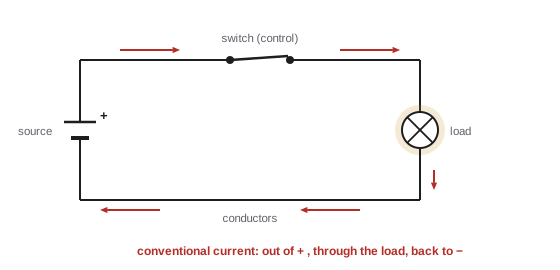
Two conventions describe its direction. Conventional current flows from positive to negative outside the source; electron flow goes the other way, because electrons are negative. Both give the same answers in calculations. Electrical codes, schematics and most textbooks use conventional current, and so does this course.
Voltage
Voltage, or potential difference, is the electrical "pressure" that pushes current through a circuit. Its symbol is \(V\) (some books use \(E\) for the voltage of a source, from electromotive force) and its unit is the volt (V). One volt means one joule of energy is given to (or taken from) each coulomb of charge moving between the two points. Voltage always exists between two points: "the voltage at a receptacle" means the voltage between its two slots, or between one slot and ground.
Common US system voltages include 120/240 V single-phase for homes, 120/208 V three-phase in many apartment and commercial buildings, and 277/480 V three-phase in commercial and industrial buildings. Utility distribution lines operate at thousands of volts (kilovolts).
Resistance
Resistance is opposition to current. Its symbol is \(R\) and its unit is the ohm (Ω). A long thin wire has more resistance than a short thick one; a heater element is designed to have a particular resistance so that it gets hot. Every real conductor has some resistance, which is why wires warm up under load and why voltage drops along long runs (Lesson 11).
Power and energy
Power is the rate of doing work or using energy. Its symbol is \(P\) and its unit is the watt (W). One watt is one joule per second. A 1500 W heater turns 1500 joules of electrical energy into heat every second.
Energy is power multiplied by time. The joule is the SI unit, but electricity is bought and sold in kilowatt-hours (kWh): one kilowatt used for one hour, equal to 3.6 million joules.
Worked problem
What a heater costs to run
A 1500 W baseboard heater runs 6 hours a day for 30 days. How much energy does it use, and what does it cost at $0.15 per kWh?
Show solution
- Power in kilowatts: 1500 W = 1.5 kW.
- Time: 6 h/day × 30 days = 180 h.
- Energy: \(E = 1.5 \times 180 = 270\) kWh.
- Cost: 270 × $0.15 = $40.50.
Answer: 270 kWh, about $40.50 for the month
A complete circuit
Current flows only around a complete loop, a closed circuit. Every useful circuit has four parts:
- A source that provides the voltage: a battery, generator, transformer or the utility supply.
- Conductors that carry the current to the load and back.
- A load that uses the energy: a lamp, heater, motor or electronic device.
- A control that opens and closes the circuit: a switch, relay or contactor. A protective device (fuse or breaker) opens it automatically if the current is too high.
An open circuit has a break somewhere, so no current flows; the full source voltage appears across the break. A short circuit is an unintended low-resistance path, often between conductors that should be insulated from each other. Because resistance is so low, very large currents flow, which is exactly what breakers and fuses are there to stop.
Units and prefixes
Electrical values range over many orders of magnitude, from microamperes in electronic sensors to thousands of amperes in a service switchboard, so we use SI prefixes:
- mega (M) = 1,000,000 = 10⁶: a 2 MΩ insulation reading; a 5 MW load.
- kilo (k) = 1000 = 10³: 25 kV distribution; 4.7 kΩ resistor; 9 kW range.
- milli (m) = 0.001 = 10⁻³: 30 mA ground fault current; 250 mV signal.
- micro (µ) = 0.000 001 = 10⁻⁶: 4–20 mA and µA signals in instrumentation; µF capacitors.
Worked problem
Converting units
Convert: (a) 4.7 kΩ to ohms, (b) 250 mA to amperes, (c) 0.0035 A to milliamperes, (d) 13 800 V to kilovolts, (e) 2 500 000 Ω to megohms.
Show solution
- (a) 4.7 × 1000 = 4700 Ω.
- (b) 250 ÷ 1000 = 0.25 A.
- (c) 0.0035 × 1000 = 3.5 mA.
- (d) 13 800 ÷ 1000 = 13.8 kV.
- (e) 2 500 000 ÷ 1 000 000 = 2.5 MΩ.
Answer: 4700 Ω, 0.25 A, 3.5 mA, 13.8 kV, 2.5 MΩ. Move the decimal three places for each step between kilo, base unit and milli
Charge, current and batteries
Batteries are rated in ampere-hours (Ah): the current they can supply multiplied by the time they can supply it. Since an ampere is a coulomb per second, an ampere-hour is 3600 coulombs.
Worked problem
How long will the battery last?
An emergency lighting unit has a 12 V, 18 Ah battery and draws 1.5 A. Ignoring the fact that real batteries deliver less at higher currents, how long can it run? How much energy does the battery store?
Show solution
- Time = capacity ÷ current = 18 Ah ÷ 1.5 A = 12 h.
- Energy = voltage × ampere-hours = 12 V × 18 Ah = 216 Wh = 0.216 kWh.
Answer: About 12 hours in theory, and 216 Wh of stored energy. In practice, capacity falls at higher discharge rates and low temperatures, and codes and standards set minimum runtimes for emergency lighting that manufacturers design to
AC and DC
Direct current (DC) flows steadily in one direction: batteries, solar panels and the internal supplies of electronic equipment. Alternating current (AC) reverses direction many times a second: in North America the utility supply alternates 60 times a second, a frequency of 60 hertz (Hz). AC is used for power distribution because transformers can easily step its voltage up and down (ELEC-210). Most of the rules in this course apply to both; where AC behaves differently (inductance, capacitance, power factor), ELEC-210 explains why.
When an electrician says a receptacle is "120 V", that is the effective (RMS) value of an AC voltage, the value that produces the same heating as 120 V DC. Meters on AC ranges display RMS values.
Current and the human body
The body conducts electricity. When it becomes part of a circuit, current flows through skin, muscles and organs, and the effects depend mainly on how much current flows, through what path, and for how long. Approximate effects of 60 Hz AC from hand to foot, as commonly cited in electrical safety training, are:
- About 1 mA: barely perceptible tingle.
- About 5 mA: painful shock; the level that ground fault circuit interrupters (GFCIs) protecting people are designed to trip near.
- About 10 to 20 mA: muscles clamp; you may be unable to let go of the conductor ("let-go threshold").
- About 50 to 100 mA and above: ventricular fibrillation, in which the heart quivers instead of pumping, becomes possible and is often fatal without defibrillation.
- Several amperes: severe burns, cardiac arrest, internal damage.
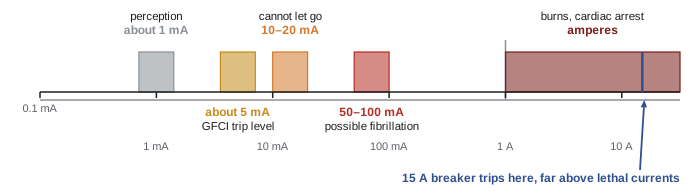
Notice the scale: currents of a few hundredths of an ampere can kill, while a 15 A breaker does not trip until currents are hundreds of times larger. Breakers and fuses protect wires and equipment from overheating; they do not protect people from shock. That is the job of GFCIs, proper grounding and bonding, insulation, guarding, and above all safe work practices such as de-energizing and verifying before work (Lesson 7).
Worked problem
How much current through a person?
A worker with wet hands touches a 120 V conductor while standing on a wet concrete floor. If the resistance of the path through the body and contact points is about 1000 Ω, roughly how much current flows? What if the skin were dry, raising the resistance to 100 000 Ω?
Show solution
- Wet: \(I = V/R = 120/1000 = 0.12\) A = 120 mA (Ohm's law, Lesson 3).
- Dry: \(I = 120/100\,000 = 0.0012\) A = 1.2 mA.
Answer: About 120 mA when wet, enough to cause ventricular fibrillation; about 1.2 mA when dry, a tingle. Body resistance varies enormously with moisture, contact area and voltage, which is why "it's only 120 volts" is a dangerous attitude. Treat every circuit as live until you have proved it is not
Reading a nameplate
Equipment nameplates state the electrical quantities you need: rated voltage, current, power (in W, kW or horsepower for motors), frequency, phase, and sometimes power factor or efficiency. For example, a water heater nameplate might read "240 V, 4500 W, 1 phase, 60 Hz". From it you can find the current (Lesson 3), check that the supply matches, and size the conductors and protection with the electrical code. Motor nameplates often give horsepower; 1 hp is 746 W of mechanical output, and the electrical input is higher because no motor is 100% efficient.
How this course is organized
The course builds DC circuit skills step by step:
- Lesson 2 looks at where electricity comes from: chemical, magnetic, light, heat and pressure sources.
- Lessons 3 and 4 cover Ohm's law and power, then resistance, resistivity and resistors.
- Lessons 5 and 6 solve series, parallel and combination circuits, then loaded dividers, bridges, sources with internal resistance, multi-source circuits and three-wire systems.
- Lesson 7 teaches safe, accurate measurement with multimeters, clamp meters and insulation testers.
- Lesson 8 covers batteries and DC power systems, Lesson 9 magnetism and electromagnetism, and Lesson 10 capacitors and inductors in DC circuits.
- Lesson 11 calculates conductor resistance and voltage drop, and Lesson 12 covers overcurrent protection and a systematic troubleshooting method.
Common mistakes
MistakeMixing prefixes in a calculation, such as using 4.7 instead of 4700 for 4.7 kΩ.
InsteadConvert to base units first, calculate, then convert back.
MistakeSaying a voltage "at" a single point.
InsteadVoltage is always between two points; say which two (line to neutral, line to line, line to ground).
MistakeConfusing power (kW) with energy (kWh).
InsteadkW is a rate; kWh is an amount. A 2 kW heater running 3 hours uses 6 kWh.
MistakeBelieving the breaker will protect you from shock.
InsteadBreakers protect conductors and equipment. Shock protection comes from GFCIs, grounding and bonding, insulation and safe work practices.
MistakeAssuming low voltage is always safe.
InsteadCurrent through the body depends on resistance, which can be low when skin is wet or broken. Treat circuits as live until verified.
Summary and key terms
- Current \(I\) (amperes) is the rate of flow of charge: \(I = Q/t\). Voltage \(V\) (volts) pushes current. Resistance \(R\) (ohms) opposes it.
- Power \(P\) (watts) is the rate of using energy; energy \(E = Pt\), sold in kWh.
- A circuit needs a source, conductors, a load and usually a control; current flows only in a closed loop. Open circuits stop current; short circuits cause very large currents.
- Prefixes: M = 10⁶, k = 10³, m = 10⁻³, µ = 10⁻⁶. Convert to base units before calculating.
- Batteries are rated in ampere-hours; energy stored ≈ V × Ah.
- North American AC is 60 Hz; meters show RMS values.
- Tens of milliamperes through the body can kill; breakers protect wiring, not people.
- Coulomb (C)
- The unit of electric charge, about 6.24 × 10¹⁸ electrons.
- Current (I)
- The rate of flow of charge, measured in amperes (A).
- Voltage (V)
- The potential difference that pushes current between two points, measured in volts.
- Resistance (R)
- Opposition to current, measured in ohms (Ω).
- Power (P)
- The rate of using or delivering energy, measured in watts (W).
- Kilowatt-hour (kWh)
- The energy used by a 1 kW load in one hour; 3.6 million joules.
- Conductor
- A material that allows current to flow easily.
- Insulator
- A material that strongly resists current.
- Open circuit
- A circuit with a break, so no current flows.
- Short circuit
- An unintended low-resistance path that allows excessive current.
- Ampere-hour (Ah)
- A battery capacity unit: current multiplied by time.
- Alternating current (AC)
- Current that reverses direction periodically; 60 Hz in North America.
- GFCI
- Ground fault circuit interrupter: a device that opens a circuit when it detects a small current leaking to ground, to protect people from shock.
Practice problems
Work each problem on paper first, then reveal the answer to check.
A current of 8 A flows for 2 minutes. How much charge passes?
Show answer
Q = It = 8 × 120 s = 960 C.
Convert 0.47 MΩ to kilohms and to ohms.
Show answer
470 kΩ = 470 000 Ω.
Convert 125 µA to milliamperes and amperes.
Show answer
0.125 mA = 0.000 125 A.
A 9 kW electric range element runs for 45 minutes. How much energy does it use?
Show answer
E = 9 kW × 0.75 h = 6.75 kWh.
At $0.12/kWh, what does it cost to run a 60 W lamp continuously for a 30-day month?
Show answer
0.06 kW × 720 h = 43.2 kWh × $0.12 = $5.18.
A 24 V battery bank is rated 200 Ah. How much energy does it store?
Show answer
24 × 200 = 4800 Wh = 4.8 kWh.
A lamp is connected to a switch that is open. What is the current, and what voltage would you measure across the open switch?
Show answer
No current flows; the full source voltage appears across the open switch.
Why is a short circuit dangerous even though it contains no load?
Show answer
Its very low resistance allows huge currents that overheat conductors, can cause arcing and fire, and must be cleared quickly by the overcurrent device.
Roughly what current flows through a 2000 Ω body path from a 240 V conductor? What effect might it have?
Show answer
240/2000 = 0.12 A = 120 mA, enough to cause ventricular fibrillation.
A 2 hp motor is 80% efficient. What is its electrical input power?
Show answer
Output = 2 × 746 = 1492 W; input = 1492/0.80 = 1865 W.
Lesson quiz · 5 questions
Score 60% or more to complete this lesson.
Create a free account to save your progress, take quizzes and earn a certificate.