
ELEC-110 · Lesson 2 of 12 · 30 min
Sources of electricity
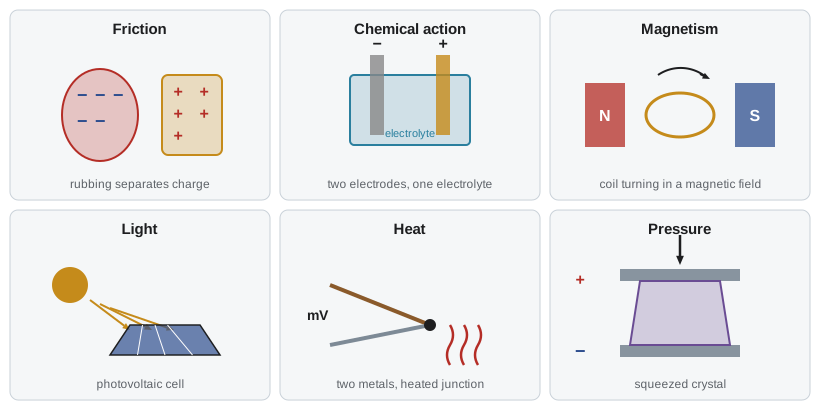
Every circuit an electrician works on starts at a source: a battery, a generator, a solar panel, a utility transformer fed by a distant power plant. Lesson 1 described voltage as the push that drives current. This lesson looks at where that push comes from. There are six ways to produce a voltage: friction, chemical action, magnetism, light, heat and pressure. Each underlies familiar equipment, from the static shock you get from a doorknob to the generators that supply the grid, the batteries in tools and UPS systems, rooftop solar panels, the thermocouples in a furnace and the sensors in a gas grill igniter. Understanding them helps you choose and troubleshoot equipment and recognize hazards such as static discharge and lightning.
Electric charge and electric fields
Lesson 1 introduced atoms, electrons and the coulomb. Two rules govern electric charge: like charges repel and unlike charges attract. Any object with more electrons than protons is negatively charged; one with fewer is positively charged. A charged object is surrounded by an electric field, a region where other charges feel a force. Voltage is a measure of the energy per unit charge in that field: one volt is one joule of energy per coulomb of charge.
where \(V\) is voltage in volts, \(W\) is energy in joules and \(Q\) is charge in coulombs. Every source of electricity does the same basic job: it uses some other form of energy to separate positive and negative charges, creating a voltage between two terminals. When a circuit connects the terminals, current flows and the energy is delivered to the load.
Worked problem
Energy carried by charge
A 12 V battery moves 5,000 coulombs of charge through a load. How much energy does it deliver? How many ampere-hours is that?
Show solution
- Energy: \(W = V Q = 12 \times 5000 = 60{,}000\) J = 60 kJ.
- Ampere-hours: \(5000/3600 = 1.39\) Ah.
Answer: 60 kJ, which is about 16.7 Wh, and 1.39 Ah. Energy in joules, watt-hours or kilowatt-hours all describe the same thing; electricians mostly use watt-hours and kilowatt-hours.
1. Friction: static electricity
Rubbing two different materials together transfers electrons from one to the other, leaving both charged. Walking across a carpet, sliding off a car seat or pouring dry powder through a pipe can build up thousands of volts. Because the charge has nowhere to go, it stays static until it finds a path, then discharges in a spark.
Static electricity is a nuisance in daily life, but it matters on the job:
- Electrostatic discharge (ESD) can damage electronic components such as circuit boards in drives, controls and computers at voltages far below what a person can feel. Technicians use wrist straps, grounded mats and antistatic bags when handling electronics.
- In hazardous locations, a static spark can ignite flammable vapors or dust. Fuel handling, grain elevators and paint booths use bonding and grounding to drain charge safely (ELEC-220).
- Lightning is static electricity on a massive scale: charge separated within storm clouds discharges to the ground at tens of thousands of amperes. Lightning protection systems and surge protective devices give it a controlled path.
2. Chemical action: cells and batteries
A cell produces voltage from a chemical reaction between two different electrodes in an electrolyte. One electrode gives up electrons more readily than the other, so electrons build up on one terminal and leave the other, producing a voltage that depends on the chemistry. A battery is two or more cells connected together. Primary cells (such as alkaline AA cells) are used once and discarded; secondary cells (such as lead-acid and lithium-ion) can be recharged by forcing current through them in reverse. Lesson 8 covers batteries in detail.
| Cell type | Nominal voltage per cell | Rechargeable | Typical uses |
|---|---|---|---|
| Alkaline | 1.5 V | No | Flashlights, meters, remotes |
| Lead-acid | 2.0 V | Yes | Vehicles, UPS systems, emergency lighting |
| Nickel-metal hydride | 1.2 V | Yes | Older cordless tools, hybrid vehicles |
| Lithium-ion | 3.6 V to 3.7 V | Yes | Cordless tools, phones, electric vehicles, UPS |
| Lithium iron phosphate | 3.2 V | Yes | Energy storage, solar systems, UPS |
3. Magnetism: generators
Almost all the electricity on the grid is produced by magnetism. When a conductor moves through a magnetic field, or a magnetic field changes around a conductor, a voltage is induced in the conductor. This principle, discovered by Michael Faraday in 1831, is called electromagnetic induction. A generator spins coils of wire in a magnetic field (or spins magnets inside coils), inducing a voltage that alternates as the coil turns, producing alternating current (ELEC-210). Something must turn the generator: steam from burning fuel or nuclear fission, falling water, wind, or a diesel engine. Lesson 9 explains magnetism and induction in more detail.
The voltage induced depends on three things: the strength of the magnetic field, the speed of motion, and the number of turns of wire. Doubling any of them doubles the voltage. This is why generator output voltage is controlled by adjusting the field strength (the excitation) while the speed is held constant to keep the frequency at 60 Hz.
In the United States, natural gas generators produce roughly 40% of electricity, with nuclear, coal, wind, hydro and solar making up most of the rest; the mix varies greatly by region.
4. Light: photovoltaic cells
A photovoltaic (PV) cell converts light directly into electricity. It is made of a semiconductor, usually silicon, treated to create a junction between two layers. When light strikes the cell, its energy frees electrons, and the junction pushes them in one direction, producing a DC voltage of about 0.5 V to 0.6 V per cell. Cells are connected in series in a module (a solar panel) to produce useful voltages, commonly 30 V to 50 V per module, and modules are connected in series strings and parallel arrays.
A PV cell behaves differently from a battery. Its voltage stays fairly constant as light changes, but its current is nearly proportional to the light level, and it can never deliver more than its short-circuit current. PV arrays still produce dangerous DC voltages whenever light falls on them, so they cannot be switched off by opening a disconnect alone; codes require rapid shutdown systems on buildings and special procedures for working on arrays.
Worked problem
A PV string
A solar module has 60 cells in series, each producing 0.6 V open circuit. Twelve modules are connected in series. What is the string's open-circuit voltage?
Show solution
- Module: \(60 \times 0.6 = 36\) V.
- String: \(12 \times 36 = 432\) V.
Answer: About 432 V DC, enough to cause a fatal shock, present whenever the sun shines. In cold weather the voltage rises further, which designers must allow for (ELEC-220).
5. Heat: thermocouples
When two different metals are joined and the junction is heated, a small voltage appears: the thermoelectric (Seebeck) effect. A thermocouple uses this to measure temperature: one junction is placed where the temperature is to be measured, and the voltage, a few millivolts, indicates the temperature difference between it and the reference junction. Thermocouples are rugged and cover a wide range, so they are used in furnaces, ovens, kilns, engines and industrial processes. In gas appliances, a thermocouple heated by the pilot flame produces enough voltage to hold a safety gas valve open; if the flame goes out, the voltage disappears and the valve closes.
Worked problem
Reading a thermocouple
A type K thermocouple produces about 41 µV per °C. Its reference junction is at 20 °C and the meter reads 15.6 mV. Estimate the measured temperature.
Show solution
- Temperature difference: \(15.6 \text{ mV} / 0.041 \text{ mV/°C} = 380\) °C.
- Measured temperature: \(380 + 20 = 400\) °C.
Answer: About 400 °C. Because the signal is so small, thermocouple extension wire of the correct type must be used, and connections must be clean; a wrong wire type creates extra junctions and errors.
6. Pressure: piezoelectricity
Some crystals and ceramics, such as quartz, produce a voltage when they are squeezed or bent: the piezoelectric effect. The voltage can be large but the energy is small. Piezoelectric devices include spark igniters in barbecues and gas appliances, pressure and vibration sensors, microphones, ultrasonic transducers, and the quartz crystals that keep accurate time in clocks, meters and computers (where the effect works in reverse, with voltage making the crystal vibrate at a precise frequency).
Conductors, insulators and semiconductors
Lesson 1 introduced conductors and insulators. The difference comes from how tightly atoms hold their outer electrons. In metals, the outer electrons are free to move, so a small voltage drives a large current. In insulators, electrons are tightly bound, and only a very high voltage can force current through, usually by breaking down the material. Insulation is rated for a maximum voltage; above it, the insulation can puncture, which is why cables are marked with voltage ratings such as 300 V, 600 V or 1000 V.
Semiconductors, such as silicon, conduct poorly in their pure state, but adding tiny amounts of other elements (doping) controls their conductivity precisely. Semiconductors are the basis of diodes, transistors, PV cells, LEDs and all electronics, including the drives, controls and power supplies electricians install every day (ELEC-330).
| Material | Resistivity at 20 °C (Ω·m) | Category |
|---|---|---|
| Silver | 1.6 × 10⁻⁸ | Conductor |
| Copper | 1.72 × 10⁻⁸ | Conductor |
| Aluminum | 2.82 × 10⁻⁸ | Conductor |
| Steel | about 10 × 10⁻⁸ to 20 × 10⁻⁸ | Conductor (poorer) |
| Silicon (pure) | about 2,300 | Semiconductor |
| Glass | 10¹⁰ to 10¹⁴ | Insulator |
| PVC | about 10¹³ | Insulator |
DC and AC sources
Batteries, PV cells and thermocouples produce direct current (DC), which flows in one direction. Generators on the grid produce alternating current (AC), which reverses direction 60 times per second in North America. AC dominates power distribution because transformers can easily change its voltage (ELEC-210). DC is used in electronics, batteries, PV systems, vehicles, telecom and control circuits, and increasingly in data centers and high-voltage DC transmission. Power supplies and inverters convert between them. This course concentrates on DC circuits, where the rules are simplest; the same rules extend to AC with the additions covered in ELEC-210.
Worked problem
Choosing a source
For each application, name the most likely source of electricity: (a) a smoke alarm's backup, (b) a remote pipeline sensor with no utility power, (c) a furnace flame safety circuit, (d) a hospital during a utility outage.
Show solution
- (a) A battery (chemical).
- (b) A solar panel charging a battery (light and chemical).
- (c) A thermocouple or flame sensor (heat).
- (d) Standby generators (magnetism), with batteries in UPS systems bridging the start-up.
Answer: Each application matches a source to its needs: batteries for small portable backup, PV for remote sites, thermocouples for self-powered safety sensing, and generators for large loads over long periods.
Common mistakes
MistakeAssuming a PV array is safe once its disconnect is open.
InsteadModules produce voltage whenever light falls on them; follow rapid shutdown and PV procedures.
MistakeHandling circuit boards without ESD protection.
InsteadUse wrist straps, grounded mats and antistatic packaging.
MistakeUsing ordinary copper wire to extend a thermocouple.
InsteadUse extension wire matching the thermocouple type.
MistakeMixing up primary and secondary cells.
InsteadNever try to recharge primary cells; they can leak or burst.
MistakeIgnoring static in hazardous locations.
InsteadBond and ground equipment to drain static charge safely.
Summary and key terms
- Voltage is energy per unit charge: V = W/Q.
- Friction creates static charge; ESD damages electronics and static sparks can ignite hazards.
- Chemical cells and batteries produce DC; voltage per cell depends on chemistry.
- Generators use magnetic induction to produce most grid electricity.
- PV cells produce about 0.5 to 0.6 V each; arrays are live whenever lit.
- Thermocouples produce millivolts from heat; piezoelectric crystals produce voltage from pressure.
- Conductors, insulators and semiconductors differ in how freely electrons move.
- Electric field
- A region where electric charges experience a force.
- Static electricity
- Charge that builds up on an object and remains until discharged.
- Electrostatic discharge
- A sudden flow of static charge, which can damage electronics.
- Cell
- A single unit that produces voltage by chemical action.
- Electromagnetic induction
- Producing a voltage by changing a magnetic field around a conductor.
- Photovoltaic cell
- A semiconductor device that converts light into electricity.
- Thermocouple
- A junction of two metals producing a voltage that depends on temperature.
- Piezoelectric effect
- Voltage produced when certain crystals are squeezed.
- Semiconductor
- A material whose conductivity is between a conductor's and an insulator's and can be controlled.
- Resistivity
- A material's inherent opposition to current, in ohm-meters.
Practice problems
Work each problem on paper first, then reveal the answer to check.
A source moves 200 C and delivers 2,400 J. What is its voltage?
Show answer
12 V.
Name the six sources of electricity.
Show answer
Friction, chemical action, magnetism, light, heat and pressure.
Why are wrist straps used when replacing a drive control board?
Show answer
To prevent electrostatic discharge damaging components.
How many lead-acid cells make a 12 V battery?
Show answer
Six.
What three factors set a generator's induced voltage?
Show answer
Field strength, speed and number of turns.
A module has 72 cells at 0.6 V. Module voltage? Ten modules in series?
Show answer
43.2 V; 432 V.
Why can't a PV array be made dead by opening a disconnect?
Show answer
The modules produce voltage whenever light falls on them.
Type K at 41 µV/°C reads 8.2 mV with a 25 °C reference. Temperature?
Show answer
200 + 25 = 225 °C.
Give two uses of piezoelectric devices.
Show answer
Gas igniters, pressure sensors, microphones, quartz timing crystals.
Why is AC used for power distribution?
Show answer
Transformers change its voltage easily.
Lesson quiz · 5 questions
Score 60% or more to complete this lesson.
Create a free account to save your progress, take quizzes and earn a certificate.