
DCT-220 · Lesson 6 of 12 · 20 min
Static and maintenance bypass
No UPS is perfect, and every UPS needs maintenance. Bypass paths are how the load keeps running when the UPS itself cannot carry it, either because it has a fault or overload, or because it has to be shut down for work. There are two kinds. The static bypass is inside the UPS and switches automatically in milliseconds. The maintenance bypass is a set of breakers outside the UPS that lets the whole UPS be isolated and worked on while the load is fed around it. Understanding these paths explains many UPS alarms, and it explains why a planned UPS maintenance job is one of the most carefully controlled operations in the building.
The static bypass
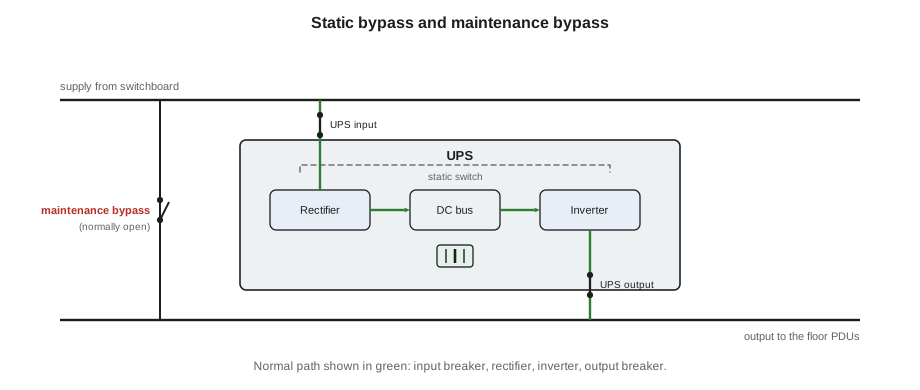
Inside every double-conversion UPS, a static switch made of thyristors connects the UPS input, or a separate bypass input, directly to the UPS output. In normal operation the static switch is off and the inverter feeds the load. If the inverter fails, the load exceeds what the inverter can carry, or the UPS detects an internal fault, the controls turn the inverter off and the static switch on at the same instant. Because the inverter output is kept in step with the bypass supply, the transfer happens without a break the load can notice, typically within a few milliseconds.
The static bypass also lets the UPS clear downstream faults. When a short circuit occurs in a PDU or cable downstream, the fault current needed to trip the right breaker quickly is far larger than an inverter can deliver. The UPS transfers to static bypass so the much stronger input supply can provide the fault current, the downstream breaker trips, and the UPS returns to the inverter once the fault is gone. A UPS event log showing a transfer to bypass and back within a second or so, at the same time as a branch breaker trip, usually shows exactly this.
The weakness of the static bypass is that the load on bypass has no stored energy behind it. If the input fails while the UPS is on static bypass, the load on that side loses power. That is why a UPS on static bypass, as in the UPS-C2 example in lesson 4, is an urgent alarm.
The maintenance bypass
For maintenance, the UPS must be completely de-energized and isolated, including its static switch, so that technicians from the vendor can work inside. The maintenance bypass is a separate path, usually a set of breakers in a wrap-around cabinet or in the switchboard, that connects the supply straight to the output distribution while the UPS is isolated. The common breaker names are the maintenance bypass breaker, which closes the bypass path, the UPS input breaker and the UPS output or isolation breaker, which disconnect the UPS. Different manufacturers and designers use different names and abbreviations, so each site's procedure uses the exact labels on its own equipment.
Transferring to maintenance bypass has to be done in a precise order. The load is first moved from the inverter to the static bypass inside the UPS, so that the UPS output and the bypass supply are in step. Then the maintenance bypass breaker is closed, paralleling the external bypass with the static switch for a moment. Then the UPS output breaker is opened, leaving the load on the maintenance bypass alone, and the UPS input and battery are isolated. The reverse sequence returns the load to the UPS. Doing these steps out of order can drop the load or connect two sources that are not in step, causing a large fault. Many systems have key interlocks or electrical interlocks that make the wrong order impossible, but procedures never rely on interlocks alone.
Why bypass transfers are planned like surgery
While a UPS is on maintenance bypass, the load on that side is exposed to the raw supply with no ride-through at all. In a 2N design, the other side still has its UPS, so the racks keep running if the input fails, but there is no redundancy left. For that reason, Stonebridge treats a UPS maintenance window as a major change:
- A method of procedure (MOP) is written for the job, listing every step, the breaker labels, the expected indications after each step, and how to back out if something unexpected happens.
- The MOP is reviewed by the critical facilities manager and approved through change management, and customers are notified in advance.
- The redundancy whiteboard is checked: the partner UPS, its batteries and the generators must all be normal before the work starts.
- The generators are often started and run on standby before the transfer, so that if the utility fails during the work the generators are already running.
- Two qualified people perform the switching: one reads each step and records the indication, the other operates. The vendor's field engineer is present.
- The technician's job is to escort, keep the room clear, watch the monitoring screens for the halls, and record times.
DCT-330 covers method of procedure writing and change management in detail. Here the important point is that the technician should know what each step is meant to do, so that they can tell when what they see on the monitoring screen does not match.
# Check a recorded maintenance bypass sequence against the MOP order (illustrative)
mop = [
    "confirm partner UPS and generators normal",
    "transfer UPS to static bypass",
    "close maintenance bypass breaker",
    "open UPS output breaker",
    "open UPS input breaker",
    "open battery breakers",
    "verify UPS isolated (vendor)",
]
recorded = [
    ("21:02", "confirm partner UPS and generators normal"),
    ("21:05", "transfer UPS to static bypass"),
    ("21:06", "close maintenance bypass breaker"),
    ("21:07", "open UPS output breaker"),
    ("21:08", "open battery breakers"),
    ("21:09", "open UPS input breaker"),
    ("21:15", "verify UPS isolated (vendor)"),
]
for k, (t, step) in enumerate(recorded):
    expected = mop[k]
    flag = "ok" if step == expected else f"OUT OF ORDER (MOP step {k + 1}: {expected})"
print(f"{t} {step:44s} {flag}")21:02 confirm partner UPS and generators normal ok 21:05 transfer UPS to static bypass ok 21:06 close maintenance bypass breaker ok 21:07 open UPS output breaker ok 21:08 open battery breakers OUT OF ORDER (MOP step 5: open UPS input breaker) 21:09 open UPS input breaker OUT OF ORDER (MOP step 6: open battery breakers) 21:15 verify UPS isolated (vendor) ok
In this record, the battery breakers were opened before the input breaker. On this particular UPS design the order of those two steps does not affect the load, and the vendor's procedure allows either, but the MOP said otherwise. The deviation must be noted and explained in the job record, and the MOP corrected for next time if the order genuinely does not matter. Every deviation from a MOP is recorded, even a harmless one, because the next deviation might not be harmless.
Bypass in a modular or distributed system
In modular UPS systems, a single module can often be isolated for service without transferring the whole system to bypass, as long as the remaining modules can carry the load. This is how the UPS-B2 module swap in DCT-120 was done: the system stayed on its inverters with three modules carrying the load, and only module 2 was isolated. Whole-system bypass is still needed for work on the system's common parts, such as the output switchgear, the static switch itself, or a battery system replacement. Some large systems have a bypass cabinet shared by all modules; others have a static switch in each module. The site's single-line diagram and procedures show which applies.
Reading bypass status on screens and mimic panels
UPS front panels show the static switch and the main breakers on their mimic diagrams, with the active path lit. Larger installations also have a mimic panel or screen for the maintenance bypass cabinet showing each breaker's position. The monitoring system shows the same information and records every change. Normal states for each piece of equipment are written on the technician's round checklist, so that a breaker in an unexpected position stands out. A maintenance bypass breaker closed outside a planned job is a serious finding, because it means the UPS may be bypassed without anyone intending it.
| Indication | Normal state | Meaning if different |
|---|---|---|
| UPS mode | Online (double conversion) or eco, as set for the hall | Static bypass: UPS not protecting; on battery: input lost |
| Static switch | Off (open) in double conversion | On: load fed from bypass input |
| Maintenance bypass breaker | Open | Closed: load may be bypassing the UPS entirely |
| UPS input breaker | Closed | Open: UPS not charging or not running from input |
| UPS output breaker | Closed | Open: UPS not feeding the load |
| Battery breakers | Closed | Open: no ride-through from that string or system |
Inverter and bypass synchronization
For a transfer between inverter and bypass to happen without a break, the inverter output must be in phase with the bypass supply. The UPS continuously synchronizes its inverter to the bypass when the bypass is within limits. If the bypass supply is out of limits, for example when a generator's frequency is drifting during a load step, the UPS may lose synchronization and show an alarm such as bypass out of tolerance. In that state the UPS will not transfer to static bypass by choice, because the transfer could cause a break. Technicians often see this alarm briefly when the generators take load after an outage; it clears once the generator frequency settles.
Worked problem
A short transfer to static bypass during a fault
During a quiet afternoon, the monitoring system logs: 14:22:31.240 UPS-B2 to static bypass; 14:22:31.300 PDU-B2-07 branch 1-05 tripped; 14:22:32.110 UPS-B2 to inverter. A customer in Hall A reports that one of their storage shelves in rack A-22-09 lost its B-side power supply.
Show solution
- Jamal lines the events up: the UPS went to bypass, a branch breaker tripped 60 milliseconds later, and the UPS returned to inverter less than a second after that.
- That pattern is the UPS supplying fault current through its static bypass so that the downstream breaker could trip.
- He traces branch 1-05 on PDU-B2-07 to rack A-22-09's B-side rack PDU, and finds from the monitoring that a single outlet carried a spike of current just before the trip.
- He reports to Roz, who inspects the rack with the customer's engineer and finds a storage shelf power supply with burn marks inside its fan grille: an internal short circuit.
- The customer replaces the power supply. The electrician inspects and resets the branch breaker. The rest of the rack ran on its A side throughout.
Answer: The protection worked exactly as designed: the fault was cleared at the smallest possible point, a single branch, with the UPS bypass supplying the fault current for a fraction of a second. Recognizing the pattern in the log turned an alarming string of events into a simple diagnosis.
Bypass during commissioning and testing
Bypass paths are also tested. When a UPS system is commissioned, and again during major maintenance, the commissioning team proves each transfer: inverter to static bypass and back, static bypass to maintenance bypass and back, and the behavior of the UPS on loss of its input while in each mode. These tests are done with a load bank or with the partner side carrying the real load, and they follow written test scripts. Technicians often help by recording the times and indications shown on the mimic panels and monitoring screens, and by confirming that the hall's IT load stayed on its other side throughout. A transfer that takes longer than the script allows, or a breaker indication that does not change when expected, is recorded as a test failure and investigated before the system is returned to service.
Records of every bypass transfer are kept, planned or not. The UPS event log records the time, the reason and the duration. Over months, these records show patterns: a UPS that transfers to static bypass more often than its neighbors may have a module or fan problem, and repeated bypass transfers at the same time of day may point to a load that steps up sharply at that time. Reviewing the UPS logs monthly is part of Stonebridge's preventive maintenance program, described in DCT-340.
Common mistakes
MistakeThinking the static bypass is a spare UPS.
InsteadOn static bypass the load has no stored energy behind it.
MistakeAssuming interlocks make bypass switching safe in any order.
InsteadFollow the MOP step by step; interlocks are a backup.
MistakeIgnoring a harmless-looking deviation from the MOP.
InsteadRecord and explain every deviation.
MistakeSeeing a closed maintenance bypass breaker on a round and assuming it is planned.
InsteadCheck for a permit; if there is none, report it urgently.
MistakeTreating a brief bypass transfer as a UPS failure.
InsteadCheck the log for a downstream breaker trip at the same moment.
Summary and key terms
- The static bypass inside the UPS transfers the load to the input in milliseconds on an inverter fault or overload.
- The static bypass supplies fault current so downstream breakers can trip, then the UPS returns to the inverter.
- The maintenance bypass is an external path that lets the whole UPS be isolated for work.
- Bypass transfers follow a strict sequence in a reviewed method of procedure, performed by two qualified people.
- While on bypass, the load on that side has no ride-through; the partner side and generators must be ready.
- Technicians know the normal breaker states and report any unexpected bypass indication.
- Static switch
- An electronic switch inside the UPS that connects the bypass input to the output.
- Maintenance bypass
- External breakers that feed the load around a UPS so the UPS can be isolated.
- Method of procedure
- A written, reviewed step-by-step plan for a change to critical equipment.
- Synchronization
- Keeping the inverter output in phase with the bypass supply so transfers have no break.
- Fault current
- The large current that flows into a short circuit until a protective device opens.
- Key interlock
- A mechanical system of locks and keys that forces breakers to be operated in a safe order.
Practice problems
Work each problem on paper first, then reveal the answer to check.
Why does a UPS transfer to static bypass when a downstream short circuit occurs?
Show answer
So the input can supply enough fault current to trip the downstream breaker quickly.
What is the first step in transferring a UPS to maintenance bypass?
Show answer
Confirm the partner UPS and generators are normal, then transfer the UPS to static bypass.
What should a technician do on finding the maintenance bypass breaker closed with no planned work?
Show answer
Report it urgently to critical facilities and the shift lead.
Why may a UPS refuse to transfer to bypass while the generators are taking load?
Show answer
The bypass supply may be out of tolerance, so the inverter cannot stay synchronized with it.
Lesson quiz · 5 questions
Score 60% or more to complete this lesson.
Create a free account to save your progress, take quizzes and earn a certificate.