
DCT-220 · Lesson 3 of 12 · 20 min
Switchgear, transformers and power distribution units
Between the unit substation and the racks lies the low-voltage distribution: the switchboards that divide the building supply into feeders, the transformers that change voltage where needed, and the floor power distribution units that bring power to a row of racks. This is the part of the plant a data center technician walks past most often. It is full of meters and indicator lights that tell a careful reader a great deal, and it is where many of the alarms on a shift begin. This lesson explains what each piece does, how to read it, and what changes are worth reporting.
Low-voltage switchboards and switchgear
A switchboard is a large metal enclosure containing a main breaker, busbars and many feeder breakers. Each feeder breaker supplies one downstream load, such as a UPS input, a mechanical panel or a lighting panel. Switchgear is a heavier class of the same thing, built with each breaker in its own compartment, usually on draw-out mechanisms so a breaker can be racked out for maintenance without shutting down the board. At Stonebridge, each hall's A and B sides have their own main switchboard, SWBD-A2 and SWBD-B2 for Hall A, fed from the two unit substations and from the generator plant through the transfer equipment described in lesson 8.
The front of a switchboard carries the information a technician needs. Each main and feeder has a breaker position indicator (open, closed, tripped), and most have an electronic trip unit with a small display showing current and sometimes power. The main section has a power meter showing voltage, current, power, energy and power factor, and often alarms for over-current or ground fault. Labels on each breaker name the load it feeds, matching the single-line diagram, and the arc flash label is on the outside of each section as DCT-120 described.
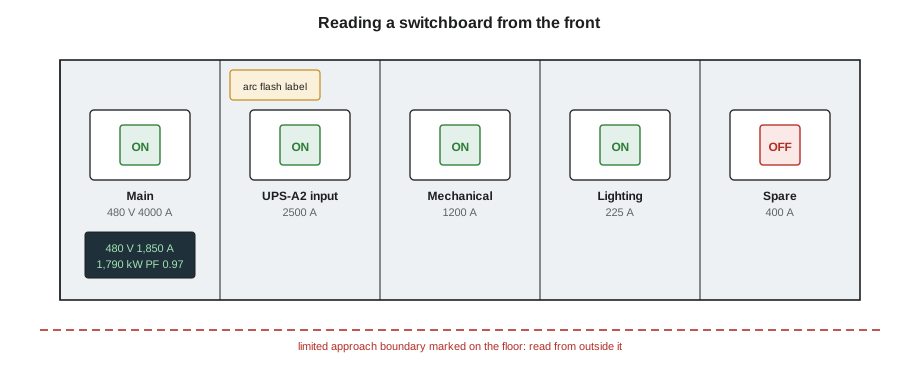
Technicians never operate switchboard breakers. Even closing a breaker that appears simply to have been left open can energize equipment someone is working on, and a breaker that has tripped has done so for a reason. The right response to an unexpected breaker position is to record it, check whether there is a permit or lockout for that feeder, and call the critical facilities team.
Protective devices: breakers and fuses
Every circuit is protected by a breaker or fuse sized for its cable and load. When current exceeds the setting for long enough, the device opens and stops the current. Electronic trip units have several settings: long-time protection for overloads that build slowly, short-time and instantaneous protection for faults, and on many larger breakers ground-fault protection. The settings are coordinated, meaning the breaker closest to a fault trips first and the breakers upstream stay closed, so a fault in one PDU does not take out a whole switchboard. Coordination studies are done by engineers, but technicians see their results: when coordination works, a fault causes one small, local outage instead of a large one.
A breaker trip on the A side of a 2N system causes no outage at the rack, because the B side carries the load. It does halve the redundancy for everything downstream of the tripped breaker, which is why a trip on either side is treated urgently.
Transformers
Transformers change one AC voltage to another using two coils wound on an iron core. Data centers have them at several points: the unit substations from medium to low voltage, the transformers inside floor PDUs that step 480 V down to 208Y/120 V, and transformers that make 415Y/240 V for busways. Smaller dry-type transformers are cooled by air through vents; large unit substation transformers may be filled with oil or another insulating liquid and stand outdoors.
A transformer is rated in kilovolt-amperes (kVA), the apparent power it can carry. Its current on each side depends on the voltage. A transformer always loses some energy as heat, partly in the core whenever it is energized and partly in the windings in proportion to the square of the load. That is why a transformer running hot or with a noticeably louder hum than usual is reported, and why the temperature gauges and alarms on transformers are part of the daily round.
import math
# A floor PDU transformer: currents on each side and loading (balanced three-phase)
kva_rating = 300.0
v_primary = 480.0        # line-to-line, V
v_secondary = 208.0     # line-to-line, V
load_kva = 148.8         # measured at the output
i_rated_sec = kva_rating * 1000 / (math.sqrt(3) * v_secondary)
i_rated_pri = kva_rating * 1000 / (math.sqrt(3) * v_primary)
i_load_sec = load_kva * 1000 / (math.sqrt(3) * v_secondary)
i_load_pri = load_kva * 1000 / (math.sqrt(3) * v_primary)
print(f"Rated current: {i_rated_pri:,.0f} A primary, {i_rated_sec:,.0f} A secondary")
print(f"Present load:  {i_load_pri:,.0f} A primary, {i_load_sec:,.0f} A secondary ({load_kva / kva_rating * 100:.0f} % of rating)")
# Winding losses rise with the square of the load (illustrative full-load figures)
core_kw, winding_kw_full = 0.9, 3.6
loss = core_kw + winding_kw_full * (load_kva / kva_rating) ** 2
print(f"Estimated transformer losses: {loss:.1f} kW, about {loss * 3412:,.0f} BTU/h of heat")Rated current: 361 A primary, 833 A secondary Present load: 179 A primary, 413 A secondary (50 % of rating) Estimated transformer losses: 1.8 kW, about 6,093 BTU/h of heat
The loss figure shows why small transformers are not a trivial heat source. A row of floor PDUs, each losing two or three kilowatts, is as much heat as several racks of servers.
Floor power distribution units
In halls with raised floors and lower-density racks, like Hall A, the floor PDU is the main link between the UPS and the racks. A floor PDU is a cabinet, usually at the end of a row or along the wall, containing an input breaker, a transformer, output panelboards with many branch circuit breakers, and a monitoring system that measures the input and output and often every branch circuit. Cables from the branch breakers run under the floor or overhead to each rack, ending in a receptacle into which the rack PDU plugs.
| Part | What it does | What the technician reads |
|---|---|---|
| Input breaker | Connects the PDU to its UPS output feeder | Open, closed or tripped indication |
| Transformer | Steps 480 V down to 208Y/120 V and creates a local neutral and ground | Temperature and alarm lights |
| Output panelboards | Branch circuit breakers, each feeding one rack receptacle | Breaker positions; labels with rack and receptacle IDs |
| Monitoring display | Voltage, current, power, energy, alarms, often per branch | Load in kW and percent, phase currents, branch currents, alarms |
| Surge protection and grounding | Limit transients; provide a local ground reference | Surge protection status light |
Floor PDUs are named for their side and number: PDU-A2-05 on the A side and its partner PDU-B2-05 on the B side, feeding the same row. A rack in that row has one cord to a branch in each. Every branch has a label giving the PDU, panel and circuit numbers, and the same identifier is printed on the receptacle above or below the rack, so a technician can trace any rack cord to its breaker without opening anything.
Reading phase balance
A three-phase PDU supplies single-phase and three-phase branch circuits. Single-phase circuits connect between two phases at 208 V or between a phase and neutral at 120 V. If the planners put too many circuits on one phase, its current rises above the others. Imbalance wastes capacity, because the PDU reaches the limit of one phase before the others, and it increases neutral current and heating. Planners balance the branches when racks are installed, but over time customers add equipment and the balance drifts. Technicians record the three phase currents on their rounds and report any phase that is much higher than the others.
# Phase balance on a floor PDU output (illustrative readings)
pdus = {
    "PDU-A2-04": (388, 392, 379),
    "PDU-A2-05": (412, 409, 418),
    "PDU-A2-06": (301, 362, 279),
}
rated_a = 833        # secondary rated current of a 300 kVA, 208 V PDU
for name, (ia, ib, ic) in pdus.items():
    avg = (ia + ib + ic) / 3
    worst = max(ia, ib, ic)
    imbalance = (worst - avg) / avg * 100
    note = "rebalance at next change window" if imbalance > 10 else "within planning limit"
print(f"{name}: phases {ia}/{ib}/{ic} A, highest at {worst / rated_a * 100:.0f} % of rating, imbalance {imbalance:.1f} % -> {note}")PDU-A2-04: phases 388/392/379 A, highest at 47 % of rating, imbalance 1.5 % -> within planning limit PDU-A2-05: phases 412/409/418 A, highest at 50 % of rating, imbalance 1.2 % -> within planning limit PDU-A2-06: phases 301/362/279 A, highest at 43 % of rating, imbalance 15.3 % -> rebalance at next change window
PDU-A2-06 has one phase carrying noticeably more than the others. It is still far from its rating, so it is not urgent, but Jamal opens a ticket for the capacity planning team so that the next new branch on that PDU goes on a lighter phase.
Ground faults, neutrals and harmonics
A ground fault is current flowing to ground through an unintended path, such as damaged insulation touching a metal frame. Larger breakers and many PDUs have ground-fault detection that alarms or trips. A ground-fault alarm without a trip is still important: it can mean a cable insulation is breaking down. Technicians report it and do not try to find the fault themselves.
IT power supplies draw current in short pulses rather than smooth sine waves, which creates harmonic currents. On 120 V circuits these harmonics add up in the shared neutral instead of canceling, so the neutral current can be larger than expected. Floor PDUs designed for IT loads have oversized neutrals and transformers rated for harmonic currents. A PDU display that shows a neutral current close to or above the phase currents, or a high total harmonic distortion, is worth reporting.
The daily electrical round
Stonebridge's daily round for the electrical rooms is a checklist on the technician's tablet. For each switchboard, transformer and floor PDU, the technician confirms the breaker positions match the normal state shown on the checklist, records the load, phase currents and any alarms, notes the temperature indications, and listens and looks for anything unusual: a burning smell, a change in hum, buzzing, discolored or damaged covers, water, dust or pests, and blocked ventilation. The checklist asks for numbers, not just ticks, because trends matter more than single readings.
- A load creeping up week by week on one PDU can reveal a customer installing more than they told the planners.
- A transformer temperature rising at the same load can mean a blocked filter or failing fan.
- A breaker indicator that changes between rounds without a permit means someone operated it, or it tripped; both need explaining.
- A label that is missing, wrong or unreadable is reported, because the label is how everyone finds the right breaker.
Worked problem
A tripped branch breaker in Hall A
A Hall A customer opens a ticket: one of their servers in rack A-17-04 is showing a power supply failure on its B cord. The server is still running on its A cord.
Show solution
- Jamal checks the rack PDU on the B side of A-17-04 in the monitoring system: it shows zero current and no input voltage.
- He reads the rack PDU's label: it is fed from PDU-B2-05, panel 2, circuit 17.
- At PDU-B2-05, the display shows branch 2-17 with zero current and a trip alarm, and the breaker handle is in the tripped position. He does not touch it.
- He checks the history: branch 2-17 carried 18 A before tripping, on a 30 A breaker. The A-side branch now carries all the rack's load, 26 A, within its rating.
- He calls Roz, who looks up the rack: the customer installed two new servers yesterday without a power review. Roz and an electrician inspect the circuit, find nothing damaged, and the electrician resets the breaker under the site procedure. It holds.
Answer: The trip came from a transient overload as the new servers powered up together while the rack was already near its planned limit. Roz opens a capacity ticket for the customer's account manager, and the customer is asked to stagger power-on and to apply for more power before adding equipment. The rack had kept running throughout on its A side, exactly as 2N distribution intends.
Common mistakes
MistakeClosing a breaker that looks as though it was left open.
InsteadUnexpected breaker positions are recorded and reported; someone may be working downstream.
MistakeRecording only that the round was done.
InsteadRecord numbers; trends show problems early.
MistakeIgnoring a ground-fault alarm because nothing tripped.
InsteadAn alarm can mean insulation breaking down; report it.
MistakeTreating a trip on the A side as harmless because the B side carries the load.
InsteadThe racks are now on one path with no redundancy; treat it urgently.
MistakeAssuming neutral current is always small.
InsteadIT loads cause harmonic currents that add up in the neutral.
Summary and key terms
- Switchboards divide the building supply into protected feeders; their fronts show breaker positions, meters and arc flash labels.
- Breakers and fuses are coordinated so that the device nearest a fault trips first.
- Transformers change voltage, are rated in kVA and lose energy as heat that rises with the square of the load.
- Floor PDUs contain an input breaker, transformer, branch breakers and monitoring, and feed racks through labeled receptacles.
- Phase imbalance, rising temperatures, ground-fault alarms and high neutral current are reported.
- Technicians read and record; they never operate distribution breakers.
- Switchboard
- An enclosure containing a main breaker, busbars and feeder breakers.
- Switchgear
- Heavier distribution equipment with each breaker in its own compartment, often draw-out.
- Coordination
- Setting protective devices so that the one nearest a fault trips first.
- kVA
- Kilovolt-ampere, the unit of apparent power used to rate transformers and UPS systems.
- Floor PDU
- A cabinet with a transformer and branch breakers that distributes power to a row of racks.
- Ground fault
- Current flowing to ground through an unintended path.
Practice problems
Work each problem on paper first, then reveal the answer to check.
Why are protective devices coordinated?
Show answer
So the device nearest a fault trips first and the outage stays small.
A transformer carries half its rating. Are its winding losses half of their full-load value?
Show answer
No, about a quarter, because they rise with the square of the load.
What should a technician do on finding a feeder breaker open that the checklist says should be closed?
Show answer
Record it, check for a permit or lockout, and call the critical facilities team without touching it.
Why can neutral current be high in a PDU feeding IT equipment?
Show answer
Harmonic currents from IT power supplies add up in the neutral.
Lesson quiz · 5 questions
Score 60% or more to complete this lesson.
Create a free account to save your progress, take quizzes and earn a certificate.