
DCT-210 · Lesson 2 of 12 · 20 min
TIA-942 spaces: ER, MDA, HDA, ZDA and EDA
On Jamal's second day, Nadia hands him a floor plan of Hall A with colored boxes drawn on it and asks him to find each box in the hall. The boxes are labeled ER, MDA, HDA and EDA, and two small ones are labeled ZDA. By lunchtime he has walked every row, and the letters have stopped being an alphabet soup. They are the names that the data center cabling standards give to the spaces where cabling is terminated and cross-connected, and every drawing, ticket and label at Stonebridge uses them.
Where the names come from
ANSI/TIA-942 is the North American standard for data center telecommunications infrastructure. Its current edition, TIA-942-C, was published in 2024. Alongside it, ISO/IEC 11801-5 covers the same ground internationally, with slightly different names, and the ANSI/BICSI 002 design practice adds detailed guidance. Canadian data centers generally follow TIA-942 directly, as most specifications in Quebec and Ontario name it. A technician does not need to know the standards clause by clause, but needs the vocabulary, because the design drawings and the labels are built on it.
TIA-942 describes the data center as a set of functional spaces connected by backbone cabling and horizontal cabling, exactly as LVT-120 described a building: backbone between the main rooms, horizontal to the work area. In a data center the work area is a cabinet full of equipment, and the spaces are mostly rows of cabinets rather than rooms.
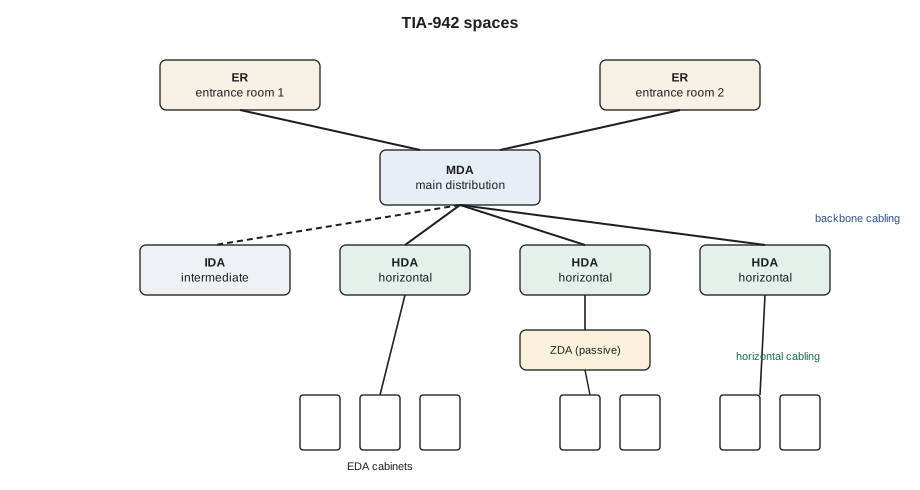
The spaces one by one
| Space | What it is | At Stonebridge |
|---|---|---|
| ER, entrance room | Where outside plant cables enter and carriers terminate | North and south entrance rooms on each campus |
| MDA, main distribution area | The central cross-connect for the computer room, with the core switches and routers | One per campus, plus a hall MDA in each hall |
| IDA, intermediate distribution area | An optional second level between the MDA and HDAs in large sites | Used between the campus MDA and Halls B and C |
| HDA, horizontal distribution area | Where horizontal cabling to the equipment rows is terminated, usually with access switches | Network cabinets at the end of each row in Hall A; network rows in Halls B, C and D |
| ZDA, zone distribution area | An optional consolidation point in the horizontal cabling, with no active equipment | Two zone boxes in Hall A under the floor, for small cages |
| EDA, equipment distribution area | The cabinets where the servers, storage and other equipment live | Every customer and tenant cabinet |
| TR, telecommunications room | A room serving spaces outside the computer room, such as offices | One per office floor of each admin building |
Colocation operators also use a name the standard does not: the meet-me room, which is usually the entrance room or a room next to it where cross-connects between carriers and customers are made. At Stonebridge the meet-me room is a secured part of the campus MDA. Its job is different enough that Lesson 9 is about it alone.
Backbone and horizontal
Cabling between the ER, MDA, IDA and HDA is backbone cabling. It is mostly single-mode fiber trunks, because these links are long and carry the highest speeds, with some multimode fiber and a little copper for management. Cabling from an HDA to the EDA, through a ZDA if there is one, is horizontal cabling. In Hall A it is a mix of Category 6A copper and multimode or single-mode fiber; in the newer halls it is almost all fiber. The standards limit the length of horizontal copper channels to 328 ft including cords, as LVT-130 explained, and the optical reach depends on the speed and the fiber type, as Lesson 5 shows.
Two rules about the hierarchy matter to technicians. First, there should be no more than one cross-connect level of each kind in a path, so that a link does not wander through a chain of panels, each adding loss and each a place to make a mistake. Second, a ZDA has no active equipment: it is just a panel or a box where horizontal cables can be consolidated near a group of cabinets, so that the cabinets can be added or moved without re-cabling back to the HDA.
What TIA-942-C changed
Nadia points out a few changes in the 2024 edition that show up in the newest halls. Cabinets in the MDA, IDA and HDA must be at least 31.5 in wide, which gives room for vertical cable managers beside the panels. At the equipment outlet the standard still calls for LC and MPO connectors, while elsewhere any optical connector that meets TIA-568.3 is permitted, which opens the door to the very small form factor connectors some manufacturers now make. Horizontal and backbone optical cabling should have at least two fibers, and single-pair balanced copper is now recognized as a horizontal cabling type. The edition also brings in the latest ASHRAE thermal envelope and adds material on edge data centers and immersion cooling.
For Jamal, the practical change is that Hall D's network rows were built to the new edition: wider cabinets, more room for managers, and MPO connectors on everything. Hall A, built in 2014, still has 24 in network cabinets crammed with panels, and its managers are always full.
Reading the hall plan
Every Stonebridge hall has a cabling plan showing each space, the trays between them and the identifier of every cabinet. Identifiers follow the scheme Jamal learned in DCT-130, campus, hall, row and cabinet, with the space type added for network cabinets:
- YUL2-A-MDA-02 is the second cabinet of Hall A's main distribution area.
- YUL2-A-HDA-31 is the network cabinet at the end of row 31, serving the cabinets in that row.
- YUL2-A-ZDA-2 is the second zone box under the floor of Hall A.
- YUL2-A-31-03 is an equipment cabinet, an EDA cabinet, in row 31.
At IAD-3 the same identifiers start with IAD3. A panel inside a cabinet adds a panel number, as in YUL2-A-HDA-31-PP4, and a port adds a port number. Lesson 11 shows how these identifiers become labels and records.
Following a path
Nadia gives Jamal a challenge: trace the path a Bayview Credit Union server in cabinet A-31-03 takes to reach the carrier that serves its branch network. He writes it out space by space.
# Trace a path through the TIA-942 spaces and check the cross-connect levels
path = [
    ("A-31-03", "EDA", "server, then a cord to panel PP1 at the top of the cabinet"),
    ("A-HDA-31", "HDA", "horizontal trunk from PP1 ends here; cord to the row access switch"),
    ("A-MDA-02", "MDA", "backbone trunk from the access switch uplink; cord to the hall core"),
    ("CMP-MDA-01", "MDA", "campus MDA and meet-me room: cross-connect to the carrier panel"),
    ("ER-N", "ER", "carrier's outside plant cable, spliced to the building trunk"),
]
levels = {}
for cab, space, what in path:
    levels[space] = levels.get(space, 0) + 1
    print(f"{space:4} {cab:11} {what}")
print("Spaces passed:", ", ".join(f"{s} x{n}" for s, n in levels.items()))
extra = [s for s, n in levels.items() if n > 1 and s not in ("MDA",)]
print("Path follows the hierarchy" if not extra else "Check: repeated levels " + ", ".join(extra))EDA A-31-03 server, then a cord to panel PP1 at the top of the cabinet HDA A-HDA-31 horizontal trunk from PP1 ends here; cord to the row access switch MDA A-MDA-02 backbone trunk from the access switch uplink; cord to the hall core MDA CMP-MDA-01 campus MDA and meet-me room: cross-connect to the carrier panel ER ER-N carrier's outside plant cable, spliced to the building trunk Spaces passed: EDA x1, HDA x1, MDA x2, ER x1 Path follows the hierarchy
The path passes two MDAs because Stonebridge has a hall MDA in each hall and a campus MDA for the whole site, an arrangement the standard allows in large multi-hall data centers. It does not pass through two HDAs or two ZDAs, which would mean someone had cabled around the plan.
Distances in the hierarchy
The spaces are placed so that the cabling between them stays within the limits of the media. Copper horizontal channels must stay within 328 ft; 10GBASE-T over Category 6A has the same limit. Multimode fiber links at 400 and 800 Gb/s are limited to tens of meters, so the HDA serving a row of high-speed equipment must be close to it. Single-mode backbone links can be hundreds of meters or more. A technician sees these limits in practice when a ticket asks for a link that the design never intended, for example a customer who wants a multimode link from a cage at the far end of Hall A to the campus MDA. The answer is a single-mode link or a different path, not a longer cord.
# Check whether a requested link stays within its medium's reach
reach_m = {"Cat 6A 10GBASE-T": 100, "OM4 100G-SR4": 100, "OM4 400G-SR4": 100, "OS2 400G-DR4": 500, "OS2 800G-DR8": 500}
requests = [("A-31-03 to A-HDA-31", "Cat 6A 10GBASE-T", 38), ("A-31-03 to CMP-MDA-01", "OM4 400G-SR4", 212),
            ("B-12-09 to B-HDA-12", "OM4 400G-SR4", 46), ("D-3-07 to D-4-02", "OS2 800G-DR8", 61)]
for name, medium, meters in requests:
    ok = meters <= reach_m[medium]
print(f"{name:22} {medium:17} {meters * 3.281:5.0f} ft {'within reach' if ok else 'too long: choose another medium or path'}")A-31-03 to A-HDA-31 Cat 6A 10GBASE-T 125 ft within reach A-31-03 to CMP-MDA-01 OM4 400G-SR4 696 ft too long: choose another medium or path B-12-09 to B-HDA-12 OM4 400G-SR4 151 ft within reach D-3-07 to D-4-02 OS2 800G-DR8 200 ft within reach
The second request fails, which is exactly the kind of thing Nadia wants a technician to catch before ordering cords. The reach values in the code are the typical figures; the real limit for a link is set by its loss budget, as Lesson 11 shows.
Worked problem
A zone box that was not on the plan
During a walk-through of Hall A, Jamal lifts a floor tile to check a leak sensor and finds a small gray box with eight Category 6A cables running into it from a nearby cage and one bundle running back toward HDA-28. It is not on the cabling plan.
Show solution
- He photographs the box and its labels, which read ZDA-3 in a customer's handwriting, and replaces the tile.
- He reports it to Nadia rather than opening it.
- Nadia finds an old ticket: a customer's contractor had installed the box in 2017 as a consolidation point for a cage that has since been reorganized.
- The box is a legitimate ZDA in function but was never recorded. Nadia opens a records ticket, the box is inspected and labeled to the Stonebridge scheme, and it is added to the hall plan with its ports.
Answer: An unrecorded consolidation point is a place where links can be broken by someone who does not know it exists. Recording it makes it part of the managed plant.
Spaces outside the computer room
Not every cabling space is in a hall. Each Stonebridge campus also has the telecommunications rooms that serve the office floors, the security control room, the network operations room and the building management system, and each of them is cabled back to the campus MDA by backbone cabling, just as an office building would be. The standards treat them as ordinary building spaces, with the building cabling rules from LVT-120. Jamal learns to recognize the difference in the labels: anything in a TR follows the building scheme, and anything in a hall follows the data center scheme. A ticket that asks for a link from an office floor to a hall always passes through the campus MDA, never through a shortcut between a TR and a hall HDA, because the MDA is where Stonebridge's network team can see and secure every connection between the two worlds.
How customers fit into the hierarchy
In a colocation hall, the customer's cage is an EDA from Stonebridge's point of view, but inside the cage the customer often builds its own small hierarchy: a customer MDA cabinet with its routers and firewalls, its own HDA cabinets, and its server cabinets. Stonebridge's responsibility ends at its panel at the top of the customer's first cabinet, the demarcation point, and the ticket for any work inside the cage must come from the customer. A technician who understands both hierarchies can explain to a new customer exactly where Stonebridge's cabling stops and theirs begins, which is one of the questions Nadia hears most often from new tenants.
Common mistakes
MistakeCalling every network cabinet an MDA.
InsteadUse the space names: MDA for the main cross-connect, HDA for the row, ZDA for a consolidation point.
MistakeInstalling switches in a ZDA.
InsteadA ZDA has no active equipment; it is a passive consolidation point.
MistakePatching a link through two HDAs to save a trunk.
InsteadFollow the hierarchy, with at most one cross-connect level of each kind.
MistakeOrdering a longer multimode cord to reach a distant MDA.
InsteadCheck the reach; use single-mode or another path.
MistakeIgnoring a box under the floor because it is not on the plan.
InsteadReport it so that it can be recorded or removed.
Summary and key terms
- TIA-942-C (2024) names the spaces: ER, MDA, IDA, HDA, ZDA and EDA, plus the TR for offices.
- Backbone cabling joins the ER, MDA, IDA and HDA; horizontal cabling runs from the HDA, perhaps through a ZDA, to the EDA.
- A ZDA is a passive consolidation point with no switches.
- The meet-me room is the colocation name for the place where carriers and customers cross-connect.
- TIA-942-C requires 31.5 in wide network cabinets and LC or MPO connectors at the equipment outlet.
- The spaces are placed so that links stay within the reach of their media.
- ER
- Entrance room, where outside plant cables enter.
- MDA
- Main distribution area, the central cross-connect and core network.
- IDA
- Intermediate distribution area, an optional level between MDA and HDA.
- HDA
- Horizontal distribution area, where horizontal cabling to equipment rows terminates.
- ZDA
- Zone distribution area, an optional passive consolidation point.
- EDA
- Equipment distribution area, the cabinets holding the equipment.
Practice problems
Work each problem on paper first, then reveal the answer to check.
Which space holds the access switches for a row in Hall A?
Show answer
The HDA at the end of the row.
What is the difference between backbone and horizontal cabling?
Show answer
Backbone joins the ER, MDA, IDA and HDA; horizontal runs from the HDA to the equipment cabinets.
Can a ZDA contain a switch?
Show answer
No; it is passive.
What does YUL2-A-HDA-31-PP4 identify?
Show answer
Patch panel 4 in the HDA cabinet for row 31 of Hall A at YUL-2.
Lesson quiz · 5 questions
Score 60% or more to complete this lesson.
Create a free account to save your progress, take quizzes and earn a certificate.