
DCT-120 · Lesson 8 of 12 · 20 min
Raised floors, ladders, lifts and working at heights
A data hall has more ways to fall than its tidy appearance suggests. In Hall A, the floor is a grid of removable tiles 2 ft above the concrete slab, and lifting a tile leaves a hole big enough to step into. Above the racks, cable trays and busway run at 9 to 11.5 ft, reached by stepladders and mobile platforms. In the halls with containment, the hot aisle roofs and ceilings carry lights, sensors and sprinkler pipes that technicians sometimes need to reach. Falls on the same level, from slips and trips, and falls from a low height, from ladders, are among the most common serious injuries in any workplace. This lesson covers raised floors, ladders, mobile elevating work platforms and the general rules for working at heights in a data hall.
Raised floors
A raised floor, also called an access floor, is made of square panels, typically 24 in on each side, resting on adjustable pedestals and sometimes connected by stringers. The space under the floor may carry cold air from the cooling units, power and data cables, chilled water pipes and leak detection cable. Panels come in several kinds: solid panels, perforated or grate panels that let cold air into the cold aisle, and panels with cut-outs for cables. Each has load ratings set by the manufacturer, as lesson 7 explained.
The main hazards of a raised floor are:
- Open tiles: a removed tile leaves a hole that people can step into, especially when walking backwards, carrying something or looking at a rack.
- Unstable tiles: a tile that rocks or sits unevenly because a pedestal has worked loose, a stringer is missing or the wrong tile has been put back.
- Removing too many tiles in a row: the floor's lateral stability relies on the panels; removing a line of tiles in a stringerless floor can let the pedestals around them move, and in some floors can let a section collapse.
- Damaged or cut tiles that no longer carry their rated load.
- Underfloor hazards: sharp metal, live cables and pipes, and the inability to see what is down there.
Lifting and replacing tiles
At Stonebridge, only technicians trained in raised floor work lift tiles, and only with a ticket for the job. The procedure is:
- Check the ticket and the floor plan, and confirm with the shift lead that the tile is not over a critical pipe or a cable that must not be disturbed.
- Place barriers around the opening before the tile is lifted: Stonebridge uses folding barriers stored at the end of each row, after the near-miss reports described in lesson 1.
- Use a tile lifter, a suction-cup tool, never fingers or a screwdriver levered under the edge.
- Lift no more tiles than the floor manufacturer allows in a row or area; in Hall A, no more than two adjacent tiles at once, and never a whole line.
- Never leave an open tile unattended. If you must leave, put the tile back or have someone stand at the barrier.
- Replace each tile in its original position and orientation, check that it sits flat and does not rock, and check that a perforated tile goes back where a perforated tile was, so that airflow is not disturbed.
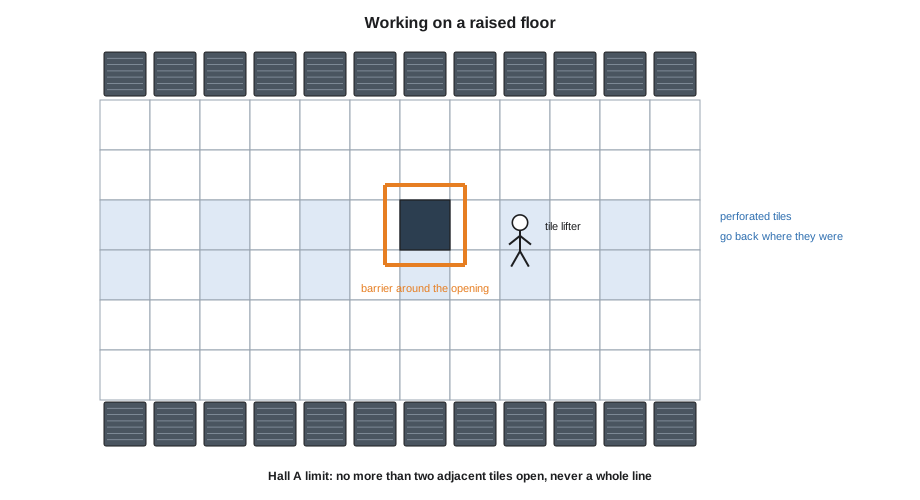
Lifting a perforated tile in the cold aisle also has a cooling effect: it releases cold air into the room at that point and can starve the racks further down the row. Technicians keep the time a perforated tile is out as short as possible, and the shift lead may ask them to watch rack inlet temperatures during longer underfloor work.
Under the floor
Underfloor work, such as pulling cables or inspecting leak detection, is done from above wherever possible, reaching in with tools. When a person must reach far into the space, they wear gloves and eye protection, use a light, and keep their hands away from anything they cannot see. Underfloor spaces are not normally treated as confined spaces, because they are open to the room once tiles are lifted, but a raised floor space that is used as an air plenum and has had its tiles sealed for a long period, or a space where a clean agent or refrigerant may have collected, must be assessed before anyone puts their head into it. The safety school's confined space course explains when a space counts as confined.
Slips and trips on the hall floor
Slips and trips cause more injuries in data centers than electrical hazards. Their causes are ordinary: cables across walkways, packaging left in aisles, carts parked in the cold aisle, condensation or a leak on a smooth floor, a tile edge raised a few millimeters, poor lighting at the end of a row. Stonebridge's rules are the ordinary good housekeeping rules applied strictly: no cables run across walkways except under approved cable protectors, no packaging in the halls, carts parked only in marked areas, spills and drips reported and cleaned at once, and any raised tile edge treated as a hazard report. Technicians wear footwear with slip-resistant soles and toe protection.
Ladders
Ladders are the most common way technicians reach overhead trays, sensors and lights, and the most common source of falls from height. Stonebridge allows only stepladders and platform ladders made of non-conductive fiberglass in the halls and electrical rooms, never metal ladders, because a metal ladder that touches an energized conductor or busway becomes part of the circuit. The rules follow the general ladder standards:
Ladders meet the ANSI A14 standards, with fiberglass ladders under A14.5, and are rated for the user's weight plus tools. OSHA's walking-working surfaces rules in 29 CFR 1910 Subpart D, adopted by VOSH, cover the use and inspection of ladders.
- Inspect the ladder before use: feet, rails, steps, spreaders and labels. Remove damaged ladders from service and tag them.
- Open stepladders fully with the spreaders locked; never use a stepladder folded and leaning against a rack.
- Set the ladder on a firm, level surface, never on an open or unstable floor tile, and never on a cart or box.
- Keep three points of contact while climbing and face the ladder.
- Do not stand on the top step or the top cap of a stepladder, or above the highest permitted step marked on the label.
- Keep your belt buckle between the rails: if you must lean out to reach the work, move the ladder.
- Carry tools in a belt or raise them with a line, not in your hands while climbing.
- Have a second person hold or watch the ladder in busy aisles, and keep others from walking under you.
# Which step is the highest one I may stand on, and can I reach the tray? (illustrative)
ladder_height = 6.0        # ft, height of the stepladder
top_safe_step = ladder_height - 2.0   # highest standing level allowed by the label
reach_above_feet = 5.0   # comfortable working reach above the feet without stretching
tray_height = 10.5
print(f"Highest permitted standing level: {top_safe_step:.2f} ft")
print(f"Comfortable reach from there:     {top_safe_step + reach_above_feet:.2f} ft")
if top_safe_step + reach_above_feet >= tray_height:
    print("This ladder reaches the tray without standing too high")
else:
print("Too short: use a taller platform ladder or a mobile platform")Highest permitted standing level: 4.00 ft Comfortable reach from there: 9.00 ft Too short: use a taller platform ladder or a mobile platform
The 6 ft stepladder cannot safely reach the tray. A taller platform ladder with a guarded platform, or a mobile platform, is the right tool.
Mobile elevating work platforms
For work on high trays, busway and lighting, Stonebridge uses small battery-powered mobile elevating work platforms, sometimes called scissor lifts or vertical mast lifts, with guardrails around the platform. They are safer than ladders for long jobs, but they bring their own hazards: tipping on an uneven or weak floor, crushing between the platform and an overhead tray or pipe, and collisions with racks. The rules:
Operators must be trained and familiarized on the specific machine, under the ANSI/SAIA A92 standards and OSHA's general duty requirements, and must inspect it before each shift.
- Check the floor rating before driving onto a raised floor; many lifts are too heavy for raised floors and are used only on slab floors or on load-spreading plates.
- Keep the gate closed and stay inside the guardrails; do not climb on the rails or put a ladder on the platform.
- Watch for overhead obstructions: trays, pipes, sprinkler heads and busway. Crushing against overhead structures is a leading cause of serious lift injuries.
- Wear a fall arrest or restraint harness when the manufacturer or the site procedure requires it, attached to the designated anchor on the platform.
- Barricade the area below to stop others walking under the work.
Containment ceilings and hot aisle roofs
Hot aisle containment in Halls B and C has a roof made of panels, with lights, sensors and sometimes fire suppression nozzles mounted in it. Containment roofs are not designed to be stood on or to carry ladders, and their panels may be designed to drop or shrink away in a fire so that sprinklers can reach the aisle. Work on or above them is done from a platform outside, never by climbing onto the containment. Leaning on a containment wall or door to reach something is also forbidden, because the panels can come loose.
Falling objects
Working at height creates a hazard for the people below. A dropped tool can injure someone, and in a data hall it can also land on running equipment or a power strip. Tools used at height are tethered where practical, small parts are carried in pouches, and the area below is kept clear with barriers or a spotter. Hard hats are worn when there is a risk of falling objects, for example during overhead tray installation, and in construction zones of the campus.
Worked problem
A new temperature sensor above aisle 9
A ticket asks for a temperature sensor to be replaced at the top of the cold aisle containment door frame in Hall A, aisle 9, at about 8 ft 6 in.
Show solution
- Jamal checks the floor under the work spot: solid tiles, none rocking, and the nearest perforated tile is two positions away.
- He picks the 4 ft fiberglass platform ladder with a guardrail, inspects it and sets it up fully open beside the door frame, not on the perforated tile.
- Roz holds the ladder and keeps people from walking under it; Jamal carries the sensor and a tethered screwdriver in a pouch.
- Standing on the platform with his belt buckle between the rails, Jamal swaps the sensor without leaning out.
- Before climbing down he checks the new sensor's reading on the monitoring app and photographs the installation for the ticket.
Answer: The job takes ten minutes. The step-by-step setup, especially avoiding the perforated tile, follows directly from the near-miss in lesson 1.
Fall protection beyond the hall
Most technician work at height happens inside the halls, but the campus has other places where falls are possible: the roofs where condensers and dry coolers sit, mezzanines in the electrical rooms, the generator yard's fuel tank platforms, and the loading dock edges. Roofs with equipment have guardrails or designated walkways; where they do not, work near the edge needs fall protection under the site program, and technicians go onto roofs only with the facilities team, after a briefing, and never alone or in high wind, ice or lightning. Loading dock edges are marked and protected with dock locks and barriers when no truck is present, because stepping backwards off a dock while pulling a pallet jack is a known cause of serious injury.
Under OSHA's general industry rules, adopted by VOSH, employers must protect workers from falls at heights of 4 feet or more on walking-working surfaces, and from any height above dangerous equipment. Stonebridge's program applies the same rules on its roofs and platforms.
Harnesses and lanyards are used only by people trained to inspect, fit and use them, and only with an anchor rated for the purpose. A harness worn without a suitable anchor, or attached to a cable tray or a pipe, gives no protection.
Common mistakes
MistakeLeaving an open floor tile unattended.
InsteadReplace it or keep someone at the barrier.
MistakeLifting a whole line of tiles to pull a cable.
InsteadFollow the floor maker's limit; in Hall A, two adjacent tiles.
MistakePutting a ladder on a floor tile that rocks.
InsteadUse a firm tile and report the unstable one.
MistakeUsing a metal ladder near busway.
InsteadUse non-conductive fiberglass ladders only.
MistakeStanding on a containment roof to reach a light.
InsteadWork from a platform outside the containment.
Summary and key terms
- Raised floors create open-tile and unstable-tile hazards; use barriers and a tile lifter, limit open tiles and replace tiles correctly.
- Perforated tiles affect cooling; return them to their places and keep them out briefly.
- Slips and trips are the most common injuries; keep walkways clear and report spills and raised edges.
- Use non-conductive stepladders on firm floors, keep three points of contact and do not stand too high.
- Mobile platforms need trained operators, floor checks, overhead watchfulness and barriers below.
- Never climb on containment; prevent falling objects with tethers, pouches and barriers.
- Raised floor
- A floor of removable panels on pedestals above the slab, with space beneath for air, cables and pipes.
- Tile lifter
- A suction-cup tool for lifting floor panels.
- Perforated tile
- A floor panel with openings that let cold air into the cold aisle.
- Mobile elevating work platform
- A powered platform with guardrails that lifts workers to height.
- Three points of contact
- Two hands and a foot, or two feet and a hand, on the ladder at all times.
Practice problems
Work each problem on paper first, then reveal the answer to check.
Why is a metal ladder forbidden in the halls?
Show answer
It conducts electricity if it touches energized conductors or busway.
What must you do if you need to leave an open floor tile?
Show answer
Replace it or have someone guard the barrier.
Why must a perforated tile go back in the same place?
Show answer
Swapping it changes the airflow to the racks.
Name two hazards of mobile elevating work platforms.
Show answer
Tipping on weak or uneven floors, crushing against overhead structures, collisions.
Lesson quiz · 5 questions
Score 60% or more to complete this lesson.
Create a free account to save your progress, take quizzes and earn a certificate.