
DCT-120 · Lesson 11 of 12 · 20 min
Fire detection and suppression: clean agents, pre-action and safety around discharge
Fires in data centers are rare, but when they happen they can destroy equipment worth more than the building and take a business offline for weeks. Data centers therefore have some of the most sophisticated fire protection in any building: very early smoke detection, sprinkler systems designed not to release water by accident, clean agent systems that put out fires with gas, and procedures that tie all of it to the power and cooling systems. This lesson explains what these systems do, what their alarms mean for a technician on the floor, and the rules that keep people safe around them. Design of fire protection belongs to fire protection engineers and the Data Center Engineering school; here the focus is the technician in the room.
Why data center fires are different
Most data center fires start small: an overheating power supply, a failing capacitor, a cable fault, a battery cell going into thermal runaway, or packaging left in the wrong place. They often smolder for some time, producing small amounts of smoke that the high airflow in the hall dilutes and carries away, which makes them hard to detect by ordinary means. The goal of a data center fire protection system is to detect a fire while it is still smoldering, alert people who can investigate and remove the source, and suppress it automatically if it grows, while protecting people and avoiding accidental discharges that would damage equipment.
Virginia's statewide building and fire codes, based on the International Building and Fire Codes, set the basic requirements for detection, alarms and sprinklers, and Stonebridge's design also follows the fire protection standards that insurers and customers expect, including NFPA 75, Standard for the Fire Protection of Information Technology Equipment, and NFPA 76 for telecommunications facilities.
Detection
Stonebridge's halls use several layers of detection:
- Aspirating smoke detection: a network of small pipes with sampling holes draws air continuously from the room, the underfloor space and the hot aisles to a very sensitive detector that can measure tiny amounts of smoke. It gives early warning, often before anyone can smell anything, with several alarm levels.
- Spot smoke detectors in ceilings, under floors and in rooms such as UPS and battery rooms.
- Heat detectors where smoke detection is not suitable, such as some mechanical spaces.
- Off-gas detection in lithium-ion battery cabinets, as lesson 5 explained.
Aspirating systems usually have staged alarms: an alert level that tells the operations center to investigate, an action level that calls staff to the area, and fire levels that trigger the fire alarm and start the suppression sequence. A technician sent to an early aspirating alarm walks the area with the shift lead's instructions, looking and smelling for the source, and reports. Often the cause is harmless, such as dust from construction or a contractor's activity, but sometimes it is a failing power supply that can be found and switched off before it becomes a fire.
Sprinklers and pre-action systems
Most data centers are sprinklered, because building codes require sprinklers in most buildings and because water is the most reliable way to control a large fire. To protect equipment from accidental water release, data halls use pre-action sprinkler systems. In a pre-action system the pipes in the room are dry, filled with supervisory air, and water is held back by a valve. Water enters the pipes only when the detection system 'pre-acts' the valve. Even then, water flows from a sprinkler only where heat has opened that particular head, so the water goes only where the fire is.
| Pre-action type | Water enters the pipes when | Use |
|---|---|---|
| Non-interlock | Either detection operates or a sprinkler head opens | Less common in data halls |
| Single-interlock | Detection operates | Common in data halls; a damaged pipe or head only gives a trouble alarm |
| Double-interlock | Detection operates and a sprinkler head opens, losing air pressure | Where water damage must be minimized; slower to deliver water |
Sprinkler heads are fragile and must not be struck, painted, covered or used to hang things from. Technicians working at height near sprinkler heads take care not to knock them. A damaged head on a pre-action system will not release water by itself, but it will make the system unable to protect that area and will cause a supervisory alarm.
Clean agent systems
Some rooms, especially in older designs or where customers require it, are protected by gaseous clean agent systems. A clean agent is a gas that extinguishes fire without leaving residue, so equipment can often be cleaned and returned to service. Two families are common:
- Halocarbon agents, such as FK-5-1-12 and HFC-227ea, which absorb heat and interrupt combustion at concentrations of a few to about nine percent. They discharge in about ten seconds.
- Inert gas agents, such as IG-541 and IG-55, mixtures of nitrogen, argon and sometimes carbon dioxide, which extinguish fire by lowering the oxygen concentration to about 12 to 14 %. They discharge over about one to two minutes.
NFPA 2001, Standard on Clean Agent Fire Extinguishing Systems, governs their design and sets limits for people. For each halocarbon agent there is a no observed adverse effect level, NOAEL: the concentration at which no harmful effects were seen in tests. Systems for normally occupied spaces are designed so that the concentration stays at or below the NOAEL. Inert gas systems are designed so that the reduced oxygen level is survivable for a limited time. Even so, the standard and Stonebridge's procedures require that everyone leaves a room before or immediately as it discharges, because the discharge itself is violent and loud, visibility drops, the agent may decompose in a fire into harmful products, and a fire's own smoke is dangerous.
# Check a clean agent design concentration against its NOAEL (typical published values)
agents = {  # agent: (typical design concentration %, NOAEL %)
    "FK-5-1-12": (5.85, 10.0),
    "HFC-227ea": (7.9, 9.0),
}
for agent, (design, noael) in agents.items():
    margin = noael - design
    status = "within NOAEL" if design <= noael else "ABOVE NOAEL: not for occupied rooms"
    print(f"{agent:10s} design {design:5.2f} %  NOAEL {noael:5.1f} %  margin {margin:4.2f} points  {status}")
# Inert gas: oxygen after discharge
o2_after = 13.0
print(f"IG-541 oxygen after discharge about {o2_after:.0f} %: leave the room; do not re-enter until ventilated")FK-5-1-12 design 5.85 % NOAEL 10.0 % margin 4.15 points within NOAEL HFC-227ea design 7.90 % NOAEL 9.0 % margin 1.10 points within NOAEL IG-541 oxygen after discharge about 13 %: leave the room; do not re-enter until ventilated
Clean agents are released from cylinders stored nearby through pipes to nozzles in the ceiling and underfloor. A discharge is very loud and the gas rushes out with enough force to lift ceiling tiles and loose items, which is why rooms protected by clean agents have restrained ceiling tiles and why nothing loose is left lying in them. The room must stay closed for the hold time so that the concentration stays high enough to prevent re-ignition; that is why these rooms are tested for air tightness and why doors to them must never be propped open.
The discharge sequence
A clean agent system does not discharge the moment smoke is detected. A typical sequence, set by the design and the site procedure, is:
- First detector in alarm: the fire alarm system signals an alarm and the operations center investigates.
- Second detector or a higher aspirating level, cross-zoned to avoid false discharges: the pre-discharge alarm starts, with a distinct sound and flashing lights at the room's doors and inside, and a countdown, often 30 seconds, begins.
- Air handling serving the room may be shut down and dampers closed, and power to some equipment may be shut down, according to the design.
- At the end of the countdown, the agent discharges, and a discharge indicator shows outside the room.
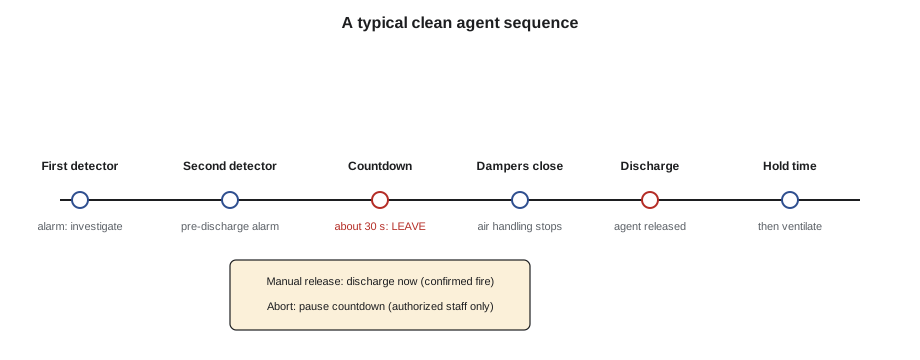
Rooms with clean agent systems have two important manual stations at their exits. The manual release station discharges the agent immediately and is used only when a fire is confirmed. The abort station, where fitted, pauses the countdown while it is held, and is used only by trained people who have confirmed there is no fire, for example when a contractor's dust has triggered the detectors. At Stonebridge, only the shift lead or the critical facilities team may use an abort station, and only following the procedure.
What a technician does on a pre-discharge alarm
The rule is the same for everyone: when the pre-discharge alarm sounds, leave the room immediately by the nearest exit, closing doors behind you, and go to the assembly point or the operations center as the procedure says. Do not stop to save files, finish a task or collect tools. Help visitors and contractors out. Do not try to investigate the cause or fight the fire, and do not hold an abort station unless you are authorized and trained. Once out, report to the shift lead what you saw. Nobody re-enters a room after a discharge until the fire service or the facilities team has confirmed there is no fire and the room has been ventilated.
# Countdown awareness: how far can you get before discharge? (illustrative walking speed)
countdown_s = 30
walk_speed = 4.0          # ft/s, a brisk walk between racks
distances = {"from the far end of aisle 12": 158, "from the center of the hall": 82, "from beside the exit": 13}
for where, d in distances.items():
    t = d / walk_speed
print(f"{where:30s} {d:4.0f} ft about {t:4.0f} s {'out in time' if t < countdown_s else 'TOO FAR: leave at the first alarm'}")from the far end of aisle 12 158 ft about 40 s TOO FAR: leave at the first alarm from the center of the hall 82 ft about 20 s out in time from beside the exit 13 ft about 3 s out in time
Thirty seconds is enough to leave most rooms, but not if a person stops to finish a task or is wearing hearing protection and does not notice the alarm at first. That is why pre-discharge alarms include strobes and why technicians leave on the first alarm when they are working far from an exit.
Emergency power off
Some data halls have emergency power off, EPO, buttons at their exits, which cut power to the IT equipment in the room, and sometimes to its cooling, in an emergency. Older codes required them in IT rooms; current codes allow them to be omitted in many cases, and many operators prefer not to have them because accidental activation causes outages. Where they exist, they are covered and labeled, and they are pressed only in a genuine emergency, such as a person being electrocuted or a fire that threatens life, and normally only on the shift lead's or the fire service's instruction. A technician should know where each one is and what it shuts down, and should report any cover that is damaged or missing.
Fire prevention on the floor
The best fire is the one that never starts. Technicians prevent fires every day by following the house rules: no cardboard, wood or packaging in the halls; no portable heaters, kettles or chargers; no daisy-chained power strips or extension cords; cables kept within tray fill limits; hot work only with a permit and a fire watch; and prompt reporting of hot smells, discolored plugs, swollen batteries and noisy fans. Fire extinguishers suitable for electrical fires, such as carbon dioxide or clean agent extinguishers, are located throughout the halls; technicians are trained to use them only on very small, early fires, when they can do so safely with a clear exit behind them, and never on a battery fire.
Impairments and maintenance
Fire protection systems are maintained and tested regularly by fire protection contractors, and parts of them are sometimes taken out of service, impaired, for work such as construction, maintenance or a contractor's dusty job. Impairments are managed through the permit system: the impaired area is recorded, the fire department and the insurer may be notified, extra fire watches are posted, and the system is restored as soon as the work ends. A technician who notices a disabled detector, a capped sprinkler head, a closed sprinkler valve or a covered aspirating sampling hole without an impairment tag reports it at once.
Worked problem
An early warning in Hall A
At 14:20 the aspirating system for Hall A reaches its alert level in zone 3. Dmitri sends Jamal to walk zone 3, which covers rows 7 to 10.
Show solution
- Jamal walks the cold aisles first, then the hot aisles, looking and smelling. In row 9 he notices a faint smell of hot electronics near cabinet A-09-03.
- He sees no smoke but hears a fan whining unevenly in a customer's switch at the top of the rack. He reports this to Dmitri without opening anything.
- Dmitri checks the customer's monitoring with them: the switch is reporting a power supply fault. The customer agrees to shut down that power supply remotely; the switch keeps running on its second supply.
- The aspirating reading falls back to normal within twenty minutes. Jamal tags the cabinet for a power supply replacement and files a report.
- If the reading had kept rising or Jamal had seen smoke, the procedure would have been to leave the area and let the fire alarm system and the fire service take over.
Answer: Early detection found a failing power supply before it became a fire. No alarm went to the fire department and no agent was discharged.
Common mistakes
MistakeStaying in a room after the pre-discharge alarm to finish a task.
InsteadLeave at once by the nearest exit and close the doors.
MistakeHolding an abort station without authority.
InsteadOnly the shift lead or critical facilities team, following the procedure.
MistakePropping open the door of a clean agent room.
InsteadDoors stay closed so the agent can hold its concentration.
MistakePressing an EPO button to stop an alarm.
InsteadEPO is for genuine emergencies on instruction only.
MistakeIgnoring a capped sprinkler head or covered sampling hole.
InsteadReport any impairment without a tag.
Summary and key terms
- Data center fires often start small and smolder; very early detection, such as aspirating systems, finds them early.
- Pre-action sprinkler systems keep pipes dry until detection operates, and heads still open only where there is heat.
- Clean agents put out fires without residue; halocarbons are designed at or below their NOAEL, inert gases lower oxygen to about 12 to 14 %.
- On the pre-discharge alarm everyone leaves immediately; only authorized people use abort stations.
- EPO buttons are for genuine emergencies only.
- Prevent fires with house rules and report impairments and warning signs promptly.
- Aspirating smoke detection
- A system that draws air through sampling pipes to a very sensitive smoke detector.
- Pre-action system
- A sprinkler system with dry pipes that fill with water only when detection operates.
- Clean agent
- A gaseous fire extinguishing agent that leaves no residue.
- NOAEL
- No observed adverse effect level: the highest agent concentration with no harmful effects seen in tests.
- Impairment
- A fire protection system or part of one taken out of service.
Practice problems
Work each problem on paper first, then reveal the answer to check.
What is the difference between a single-interlock and a double-interlock pre-action system?
Show answer
Single-interlock fills on detection alone; double-interlock needs detection and a fused head losing air pressure.
Why are clean agent rooms kept airtight?
Show answer
So the agent concentration holds long enough to stop re-ignition.
What do you do on a pre-discharge alarm?
Show answer
Leave immediately, close doors, help others out, report to the shift lead.
When may an EPO button be pressed?
Show answer
Only in a genuine emergency, normally on the shift lead's or fire service's instruction.
Lesson quiz · 5 questions
Score 60% or more to complete this lesson.
Create a free account to save your progress, take quizzes and earn a certificate.