
DCT-120 · Lesson 7 of 12 · 19 min
Lifting, moving and installing heavy equipment
In 2014, when Hall A opened, a fully loaded customer cabinet weighed perhaps 1,500 lb. Today a single liquid-cooled AI compute rack of the kind Corvid AI is installing in Hall D can weigh around 3,300 lb, as much as a small car, and arrives on a crate that is heavier still. Servers, storage shelves, UPS modules and battery blocks are heavy too. Moving equipment is one of the most common causes of injury in data centers: strained backs, crushed fingers and toes, and equipment tipping over. It is also a common cause of damage to floors, doors and neighboring equipment. This lesson covers manual handling at technician level, moving racks and crates, floor loading and installing equipment safely.
Manual handling: the risk factors
Musculoskeletal injuries, to the back, shoulders, wrists and knees, come from forces, awkward postures and repetition. Lifting a server into a rack combines all three: the load is heavy, it is held away from the body, it must be raised to shoulder height or lowered near the floor, and the rails must be lined up while holding it. The general manual handling course in the safety school covers the body mechanics. In the data hall, the practical rules are:
- Know the weight before lifting. Server and storage specifications list it; many 2U and 4U servers weigh 55 to 100 lb or more when fully populated.
- Use a server lift for anything heavier than the site's one-person limit, and for any lift above chest height or below knee height.
- Use two people for loads the procedure says need two, with one person giving the commands.
- Remove power supplies, drives or fans before lifting when the manufacturer allows, to lighten the load.
- Keep the load close, avoid twisting, and move the feet rather than turning the back.
Stonebridge sets a one-person lifting limit of 50 lb for lifts between knee and shoulder height, lower for awkward lifts. This kind of limit comes from ergonomic guidelines such as the lifting equation published by the US National Institute for Occupational Safety and Health, which reduces the recommended weight as the load moves away from the body, the lift goes higher or lower, and the frequency increases. The code below shows a simplified version for a few common situations.
# Simplified lifting guide in the style of the NIOSH lifting equation (illustrative)
load_constant = 51        # lb, ideal conditions
def recommended(h_dist, v_height, travel, twist_deg):
    hm = min(1.0, 10 / h_dist)                 # horizontal distance from the body
    vm = 1 - 0.003 * abs(v_height - 30) * 2.54        # height of the hands at the start
    dm = 0.82 + 1.8 / travel                     # vertical travel
    am = 1 - 0.0032 * twist_deg                   # twisting
    return load_constant * hm * vm * min(1.0, dm) * am
cases = [("server at waist, close, small lift", (10, 30, 10, 0)),
         ("server to top of rack, arms out", (20, 63, 33, 0)),
         ("server from floor box, twisting", (18, 4, 26, 45))]
for name, args in cases:
print(f"{name:36s} recommended limit about {recommended(*args):5.1f} lb")server at waist, close, small lift recommended limit about 51.0 lb server to top of rack, arms out recommended limit about 16.7 lb server from floor box, twisting recommended limit about 17.3 lb
The answers show why a server that is easy to handle at waist height becomes a two-person or lift job at the top of a rack. Stonebridge's halls each have server lifts, battery-powered platforms that raise a server to the rail height and let it slide across on rollers, and their use is mandatory above the one-person limit.
Moving racks and crates
Cabinets arrive either empty, to be fitted out on site, or pre-integrated, with equipment already installed and cabled by the manufacturer. Pre-integrated racks are becoming the norm for AI clusters because they are tested at the factory. They are heavy and top-heavy, and their castors are designed for short moves on smooth floors, not for crossing ramps or door thresholds. Moving them is planned work:
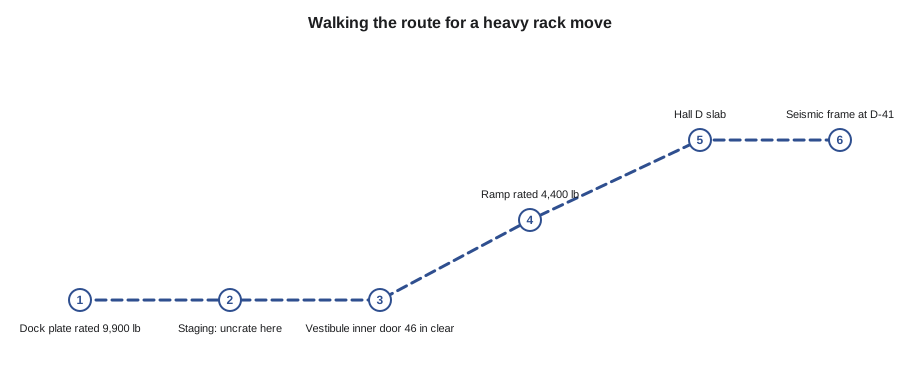
- Plan the route from the loading dock to the final position and walk it before the move: door widths and heights, thresholds, ramps, lifts, floor ratings, turns and obstacles.
- Use the right equipment: pallet jacks or powered pallet trucks for crates, rack dollies or air skates for heavy racks where the castors are not rated for the route.
- Use enough people: one to steer, others to push and to watch the corners, and a spotter at blind spots. Nobody walks in front of a moving rack on a slope.
- Move slowly; a rack that starts to tip cannot be held. Keep hands and feet clear of the base.
- Never try to catch a falling rack or crate. Step away.
Floor loading
Every floor has a rated load. Slab-on-grade floors, like Hall D's, can usually take very heavy racks. Raised floors, like Hall A's, are rated by the manufacturer for several kinds of load: a uniform load spread over the whole tile, a concentrated load on a small area such as a castor, and a rolling load for moving equipment across the tiles. A rack whose static weight is fine can still crack a tile when it is rolled across it, because the castor concentrates the load. Freight lifts, ramps and loading dock plates have their own ratings. The facilities team keeps a floor loading plan, and every move of equipment over a set weight needs their approval.
# Check a rack move against floor, ramp and lift ratings (illustrative ratings)
rack_kg = 1500
castors = 4
footprint_m2 = 0.6 * 1.2
limits = {"Hall A raised floor, rolling load per castor": 450,
          "Hall A raised floor, uniform load per square meter": 1200,
          "freight lift capacity": 2700,
          "ramp to Hall D, rated load": 2000}
per_castor = rack_kg / castors * 1.25          # allow for uneven loading
per_m2 = rack_kg / footprint_m2
checks = [("Hall A raised floor, rolling load per castor", per_castor),
          ("Hall A raised floor, uniform load per square meter", per_m2),
          ("freight lift capacity", rack_kg + 400),          # rack plus dolly and crew
          ("ramp to Hall D, rated load", rack_kg + 150)]
for name, value in checks:
    lim = limits[name]
print(f"{name:52s} {value * 2.2046:7.0f} lb vs {lim * 2.2046:5.0f} lb {'OK' if value <= lim else 'EXCEEDS - choose another route or spread the load'}")Hall A raised floor, rolling load per castor 1033 lb vs 992 lb EXCEEDS - choose another route or spread the load Hall A raised floor, uniform load per square meter 4593 lb vs 2646 lb EXCEEDS - choose another route or spread the load freight lift capacity 4189 lb vs 5952 lb OK ramp to Hall D, rated load 3638 lb vs 4409 lb OK
The check shows that a 3,300 lb rack cannot be rolled across Hall A's raised floor on its castors, nor stood on it, even though the lift and ramp are fine. That is why heavy AI racks go to Hall D on its concrete slab, and why any heavy equipment that must cross a raised floor goes on load-spreading plates laid as a temporary path.
Installing equipment in a rack
Installing equipment is where heavy objects meet live systems. The rack being worked on and the racks around it are running. A few rules prevent most problems:
- Load racks from the bottom up and remove equipment from the top down, so the rack stays stable. Heavy items go low.
- Extend the rack's stabilizer feet or anti-tip plate, or confirm it is bolted down, before sliding any server out on its rails. A rack with several servers extended at once can tip forward.
- Extend only one piece of equipment at a time.
- Use the correct rails for the equipment and the rack, fully engaged and latched; never rest a server on another server.
- Keep cords and cables clear of rail mechanisms; pinched cords are a common cause of damaged insulation.
- Wear safety footwear with toe protection and cut-resistant gloves where sharp rail edges are a hazard.
# Is it safe to extend another server? Simple tip check (illustrative)
rack = {"bolted": False, "stabilizer_out": True}
extended = ["U30 storage shelf"]
request = "U12 server"
max_extended = 1
if not rack["bolted"] and not rack["stabilizer_out"]:
    print("STOP: deploy the stabilizer before extending anything")
elif len(extended) >= max_extended:
    print(f"STOP: retract {extended[0]} before extending {request}")
else:
print(f"OK to extend {request}")STOP: retract U30 storage shelf before extending U12 server
Seismic bracing and anchoring
Northern Virginia has relatively low seismic hazard, but the 2011 Mineral earthquake was felt widely across the region, and racks in Stonebridge's halls are anchored to the floor or to seismic frames according to the structural engineer's design. Technicians installing new racks never remove anchors, and any rack moved must be re-anchored before equipment is installed.
Unpacking and the loading dock
The loading dock has its own hazards: trucks, pallet jacks and forklifts, dock edges, heavy crates and banding straps that spring back when cut. Stonebridge keeps unpacking out of the white space altogether. Equipment is unpacked in the staging room next to the dock, where cardboard, wood, foam and plastic are removed and recycled before the equipment goes onto the hall floor. That keeps dust and combustibles out of the halls, protects the clean agent and detection systems from false alarms caused by dust, and keeps cutting tools and banding away from live racks. Only trained operators drive forklifts, and technicians keep clear of forklift routes.
Worked problem
A Corvid AI rack into Hall D
Carmen Ortiz's team is receiving the first of a batch of pre-integrated compute racks for Hall D, each about 3,300 lb, crated on a pallet.
Show solution
- Two days before, Jamal and Roz walk the route with Carmen and a facilities engineer, measuring the vestibule door, checking the ramp rating and confirming the rack castors are rated for the ramp slope.
- On the day, a trained operator moves the crate to the staging room with a powered pallet truck. The crate is opened and the banding cut by the rigging contractor, standing to the side.
- The rack rolls off the pallet down the crate's built-in ramp with four people: one steering at the rear, two at the sides, one spotting the front. Nobody stands downhill.
- In Hall D the rack is positioned, leveled and anchored to its seismic frame before the liquid cooling hoses and power are connected by the qualified trades.
- Jamal checks the floor and route for damage afterwards and records the move in the ticket.
Answer: The rack is in place without injury or damage. Walking the route found that the vestibule's inner door needed its closer removed for the move, which would otherwise have pinched the rack mid-doorway.
Carts, pallet jacks and powered equipment
Inside the building, most equipment moves on carts and pallet jacks. Stonebridge's carts have brakes, guard rails and a load rating printed on them, and technicians check that the load is within the rating and does not block their view before they push. Carts are pushed, not pulled, so that the person can see ahead and is not run over if the cart rolls. Long or tall loads need a second person to watch the far end, and nothing is stacked higher than the cart's rails. Manual pallet jacks are rated for the load and are lowered fully when parked. Powered pallet trucks and stackers are operated only by trained people, because a powered truck carrying a crate has far more momentum than a person can stop. In the halls, carts are parked only in the marked bays at the end of each row, never in the cold aisle where they block airflow and exits.
The doors on the route matter too. Fire doors and security doors are heavy and close automatically; propping them open for a move breaks both the fire separation and the security layers described in DCT-110. Stonebridge uses a door control request: security holds the doors open for the move with an officer present and closes them as soon as the load has passed. A technician never wedges a fire door open, even for a minute.
Common mistakes
MistakeLifting a heavy server into a high position alone.
InsteadUse the server lift above the one-person limit or above chest height.
MistakeRolling a heavy rack across a raised floor on its castors.
InsteadCheck rolling load ratings; use load-spreading plates or another route.
MistakeExtending several servers at once on an unbolted rack.
InsteadExtend one at a time with stabilizers deployed.
MistakeTrying to catch a tipping rack.
InsteadStep away; it cannot be held.
MistakeUnpacking crates in the white space.
InsteadUnpack in the staging room and keep packaging out of the halls.
Summary and key terms
- Heavy equipment is a major cause of injury and damage; modern AI racks can weigh around 3,300 lb.
- Know the weight, use server lifts and two-person lifts, keep loads close and avoid twisting.
- Plan rack moves by walking the route and checking doors, ramps, lifts and floor ratings.
- Raised floors have uniform, concentrated and rolling load ratings; castors concentrate loads.
- Load racks bottom up, deploy stabilizers, extend one item at a time and keep cords clear of rails.
- Unpack in staging, keep combustibles out of halls and keep clear of forklifts.
- Pre-integrated rack
- A rack delivered with its equipment installed and cabled at the factory.
- Rolling load
- The load a floor tile can take from a wheel or castor moving across it.
- Server lift
- A powered platform that raises equipment to rail height for installation.
- Stabilizer
- A foot or plate that stops a rack tipping forward when equipment is extended.
- Staging room
- A room next to the dock where equipment is unpacked before entering the halls.
Practice problems
Work each problem on paper first, then reveal the answer to check.
Why do heavy items go at the bottom of a rack?
Show answer
To keep the center of gravity low and the rack stable.
A rack's static load is within the raised floor's uniform rating. Why can it still crack a tile when moved?
Show answer
Castors concentrate the load; the rolling load rating may be exceeded.
What should you do if a rack starts to tip during a move?
Show answer
Step away; never try to catch it.
Why are crates unpacked outside the white space?
Show answer
To keep dust, combustibles and cutting tools away from live equipment and detection.
Lesson quiz · 5 questions
Score 60% or more to complete this lesson.
Create a free account to save your progress, take quizzes and earn a certificate.