
CYB-101 · Lesson 12 of 12 · 23 min
Capstone: a security review of a small business
▶ Video coming soon A video version of this lesson is on the way.
This capstone brings the course together. Sam's security review of Ridgeline Coffee Roasters began with a phishing email in lesson 1 and has touched every topic since: threat actors, attacks, controls, cryptography, certificates, identity, networks, endpoints, monitoring and incident response. Now it is time to finish the review the way a professional would: with a structured assessment, a risk register, a prioritized roadmap and a short report that the owner can act on. The same method works for any small organization, from a dental office to a hardware store, and it is a good model for the first security review you carry out yourself.
Scoping the review
Every review starts by agreeing its scope: what is included, what is not, who must be involved and what the result will look like. Ridgeline's review covered its people and processes, the office, cafe and roastery, every device in the inventory, the network, and the cloud services the business depends on: Microsoft 365, the online shop, the point-of-sale and payment provider, the payroll provider and the bank. It did not include testing the providers' own systems, which is their responsibility under the shared responsibility model; instead the review checked how Ridgeline configured and used those services. Rosa agreed that the result would be a risk register, a roadmap and a two-page summary, and that Sam would present it at a staff meeting.
A review is not an attack. Sam's review used conversations, walk-throughs, configuration checks, logs and the dashboards of Ridgeline's own services, all with Rosa's written permission. Any active security testing, such as scanning the network for vulnerabilities, requires explicit authorization from the owner of every system involved, and is always kept within the agreed scope.
Gathering information
Sam gathered information in four ways. Interviews with each person asked what they do, which systems and data they use, what would hurt most if it stopped or leaked, and what they find awkward about security, since awkward controls get bypassed. A walk-through of each site looked at doors, screens, cables, card readers, the network closet and the shelf where the NAS sits. A technical check of each device compared it with the baseline from lesson 9, and the cloud services were checked for MFA, admin accounts, sharing settings and alerts. Finally, a document review looked for the policies and records that should exist: the inventory, the backup log, the leaver checklist and the incident plan.
The interviews produced several of the most important findings. Anita mentioned that the bank sends a code to her phone for large payments, but that she sometimes reads the code to Rosa over the phone when Rosa approves from home, which would let a caller pretending to be Rosa capture it. Kai mentioned that the roaster's temperature logger runs an old version of its software that the maker no longer updates. Mei mentioned that baristas share a single point-of-sale login for speed during the morning rush.
Assessing controls area by area
To keep the review complete, Sam worked through a checklist drawn from the CIS Controls and the Canadian Center for Cyber Security's baseline controls for small organizations, grouped into areas. For each area the question was simple: is the control in place, partly in place or missing? A score per area shows at a glance where the business is strong and where it is weak.
| Area | Key checks | Ridgeline status |
|---|---|---|
| Inventory | All devices, software and services listed with owners | In place (built in NET-101) |
| Accounts and MFA | Individual accounts, MFA everywhere, leavers removed, access reviews | Partly: shared POS login remains |
| Data protection | Classification, encryption at rest, backups tested and protected | In place since the ransomware incident |
| Secure configuration | Baselines, admin rights limited, unused software removed | Partly: roaster logger unsupported |
| Updates | Automatic updates, weekly checks, end-of-support plan | In place |
| Network | Segmentation, firewall rules, secure Wi-Fi, no exposed remote access | In place |
| Monitoring | Central logs, alerts with owners, weekly review | Partly: router logs not yet reviewed monthly |
| People | Training, phishing reporting, clear procedures | Partly: bank code habit |
| Incident response | Plan, contacts offline, tabletop exercise, records | In place |
Try it yourself
Score the control areas
Each check in the review is recorded as "yes", "partly" or "no". Complete area_score(checks) so that it returns a score out of 100 for one area, where yes counts 2 points, partly 1 and no 0, divided by the maximum possible and rounded to the nearest whole number, with halves rounded up (Python's round() rounds halves to the nearest even number, so add 0.5 and use int() instead). An area with no checks scores 0. Then weakest(areas) returns the name of the area with the lowest score (ties: alphabetical).
areas = {
    "Accounts and MFA": ["yes", "yes", "partly", "no"],
    "Network": ["yes", "yes", "yes", "yes"],
    "People": ["yes", "partly", "partly"],
}

def area_score(checks):
    points = {"yes": 2, "partly": 1, "no": 0}
    return 0

def weakest(areas):
    return None

for name, checks in areas.items():
    print(name, area_score(checks))
print("weakest:", weakest(areas))
The risk register
Each finding becomes an entry in a risk register: a table listing the risk, the asset and threat involved, its likelihood and impact scores from lesson 4, the current controls, the proposed treatment, the owner and a target date. The register turns a pile of observations into decisions, and it stays alive after the review: Ridgeline will update it every quarter and after any incident. Sam also estimated the effort for each fix on a three-point scale, so that quick wins with high risk scores could be scheduled first.
register = [
    # (risk, likelihood, impact, effort 1 low to 3 high)
    ("Bank codes read aloud over the phone", 3, 5, 1),
    ("Shared point-of-sale login", 4, 3, 1),
    ("Unsupported roaster logger software", 3, 3, 3),
    ("Router logs not reviewed", 3, 2, 1),
    ("No staff phishing refresher this year", 3, 4, 1),
]
rows = []
for risk, likelihood, impact, effort in register:
    score = likelihood * impact
    phase = "this month" if score >= 12 and effort == 1 else "next 3 months" if score >= 9 else "this year"
    rows.append((score, effort, phase, risk))
for score, effort, phase, risk in sorted(rows, key=lambda r: (-r[0], r[1])):
print(f"{score:>2} effort {effort} {phase:<13} {risk}")15 effort 1 this month Bank codes read aloud over the phone 12 effort 1 this month Shared point-of-sale login 12 effort 1 this month No staff phishing refresher this year 9 effort 3 next 3 months Unsupported roaster logger software 6 effort 1 this year Router logs not reviewed
Try it yourself
Plan the roadmap phases
Complete phase(likelihood, impact, effort) using Sam's rule: a risk goes in "this month" if its score (likelihood times impact) is 12 or more and its effort is 1 (low); otherwise "next 3 months" if its score is 9 or more; otherwise "this year". Then plan(register) returns a dictionary mapping each phase name to a list of the risks in it, in their original order. Every phase name should appear even if its list is empty.
register = [
    ("Bank codes read aloud", 3, 5, 1),
    ("Shared point-of-sale login", 4, 3, 1),
    ("Unsupported logger software", 3, 3, 3),
    ("Router logs not reviewed", 3, 2, 1),
]

def phase(likelihood, impact, effort):
    return "this year"

def plan(register):
    result = {"this month": [], "next 3 months": [], "this year": []}
    # add each risk name to the right list
    return result

print(plan(register))
Treatments for the main findings
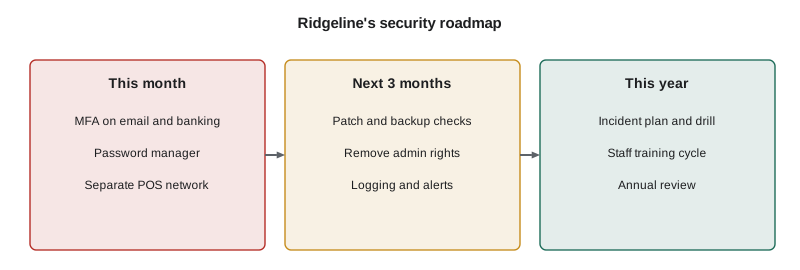
For the bank codes, the treatment was a process change and a technical one: Rosa now approves payments from her own bank login on her own phone, with its own second factor, so that no code is ever read aloud, and staff were reminded that no genuine caller, including Rosa or the bank, will ever ask for a code. For the shared point-of-sale login, the provider supports individual staff PINs that take a second to enter; each barista now has one, which restores accountability for refunds and voids without slowing the morning rush. For the roaster logger, replacement software is planned for the spring equipment budget, and until then a compensating control keeps the logger on the roastery segment with no internet access and its data copied nightly to the NAS. The router logs were added to Sam's monthly review, and a short phishing refresher, built around the original payroll email, was scheduled for the next staff meeting.
Some findings were accepted. The guest Wi-Fi occasionally slows on busy Saturdays, which is an availability nuisance with no effect on Ridgeline's own data, so Rosa accepted it and it was recorded with a review date. The review also recognized what was already working well, which matters for morale and for knowing what to keep: the segmented network, the tested and protected backups, the incident plan proven in a real incident, and staff who report problems quickly.
Writing the report
Security reports fail when they are written for other security people. Rosa needs to know what matters, what it will cost, what she must decide and what happens next; she does not need a list of protocol names. Sam's two-page summary followed a simple structure. It opened with a one-paragraph overall picture: Ridgeline's security has improved a great deal this year and is now good for a business of its size, with three gaps to close. It then listed the top risks in plain language, each with its business impact, the recommended fix, the cost and the owner. It summarized the roadmap by phase, named the decisions Rosa needed to make, and ended with what was already working well and the date of the next review. The full risk register and the area-by-area checklist went in an appendix for Jordan and Sam.
Presenting the results to the whole staff, briefly and without blame, was the last step. People follow security practices far more reliably when they understand the reasons, and the staff meeting gave Mei a chance to explain why the shared login had seemed necessary, which helped choose a fix that worked for the cafe.
Worked problem
Writing one finding for the owner
Rewrite this technical finding for Rosa: "Bank second-factor OTP disclosed verbally; susceptible to vishing-based MFA interception."
Show solution
- Say what is happening in plain words: Anita sometimes reads the bank's approval code to Rosa over the phone.
- Say why it matters for the business: a criminal who phones pretending to be Rosa could collect the code and send money from Ridgeline's account.
- Give the fix, cost and owner: Rosa approves payments from her own bank login on her phone; no cost; Rosa and Anita, this week.
- Add the supporting rule: no genuine caller ever needs a bank code, so staff should hang up and report any such request.
Answer: A good finding states the behavior, the business risk, the fix with cost and owner, and the rule that prevents it recurring.
Keeping security going
A review is a snapshot, and security is a continuing practice. Ridgeline's calendar now holds the routines built throughout this course: weekly checks of updates, backups and the security dashboard; the monthly backup restore test and log review; quarterly access reviews and risk register updates; a yearly tabletop exercise, staff refresher and full review; and the leaver checklist whenever someone leaves. Changes trigger reviews too: a new service, a new device or a new kind of data all prompt the question of what could go wrong and which controls are needed.
For you, this course is the foundation for the specialist courses that follow in the IT programs: network security, security operations, incident response and forensics, vulnerability management, cloud security, and governance, risk and compliance. It also covers the core of the CompTIA Security+ exam objectives. The habits it teaches, understanding what matters, thinking about how it could be harmed, choosing sensible controls, watching for problems and being ready to respond, apply at every level of the field.
Common mistakes
MistakeStarting a review without an agreed scope and written permission.
InsteadAgree scope, participants and deliverables first, and get authorization for any technical testing.
MistakeRelying only on technical scans.
InsteadInterviews and walk-throughs reveal process risks, such as codes read aloud, that no tool will find.
MistakeListing findings in the order they were found.
InsteadScore each risk and schedule high-risk, low-effort fixes first.
MistakeWriting the report in technical jargon for the owner.
InsteadExplain business impact, fixes, costs, owners and decisions in plain language.
MistakeProposing fixes that make work impossible.
InsteadInvolve the people affected so that controls fit how they work and are not bypassed.
MistakeTreating the review as finished once the report is delivered.
InsteadKeep the risk register alive with regular updates and schedule the next review.
Summary and key terms
- A review starts with an agreed scope, participants, deliverables and written permission.
- Interviews, walk-throughs, technical checks and document reviews gather the evidence.
- A checklist by area, drawn from established frameworks, keeps the assessment complete.
- Findings go into a risk register with scores, treatments, owners and dates.
- A roadmap schedules high-risk, low-effort fixes first and uses compensating controls where needed.
- The owner's report explains business impact and decisions in plain language.
- Regular routines and change-triggered reviews keep security going between reviews.
- security review
- A structured assessment of an organization's security.
- scope
- What a review or test covers and what it excludes.
- shared responsibility model
- The division of security duties between a cloud provider and its customer.
- risk register
- A living table of risks, scores, treatments, owners and dates.
- roadmap
- A phased plan of improvements.
- quick win
- A high-value fix that takes little effort.
- compensating control
- A temporary or alternative control used when the preferred one is not possible.
- authorization
- Written permission from a system owner, required before any security testing.
Practice problems
Work each problem on paper first, then reveal the answer to check.
Why did the review not test the payment provider's own systems?
Show answer
They are outside Ridgeline's scope and the provider's responsibility under the shared responsibility model; Ridgeline checked its own configuration and use.
Which finding came from an interview rather than a technical check?
Show answer
Any of: bank codes read aloud, the shared point-of-sale login, or the unsupported logger software.
A risk scores 15 and its fix takes high effort. Which phase does it go in under Sam's rule?
Show answer
Next 3 months, because the this-month phase requires low effort.
What compensating control protects the unsupported roaster logger until it is replaced?
Show answer
Keeping it on the roastery segment with no internet access, and copying its data nightly to the NAS.
What should the opening paragraph of an owner's security report do?
Show answer
Give the overall picture in plain language, including the main gaps, before any detail.
Name three recurring routines that keep Ridgeline secure after the review.
Show answer
Any three of: weekly update and backup checks, monthly restore tests and log reviews, quarterly access reviews and register updates, yearly tabletop, refresher and full review, leaver checklist.
Lesson quiz · 5 questions
Score 60% or more to complete this lesson.
Create a free account to save your progress, take quizzes and earn a certificate.