
CRE-499 · Lesson 6 of 12 · 27 min
The launch plan: the first thirty days
Launching a channel is not a single moment but a short campaign. In the first thirty days you publish your opening content, tell the people who already know you, take part in communities where your audience gathers, start your owned channel and learn quickly from the first data. This lesson applies the growth and community ideas from CRE-301, the funnel thinking from CRE-302 and CRE-340 and the email and privacy rules from CRE-320 and CRE-440. The deliverable is a launch plan of two pages with a thirty-day schedule, targets derived from funnel rates and an email setup that complies with the law.
Set expectations honestly. Most new channels grow slowly at first, because platforms have little data about who should see them. The point of the launch is to give your content the best possible start, gather early signals and build habits. A quiet first month is normal; a launch without a plan wastes the attention you can generate.
What to launch with
Launch with enough content that a curious visitor can see what the channel offers and has a reason to subscribe. For a weekly or fortnightly long-form channel, publishing two or three pieces in the first week and then settling into the regular schedule works well. Lead with your strongest, most searchable topics from the backlog, ideally ones with proven demand from your outlier research. Add a short channel trailer or pinned introduction that states the promise and schedule in under a minute.
Make the channel page ready before you invite anyone: banner, description, links, playlists organized by pillar and a clear next step for visitors. A visitor who arrives from a friend's share and finds a confusing, half-finished page is unlikely to return.
The launch funnel and targets
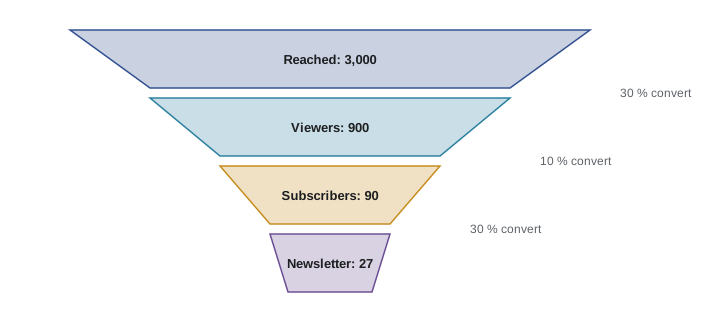
Set launch targets from funnel rates rather than wishes. A simple funnel runs from people reached, to visitors who view, to viewers who subscribe or follow, to subscribers who also join your owned channel. Use conservative rates from your validation tests and from CRE-301 and CRE-302 benchmarks, then calculate what each stage implies. The calculation shows which stage matters most and keeps your targets realistic.
Worked problem
Launch targets from funnel rates
Jordan expects to reach about 3,000 people in the first thirty days through personal networks, two bike communities, the bike shop's social account (with the owner's permission) and a collaboration. Assume 30 % of those reached view at least one video, 10 % of viewers subscribe and 30 % of subscribers join the newsletter. What targets follow?
Show solution
- Viewers: \( 3{,}000 \times 0.30 = 900 \).
- Subscribers: \( 900 \times 0.10 = 90 \).
- Newsletter sign-ups: \( 90 \times 0.30 = 27 \).
Answer: The launch targets are roughly 900 viewers, 90 subscribers and 27 newsletter sign-ups from outreach alone, before search and recommendations add more. If Jordan wants 150 newsletter subscribers by the end of term, outreach will not be enough; search content and newsletter calls to action across the term must do most of the work.
Look at which rate has the most leverage. Raising the view rate from 30 % to 40 % (better titles and thumbnails in shares) adds 300 viewers; raising subscription from 10 % to 15 % (a clearer promise and call to action) adds 45 subscribers. Work on the stage where a realistic improvement makes the biggest difference.
The thirty-day schedule
Plan the launch day by day for the first week and week by week after that. Spread outreach across the month rather than spending it all on day one, so that each new piece of content has fresh attention.
| When | Actions |
|---|---|
| Days −7 to −1 | Finish buffer; prepare channel page, trailer and newsletter welcome email; draft personal messages and community posts; confirm collaboration date |
| Day 1 | Publish two long pieces and trailer; send personal messages to friends and family who are genuinely interested; post on your own social accounts |
| Days 2 to 4 | Reply to every comment; share one useful short; post a helpful contribution (not just a link) in one community that allows it |
| Days 5 to 7 | Publish third piece; send first newsletter; review first-week data; note questions viewers ask |
| Week 2 | Collaboration or guest appearance; second community contribution; answer viewer questions with a short |
| Week 3 | Regular schedule; first small test (for example a title variant); share a behind-the-scenes post |
| Week 4 | Thirty-day review: compare results with targets, update the plan and charter if needed |
Cross-promotion and collaboration
Cross-promotion means using one channel or relationship to send attention to another. Repurpose clips from long videos into shorts on the same platform and on a second platform, each with a clear pointer to the full video. Mention your newsletter in videos and your videos in your newsletter. Collaborations, as CRE-301 explained, let two creators share audiences; at the launch stage, look for creators of similar size or slightly larger in a neighboring niche, and offer real value such as an expert segment, a joint challenge or a useful guest video.
Communities can be powerful but punish self-promotion. Read each community's rules, contribute helpful answers for a while before sharing your own content, share only where it genuinely answers a question, and disclose that it is your channel. Spamming links can get you banned and damages your reputation in exactly the places your audience lives.
Owned channels and email
An owned channel is one where you control the relationship with your audience, such as an email list or a website, rather than depending on a platform's algorithm. CRE-301 and CRE-440 explained why owned channels reduce platform risk: if a platform changes its recommendations or your account is suspended, you can still reach people who chose to hear from you. Start your list at launch, even if it grows slowly. A simple free email service, a sign-up form with a clear promise ('a fortnightly email with one fix, one safety tip and new videos') and a short welcome email are enough.
Email marketing is regulated, and the rules apply to student projects just as they apply to companies.
In the US, the CAN-SPAM Act governs commercial email, including newsletters that promote your channel, products or sponsors. CAN-SPAM does not require consent before the first email, but it requires accurate header and subject lines, identification of the message as an advertisement where applicable, a valid physical postal address (a post office box or registered private mailbox is allowed), a clear way to opt out and honoring opt-outs within ten business days. Using a confirmed opt-in sign-up anyway is best practice, because it improves deliverability and builds trust, and some states and email providers expect it. The FTC enforces CAN-SPAM, with civil penalties of more than $53,000 per violating email, adjusted annually for inflation. Text messages are covered by stricter rules under the Telephone Consumer Protection Act, which generally requires prior express written consent for marketing texts. Your privacy notice should explain how you will use and protect email addresses under the FTC Act and any applicable state privacy law.
| Requirement | CAN-SPAM (US) |
|---|---|
| Consent before sending | Not required, but confirmed opt-in is best practice |
| Accurate headers and subject lines | Yes |
| Physical postal address | Yes (post office box allowed) |
| Opt-out mechanism | Yes, working for at least 30 days after sending |
| Honor opt-out | Within 10 business days |
| Maximum penalty | More than $53,000 per violating email (inflation-adjusted) |
Worked problem
Growing the list across the term
Jordan expects 27 sign-ups from launch outreach. After launch, each long video averages 600 views in its first month, and about 2 % of viewers join the newsletter through the call to action. With six long videos across the term, roughly how many subscribers will the list have by week 14, assuming 5 % of subscribers unsubscribe over the term?
Show solution
- Sign-ups from videos: \( 6 \times 600 \times 0.02 = 72 \).
- Total before unsubscribes: \( 27 + 72 = 99 \).
- After 5 % unsubscribes: \( 99 \times 0.95 \approx 94 \).
Answer: About 94 subscribers, short of the 150 goal in Jordan's charter. Options include a stronger lead magnet such as a printable pre-ride checklist, mentioning the newsletter in shorts, or adjusting the goal at mid-term with a written reason.
Measuring the launch
Decide in advance what you will look at after the first week and after thirty days. Early on, rates are more informative than totals: click-through rate on impressions, average view percentage, the share of viewers who subscribe, and newsletter sign-up rate. Expect noise; a single share in a large community can swing everything. Record results in your log with dates, compare them with your funnel targets and adjust the next month's plan. CRE-440's warning about reading too much into small samples applies strongly during a launch.
Celebrate the right things. A first comment from a stranger asking a follow-up question, a viewer who returns for a second video or an email reply saying a fix worked are all signs that the channel is delivering value, even when the totals are small.
Launch risks
Note the main risks of the launch in your risk register: a technical problem on launch day, a collaboration that falls through, a community that removes your post, a negative comment that knocks your confidence, or an exam that collides with launch week. For each, write a response. Keeping one extra finished video in reserve, scheduling launch away from exam week and having a backup collaborator are simple, effective mitigations.
Writing launch messages that people want to receive
Personal outreach works best when it is genuinely personal and easy to act on. A short message to a friend who rides a bike to work ('I started a channel on cheap bike fixes; the first video is on squeaky brakes, which you mentioned last month. I would love your honest feedback') is far more effective than a mass message asking everyone to subscribe. Ask for feedback or a specific action rather than general support, and never pressure people or send repeated reminders. Friends and family who are not in your audience can still help by sharing with someone who is, but their own views may teach the algorithm the wrong audience, so do not ask them to binge your videos.
Prepare a short launch kit in advance: two or three sentences describing the channel, a link to the best first video, one image sized for social posts and a link to your newsletter sign-up. With the kit ready, sharing takes seconds, and every share describes the channel in the same clear way. Keep a simple record of where you shared and when, so that your thirty-day review can link spikes in views to specific actions rather than guesses.
Common mistakes
MistakeLaunching with one video and an unfinished channel page.
InsteadLaunch with two or three strong pieces, a trailer and a complete page.
MistakeSpending all outreach on day one.
InsteadSpread outreach across the month so each new piece gets fresh attention.
MistakePosting links in communities without contributing.
InsteadFollow community rules, contribute first and disclose that it is your channel.
MistakeAdding people to a mailing list without proper consent or opt-out.
InsteadUse a clear opt-in form, identify yourself and honor unsubscribes within ten business days.
MistakeJudging the launch on totals alone.
InsteadCompare rates with funnel targets and treat small samples with caution.
Summary and key terms
- A launch is a thirty-day campaign, not a single day; slow early growth is normal.
- Launch with two or three strong, searchable pieces, a trailer and a ready channel page.
- Funnel rates turn outreach into realistic targets and show which stage has the most leverage.
- Spread outreach across the month and plan collaborations and community contributions.
- Start an owned channel such as an email list at launch to reduce platform risk.
- Email marketing must follow CASL in Canada or CAN-SPAM in the US, with clear identification and opt-outs.
- Measure early rates, compare with targets, record results and manage launch risks.
- Launch campaign
- A planned series of actions over the first weeks of a channel.
- Channel trailer
- A short introduction that states a channel's promise and schedule.
- Conversion rate
- The share of people at one funnel stage who move to the next.
- Cross-promotion
- Using one channel or relationship to send attention to another.
- Owned channel
- A channel where the creator controls the audience relationship, such as an email list.
- Lead magnet
- A useful free item offered in exchange for joining a list.
- Express consent
- Clear, affirmative permission to receive messages.
- Confirmed opt-in
- A sign-up confirmed by clicking a link sent to the email address.
- Commercial electronic message
- Under CASL, an electronic message encouraging participation in a commercial activity.
- Unsubscribe mechanism
- A working way for recipients to stop receiving messages.
Practice problems
Work each problem on paper first, then reveal the answer to check.
Why spread outreach across the month?
Show answer
So each new piece gets fresh attention and early attention is not wasted.
Reach 2,000, view rate 25 %, subscribe rate 8 %. Subscribers?
Show answer
2,000 × 0.25 × 0.08 = 40.
In the funnel above, which adds more: raising view rate to 35 % or subscribe rate to 10 %?
Show answer
View rate gives 56 subscribers; subscribe rate gives 50. View rate adds slightly more.
Name two parts of a channel page to finish before launch.
Show answer
Banner, description, links, playlists by pillar, trailer (any two).
How should you share content in online communities?
Show answer
Follow the rules, contribute first, share only where helpful and disclose it is your channel.
Why start an email list at launch?
Show answer
It builds a direct audience relationship that does not depend on platform algorithms.
Within how many business days must unsubscribes be honored under both CASL and CAN-SPAM?
Show answer
Ten business days.
Does CAN-SPAM require consent before the first email?
Show answer
No, but confirmed opt-in is best practice; CASL does require consent.
Five videos at 800 views with 1.5 % sign-up. New subscribers?
Show answer
60.
Name two launch risks and a mitigation.
Show answer
Technical failure, failed collaboration, removed post, exam clash; keep a spare video, schedule away from exams.
Lesson quiz · 5 questions
Score 60% or more to complete this lesson.
Create a free account to save your progress, take quizzes and earn a certificate.