
CRE-499 · Lesson 11 of 12 · 29 min
Business plan and financial projection
The business plan looks beyond the term. It describes what your channel could become over the next twelve months, how it would make money, what it would cost, what could go wrong and what you would do about it. It brings together the strategy from CRE-440, the revenue and unit economics from CRE-302, the contracts, money and taxes from CRE-330, the team and finance thinking from CRE-401 and the risk and reputation work from CRE-430. The deliverable is a plan of four to six pages with a twelve-month financial projection in three scenarios and a risk register.
A business plan for a small creator is not a pitch for venture capital. Its main reader is you. Writing it forces you to test whether the channel can become a sustainable side project, a part-time business or eventually more, and what would have to be true for each. A plan that concludes 'this works best as a passion project with modest income' is perfectly valid if the reasoning is sound.
Structure of the plan
- Executive summary: the channel, its audience, its results so far and the twelve-month goal in half a page.
- Market and audience: niche size, audience needs, competitors and your positioning, from lessons 2 and 8.
- Content and growth plan: formats, cadence, growth levers and owned channels for the next year.
- Revenue model: streams, pricing and timing, informed by the pilot.
- Operations: time, tools, any help you will need and your production system.
- Financial projection: twelve-month forecast in three scenarios with assumptions stated.
- Risks: a risk register with likelihood, impact, owner and responses.
- Milestones and decision points: what you will review and when.
Building growth assumptions
Every projection rests on assumptions, and the plan is only as good as they are. Base them on your own data from the term wherever possible: views per video, growth in watch time, conversion rates for subscribers and email sign-ups, affiliate EPC and product conversion from the pilot. Where you must use outside benchmarks, cite them and treat them cautiously. State every assumption in a table so that a reader can challenge it.
| Assumption | Base case | Source |
|---|---|---|
| Long videos per month | 2 | Term capacity and calendar |
| Median views per long video in first 3 months, month 1 | 1,050 | Term data (lesson 10) |
| Monthly growth in views per video | 6 % | Weeks 5 to 13 trend, slowed for caution |
| Affiliate clicks per 1,000 views | 18 | Pilot results |
| Affiliate EPC | $0.08 | Pilot results |
| Digital product sales per 100 email subscribers per month | 1.5 | Pilot results |
| Email subscribers, month 1 | 110 | End of term |
| Sponsored segments per quarter from month 6 | 1 at $100 | Pitch learning and rate card |
Compound growth
Growth compounds: a 6 % monthly increase is applied to a larger number each month. The formula for a value after n periods of steady growth is shown below. Small differences in the growth rate make large differences over a year, which is why scenarios matter.
Worked problem
Projecting views per video
Median views per video start at 1,050 in month 1. What are the expected median views in month 12 under 3 %, 6 % and 10 % monthly growth?
Show solution
- Month 12 is 11 periods after month 1.
- At 3 %: \( 1{,}050 \times 1.03^{11} \approx 1{,}050 \times 1.384 \approx 1{,}453 \).
- At 6 %: \( 1{,}050 \times 1.06^{11} \approx 1{,}050 \times 1.898 \approx 1{,}993 \).
- At 10 %: \( 1{,}050 \times 1.10^{11} \approx 1{,}050 \times 2.853 \approx 2{,}996 \).
Answer: Depending on the growth rate, month-12 views per video range from about 1,450 to 3,000, a twofold spread. The base case of 6 % roughly doubles views per video over the year.
Membership and recurring revenue
Recurring revenue, such as memberships, is valuable because it is more predictable than one-off sales. CRE-302 explained monthly recurring revenue, churn and the steady state at which new members balance cancellations. If your plan includes a membership later, estimate how many members you need to cover its cost in time and money.
Worked problem
Break-even members for a membership tier
Jordan considers a $4 monthly membership offering early access and a monthly live repair clinic. The platform keeps 30 % of membership revenue. Running the clinic and member posts takes about 4 hours a month, which Jordan values at $15 an hour. How many members are needed to break even, and is that reachable if 6 people join each month and 10 % cancel each month?
Show solution
- Net per member: \( 4 \times 0.70 = \$2.80 \) a month.
- Monthly cost of time: \( 4 \times 15 = \$60 \).
- Break-even members: \( 60 / 2.80 \approx 21.4 \), so 22 members.
- Steady state: \( 6 / 0.10 = 60 \) members.
Answer: About 22 members are needed to break even, and the steady state of 60 members would earn about $168 a month net, about $108 above the time cost. The plan should check that the channel is eligible for membership features and that 6 new members a month is realistic given the audience size.
The twelve-month projection
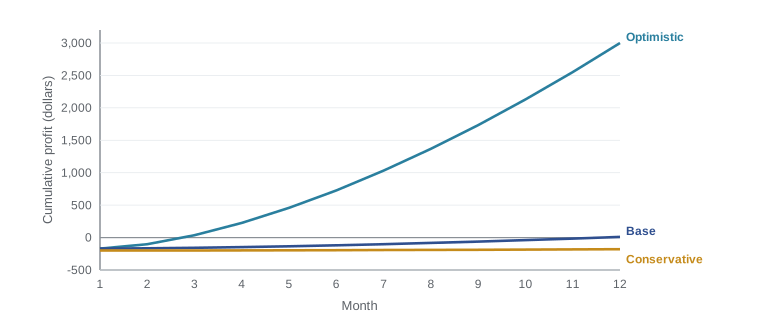
Build the projection month by month in a spreadsheet. For each month, calculate views, then revenue from each stream using your assumptions, then costs (software, equipment, any paid help, platform fees), then profit before tax. Show three scenarios: a conservative case with lower growth and conversion, a base case and an optimistic case. CRE-440's scenario planning method applies: the point is not to predict the future but to see the range of outcomes and plan for the bad case.
Worked problem
A simplified annual projection
Base case for the year: total views of 46,000 across long videos (from the growth assumption). Affiliate: 18 clicks per 1,000 views at $0.08 EPC. Product: 1.5 sales per 100 subscribers a month at $4.20 net, with subscribers averaging 180 over the year. Sponsorships: 2 segments at $100. Costs: $240 software, $150 equipment. Calculate profit before tax.
Show solution
- Affiliate clicks: \( 46{,}000 / 1{,}000 \times 18 = 828 \); revenue \( 828 \times 0.08 \approx \$66 \).
- Product sales: \( 1.5 / 100 \times 180 \times 12 = 32.4 \), about 32 sales; revenue \( 32 \times 4.20 \approx \$134 \).
- Sponsorships: \( 2 \times 100 = \$200 \).
- Total revenue: \( 66 + 134 + 200 = \$400 \); costs \( 240 + 150 = \$390 \).
- Profit before tax: \( 400 - 390 = \$10 \).
Answer: The base case roughly breaks even in year one. That is common for small channels and shows where the leverage lies: sponsorships and the product contribute most, while affiliate income is minor at this scale. The plan might reduce software costs, raise the product's conversion with a second product, or pursue more sponsorships as views grow.
Taxes and money management
Plan for tax on profits and keep business money separate. CRE-330 recommended setting aside a percentage of every payment in a separate account so that a tax bill is never a surprise.
In the US, a sole proprietor pays income tax on net self-employment income plus self-employment tax of 15.3 % on 92.35 % of net earnings (12.4 % Social Security up to the 2026 wage base of $184,500 and 2.9 % Medicare), and may need to make quarterly estimated tax payments. Many advisers suggest setting aside 25 to 30 % of profit for federal, state and self-employment taxes at modest income levels. The qualified business income deduction may reduce taxable income. Keep records for at least three years, and longer for some items.
Worked problem
Setting aside tax
In the optimistic case, the channel earns $3,000 profit in the year. If Jordan sets aside 28 % of each month's profit, how much is reserved, and what is left?
Show solution
- Reserve: \( 0.28 \times 3{,}000 = \$840 \).
- Remaining: \( 3{,}000 - 840 = \$2{,}160 \).
Answer: Setting aside $840 covers a likely tax bill at this income level with room to spare; any excess can be released after filing. The actual amount depends on Jordan's total income and province or state.
The risk register
A risk register lists the main risks, scores each by likelihood and impact, assigns an owner and records responses. CRE-430 used a likelihood-times-impact score from 1 to 25; reuse it here. Include platform risks (a policy or algorithm change), personal risks (burnout, a busy semester), legal and reputational risks (a disclosure mistake, a safety complaint), financial risks (a sponsor not paying) and technical risks (account takeover, lost footage).
| Risk | Likelihood (1 to 5) | Impact (1 to 5) | Score | Response |
|---|---|---|---|---|
| Burnout during exam periods | 4 | 4 | 16 | Buffer of three videos; lighter cadence in exam months |
| Platform eligibility thresholds rise | 3 | 3 | 9 | Diversify into owned channel and product sales |
| Unsafe-repair complaint or injury claim | 2 | 5 | 10 | Safety review in checklist; clear limits; recommend professionals for risky jobs |
| Account takeover | 2 | 5 | 10 | Passkeys, two-step verification, recovery codes offline |
| Sponsor pays late or not at all | 3 | 2 | 6 | Written contract, deposit, payment terms of 30 days |
| Loss of footage | 2 | 3 | 6 | 3-2-1 backups |
Milestones and decision points
End the plan with milestones and decision points: for example, review the channel in month 3, month 6 and month 12; at month 6, decide whether to launch a membership if the email list exceeds 250 and views per video exceed 1,400; at month 12, decide whether to continue as a side project, scale up or pause. Pre-set decision points stop you from drifting and connect the plan to the evidence you will keep collecting.
Testing the plan with a reader
Before you submit, give the plan to someone who has not seen your channel, such as a classmate, a friend who runs a small business or a family member, and ask three questions: what is the channel, how will it make money, and what is the biggest risk? If their answers match yours, the plan is clear. If not, rewrite the summary and the revenue section until it explains itself. Ask them also which assumption they find least believable, and either support it with evidence from the term or soften it. A plan that survives a skeptical reader is far more useful than one that only convinces its author.
Keep the projection spreadsheet simple enough to update monthly. Put assumptions in one block of cells and calculations elsewhere, so that changing a growth rate or conversion rate updates every month and every scenario at once. Record actual results next to the forecast as the months pass; comparing them is the best way to improve your forecasting, and it turns the business plan from a one-time assignment into a tool you keep using after the term.
Common mistakes
MistakeUsing wishful growth rates without evidence.
InsteadBase assumptions on term data, cite outside benchmarks and state every assumption.
MistakeShowing only one optimistic forecast.
InsteadPresent conservative, base and optimistic scenarios and plan for the bad case.
MistakeForgetting platform fees and the value of time.
InsteadInclude fees, costs and time when calculating break-even.
MistakeSpending all income before tax is due.
InsteadSet aside a share of every payment in a separate account.
MistakeListing risks without responses or owners.
InsteadScore each risk and record a response and owner.
Summary and key terms
- The business plan looks twelve months ahead and is written mainly to test sustainability.
- It covers summary, market, content and growth, revenue, operations, finances, risks and milestones.
- Assumptions should come from term data where possible and be stated openly.
- Growth compounds, so small differences in rate create large differences over a year.
- Recurring revenue needs a break-even member count and a steady-state check.
- A month-by-month projection in three scenarios shows the range of outcomes.
- Plan for taxes, keep a risk register with responses and set decision points.
- Business plan
- A document describing a venture's goals, model, operations, finances and risks.
- Assumption
- A stated input to a forecast that may turn out to be wrong.
- Compound growth
- Growth applied to a value that already includes earlier growth.
- Monthly recurring revenue
- Predictable revenue from subscriptions or memberships each month.
- Churn rate
- The share of members or subscribers who cancel in a period.
- Steady state
- The level at which new joiners balance cancellations.
- Scenario
- A consistent set of assumptions describing one possible future.
- Profit before tax
- Revenue minus costs, before income and self-employment taxes.
- Risk register
- A table of risks with likelihood, impact, owner and response.
- Decision point
- A pre-set time and condition for reviewing and choosing a course.
Practice problems
Work each problem on paper first, then reveal the answer to check.
List five sections of a creator business plan.
Show answer
Summary, market and audience, content and growth, revenue model, operations, financial projection, risks, milestones (any five).
2,000 views growing 5 % a month. Views after 6 months of growth?
Show answer
2,000 × 1.05⁶ ≈ 2,680.
A $5 membership with 30 % platform fee and $70 monthly time cost. Break-even members?
Show answer
Net $3.50; 20 members.
8 new members a month and 8 % churn. Steady state?
Show answer
100 members.
Why present three scenarios?
Show answer
To show the range of outcomes and plan for the bad case.
30,000 views, 20 clicks per 1,000 at $0.10 EPC. Affiliate revenue?
Show answer
$60.
Profit $1,800 with a 25 % set-aside. Reserve?
Show answer
$450.
Score a risk with likelihood 3 and impact 4.
Show answer
12.
Give one platform, one personal and one legal risk.
Show answer
Algorithm or policy change; burnout; disclosure or safety complaint.
What is a decision point?
Show answer
A pre-set time and condition for reviewing whether to continue, change or pause.
Lesson quiz · 5 questions
Score 60% or more to complete this lesson.
Create a free account to save your progress, take quizzes and earn a certificate.