
CRE-499 · Lesson 10 of 12 · 28 min
Media kit and pitching a brand
A media kit is a short document that tells potential partners who you are, who your audience is, what results your content achieves and how you can work together. A pitch is the message that starts a conversation with a specific brand. Even if no deal closes during the term, building a truthful media kit and sending one well-researched pitch are core professional skills, and they test whether you understand your own channel's value. This lesson applies CRE-310's work on media kits, pricing and pitching, and CRE-340's view of how brands evaluate creators. The deliverables are a media kit of one to two pages and one pitch, sent or ready to send, with your reasoning.
Honesty matters more than polish. Brands and agencies check data, and many ask for screenshots of analytics. Inflated numbers, bought followers or cherry-picked periods destroy credibility when discovered and can breach advertising rules. A small channel with honest, specific data and a clear audience is more attractive to the right partner than vague claims of influence.
What a media kit contains
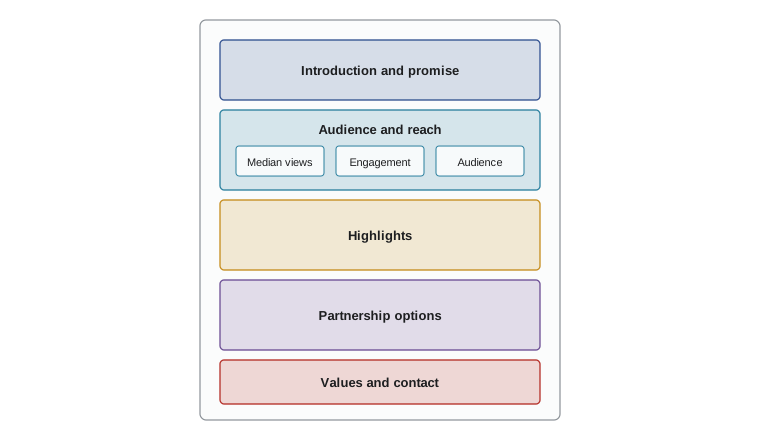
Keep the media kit short and scannable. Partners read many of them; make yours easy to judge in a minute.
- Introduction: your name or channel, one-sentence promise and niche, and a photo or logo.
- Audience: who watches, with demographics such as age range and location, and interests drawn from your analytics and research.
- Reach and engagement: subscribers or followers, typical views per video in the first 30 days, average view duration or percentage, and engagement rate, each with the date range.
- Highlights: two or three best-performing pieces with results, plus any audience feedback that shows trust.
- Partnership options: the formats you offer, such as an integrated segment, a dedicated short, a newsletter mention or an affiliate partnership, with indicative rates or "rates on request".
- Values and policies: your sponsorship policy, disclosure commitment and categories you do not work with.
- Contact: business email and response time.
Choosing the right numbers
For partners, typical performance is more useful than peaks. Report the median views per video in the first 30 days across recent pieces rather than your single best video. Give date ranges for every figure. CRE-310 recommended calculating engagement rate by reach or by views rather than by followers, because followers include many inactive accounts while views reflect the audience that actually sees a piece.
Worked problem
Typical views and engagement rate
Jordan's last six long videos earned 30-day views of 820, 1,350, 640, 2,900, 980 and 1,100. The most recent video had 1,100 views, 62 likes, 18 comments, 9 shares and 21 saves. Calculate the median 30-day views and the engagement rate by views for the recent video.
Show solution
- Sorted views: 640, 820, 980, 1,100, 1,350, 2,900.
- Median: average of the middle two, \( (980 + 1{,}100)/2 = 1{,}040 \).
- Mean for comparison: \( 7{,}790 / 6 \approx 1{,}298 \), pulled up by the 2,900 outlier.
- Engagement: \( (62 + 18 + 9 + 21)/1{,}100 = 110/1{,}100 = 10 \% \).
Answer: Jordan should report about 1,040 median 30-day views and a 10 % engagement rate by views, with dates. The mean would overstate typical reach by about a quarter because of one hit.
Pricing sponsored content
CRE-310 explained several ways to price. For a small channel, a CPM-based estimate grounded in your typical views is a sensible starting point, adjusted for engagement, audience fit, production effort and usage rights. CPM means cost per thousand views. Sponsored integrations on niche YouTube channels are often quoted in a broad range, and rates vary widely by niche, audience location, format and season, so treat any benchmark as illustrative and check current industry sources.
Worked problem
Building a rate for an integrated segment
Jordan expects about 1,040 views in 30 days for a video with a sponsored segment. Using an illustrative CPM of $25 for an integrated segment in a niche hobby channel, plus a 20 % premium for a highly relevant audience, and a separate usage fee of 30 % of the base for the brand to reuse the clip in its own ads for 90 days, what is the quote?
Show solution
- Base fee: \( 1{,}040 / 1{,}000 \times 25 = \$26 \).
- Audience-fit premium: \( 26 \times 1.20 = \$31.20 \).
- Usage fee: \( 0.30 \times 26 = \$7.80 \).
- Total: \( 31.20 + 7.80 = \$39 \).
Answer: A CPM-based quote is about $39. That is far below the value of Jordan's production time, which shows why small creators often add a minimum fee based on effort, accept products in kind (still disclosed), or start with affiliate or performance-based deals. Jordan might quote a $75 minimum for a segment and explain the audience fit.
| Option | Basis | Example quote | Notes |
|---|---|---|---|
| Integrated segment (60 to 90 s) | CPM on median views, minimum fee | $75 minimum | Includes script approval, one revision |
| Dedicated short | CPM on short views, minimum fee | $40 | Lower production time |
| Newsletter mention | Per subscriber or flat | $20 for about 100 subscribers | Small but highly engaged list |
| Affiliate or performance | Commission on sales | 8 to 12 % commission | Low risk for the brand |
| Usage rights | Percentage of base per period | +30 % for 90 days | Separate from creation fee |
Finding the right brand
Pitch brands that fit your audience and values. CRE-340 explained that brands look for audience fit, authenticity, content quality and safety, not just reach. For a small channel, the best targets are usually brands whose products you already use and show, small or local businesses whose customers match your audience, and companies with creator or affiliate programs designed for smaller creators. Research each brand: what it sells, who it targets, what campaigns it has run with creators, and whether it has worked with channels in your niche.
Score potential partners quickly on fit, values, likelihood of response and value to your audience, and choose one for your capstone pitch. Avoid brands in categories your policy excludes or that would require claims you cannot support, and remember the extra rules for regulated categories such as health, finance, alcohol and gambling described in CRE-420.
Writing the pitch
A good pitch is short, specific and about the brand's goals rather than your wishes. Address a named person if possible, show you understand the brand, explain why your audience matters to them, propose a concrete idea, give one or two numbers with dates, and end with a simple next step. Attach or link the media kit. Keep it under about 200 words.
An example pitch from Jordan to a small tool company: 'Hi Sam, I run Budget Bike Fixes, a YouTube channel teaching students and commuters to repair cheap bikes with basic tools. Your folding multi-tool already appears in four of my videos because it is the one I recommend for roadside fixes. My viewers are mostly 18 to 34 and based in Canada and the US; my recent videos get about 1,000 views in their first month with a 10 % engagement rate, and viewers often ask which tool I use. I would love to make a winter roadside-repair video built around your multi-tool, with a clearly disclosed 60-second segment and an exclusive discount code for my newsletter. My media kit is attached. Would you be open to a 15-minute call next week? Best, Jordan.'
Worked problem
Estimating a pitch pipeline
CRE-310 described pitching as a pipeline. Suppose a small creator's pitches get a reply 20 % of the time, and 25 % of replies lead to a deal. How many well-researched pitches are needed, on average, for one deal?
Show solution
- Deals per pitch: \( 0.20 \times 0.25 = 0.05 \).
- Pitches per deal: \( 1 / 0.05 = 20 \).
Answer: About 20 pitches for one deal. That is why a single capstone pitch is assessed on quality rather than outcome, and why creators treat outreach as a steady process with follow-ups rather than a one-off.
Negotiating and contracting
If a brand responds, use the negotiation and contract skills from CRE-310 and CRE-330. Clarify deliverables, timelines, approvals and revisions, payment amount and timing, usage rights and duration, exclusivity, disclosure requirements and what happens if the content is late or the deal is canceled. Put everything in writing, even for a small deal, and never accept terms that require you to hide the relationship or make unsupported claims. If anything about a contract worries you, ask your instructor or a qualified adviser before signing.
For US creators working with Canadian brands, agree the currency (US dollars or Canadian dollars) and who bears payment fees, and remember that the payment is business income on your Schedule C; a Canadian payer may ask for an NR301 form to apply treaty benefits, as CRE-460 explained.
Following up and learning
If you do not hear back within about a week, send one short, polite follow-up. If there is still no reply, move on and record the outcome. Whatever happens, note what you learned: which parts of the media kit were hardest to complete, which numbers felt weak, and what a brand would need to see to say yes. That reflection feeds the business plan in the next lesson and the final presentation.
Preparing proof and answering common questions
Brands and agencies often ask the same follow-up questions, so prepare answers before you pitch. Expect requests for screenshots of audience demographics, top locations and recent video performance; take them from your analytics with dates visible, and never edit them. Expect questions about how you will disclose the partnership, how many revisions you allow, how long the content will stay up and whether the brand can reuse it in ads. Expect to be asked about past partnerships; if you have none, say so honestly and offer your monetization pilot as evidence that you handle recommendations and disclosures responsibly.
Prepare a short case study from your best-performing piece: the goal, what you made and the result, with numbers and dates. Even without a past sponsor, a clear example of content that achieved a measurable result for viewers shows a brand how you think. Keep a simple outreach tracker with the brand, contact, date sent, follow-up date, response and outcome. Over time the tracker shows your real reply and deal rates, which improves your forecasts in the business plan and tells you whether your pitches need work.
Finally, remember that saying no is part of professional practice. If an offer does not fit your audience, conflicts with your values or asks for terms you cannot accept, decline politely and keep the relationship friendly. A brand that is wrong for you today may be right later, and creators who decline unsuitable deals protect the trust that makes them valuable to the right partners.
Common mistakes
MistakeReporting only your best video's numbers.
InsteadReport median 30-day views and date ranges for every figure.
MistakeCalculating engagement rate on followers.
InsteadUse engagement rate by views or reach, which reflects the active audience.
MistakePricing purely on CPM when views are small.
InsteadAdd a minimum fee based on effort, or offer affiliate or performance deals.
MistakeSending a generic pitch to many brands.
InsteadResearch each brand and propose a specific idea tied to its goals.
MistakeAgreeing to undisclosed promotion.
InsteadAlways require clear disclosure and put terms in writing.
Summary and key terms
- A media kit shows who you are, your audience, typical results, partnership options, values and contact details.
- Honest, specific, dated numbers build more credibility than inflated or cherry-picked ones.
- Report median views and engagement rate by views rather than peak views or follower-based rates.
- A CPM-based fee uses expected views and a CPM, adjusted for fit and usage, often with a minimum fee.
- Pitch brands that fit your audience and values, after researching their goals.
- A pitch is short, specific and focused on the brand, with one or two dated numbers and a clear next step.
- Treat pitching as a pipeline, contract everything in writing and record what you learn.
- Media kit
- A short document presenting a creator's audience, results and partnership options.
- Pitch
- A message proposing a partnership to a specific brand.
- Median views
- The middle value of views across a set of videos.
- Engagement rate by views
- Interactions divided by views.
- CPM
- Cost per thousand views or impressions.
- Rate card
- A list of partnership options and indicative prices.
- Usage rights
- Permission for a brand to reuse a creator's content, for a set scope and time.
- Minimum fee
- The lowest price a creator accepts regardless of a CPM calculation.
- Pipeline
- The sequence of stages from first contact to signed deal.
- Exclusivity
- A contract term preventing work with competing brands for a period.
Practice problems
Work each problem on paper first, then reveal the answer to check.
List five sections of a media kit.
Show answer
Introduction, audience, reach and engagement, highlights, partnership options, values, contact (any five).
Views 500, 700, 900, 4,000. Median?
Show answer
800.
120 interactions on 1,500 views. Engagement rate by views?
Show answer
8 %.
2,000 expected views at a $20 CPM. Base fee?
Show answer
$40.
Add 25 % usage fee on that base. Total?
Show answer
$50.
Why add a minimum fee?
Show answer
CPM fees on small view counts may not cover production effort.
Name three things a pitch should include.
Show answer
Named recipient, understanding of the brand, why the audience matters, a concrete idea, one or two numbers, a next step (any three).
Reply rate 25 %, deal rate 20 %. Pitches per deal?
Show answer
20.
Name four contract terms to agree.
Show answer
Deliverables, timelines, approvals, payment, usage, exclusivity, disclosure, cancellation (any four).
When should you follow up an unanswered pitch?
Show answer
Once, politely, after about a week.
Lesson quiz · 5 questions
Score 60% or more to complete this lesson.
Create a free account to save your progress, take quizzes and earn a certificate.