
CRE-420 · Lesson 3 of 12 · 25 min
Entertainment, pop culture and commentary
Entertainment and commentary channels cover film, television, music, celebrities, internet culture and current events. Formats include reviews, reaction videos, recaps, video essays, podcasts, news roundups and satire. The niche has enormous demand and a fast news cycle, but it has two recurring challenges. The first is using other people's copyrighted material, such as clips, music, images and trailers, in your own work. The second is talking about real people without defaming them or invading their privacy. This lesson focuses on both, along with how commentary creators earn and keep their credibility.
Formats and what makes them work
Commentary works when the creator adds something the original material does not: insight, humor, context, expertise, a distinctive voice or a community conversation. A film review that explains why a scene works, a video essay that connects a show to its historical context, or a satirical take on celebrity culture all give viewers a reason to watch the creator rather than the source. Content that simply reposts other people's work with minimal additions tends to perform poorly over time, attract copyright claims and offer weak legal protection.
- Reviews and recommendations: judgments about quality and value, ideally with clear criteria.
- Reaction videos: real-time responses to trailers, music videos, clips or other creators' content.
- Recaps and breakdowns: summaries and analysis of episodes, films or events.
- Video essays: structured arguments about media, culture or history.
- News and gossip: timely coverage of entertainment and internet events.
- Satire and parody: humorous imitation or exaggeration to comment on a subject.
Copyright and commentary
Clips, stills, music, trailers, artwork and other creators' videos are almost always protected by copyright. Using them without permission is infringement unless an exception applies. Both Canada and the United States have exceptions that support commentary, but they work differently, and neither gives a blanket right to use material just because you are talking about it.
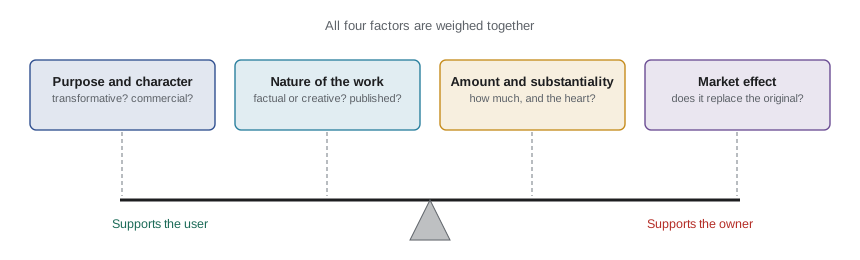
The United States uses fair use. Section 107 of the Copyright Act lists four factors that courts weigh together: the purpose and character of the use, including whether it is commercial and whether it is transformative; the nature of the copyrighted work; the amount and substantiality of the portion used; and the effect of the use on the potential market for or value of the work. Commentary, criticism and parody are classic examples of fair use, but every case depends on its facts. In Andy Warhol Foundation v. Goldsmith (2023), the Supreme Court emphasized that a use with a purpose similar to the original's, such as licensing an image to a magazine, weighs against fair use even if the new work adds new meaning.
In both countries, the safest commentary uses only as much of the original as needed to make a point, mixes it with substantial original commentary, does not replace the original for viewers, and credits the source. Showing an entire music video with a few seconds of reaction, or uploading a full episode with a voiceover, is far riskier than showing short clips to illustrate an argument.
Courts have generally been more sympathetic to reaction content that genuinely comments on and critiques the original. In a well-known 2017 US case, Hosseinzadeh v. Klein, a court found that a reaction video mixing clips of another creator's video with extensive mocking commentary was fair use. That outcome turned on the specific facts and does not mean all reaction videos are lawful.
Platform copyright systems
In practice, most copyright disputes for creators are handled by platform systems rather than courts. YouTube's Content ID automatically matches uploads against reference files from rights holders, who can choose to block a video, track it, or take its ad revenue. Rights holders can also send takedown requests that lead to copyright strikes, and three strikes can end a channel. Other platforms use similar matching and takedown systems.
Creators can dispute claims they believe are wrong, for example where they have a license or believe their use is fair dealing or fair use, but disputes have consequences. Repeated disputes over legitimate claims can lead to strikes, and in the United States a counter-notification under the Digital Millennium Copyright Act opens the door to a lawsuit. In Canada, the Copyright Act uses a notice-and-notice system for internet providers, but video platforms apply their own global policies, often modeled on US law.
Worked problem
Estimating the cost of a claimed video
A commentary video earns 200,000 views at an RPM of $4. A music label claims it under Content ID because of 40 seconds of a song, and takes all ad revenue. The creator could have used a licensed track from a library costing $15. How much did the claim cost the creator?
Show solution
- Revenue lost: 200,000 ÷ 1,000 × $4 = $800.
- Cost of a licensed alternative: $15.
- Net cost of using the claimed song: $800 − $15 = $785.
Answer: The claim cost about $785. Using licensed or original music where the song itself is not the subject of the commentary is usually far cheaper than losing a video's revenue.
Talking about real people: defamation
Entertainment and commentary content often discusses celebrities, public figures and other creators. Opinions, criticism and satire are a normal part of public debate, but false statements of fact that damage someone's reputation can be defamation. Calling a film boring is an opinion. Saying an actor committed a crime, without proof, is a factual claim that could lead to a lawsuit if it is false.
In the United States, the First Amendment strongly protects speech about public figures. Under New York Times v. Sullivan (1964) and later cases, public figures must prove that a false statement was made with actual malice, meaning knowledge of its falsity or reckless disregard for the truth. Opinions that do not imply false facts are generally protected. Private individuals have an easier path to suing. Many states have anti-SLAPP laws that allow early dismissal of suits targeting speech on public issues, and some award legal fees to defendants who win.
For creators in both countries, good practice is the same. Separate fact from opinion clearly. Check facts before stating them, especially allegations of wrongdoing. Use words like allegedly only when you are genuinely reporting an allegation made by someone else, and identify the source. Correct mistakes quickly and visibly. Be especially careful with private people who briefly go viral, who have not chosen public life and may be harmed more by attention.
Privacy, drama and pile-ons
Drama channels that cover conflicts between creators can attract huge audiences, but they can also cause real harm. Repeating rumors, sharing private messages, revealing personal details or encouraging audiences to pile on can lead to harassment, mental health crises and legal claims for defamation or invasion of privacy. Provinces such as British Columbia, Saskatchewan, Manitoba and Newfoundland and Labrador have privacy statutes, Ontario courts recognize privacy torts, and US states recognize several privacy torts, including public disclosure of private facts.
Ethical commentary focuses on public conduct and ideas rather than private lives, avoids identifying non-public people, does not encourage audiences to contact or attack anyone, and considers whether coverage serves viewers or merely exploits someone's worst moment. The approach in CRE-350 on harassment applies in reverse here: commentary creators have the power to start pile-ons and a responsibility not to.
Earning in entertainment and commentary
Entertainment and commentary RPMs are often modest, so creators rely on sponsorships, memberships and podcasts. Sponsors include apps, subscription services, consumer products and streaming services. A specific issue in this niche is independence. If a streaming service sponsors your channel, reviewing its shows creates a conflict of interest, and viewers need to know about the relationship. Free screener copies, press junkets, premiere invitations and travel to events are all material connections that should be disclosed when you review the related work.
| Situation | Material connection? | What to do |
|---|---|---|
| A studio sends you a free screener of a film you review | Yes | Disclose that you received a free advance copy |
| A streaming service sponsors an episode of your podcast | Yes | Disclose the sponsorship; consider not reviewing its shows in that episode |
| You bought your own ticket to a film | No | No disclosure needed, though saying so builds trust |
| A studio flies you to a premiere and pays your hotel | Yes | Disclose the trip and paid expenses in related content |
| You earn affiliate commissions from a streaming signup link | Yes | Disclose the affiliate relationship near the link and in the video |
Credibility is the main asset of a review channel. Audiences return because they trust a creator's judgment. Accepting free products and access is common and acceptable when disclosed, but reviews must remain honest. Some creators set public review policies explaining what they accept, what they disclose and that no sponsor can see or change a review before it is published.
Satire, parody and AI-generated content
Satire and parody have long traditions and specific recognition in copyright law: parody and satire are listed fair dealing purposes in Canada, and parody that targets the original work is a strong fair use argument in the United States. However, satire does not protect false statements of fact that viewers might believe are true. Satirical content should be clearly recognizable as such.
AI tools have made it easy to create realistic fake images, audio and video of celebrities. Using them in commentary raises the issues covered in CRE-410: personality and publicity rights, defamation if fake content is presented or mistaken as real, platform rules requiring labels on realistic synthetic content, and laws against non-consensual intimate deepfakes. Creators should label synthetic content clearly and avoid fake depictions that could be mistaken for real events or that put real people in false or degrading situations.
A review policy
Many entertainment and commentary creators publish a short review policy on their channel or website. A good policy explains how the creator chooses what to cover, what free access they accept, how they disclose it, whether sponsors can see content before publication, and how corrections are handled. A policy sets expectations for viewers and for studios, labels and brands, and makes it easier to say no to requests that would compromise independence.
- What we accept: screeners, review copies and event invitations, always disclosed.
- What we do not accept: payment for positive reviews or approval rights over content.
- Corrections: errors are corrected in the video description and pinned comment, and in the video itself where possible.
Publishing the policy and following it consistently is one of the simplest ways to build long-term credibility in a niche where viewers are often suspicious of paid opinions.
Common mistakes
MistakeAssuming any clip can be used because the video is commentary.
InsteadUse only what you need, add substantial commentary, credit sources and check fair dealing or fair use factors.
MistakeUsing popular songs as background music.
InsteadUse licensed or original music unless the song itself is the subject of commentary.
MistakeStating rumors as facts about real people.
InsteadSeparate fact from opinion, verify allegations and attribute claims to sources.
MistakeHiding screeners, trips and sponsorships from viewers.
InsteadDisclose free access, paid travel and sponsorships in related reviews.
MistakeEncouraging viewers to target someone in a drama video.
InsteadFocus on public conduct and ideas and never direct audiences at individuals.
Summary and key terms
- Commentary succeeds when it adds insight, humor, context or expertise to the original material.
- Fair dealing in Canada requires a listed purpose and a fair dealing; fair use in the United States weighs four factors.
- Using small, relevant portions with substantial commentary and credit is safer than reposting whole works.
- Platform systems such as Content ID handle most disputes and can redirect revenue or issue strikes.
- Defamation law protects reputation; Canadian law is generally more favorable to plaintiffs than US law.
- Free screeners, trips, sponsorships and affiliate links are material connections that must be disclosed.
- Satire and AI-generated content should be clearly labeled and must not mislead viewers about real events.
- Fair dealing
- A Canadian copyright exception for listed purposes when the dealing is fair.
- Fair use
- A US copyright exception decided by weighing four statutory factors.
- Transformative use
- A use that adds new purpose, meaning or message to the original.
- Content ID
- YouTube's system that matches uploads against rights holders' reference files.
- Copyright strike
- A penalty on a channel after a valid copyright takedown.
- Defamation
- A false statement that damages a person's reputation.
- Actual malice
- In US law, knowledge of falsity or reckless disregard for the truth.
- Anti-SLAPP law
- A law allowing early dismissal of lawsuits aimed at silencing public debate.
- Screener
- An advance copy of a film or show provided to reviewers.
- Satire
- Humor or exaggeration used to criticize or comment on a subject.
Practice problems
Work each problem on paper first, then reveal the answer to check.
List the Canadian fair dealing purposes.
Show answer
Research, private study, education, parody, satire, criticism, review and news reporting.
What must you mention for fair dealing for criticism or review?
Show answer
The source and, if given, the author, performer, maker or broadcaster.
Name the four US fair use factors.
Show answer
Purpose and character, nature of the work, amount used, effect on the market.
A claimed video had 150,000 views at RPM $5. What revenue was redirected?
Show answer
$750.
Why is reuploading a full episode with voiceover risky?
Show answer
It uses the whole work, adds little and can replace the original.
Is "this film was boring" defamatory?
Show answer
No, it is an opinion, not a factual claim.
What must US public figures prove in defamation cases?
Show answer
Actual malice: knowledge of falsity or reckless disregard for the truth.
Is a free advance screener a material connection?
Show answer
Yes, it should be disclosed in the review.
What is one purpose of anti-SLAPP laws?
Show answer
To dismiss weak lawsuits aimed at silencing commentary on public issues early.
Why label satirical deepfakes?
Show answer
To avoid misleading viewers, defaming people and breaching platform rules.
Lesson quiz · 5 questions
Score 60% or more to complete this lesson.
Create a free account to save your progress, take quizzes and earn a certificate.