
CRE-420 · Lesson 2 of 12 · 27 min
Gaming and esports
Gaming is one of the largest creator niches in the world, spanning let's plays, live streams, walkthroughs, reviews, speedruns, esports commentary, news and comedy. It has a young, highly engaged audience and a culture that values authenticity, skill and community. It also has lower ad rates than many niches, intense competition, and a set of issues that other niches do not face: game publishers' rights over the footage creators use, age ratings, in-game purchases, and the line between gaming and gambling. This lesson covers how gaming creators build audiences and earn, and the rules that are specific to the niche.
Formats and audiences
Gaming content comes in many formats, and each attracts a different audience. Live streaming on platforms such as Twitch, YouTube and Kick builds community through real-time chat, long sessions and regular schedules. Edited videos, including highlights, guides and video essays, are easier to discover through search and recommendation. Short clips travel widely on short-form feeds and can pull viewers to long content. Many successful gaming creators combine all three, streaming live and cutting the best moments into videos and shorts.
- Let's plays and live streams: entertainment built around personality and community.
- Guides and walkthroughs: search-driven content that answers specific questions.
- Reviews and news: timely content around releases, updates and industry events.
- Speedruns and challenge runs: skill-based content with dedicated communities.
- Esports commentary and analysis: content around competitive leagues and tournaments.
- Video essays and retrospectives: longer analysis of games, design and history.
Gaming audiences skew young, and a significant share are under 18. That shapes everything from sponsor choices to legal duties. Content aimed at children triggers stricter rules on data collection and advertising, as lesson 10 explains, and sponsorships for energy drinks, gambling-adjacent products or mature games need careful thought about who is watching.
Using game footage: publisher permissions
Every game is a copyrighted work, and gameplay footage reproduces its art, music and design. Creators can show games only because most publishers allow it. Publishers usually set out their terms in a video policy or content creator policy that says whether you may stream and monetize footage, whether you must credit the game, and what you may not do, such as leaking unreleased content or using the game's music separately. These policies differ: most major publishers allow monetized gameplay videos, some restrict certain uses, and a few have issued takedowns against creators who criticized their games, which drew strong backlash.
Read the policy for each game you cover, especially before monetizing. Watch out for licensed music inside games: in-game radio stations and soundtracks may include tracks the publisher licensed only for the game, which can trigger automated copyright claims on video platforms. Many games offer a streamer mode that removes licensed music. Embargoes are another common condition: review copies often come with a date before which you may not publish, and breaking an embargo can end your access to future review copies.
Where a publisher's policy does not cover a use, creators may rely on fair dealing in Canada or fair use in the United States, which lesson 3 explains. Commentary, criticism and review generally have stronger claims than simply uploading long stretches of unedited footage with little added. Publisher permission is far safer than relying on those defenses.
How gaming creators earn
Gaming creators typically earn from a mix of sources. Streaming platforms share revenue from subscriptions, ads and virtual tips such as Twitch Bits or YouTube Super Chats. Video platforms share ad revenue. Sponsorships come from game publishers, hardware makers, peripherals, energy drinks, VPNs and apps. Affiliate links cover gear such as headsets, keyboards, chairs and capture cards. Some creators run merchandise stores or earn from game creator programs that pay a share of in-game purchases made with a creator's code.
| Revenue source | How it works | Typical considerations |
|---|---|---|
| Streaming subscriptions | Monthly payments from viewers, shared with the platform | Revenue split varies by platform and creator tier |
| Ads | Pre-roll and mid-roll ads on streams and videos | Gaming RPMs are usually lower than in many niches |
| Tips and virtual currency | Viewers send tips during streams | Volatile; depends on community and events |
| Sponsorships | Paid integrations by game publishers and brands | Disclose clearly; check audience age for products |
| Creator codes | Share of in-game purchases made with your code | A material connection that must be disclosed |
| Affiliates | Commission on gear sales through your links | Disclose; recommend gear you would use |
Worked problem
Comparing a sponsored stream with a creator code
A publisher offers a streamer either a flat $1,200 for a sponsored three-hour stream or a creator code paying 5 % of in-game purchases made with the code. The streamer estimates that 300 viewers would each spend an average of $20 using the code over the following month. Which offer pays more?
Show solution
- Creator code purchases: 300 × $20 = $6,000.
- Commission: 5 % × $6,000 = $300.
- Flat fee: $1,200.
Answer: The flat fee pays $1,200 against about $300 from the code. The code would need purchases of $1,200 ÷ 0.05 = $24,000 to match the fee. The code also nudges viewers to spend, which raises ethical questions when many viewers are young.
Creator codes are a material connection. If you earn from purchases made with your code, you must disclose that clearly, just as you would a sponsorship. Encouraging viewers to spend money in a game, especially young viewers and especially on random rewards, raises ethical concerns covered below.
Age ratings and mature content
Video games in Canada and the United States are rated by the Entertainment Software Rating Board, or ESRB, which assigns ratings such as E for Everyone, E10+, T for Teen, M for Mature 17+ and AO for Adults Only, plus content descriptors and interactive elements such as in-game purchases. Online-only and mobile games may use storefront ratings instead. In Canada, provincial film classification bodies have historically recognized ESRB ratings, and major retailers enforce them voluntarily.
Ratings do not bind creators directly, but they matter. Platforms require age restrictions or content warnings for graphic violence, sexual content and other mature material, and repeated violations can lead to demonetization or strikes. Showing M-rated games to a channel full of young viewers also creates reputational and ethical problems, and sponsors may avoid it. Use platform age gates, mark mature content, and think about whether your content and your audience match.
Loot boxes, skins and gambling-adjacent content
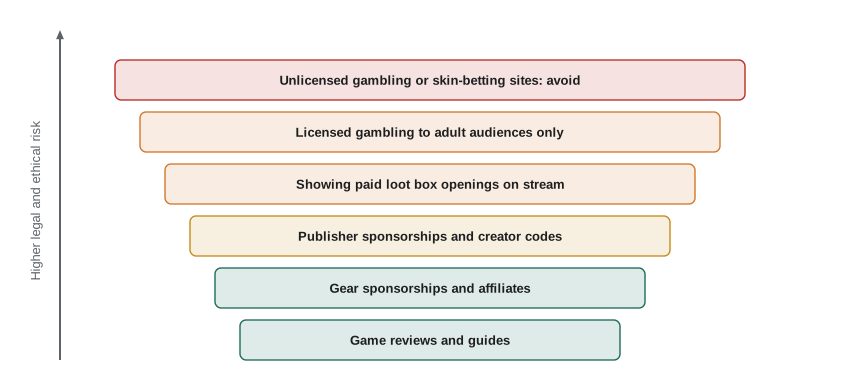
Loot boxes are in-game items bought with real money or premium currency that give random rewards. Critics argue that they share features with gambling, especially when they are sold to children. Some countries have restricted them; Belgium, for example, treats paid loot boxes as gambling. Skins, which are cosmetic items with real-world value, have also been used as stakes on third-party gambling sites, and some of those sites have targeted young people and relied on creators to promote them without proper disclosure.
The United States does not have a federal law on loot boxes, but the FTC has acted on related practices. In January 2025 the FTC settled with the publisher of Genshin Impact for US$20 million over claims that it misled players, including children, about loot box odds and costs, and the order bans selling loot boxes to children under 16 without parental consent. Sports betting is legal in many states since the Supreme Court struck down the federal ban in 2018, but each state sets its own rules, and gambling advertising codes require that audiences be overwhelmingly adults. Promoting unlicensed gambling or skin-betting sites can breach state law and FTC rules.
Major streaming platforms have also tightened rules. Twitch banned streams of unlicensed gambling sites featuring slots, roulette or dice games in 2022, and platforms generally restrict gambling sponsorships and require age gating. Creators who receive offers from gambling or skin-betting sites should treat them as high-risk: check whether the operator is licensed where your viewers live, whether your audience is overwhelmingly adult, and what the platform allows. If in doubt, decline.
Esports
Esports, or organized competitive gaming, has its own creator ecosystem. Creators work as commentators, analysts, team content producers and community hosts, and esports teams themselves run creator rosters that combine competitive players with entertainers. Sponsorships in esports come from hardware, apparel, telecom, food and drink brands, and increasingly from betting companies where that is legal. Tournament organizers and leagues control broadcast rights, so creators who want to show or co-stream matches need permission, often through official co-streaming programs.
Esports careers can be short and unstable. Teams restructure, leagues change and games rise and fall in popularity. Creators who build their own audience and brand alongside any team role are more resilient. Contracts with esports organizations deserve the same care as any creator contract covered in CRE-330: watch the terms on content ownership, revenue splits, exclusivity, streaming obligations and what happens to your channel if you leave.
Community and safety
Gaming communities can be welcoming and creative, but they can also be toxic. Harassment, hate raids, doxxing and swatting have targeted gaming creators, especially women, LGBTQ+ creators and creators of color. CRE-350 covered safety planning in depth. In gaming specifically, use chat moderation tools, follower-only or subscriber-only modes during raids, delays on live streams where location could be revealed, and clear community rules enforced consistently. Avoid showing your location, your home's exterior or details that could reveal where you live.
Creators also set the tone for their community. Behavior that a creator tolerates or encourages, such as pile-ons against other players or slurs in chat, spreads. Many sponsors now check a creator's community health before signing deals. A well-moderated, inclusive community is better for viewers, safer for the creator and more attractive to brands.
Planning a gaming content week
Gaming creators who stream and upload need a schedule that balances live time with editing. A common pattern is three or four streams a week at consistent times, one or two edited videos built from stream highlights, and daily short clips. Consistency matters because live audiences plan around a schedule, and missed streams lose viewers to other channels.
Worked problem
Budgeting a streaming week
A streamer plans four 3-hour streams, two edited videos needing 5 hours each, and seven shorts needing 30 minutes each. Preparation and community tasks take another 6 hours. How many hours is the week?
Show solution
- Streams: 4 × 3 = 12 hours.
- Edited videos: 2 × 5 = 10 hours.
- Shorts: 7 × 0.5 = 3.5 hours.
- Total: 12 + 10 + 3.5 + 6 = 31.5 hours.
Answer: About 31.5 hours a week. Streamers who also work or study often reduce edited videos or hire a clip editor, and many build in a regular day off to avoid burnout.
Time spent live is only part of the work. Editors, moderators and clip channels can extend a streamer's reach, but each brings costs and agreements about pay, credit and ownership of edits that should be written down.
Common mistakes
MistakeAssuming any game footage can be monetized.
InsteadRead each publisher's content policy and watch for licensed music and embargoes.
MistakePromoting a creator code without disclosure.
InsteadDisclose that you earn from purchases made with your code, as for any sponsorship.
MistakeAccepting gambling or skin-betting sponsorships without checks.
InsteadVerify licensing where viewers live, audience age and platform rules, or decline.
MistakeIgnoring the age of the audience when choosing sponsors.
InsteadMatch products and content to the audience, and use age gates for mature material.
MistakeLeaving chat unmoderated during growth.
InsteadSet community rules, use moderation tools and plan for raids and harassment.
Summary and key terms
- Gaming spans streams, guides, reviews, speedruns, esports and essays, with a young, engaged audience.
- Game footage is copyrighted; publishers' content policies set the terms for streaming and monetizing.
- Gaming creators earn from subscriptions, ads, tips, sponsorships, creator codes and affiliates.
- ESRB ratings and platform rules guide how mature content is labeled and age-restricted.
- Loot boxes, skins and gambling promotion raise legal and ethical risks, especially with young audiences.
- Esports offers creator roles but needs care with broadcast rights and team contracts.
- Strong moderation and community standards protect creators, viewers and sponsor relationships.
- Let's play
- A video or stream of a person playing a game with commentary.
- Content creator policy
- A publisher's rules for using its game footage in videos and streams.
- Embargo
- A date before which reviewers agree not to publish coverage.
- Creator code
- A code viewers enter when buying in-game items that pays the creator a share.
- ESRB
- The Entertainment Software Rating Board, which rates games in Canada and the United States.
- Loot box
- A paid in-game item that gives random rewards.
- Skin
- A cosmetic in-game item that can have real-world value.
- Co-streaming
- Streaming an official broadcast on your own channel with permission.
- Hate raid
- A coordinated flood of abusive accounts into a stream's chat.
- Streamer mode
- A game setting that removes licensed music and sensitive information for streaming.
Practice problems
Work each problem on paper first, then reveal the answer to check.
Why do creators need to check a publisher's content policy?
Show answer
Games are copyrighted; the policy sets what streaming and monetization are allowed.
A creator code pays 4 % on $8,000 of purchases. What does the creator earn?
Show answer
$320.
What sales are needed for a 5 % code to match a $1,000 fee?
Show answer
$1,000 ÷ 0.05 = $20,000.
What does an M rating from the ESRB mean?
Show answer
Mature 17+, content generally suitable for ages 17 and up.
Why are loot boxes controversial?
Show answer
They give random rewards for money and resemble gambling, especially for children.
Name one check before accepting a gambling sponsorship.
Show answer
Whether the operator is licensed where viewers live; audience age; platform rules.
Why might in-game music cause copyright claims?
Show answer
It may be licensed only for the game, not for videos.
What is co-streaming?
Show answer
Streaming an official esports broadcast on your channel with permission.
Give two tools for handling hate raids.
Show answer
Follower-only or subscriber-only chat, moderators, filters, stream delay.
Why should gaming creators build their own brand alongside team roles?
Show answer
Esports teams and leagues are unstable; an independent audience is more resilient.
Lesson quiz · 5 questions
Score 60% or more to complete this lesson.
Create a free account to save your progress, take quizzes and earn a certificate.