
CRE-420 · Lesson 10 of 12 · 27 min
Parenting, family and kids content
Family content includes parenting advice, family vlogs, pregnancy and baby content, homeschooling, kids' crafts and activities, toy reviews, children's educational channels and content made by young creators themselves. Some of the most-watched channels on any platform feature children. The niche can be supportive and educational, but it raises serious questions that other niches do not: children cannot meaningfully consent to having their lives filmed and monetized, their earnings may not belong to them, their privacy and safety are at stake, and content aimed at children triggers strict laws on data collection and advertising. This lesson covers those issues and how to create family content responsibly.
The ethics of featuring children
When adults share their own lives, they choose what to reveal. Children featured in family content usually do not. Videos of tantrums, illnesses, bath time, punishments, puberty or private struggles remain online for years and can follow children into school, work and relationships. Some young adults who grew up on family channels have spoken publicly about feeling exploited, losing their privacy and never seeing the money their appearances earned. Researchers and child advocates have raised concerns about pressure to perform, blurred lines between family life and work, and exposure to predators.
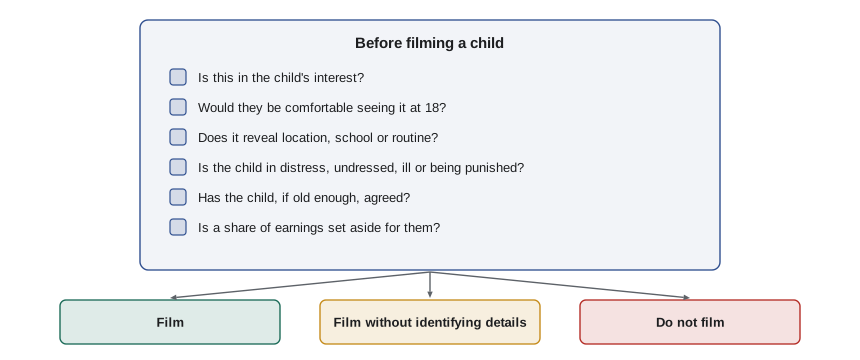
Responsible family creators start from the child's interests rather than the channel's. Practical principles include:
- Ask whether you would be comfortable if this video were seen by your child's future classmates, partners or employers.
- Avoid content showing children in distress, being punished, undressed, ill or in embarrassing situations.
- Give children a growing say as they mature, including the right to refuse and to have content removed.
- Never reveal schools, home locations, routines or full names that make children easy to find.
- Limit filming time and keep some family life entirely off camera.
- Set aside a fair share of earnings for children who appear in monetized content.
Many parenting creators now choose not to show their children's faces at all, or to show them only from behind or in ways that do not identify them, while still sharing the realities of parenting. That approach can protect children while keeping the community and advice that make the niche valuable.
Child creator laws: who owns the money
Child performers in film and television have long had legal protections in some places, such as requirements to set aside earnings in trust and limits on working hours. Family vlogging and child influencers fell outside most of those laws until recently. Several US states have now passed laws aimed specifically at children in monetized online content, while Canada has not yet adopted a specific law.
Several US states have passed child influencer laws. Illinois was first, with a law in force from July 1, 2024, requiring vloggers who feature children under 16 in at least 30 % of their compensated content over a 30-day period to set aside a share of earnings in trust and keep records. California's Child Content Creator Rights Act (SB 764), signed in September 2024 and in force from 2025, requires vloggers who feature a minor in at least 30 % of their content and earn at least $1,250 a month to deposit 65 % of the minor's proportionate share of earnings into a trust; a related law (AB 1880) extended Coogan's Law protections to minors who are themselves content creators under contracts. Minnesota's law, in force from July 1, 2025, goes further: it prohibits children under 14 from engaging in the work of content creation for monetized content, requires trust set-asides for older minors and gives people the right to have content featuring them as children deleted. Other states have considered similar bills.
Worked problem
Calculating a California trust set-aside
A California family channel earns $20,000 from a video in which their child appears in 50 % of the content. Under SB 764, the vlogger must deposit 65 % of the child's proportionate share into a trust. How much is that?
Show solution
- Child's proportionate share: 50 % × $20,000 = $10,000.
- Trust deposit: 65 % × $10,000 = $6,500.
Answer: The vlogger must deposit $6,500 into the child's trust. Even where no law requires it, setting aside a comparable share is a fair practice for any family channel.
Content made for children: COPPA and privacy law
Content directed at children, as distinct from content that features children, brings strict rules on collecting children's personal information. These rules shape how platforms treat children's content and limit how creators can earn from it.
In the United States, the Children's Online Privacy Protection Act (COPPA) and the FTC's COPPA Rule restrict collecting personal information from children under 13 on websites, apps and services directed at children, or where operators know they are collecting from children, without verifiable parental consent. The FTC updated the rule in 2025, with most new requirements applying from April 22, 2026. In 2019, the FTC and New York's attorney general reached a US$170 million settlement with Google and YouTube over collecting children's data, which led YouTube to require creators to mark content as made for kids, and the FTC has said individual channel owners can be liable too.
YouTube's made for kids setting applies worldwide. Creators must mark videos and channels made for children, based on factors such as the subject matter, the intended audience, the presence of child actors, characters, toys and games, and the language and style. Made-for-kids content cannot show personalized ads, and features such as comments, notifications and some monetization tools are disabled. Marking content incorrectly, either to avoid the restrictions or by mistake, can lead to penalties from the platform and, in the United States, legal liability. Other platforms have their own rules for children's content and younger users.
Advertising to children
In the United States, there is no general ban on advertising to children, but children's advertising is closely watched. The Children's Advertising Review Unit (CARU), part of BBB National Programs, sets self-regulatory guidelines that cover influencer marketing to children, including requirements that disclosures be understandable to children, often by being spoken as well as written, and that content not blur the line between entertainment and advertising. The FTC enforces the FTC Act and COPPA, and has taken action against children's channels and brands over undisclosed advertising and data practices.
Children have a harder time recognizing advertising than adults. A toy unboxing paid for by a manufacturer, with excited child presenters, can be indistinguishable from play to a young viewer. Good practice is to keep sponsored content clearly separate from ordinary content, disclose in words children understand, avoid urging children to ask parents to buy products, and avoid sponsorships for foods and products that are unhealthy or unsuitable for children.
| Situation | Main issue | Better practice |
|---|---|---|
| Paid toy unboxing aimed at young children | Children may not recognize advertising; Quebec ban for under 13 | Clear spoken disclosure; avoid for Quebec audiences |
| Family vlog showing a child's tantrum | Privacy and dignity | Do not post; discuss parenting without the footage |
| Contest asking kids to submit name and email | Personal information from children | Parental consent and minimal data, or avoid |
| Content mainly for kids not marked made for kids | Platform rules and COPPA | Mark correctly and accept limits |
| Child appears in most paid content | Earnings and possible child creator laws | Trust set-aside and records |
Safety from predators and harassment
Children's content can attract predators. Comments sections on videos featuring children have been used to share time stamps and inappropriate remarks, which led YouTube to disable comments on many videos featuring minors. Predators may also contact children through direct messages or ask for more content. Parents should moderate comments closely or turn them off, avoid filming children in swimwear, bath or bedtime settings, never share real-time locations, watch for unusual viewer requests, and report concerning behavior to platforms and authorities.
In the United States, suspected online child sexual exploitation can be reported to the National Center for Missing and Exploited Children (NCMEC) through its CyberTipline, which also offers resources for parents.
Young creators
Many teenagers are creators themselves. Most platforms require users to be at least 13, and some features, such as live streaming, monetization and direct messages, are restricted for younger teens. Parents of young creators should understand platform rules, manage contracts and payments, protect earnings, and help their children deal with criticism and privacy. Brand contracts with minors may need parental signatures and may be voidable by the minor in some jurisdictions. Young creators also have the right to education, rest and a life beyond the channel.
Parents can model good practice by explaining online risks, agreeing on boundaries for what is shared, reviewing privacy settings together, and keeping communication open so young creators feel safe reporting problems. Supporting a child's creativity while protecting their wellbeing and future is the central task of any family involved in content creation.
Parenting content without showing children
Parenting creators can share a great deal without exposing their children. Effective approaches include talking to camera about experiences and lessons, showing hands, backs or silhouettes, using illustrations or animation, interviewing experts, sharing products and routines without children on screen, and describing situations with details changed. Many audiences value advice and honesty about parenting more than footage of children, and some creators have grown faster after deciding to stop showing their children's faces.
Creators who already have years of content featuring children can review old videos, remove or make private content that children may find embarrassing, and talk with older children about what they want kept online. Some families agree that children will decide, at a certain age, whether old content remains public.
Sponsorships in family content
Family creators receive offers from toy companies, baby products, children's clothing, food brands, educational apps and family travel. Before accepting, consider whether the product is safe and suitable, whether the content will be directed at children, which raises the advertising rules covered above, and whether children's involvement in the sponsored content is fair to them. A practical rule is to keep children out of paid content entirely, or to treat their participation as work with fair pay set aside for them, reasonable hours and their agreement.
Worked problem
Setting aside a fair share voluntarily
A Canadian family channel, not covered by a child influencer law, earns $48,000 a year, and their child appears in about 40 % of the content. The parents decide to follow California's 65 % formula voluntarily. How much should they set aside for the year?
Show solution
- Child's proportionate share: 40 % × $48,000 = $19,200.
- Voluntary set-aside: 65 % × $19,200 = $12,480.
Answer: About $12,480 for the year. Following a recognized formula voluntarily gives the family a clear, fair benchmark even where the law does not require it.
Whatever the arrangement, record the amounts set aside and keep the account separate from family spending. Clear records protect the child, make it easier to show fairness later, and prepare the family for any future law that requires them.
Common mistakes
MistakePosting children's tantrums, illnesses or embarrassing moments.
InsteadAsk whether the child would be comfortable seeing it as an adult, and keep such moments off camera.
MistakeKeeping all earnings from content featuring children.
InsteadSet aside a fair share in trust and follow any applicable child creator law.
MistakeMarking child-directed content as not made for kids.
InsteadMark content accurately and accept the restrictions on ads and features.
MistakeRunning paid toy content for young Quebec viewers.
InsteadRemember Quebec bans commercial advertising directed at children under 13.
MistakeLeaving comments open on videos featuring children.
InsteadModerate closely or turn off comments and report concerning behavior.
Summary and key terms
- Featuring children raises consent, privacy, dignity and safety issues that other niches do not.
- Child-first principles include avoiding distressing or identifying content and giving children a growing say.
- Illinois, California and Minnesota have child influencer laws; Canada has no specific law yet.
- COPPA in the United States and privacy laws in Canada restrict collecting children's personal information.
- YouTube requires creators worldwide to mark content made for kids, which limits ads and features.
- Quebec bans commercial advertising to children under 13; CARU sets US self-regulatory standards.
- Parents must protect children from predators and support young creators' wellbeing.
- Family vlog
- A channel documenting a family's daily life, often featuring children.
- Child influencer law
- A law protecting earnings and rights of children featured in monetized online content.
- Coogan's Law
- A California law requiring part of a minor performer's earnings to be held in trust.
- Trust set-aside
- A share of earnings deposited in an account for a child.
- COPPA
- The US Children's Online Privacy Protection Act.
- Verifiable parental consent
- Confirmation, under COPPA, that a parent agrees to data collection from a child.
- Made for kids
- YouTube's designation for content directed at children.
- Consumer Protection Act ss. 248–249
- Quebec provisions banning commercial advertising directed at children under 13.
- CARU
- The Children's Advertising Review Unit of BBB National Programs.
- Cybertip.ca
- Canada's national tipline for reporting online child sexual exploitation.
Practice problems
Work each problem on paper first, then reveal the answer to check.
Give two child-first principles for family content.
Show answer
Avoid distressing or identifying content; give children a say; limit filming; set aside earnings.
Under SB 764, a child is in 40 % of a $15,000 video. Trust deposit?
Show answer
65 % × (40 % × $15,000) = $3,900.
From what date did Minnesota's child influencer law apply?
Show answer
July 1, 2025.
What does Minnesota prohibit for children under 14?
Show answer
Engaging in the work of content creation for monetized content.
Does Canada have a specific child influencer law?
Show answer
Not at the time of writing.
What age does COPPA protect?
Show answer
Children under 13.
What happens to YouTube videos marked made for kids?
Show answer
No personalized ads; comments and some features disabled.
What does Quebec prohibit under CPA ss. 248–249?
Show answer
Commercial advertising directed at children under 13.
Where can Canadians report online child exploitation?
Show answer
Cybertip.ca.
Why should disclosures to children be spoken?
Show answer
Young children may not read or understand written disclosures.
Lesson quiz · 5 questions
Score 60% or more to complete this lesson.
Create a free account to save your progress, take quizzes and earn a certificate.