
CRE-420 · Lesson 12 of 12 · 30 min
Capstone: a niche strategy and compliance plan
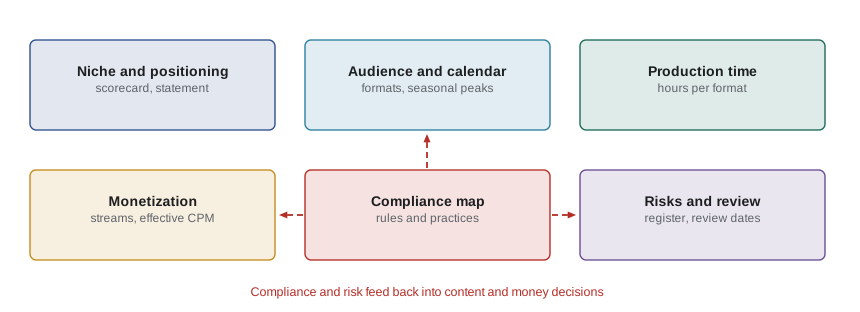
This capstone brings the course together. You will write a niche strategy and compliance plan for a channel, either your own or a realistic fictional one. The plan explains which niche and sub-niche you will serve and why, how you will reach your audience, how you will earn, how much time content takes to produce, which rules apply to your niche and how you will follow them. The lesson walks through each part with a worked example for a fictional creator, then gives you a template and a checklist to assess your own plan.
The worked example: Amara's channel
Amara is a registered dietitian who wants to start a channel about affordable, culturally diverse family meals. She has noticed that much cooking content assumes expensive ingredients and ignores the dishes many families actually cook, and that nutrition content is often dominated by creators without credentials promoting restrictive diets. Her niche sits at the intersection of food, nutrition and family content, which means it inherits rules from several lessons in this course: food claims, nutrition and professional regulation, and children.
Amara lives in Illinois and is licensed as a dietitian by the state. Most of her expected audience is in the United States, and she plans to publish in English with Spanish subtitles and some Spanish-language shorts.
Part 1: niche, audience and positioning
The first part of the plan defines the niche and the audience. Amara uses the scorecard from lesson 1, comparing her preferred niche with two alternatives: general healthy cooking and weight-loss nutrition. Her niche scores well on personal fit and competition, moderately on demand and monetization, and requires careful compliance because of her professional status and the involvement of children in family meals.
| Criterion | Weight | Affordable family meals | General healthy cooking | Weight-loss nutrition |
|---|---|---|---|---|
| Demand | 20 % | 4 | 5 | 5 |
| Competition (higher = easier) | 20 % | 4 | 1 | 2 |
| Monetization | 20 % | 3 | 3 | 4 |
| Personal fit and credibility | 30 % | 5 | 3 | 3 |
| Compliance burden (higher = lighter) | 10 % | 3 | 4 | 1 |
Worked problem
Scoring Amara's options
Calculate the weighted score for each of Amara's three options from the table.
Show solution
- Affordable family meals: 0.2 × 4 + 0.2 × 4 + 0.2 × 3 + 0.3 × 5 + 0.1 × 3 = 0.8 + 0.8 + 0.6 + 1.5 + 0.3 = 4.0.
- General healthy cooking: 0.2 × 5 + 0.2 × 1 + 0.2 × 3 + 0.3 × 3 + 0.1 × 4 = 1.0 + 0.2 + 0.6 + 0.9 + 0.4 = 3.1.
- Weight-loss nutrition: 0.2 × 5 + 0.2 × 2 + 0.2 × 4 + 0.3 × 3 + 0.1 × 1 = 1.0 + 0.4 + 0.8 + 0.9 + 0.1 = 3.2.
Answer: Affordable family meals scores 4.0, well ahead of 3.1 and 3.2. Its advantage comes from personal fit and lower competition, and weight-loss nutrition is held back by a heavy compliance burden and eating-disorder risks.
Her positioning statement reads: for busy families who want to eat well on a budget without giving up the foods they love, my channel offers affordable, culturally diverse recipes and evidence-based nutrition tips, unlike diet-focused channels, because I am a registered dietitian who cooks for a family on a real budget. The statement names the audience, the benefit, the alternative and the reason to believe, and it signals her professional credibility without promising results.
Part 2: content plan and production time
The content plan lists formats, frequency and a seasonal calendar. Amara plans one long recipe video a week, three shorts a week cut from the long videos, and a monthly nutrition explainer. She maps seasonal peaks from lesson 8, such as back-to-school lunches, holiday baking and Lunar New Year, Ramadan and Diwali meals, and schedules those videos four to six weeks ahead.
Production time decides whether a plan is sustainable. Amara estimates time per piece for each format, including planning, shopping, filming, editing and posting, and checks the total against the hours she can spare alongside her job.
| Format | Per month | Hours each | Hours per month |
|---|---|---|---|
| Long recipe video | 4 | 8 | 32 |
| Shorts cut from long videos | 12 | 0.75 | 9 |
| Nutrition explainer | 1 | 10 | 10 |
| Community management and admin | n/a | n/a | 12 |
Worked problem
Checking whether the plan is sustainable
Amara can spare 15 hours a week, or about 60 hours a month. Using the table, does the plan fit, and how much margin does she have?
Show solution
- Total hours: 32 + 9 + 10 + 12 = 63 hours a month.
- Available: about 60 hours.
- Shortfall: 63 − 60 = 3 hours.
Answer: The plan exceeds her time by about 3 hours a month. Options include batch-filming two long videos in one session, which might save 4 hours, reducing shorts to ten a month, or hiring an editor once revenue allows. Building in margin reduces burnout risk, as CRE-350 explained.
Part 3: monetization plan
The monetization plan estimates revenue from each stream over the first year, using conservative assumptions. For Amara, revenue sources include ads, affiliate links for kitchen tools and grocery delivery, sponsorships from food brands and kitchen equipment, and later a paid meal-planning guide. Because she is a registered dietitian, her college's rules affect which sponsorships she may accept and how she presents them.
Sponsor rates vary by niche. Food and family sponsors may pay a different CPM from finance or technology sponsors, and a creator's credentials can raise their value to brands that want credible voices. Amara estimates a sponsorship CPM based on expected views and compares it with offers.
Worked problem
Comparing sponsor offers by CPM
Amara's long videos average 25,000 views after 30 days. A grocery delivery app offers $600 for an integration, and a kitchen appliance brand offers $900 for a dedicated video expected to get 20 % fewer views than her average. Calculate the effective CPM of each offer.
Show solution
- Grocery app: $600 ÷ 25,000 × 1,000 = $24 CPM.
- Appliance views: 25,000 × (1 − 0.20) = 20,000.
- Appliance: $900 ÷ 20,000 × 1,000 = $45 CPM.
Answer: The appliance deal pays a $45 CPM against $24, though a dedicated video takes more work. Amara must also check that each product fits her audience and her professional rules before accepting either.
Part 4: compliance map
The compliance map lists every rule area that applies to the niche, what it requires and how the creator will meet it. For Amara, the map draws on almost every lesson in this course. Writing it down turns general knowledge into specific practices.
Amara's US compliance map includes: Illinois licensing law and professional standards for dietitians, including advertising and scope of practice; the FTC Act and Endorsement Guides for sponsorships and affiliates, and the FTC's Health Products Compliance Guidance for any health claims; FDA food labeling and claim rules for any product claims; DSHEA and FTC evidence standards if she discusses supplements; HIPAA if she works for a covered entity, and her professional duty of confidentiality for any client stories; COPPA if any content is directed at children under 13; Illinois's child influencer law if her children appear in a large share of paid content; and platform policies on medical misinformation, branded content and content made for kids.
| Rule area | What it requires | Amara's practice |
|---|---|---|
| Professional standards | No misleading advertising; manage conflicts; stay within scope | General education only; refer individuals to their own care providers |
| Sponsorship disclosure | Clear, early disclosure of material connections | Spoken and on-screen disclosure plus description; platform tools |
| Food and health claims | Only permitted claims; evidence for objective claims | No disease or detox claims; cite evidence for nutrition statements |
| Supplements | Authorized or substantiated claims only | Decline supplement sponsorships in year one |
| Children | Privacy, dignity, advertising limits | Children not shown on camera; no child-directed sponsored content |
| Eating-disorder safety | Avoid harmful weight and calorie content | No calorie targets in titles; supportive language; resources pinned |
Part 5: compliance scoring
A simple scoring system helps creators check each piece of content before publishing. Amara creates a checklist of ten items that apply to her niche and scores each script. Any item answered no must be fixed before publishing.
- Disclosure: are all sponsorships, gifts and affiliate links disclosed clearly and early?
- Claims: are all nutrition and product claims permitted and supported?
- Scope: does the content stay general and avoid individual diagnosis or treatment?
- Professional rules: does it meet college or board standards on advertising and conflicts?
- Children: are children absent, unidentifiable or shown only with care and consent?
- Allergens and safety: are allergens flagged and food safety steps correct?
- Language: is the content free of diet-culture and weight-stigmatizing language?
- Sources: are evidence sources noted for nutrition statements?
- Platform settings: are paid promotion and made-for-kids settings correct?
- Country: does the content state which country's rules or products it refers to?
Worked problem
Scoring a draft sponsored video
Amara reviews a sponsored video script for a meal kit. It meets eight of the ten checklist items, but the sponsor's script says the kits help kids focus better at school, and the disclosure is only in the description. What is the score, and what must change?
Show solution
- Score: 8 ÷ 10 = 80 %.
- Claims item fails: "helps kids focus better" is an unsupported health claim aimed at children's outcomes.
- Disclosure item fails: disclosure must be clear and early in the video, not only in the description.
Answer: The draft scores 80 % and cannot be published until both items are fixed. Amara removes the focus claim, replaces it with a factual statement about the kits, and adds spoken and on-screen disclosure at the start.
Part 6: risks and review
The final part lists the main risks to the plan and how the creator will respond. For Amara, risks include burnout from combining her job and the channel, a sponsor pressuring her to make claims she cannot support, a viral video attracting harassment, changes in platform policies or algorithm, and a complaint to her professional regulator. For each risk, she notes how likely and serious it is, what she will do to prevent it and how she will respond if it happens.
A plan is a living document. Amara sets review dates every three months to update her numbers, check whether laws or platform rules have changed and adjust her content mix. She also commits to correcting any errors publicly and keeping a record of her sponsorship agreements and the evidence behind her claims, which helps if a regulator or platform ever asks.
Your capstone assignment
Write a niche strategy and compliance plan of about 2,000 to 3,000 words for a channel of your own or a realistic fictional one. Use the six parts from this lesson: niche, audience and positioning with a scorecard; content plan, seasonal calendar and production time budget; monetization plan with conservative estimates; compliance map listing rule areas, requirements and your practices, with the Canadian or US rules that apply; a compliance checklist with at least eight items specific to your niche; and a risk register with review dates. Include at least three calculations, such as a weighted scorecard, a time budget and a sponsor CPM comparison, and cite the laws, codes and platform policies you rely on, noting that they describe the law at the time of writing and are not legal advice.
A strong plan is specific, honest about trade-offs and realistic about time and money. It shows that you understand not just how to grow in your niche, but how to do it in a way your audience, sponsors, regulators and future self can trust.
Common mistakes
MistakeWriting a plan that ignores production time.
InsteadEstimate hours per format and check the total against your real capacity, with margin.
MistakeListing rules without practices.
InsteadFor each rule area, write the specific practice you will follow.
MistakeUsing optimistic revenue assumptions.
InsteadUse conservative estimates and update them with real data each quarter.
MistakeTreating the compliance map as a one-time task.
InsteadReview laws, platform rules and the plan on a regular schedule.
MistakeAccepting sponsor scripts without checking claims.
InsteadScore each script against your checklist and fix failures before publishing.
Summary and key terms
- A niche strategy and compliance plan has six parts: positioning, content, time, money, compliance and risk.
- A weighted scorecard justifies the niche choice and makes trade-offs visible.
- Production time budgets reveal whether a content plan is sustainable.
- Effective CPM helps compare sponsor offers fairly.
- A compliance map turns niche rules into specific, written practices.
- A per-video checklist score catches problems before publishing.
- Plans should be reviewed regularly as data, laws and platform rules change.
- Niche strategy
- A plan describing the niche, audience, content and business of a channel.
- Compliance map
- A list of rule areas, requirements and practices for a niche.
- Compliance checklist
- A per-content list of checks that must pass before publishing.
- Production time budget
- An estimate of hours needed per format and per month.
- Effective CPM
- A sponsor fee divided by expected views, times 1,000.
- Risk register
- A list of risks with likelihood, impact, prevention and response.
- Batch filming
- Filming several pieces of content in one session to save time.
- Review date
- A scheduled time to update a plan with new data and rules.
- Positioning statement
- A sentence describing audience, benefit, alternatives and reason to believe.
- Conservative estimate
- An estimate that deliberately avoids optimistic assumptions.
Practice problems
Work each problem on paper first, then reveal the answer to check.
Name the six parts of the capstone plan.
Show answer
Positioning; content and calendar; production time; monetization; compliance map; risks and review.
A plan needs 70 hours a month and you have 60. What is the shortfall?
Show answer
10 hours.
A $750 sponsorship on a 30,000-view video has what effective CPM?
Show answer
$25.
A dedicated video gets 25 % fewer than 24,000 views. Expected views?
Show answer
18,000.
A script passes 7 of 10 checklist items. Score?
Show answer
70 %.
Can a script with one failed item be published?
Show answer
No, failures must be fixed first.
Weights 0.5, 0.3, 0.2 and scores 4, 5, 2 give what score?
Show answer
2.0 + 1.5 + 0.4 = 3.9.
Why include review dates?
Show answer
Data, laws and platform rules change over time.
Give two risks for a creator who also works full time.
Show answer
Burnout, missed schedule, sponsor pressure, harassment, policy change.
Why note the country in content?
Show answer
Rules, products and prices differ between Canada and the United States.
Lesson quiz · 5 questions
Score 60% or more to complete this lesson.
Create a free account to save your progress, take quizzes and earn a certificate.