
CRE-410 · Lesson 9 of 12 · 26 min
Platform policies, AI labels and content credentials
Every major platform now has rules about AI-generated and AI-altered content. Most require creators to label realistic synthetic content, many add labels automatically when they detect it, and some restrict particular uses entirely, such as deceptive deepfakes of real people or synthetic content in political advertising. Alongside platform rules, an industry standard called content credentials is spreading, letting files carry information about how they were made. This lesson explains how these systems work and how to comply. Platform policies change often; the details below are accurate at the time of writing (October 2026), and you should always check the current help pages before relying on them.
The common principle: realistic content that could mislead
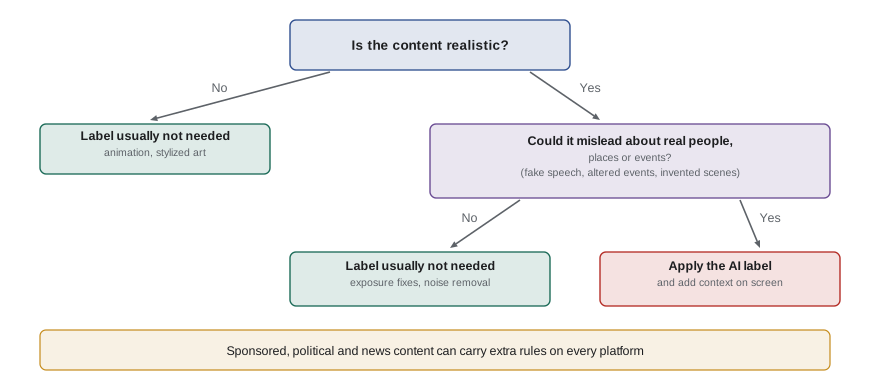
Platform rules differ in detail but share a core idea. Labels are usually required when AI is used to make realistic content that a viewer could mistake for real, especially content that:
- Makes a real person appear to say or do something they did not say or do.
- Alters footage of a real event or place.
- Generates a realistic-looking scene that did not happen.
Labels are usually not required for clearly unrealistic or animated content, minor edits such as color correction, beauty filters or background blur, or for using AI to help with production tasks such as scripts, captions or idea generation. The question platforms ask is not whether AI was involved, but whether viewers might be misled about what is real.
YouTube
YouTube requires creators to disclose, during upload, when realistic content is meaningfully altered or synthetically generated. In May 2026 YouTube announced that it would apply labels automatically when its systems detect significant photorealistic AI use that a creator did not disclose, and that labels for photorealistic or meaningfully altered content would appear more prominently: below the player for long videos and as an overlay on Shorts. Content made with YouTube's own AI tools, or uploaded with content credentials showing AI generation, carries labels the creator cannot remove. YouTube has said a label by itself does not reduce recommendations or monetization, but failing to disclose can lead to content removal or penalties under its policies, and sensitive topics such as elections, health and news may receive extra context. YouTube also offers tools for creators to find and request removal of AI content that imitates their face or voice.
TikTok
TikTok requires users to label realistic AI-generated content and provides an AI-generated content label in the posting flow. It reads content credentials attached to uploads and labels them automatically, and it has reported labeling well over a billion videos this way. In late 2025 TikTok announced tests of invisible watermarks on AI content made with its own tools and on uploads with content credentials, and a control letting users adjust how much AI-generated content appears in their feeds. TikTok's rules prohibit harmful synthetic content, including misleading deepfakes of private individuals and certain public figures.
Meta platforms
Meta labels content on Facebook, Instagram and Threads with an “AI info” label when it detects industry-standard signals, such as content credentials or invisible watermarks, or when users self-disclose. Creators are asked to disclose photorealistic video and realistic audio that was digitally created or altered, and Meta may add more prominent labels where content carries a particularly high risk of misleading people on important matters. Meta also requires advertisers to disclose digitally altered content in ads about social issues, elections and politics.
| Platform | Creator disclosure | Automatic labeling | Notes |
|---|---|---|---|
| YouTube | Required for realistic altered or synthetic content | Yes, including detection since May 2026 | More prominent labels for photorealistic content; likeness tools |
| TikTok | Required for realistic AI content | Yes, via content credentials and detection | Invisible watermark and feed-control tests |
| Meta (Facebook, Instagram, Threads) | Requested for photorealistic video and realistic audio | Yes, via industry signals | Political and social issue ads need disclosure |
| All platforms | Sponsorship disclosure still required | Not a substitute | Advertising law applies on top of platform rules |
Content credentials and C2PA
Content credentials are a way to attach a tamper-evident record of a file's origin and editing history to the file itself. They are based on a technical standard published by the Coalition for Content Provenance and Authenticity (C2PA), a group founded by technology and media companies. A credential can record which camera or software created a file, what edits were made, whether generative AI was used and who signed it. Viewers can inspect the credential with compatible tools, often by clicking a small “cr” icon.
Credentials work best as a positive signal: they let honest creators prove where their content came from. Some cameras can now sign photos at the moment of capture, and many editing and AI tools add credentials when exporting. However, credentials have limits. Metadata can be stripped when files are screenshotted, re-encoded or uploaded to services that do not preserve it. The absence of a credential does not prove content is fake. And a credential shows what the signing software recorded, not whether the content is true.
Invisible watermarks complement credentials. A watermark embeds a hidden signal in the pixels or audio itself, which can survive some editing and re-uploading. Several AI developers add watermarks to their outputs, and platforms use them to detect AI content. Like credentials, watermarks can sometimes be removed or damaged, so platforms combine several signals.
Worked problem
How often do credentials survive?
A creator uploads 50 images with content credentials to five services, 10 per service. When checking afterwards, credentials survive on all 10 images on two services, 6 on one, 2 on another and none on the last. What share survived overall?
Show solution
- Surviving: 10 + 10 + 6 + 2 + 0 = 28.
- Share: 28 ÷ 50 = 56 %.
Answer: Only 56 % survived. Credentials are useful but cannot be relied on alone; keep originals and your AI use log as backup evidence.
Sponsored content and AI
Platform AI labels do not replace advertising disclosures. If a sponsored video uses a synthetic voice, an AI-generated product demonstration or a digital twin, two separate questions arise: is the sponsorship disclosed, and is the use of AI disclosed where it could mislead viewers about the product or the endorser? In Canada, the 2025 Ad Standards guidelines suggest disclosing when AI generates or significantly alters images that show a product's benefits or attributes, with tags such as #MadeWithAI. In the United States, the FTC's position is that there is no AI exemption from truth-in-advertising law, so AI-generated demonstrations must not misrepresent what a product does. Sponsors increasingly write AI rules into contracts, such as banning synthetic voices in reads or requiring approval for any generated imagery.
Political, election and news content
AI content about elections, political candidates and news events faces the strictest rules. Platforms may require disclosure, add context, reduce distribution or remove content. Political advertising rules in both countries also apply: Canadian federal election law has provisions on impersonation and false statements during campaigns, and many US states have passed laws regulating deceptive AI content in election communications, with requirements that vary by state and some subject to court challenges. Creators covering politics should avoid realistic synthetic depictions of real candidates unless clearly satirical and labeled, and should check the current rules before elections.
Practical compliance habits
- Decide labels at the planning stage, not at upload, so scripts and edits account for them.
- Add a disclosure check to your publishing gate (lesson 8).
- Keep content credentials on exports where your tools support them, and keep original files.
- Explain your AI use in descriptions or community posts when it helps viewers understand your process.
- When in doubt, label. Over-labeling rarely causes harm; under-labeling can lead to removal, penalties and lost trust.
Writing good AI disclosures
When a disclosure is needed, or when you choose to disclose voluntarily, make it clear, prominent and specific. Platform labels handle the basic signal. In addition, many creators add a short line in the video itself or the description, such as "The French audio track uses an AI voice clone of my own voice" or "The opening scene is AI-generated; everything else was filmed on location". Specific disclosures inform viewers better than vague ones such as "AI may have been used".
Placement matters. Disclosures buried at the end of a long description are easily missed. For realistic synthetic scenes, an on-screen note at the moment the scene appears is clearest. For sponsored content, CRE-320 explained that disclosures must be visible before viewers engage with the endorsement; AI disclosures in sponsored content should follow the same principle.
When platforms get it wrong
Automatic labeling systems make mistakes. A heavily edited but genuine video may be labeled as AI, or AI content may slip through unlabeled. If a platform wrongly labels your genuine content, check whether its dispute process applies, keep your original files and any content credentials as evidence, and explain the situation to your audience if needed. Labels applied because of content credentials or the platform's own AI tools usually cannot be removed, which is another reason to understand what your tools embed in exported files.
Worked problem
Choosing what to label
A creator's video has five elements: AI noise reduction on narration, AI-generated captions, an AI-extended background in one shot, a realistic AI-generated recreation of a historical street scene shown for 20 seconds, and AI-written chapter titles. Which elements most likely need a platform AI label?
Show solution
- Noise reduction, captions and chapter titles are production assistance.
- The extended background is a minor edit if it does not change meaning.
- The realistic historical recreation could be mistaken for real footage.
Answer: Label the video because of the realistic recreation, and add an on-screen note during that scene. The other elements generally do not require labels.
Keeping up with changing policies
Platform AI policies have changed several times a year since 2023, often with little notice. Assign someone on your team to check the AI and synthetic media sections of each platform's help center and creator blog every quarter, and after major announcements. Note the date you last checked in your SOPs. When policies tighten, review recent uploads for content that may now need labels; platforms sometimes apply new rules to older videos. When in doubt about a specific case, platform creator support teams and partner managers can often clarify how a rule applies, and their answers are worth recording for future reference.
Common mistakes
MistakeAssuming any AI involvement needs a label, or that none does.
InsteadFocus on whether realistic content could mislead viewers about what is real.
MistakeRelying on content credentials to prove authenticity.
InsteadTreat credentials as helpful but strippable; keep originals and logs.
MistakeUsing a platform AI label instead of a sponsorship disclosure.
InsteadDisclose both the sponsorship and misleading AI use separately.
MistakeMaking realistic synthetic videos of political candidates.
InsteadAvoid them, or clearly label satire and check election rules.
MistakeDeciding disclosure only at upload.
InsteadPlan labels during pre-production and check them at a publishing gate.
Summary and key terms
- Platforms focus labeling on realistic content that could mislead viewers about real people, places or events.
- YouTube requires disclosure and has applied automatic, more prominent labels for photorealistic AI content since May 2026.
- TikTok requires labels for realistic AI content and reads content credentials automatically.
- Meta labels content using industry signals and requires disclosure in political and social issue ads.
- Content credentials, based on C2PA, record origin and edits but can be stripped; watermarks add another signal.
- Platform labels do not replace sponsorship disclosures or truth-in-advertising obligations.
- Political and election content faces the strictest rules; check them before elections.
- AI label
- A platform notice that content was generated or altered with AI.
- Synthetic content
- Content generated or substantially altered by AI.
- Content credentials
- Tamper-evident provenance information attached to a file.
- C2PA
- Coalition for Content Provenance and Authenticity, which publishes the content credentials standard.
- Provenance
- The origin and history of a piece of content.
- Invisible watermark
- A hidden signal embedded in content to identify it as AI-generated or from a source.
- Metadata
- Information stored with a file about its creation and properties.
- Deepfake
- Realistic synthetic media that makes a person appear to say or do something they did not.
- Self-disclosure
- A creator voluntarily marking content as AI-generated.
- Truth in advertising
- The legal principle that advertising must not mislead.
Practice problems
Work each problem on paper first, then reveal the answer to check.
Does a cartoon-style AI animation usually need a platform label?
Show answer
Usually not, because it is clearly unrealistic.
Does AI noise removal on your own voice need a label?
Show answer
Usually not; it is a minor production edit.
Does a realistic AI video of a real celebrity endorsing a product need a label?
Show answer
Yes, and it likely breaches consent, publicity and advertising rules.
What does C2PA stand for?
Show answer
Coalition for Content Provenance and Authenticity.
Why can content credentials not prove content is real?
Show answer
They record what software reported and can be stripped or missing.
30 of 40 credentials survive. Share?
Show answer
75 %.
Does a platform AI label satisfy sponsorship disclosure?
Show answer
No; both disclosures are needed.
What has the FTC said about AI and advertising law?
Show answer
There is no AI exemption.
Name one practical compliance habit.
Show answer
Plan labels early, add a disclosure gate, keep credentials and originals.
When in doubt about labeling, what should you do?
Show answer
Label.
Lesson quiz · 5 questions
Score 60% or more to complete this lesson.
Create a free account to save your progress, take quizzes and earn a certificate.