
CRE-410 · Lesson 1 of 12 · 27 min
How generative AI works for creators
Generative artificial intelligence has moved from a novelty to an everyday tool for many creators in only a few years. Tools can now draft scripts, suggest titles, remove background noise, cut long recordings into short clips, translate a voice into another language, generate images and even produce short video scenes from a written description. Used well, these tools save time and open up work that would once have needed a large team. Used carelessly, they produce errors, generic content, legal problems and a loss of audience trust.
This course is about using AI tools well. It does not assume you are a programmer, and it does not try to teach you every product on the market, because products change every few months. Instead it teaches the categories of tools, how they work at a practical level, what they are good and bad at, and how to build them into a production workflow with human judgment, quality checks, honest disclosure and respect for other people's rights. Where this course names specific products, it does so only as examples at the time of writing (October 2026), not as endorsements.
CRE-202 introduced the core craft of making content. CRE-320 covered advertising disclosure law and CRE-401 covered building a team. This course draws on all three: AI changes how content is made, what must be disclosed and which jobs a growing creator company needs.
What "generative" means
Most software follows rules a programmer wrote: if this happens, do that. Machine learning is different. A machine learning model is a large mathematical function whose internal settings, called parameters or weights, are adjusted automatically during training so that the model's outputs match patterns in example data. A generative model is one trained to produce new content, such as text, images, audio or video, that resembles the data it learned from.
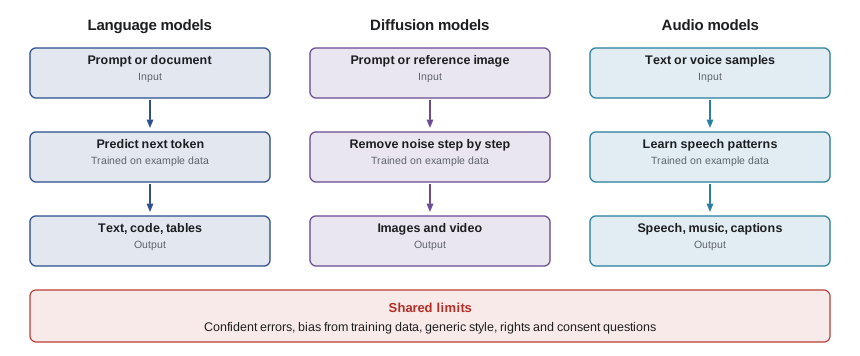
Three families of generative models matter most to creators:
- Large language models (LLMs) produce text, and increasingly code, tables and structured data. They power chat assistants, script helpers, title generators and many summarizing tools.
- Image and video models, most of them based on a technique called diffusion, produce pictures and moving images from text descriptions, reference images or rough sketches.
- Audio models produce speech, music and sound effects. Voice models can clone a particular person's voice from samples, and speech recognition models do the reverse, turning speech into text for captions and transcripts.
Many modern systems are multimodal: they accept and produce several kinds of content at once, such as reading an image and describing it in words, or taking a script and producing narrated video.
How a language model writes
A large language model is trained on enormous amounts of text. During training it repeatedly sees a passage with the next word hidden and adjusts its parameters to predict that word better. Text is actually split into pieces called tokens, which are often whole words, parts of words or punctuation marks. After training on billions of examples, the model becomes very good at predicting likely continuations, and that ability turns out to support summarizing, translating, answering questions and drafting new writing.
When you type a prompt, the model produces a response one token at a time. At each step it calculates how likely each possible next token is, then picks one, sometimes with a little randomness. A setting often called temperature controls that randomness: low temperature makes answers more predictable and repetitive; high temperature makes them more varied and more likely to go off track.
Most assistants used by creators are then tuned further with human feedback, so that they follow instructions, decline harmful requests and write in a helpful style. Many can also search the web, read documents you upload or call other tools, which helps them work with current information rather than only what was in their training data.
Worked problem
Estimating tokens in a script
A rule of thumb for English is that one token is roughly three-quarters of a word, so 100 tokens is about 75 words. A creator pastes a 6,000-word transcript into an assistant and asks for a 600-word summary. Roughly how many tokens are involved?
Show solution
- Input tokens: 6,000 ÷ 0.75 = 8,000 tokens.
- Output tokens: 600 ÷ 0.75 = 800 tokens.
- Total: about 8,800 tokens, plus a little for the instructions.
Answer: About 8,800 tokens. Token counts matter because many tools limit how much text they can read at once (the context window) and because paid services often charge per token.
Why language models make things up
Because a language model predicts plausible text rather than looking up verified facts, it can produce statements that sound confident but are false. This is often called hallucination or confabulation. A model may invent a quotation, a statistic, a study, a court case or a book that does not exist, or mix up two people with similar names. It may give an outdated answer if its training data ended before a recent change. Tools that search the web reduce but do not remove this problem, because the model can still misread a source or cite a page that does not support its claim.
For creators this is the single most important limitation to understand. An AI-drafted script can contain a fabricated statistic that you then repeat to hundreds of thousands of viewers. The audience will hold you responsible, not the tool. Lesson 2 sets out a fact-checking workflow; for now, treat every factual claim from a language model as a lead to verify, not a fact to publish.
| Task | Typical AI reliability | Human role |
|---|---|---|
| Brainstorming titles and angles | High usefulness, low risk | Choose and refine |
| Rewriting your own text for clarity | Usually good | Check meaning is kept |
| Summarizing a document you provide | Good, with occasional omissions | Spot-check against the source |
| Stating facts, figures and dates | Variable; errors common | Verify every claim |
| Legal, medical or financial claims | Risky | Use qualified sources and experts |
| Quotations and citations | Often invented | Find the original every time |
How image and video models work
Most current image generators use diffusion. During training, the model is shown images with increasing amounts of random noise added until they are pure static, and it learns to reverse the process: to predict and remove the noise step by step. Each training image is paired with a text description, so the model also learns which visual patterns go with which words. To generate a new picture, the model starts from random noise and removes it in many small steps, steered by your prompt, until an image emerges.
Video models extend the same idea across time, generating sequences of frames that stay consistent with each other. They have improved dramatically, but they still struggle with long scenes, consistent characters across shots, readable text, hands and fine details, physical cause and effect, and precise control. Many tools now let you guide generation with a reference image, a pose, a depth map or a rough edit, which gives far more control than a text prompt alone.
Image models also inherit patterns from their training data, including stereotypes. Asked for a doctor, a chief executive or a nurse, a model may default to particular genders, ages or ethnicities. Asked for a landmark or a celebrity, it may produce something close to copyrighted or trademarked material. These are reasons for careful prompting and review, covered in lesson 4.
How voice and audio models work
Speech recognition models convert audio into text and power automatic captions, transcripts and text-based editing. Text-to-speech models do the reverse, and modern voice cloning can produce a convincing copy of a voice from a few minutes, or even seconds, of recorded speech. Voice conversion models change one voice into another while keeping the timing and emotion of the original performance, which is how many AI dubbing tools work. Music and sound-effect generators create audio from text descriptions.
Voice is especially sensitive because it is tied to identity. A cloned voice can be used to impersonate someone, to scam their family or fans, or to make them appear to endorse something they never said. Lessons 5, 6 and 10 return to consent, platform rules and the law on voice and likeness.
What AI does well for creators
Despite the limits, AI tools are genuinely useful when matched to the right tasks. They are strongest where the work is repetitive, where a first draft is helpful even if imperfect, and where a human can quickly judge the output. Common high-value uses include:
- Transcribing interviews and recordings so you can search, quote and edit by text.
- Generating many options quickly, such as 30 title ideas or 10 thumbnail concepts, so the creator can choose.
- Cleaning audio, removing filler words and silences, and producing rough cuts.
- Repurposing a long video into clips, posts, newsletters and blog articles.
- Translating captions and, with care, dubbing content into other languages.
- Summarizing comments, analytics and research documents to spot patterns.
AI is weakest where originality, lived experience, taste, accuracy and trust matter most. Audiences follow creators for their voice, perspective and relationships. A useful principle is to automate the work around the creative core, not the core itself.
The cost side: money, time and attention
AI tools are rarely free in practice. Many charge monthly subscriptions, some charge per minute of audio or per generated image, and developer services charge per token. There are hidden costs too: time spent writing prompts, reviewing and fixing output, learning tools and switching between them. A tool that saves two hours of editing but adds an hour of correction saves only one hour.
Worked problem
Is a transcription subscription worth it?
A creator records four interviews a month, each 60 minutes long. Transcribing by hand takes about 4 minutes of work per minute of audio. An AI transcription service costs $30 a month and its transcripts need about 0.5 minutes of checking per minute of audio. The creator values their time at $40 an hour. Is the subscription worth it?
Show solution
- Audio per month: 4 × 60 = 240 minutes.
- Manual time: 240 × 4 = 960 minutes = 16 hours.
- AI-assisted time: 240 × 0.5 = 120 minutes = 2 hours.
- Time saved: 16 − 2 = 14 hours, worth 14 × $40 = $560.
- Net benefit: $560 − $30 = $530 a month.
Answer: Yes. The subscription saves about 14 hours and roughly $530 of time value a month, even after checking time.
Rights, consent and trust: a preview
Every AI use raises three questions this course returns to repeatedly. First, rights: what material was the tool trained on, who owns what you produce, and are you copying someone else's work, voice or likeness? Second, consent: has every person whose face, voice or words appear in your content agreed to how you are using them? Third, trust: would your audience feel misled if they knew how a piece of content was made? Platforms and regulators increasingly require disclosure of realistic synthetic content, and audiences reward creators who are open about their process.
Common mistakes
MistakeTreating an AI answer as a verified fact.
InsteadTreat every factual claim as a lead and check it against a reliable source.
MistakeAssuming a tool knows recent events.
InsteadCheck whether the tool searches current sources and verify dates.
MistakeCounting only subscription fees as the cost.
InsteadInclude prompting, review, correction and learning time.
MistakeAutomating the parts audiences value most.
InsteadAutomate the work around your creative voice, not the voice itself.
MistakeCloning a voice or face without thinking about consent.
InsteadGet clear, informed permission before using anyone's likeness.
Summary and key terms
- Generative AI models learn patterns from example data and produce new text, images, audio or video.
- Language models predict the next token; image and video models mostly use diffusion; audio models handle speech recognition, synthesis and cloning.
- Language models can confidently invent facts, quotes and sources, so every claim needs checking.
- Image and video models struggle with consistency, text, fine detail and control, and can reproduce stereotypes.
- Voice cloning is powerful and sensitive because voice is tied to identity.
- AI is most valuable for repetitive tasks, first drafts and generating options that humans judge.
- Real costs include subscriptions plus prompting, review and correction time.
- Generative AI
- Machine learning systems that produce new content resembling their training data.
- Large language model (LLM)
- A model trained on large amounts of text to predict and generate language.
- Token
- A piece of text, often a word or part of a word, that a language model reads and writes.
- Context window
- The maximum amount of text a model can consider at one time.
- Temperature
- A setting that controls how random or predictable a model's output is.
- Hallucination
- A confident but false statement produced by an AI model.
- Diffusion model
- A model that generates images or video by removing noise step by step, guided by a prompt.
- Multimodal
- Able to accept or produce more than one kind of content, such as text and images.
- Voice cloning
- Producing synthetic speech that imitates a specific person's voice.
- Speech recognition
- Converting spoken audio into text.
Practice problems
Work each problem on paper first, then reveal the answer to check.
About how many tokens are in a 3,000-word document?
Show answer
3,000 ÷ 0.75 = about 4,000 tokens.
Why do language models invent facts?
Show answer
They predict plausible text rather than looking up verified information.
What does a higher temperature setting do?
Show answer
It makes output more varied and less predictable.
How does a diffusion model generate an image?
Show answer
It starts from noise and removes it step by step, guided by the prompt.
Name two weaknesses of current video models.
Show answer
Long scenes, consistent characters, readable text, hands, physics, precise control.
Why is voice cloning especially sensitive?
Show answer
Voice is tied to identity and can be used to impersonate or mislead.
Manual transcription takes 5 minutes per audio minute; AI checking takes 1. For 120 minutes of audio, how much time is saved?
Show answer
600 − 120 = 480 minutes, or 8 hours.
Give one high-value, low-risk creator use of AI.
Show answer
Brainstorming titles, transcription, removing silences, generating options.
What three questions should every AI use raise?
Show answer
Rights, consent and trust.
What does multimodal mean?
Show answer
Accepting or producing more than one kind of content.
Lesson quiz · 5 questions
Score 60% or more to complete this lesson.
Create a free account to save your progress, take quizzes and earn a certificate.