
CRE-410 · Lesson 10 of 12 · 25 min
AI, copyright, likeness and privacy law in the US
AI law is changing quickly, and much of it is still being decided by courts, regulators and legislatures. This lesson gives creators a working map of the main legal questions: who owns AI-assisted content, whether training AI on other people's work is lawful, how voices and faces are protected, what privacy law requires, and how advertising and transparency rules apply. It describes the law at the time of writing (October 2026) in general terms.
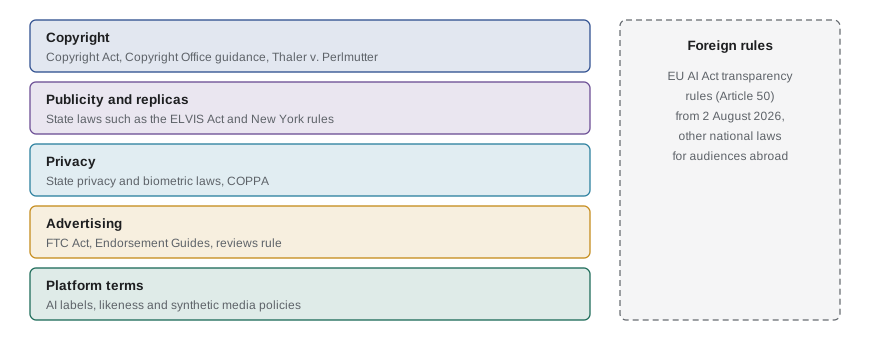
Copyright in AI-assisted work
US copyright law protects original works of authorship, and the US Copyright Office and the courts have consistently held that this requires a human author. In its January 2025 report on copyrightability, the Copyright Office concluded that prompts alone generally do not give enough control over the output to make the person who wrote them its author, but that human selection and arrangement of AI material, and human changes to it, can be protected. The courts agreed in Thaler v. Perlmutter: the D.C. Circuit held in March 2025 that a work generated autonomously by an AI system cannot be registered, and the Supreme Court declined to hear an appeal in March 2026.
When registering AI-assisted works, the Copyright Office requires applicants to disclose AI-generated material that is more than minimal and to describe the human contribution, such as the text they wrote, the selection and arrangement they made, or the edits they applied to AI output. Failing to disclose can lead to a registration being canceled. Registration matters in the United States because it is generally required before suing for infringement of a US work, and early registration makes statutory damages and legal fees available.
For creators, the practical lessons are the same in both countries. Keep a record of your human contributions: scripts you wrote, footage you shot, selection and sequencing decisions, and edits to AI material. Treat purely generated elements, such as an AI background or a fully generated music bed, as potentially unprotected, which means others might copy them freely. Do not assume a tool's terms giving you ownership of output create copyright the law does not recognize; terms can only assign whatever rights exist.
Training data and infringement
In the United States, developers rely mainly on fair use, which weighs the purpose of the use, the nature of the work, the amount used and the effect on the market. Early decisions are mixed and fact-specific. In 2025, a federal judge in Bartz v. Anthropic found training on lawfully acquired books to be fair use but not the copying of pirated books, and the case later settled for about US$1.5 billion. Other cases, including The New York Times v. OpenAI and Microsoft and Getty Images' US claims against Stability AI, were ongoing at the time of writing. The Copyright Office's May 2025 pre-publication report on training said some training uses are likely fair and others are not, depending especially on market harm.
For creators, the training debate cuts both ways. Your own content may have been used to train models, and you may want to use platform settings or opt-outs that limit future use where they exist. At the same time, the tools you use may have been trained on others' work. The bigger practical risk for you is output: if a generated image, song or passage closely copies an existing work, publishing it can infringe regardless of how the model was trained. Lesson 4's safeguards apply: avoid prompts aimed at copying protected works, check outputs and choose tools with clear commercial terms.
Outside North America, courts have also started ruling. In November 2025 the High Court of England and Wales largely rejected Getty Images' copyright claims against Stability AI, finding the trained model was not itself an infringing copy. Such foreign decisions are not binding in Canada or the United States but are watched closely.
Voice and likeness
In the United States, the right of publicity is mainly state law, protecting a person's name, image, likeness and in many states voice against unauthorized commercial use. Several states have passed AI-specific laws. Tennessee's ELVIS Act (in force July 2024) expressly protects voice, including simulated voices, and creates liability for tools whose primary purpose is producing unauthorized replicas. California's AB 2602 (2025) makes contract terms allowing digital replicas of performers unenforceable unless they describe the intended uses and the performer was represented. New York requires advertisers to disclose synthetic performers in ads (penalties of $1,000 for a first violation and $5,000 for later ones, in force from June 2026) and protects deceased performers' digital replicas. A federal bill, the NO FAKES Act, was reintroduced in 2025 but had not been passed at the time of writing. The TAKE IT DOWN Act (2025) makes publishing non-consensual intimate images, including AI deepfakes, a federal crime and requires platforms to remove them on request.
Whatever the jurisdiction, the creator's rule is simple: get informed, written consent before creating or publishing a synthetic version of anyone's voice or face, and never create sexual or degrading deepfakes of anyone. Satire and commentary about public figures can be protected expression, but realistic fakes that could be taken as genuine, or that suggest endorsement, are high-risk.
| Situation | Main legal concerns |
|---|---|
| Cloning a co-host's voice for dubs | Consent and contract terms; personality or publicity rights |
| Realistic fake of a celebrity "endorsing" your sponsor | Personality or publicity rights, false endorsement, misleading advertising |
| AI image in the style of a living artist | Possible copyright infringement if it copies protected expression; reputational risk |
| Fully AI-generated mascot | Weak or no copyright protection; consider trademark |
| Uploading guests' interviews to a voice tool | Privacy and biometric data rules; consent; tool data terms |
Privacy and biometric data
The United States has no general federal privacy law for private businesses, but a growing number of states, led by California, have comprehensive privacy laws giving residents rights over their personal information. Biometric laws matter most for AI likeness work: Illinois' Biometric Information Privacy Act requires informed written consent before collecting face geometry or voiceprints and allows individuals to sue, and Texas and Washington have their own biometric rules. COPPA restricts collecting personal information from children under 13 online, and the FTC's amended COPPA rule, with compliance required from April 2026, tightened consent and data retention requirements. For creators, voice samples, face scans of guests and viewer data can trigger these laws; collect only what you need, with clear consent, and check where AI tools store it.
Advertising, disclosure and AI claims
Section 5 of the FTC Act prohibits unfair or deceptive practices, and the FTC has said repeatedly that there is no AI exemption from that law. In September 2024 it announced Operation AI Comply, a set of actions against companies making deceptive AI claims or using AI to deceive, such as a service marketed as a robot lawyer. The FTC's rule on consumer reviews and testimonials (in force October 2024) bans fake reviews, including AI-generated ones that misrepresent being from real customers, with civil penalties per violation. The Endorsement Guides apply to virtual and AI influencers as to human ones.
Worked problem
Estimating penalty exposure
A creator agency in New York produces three ads using synthetic performers without the required disclosure after the law takes effect. Using the $1,000 and $5,000 penalty levels, what is the potential civil penalty if each ad counts as a separate violation?
Show solution
- First violation: $1,000.
- Two later violations: 2 × $5,000 = $10,000.
- Total: $1,000 + $10,000 = $11,000.
Answer: About $11,000 in penalties, plus the cost of pulling the ads and possible claims from the affected performers or brands.
Foreign audiences and the EU AI Act
Creators reach global audiences, and some foreign laws may apply to content aimed at their residents. The most important is the European Union's AI Act. Its transparency obligations in Article 50 took effect on 2 August 2026. Among other things, those who deploy AI to create deepfakes, meaning realistic image, audio or video content resembling real people, places or events that could falsely appear authentic, must disclose that the content is artificially generated or manipulated. For evidently artistic, creative, satirical or fictional works, disclosure can be lighter, such as a mention that does not spoil the work, but commercial content does not qualify for that relief just because it has a fictional setting. Fines can be large. Creators with significant EU audiences or EU sponsors should treat platform AI labels as a minimum and follow EU guidance for campaigns aimed there.
Staying current
This area changes monthly. Follow reliable sources such as government copyright and privacy offices, regulators' guidance, professional associations for creators and performers, and reputable law firm updates. Revisit your AI policies at least twice a year, and whenever you start a new kind of AI use, such as your first digital twin or first AI-dubbed sponsored campaign.
A legal checklist for AI projects
Before starting a project that uses AI in a significant way, run through a short checklist with your team, and with a lawyer for higher-risk work:
- Inputs: do we have the rights and consents for everything we upload, including guest recordings, music, footage and other people's writing?
- Tool terms: do the tool's terms allow commercial use, and what do they say about ownership, training on our uploads and indemnities?
- Outputs: could anything generated resemble an existing protected work, trademark or real person?
- Likeness: have all people whose faces or voices are reproduced given informed, written consent covering this use?
- Privacy: are we collecting personal or biometric information, and have we met consent, notice and security requirements?
- Advertising: does the content make claims, endorse products or show demonstrations that AI could make misleading?
- Audiences: are we targeting regions, such as the EU, with additional rules?
- Records: are we logging what was generated and our human contributions?
The checklist does not replace legal advice, but it helps you spot when you need it.
Remember that laws differ between provinces and states, and that content published online can reach people in many places at once. The most cautious approach is to follow the strictest rule likely to apply to your audience, especially for consent to use people's likenesses and for disclosure of synthetic content.
Common mistakes
MistakeAssuming you own copyright in anything an AI tool produces for you.
InsteadProtection depends on human authorship; document your contributions.
MistakeBelieving tool terms override the law.
InsteadTerms can only assign rights that exist and cannot license others' likenesses.
MistakeCreating a synthetic version of a real person without consent.
InsteadGet informed, written consent; avoid realistic fakes of public figures.
MistakeUploading guests' voices or faces to AI tools casually.
InsteadTreat them as personal and possibly biometric information requiring consent.
MistakeIgnoring foreign audiences.
InsteadCheck rules such as the EU AI Act when content or campaigns target other regions.
Summary and key terms
- Copyright protection for AI-assisted work depends on human authorship; purely generated material may be unprotected.
- In the United States, Thaler v. Perlmutter and Copyright Office guidance confirm that human authorship is required.
- The lawfulness of training AI on copyrighted works is still being decided; your bigger risk is output that copies existing works.
- State publicity laws and AI-specific laws such as Tennessee's ELVIS Act and New York's synthetic performer law protect voice and likeness.
- State privacy and biometric laws such as Illinois' BIPA, and COPPA, govern personal and biometric information.
- Advertising law applies fully to AI content and AI influencers.
- The EU AI Act's transparency rules have applied since August 2026 and can reach content aimed at EU audiences.
- Author
- The person who creates a work and is the first owner of its copyright, subject to agreements.
- Originality
- The quality a work needs for copyright protection, linked to human skill and judgment or creativity.
- Fair dealing
- Canadian exceptions allowing use of works for purposes such as research, criticism, parody and news reporting.
- Fair use
- A flexible US exception weighing purpose, nature, amount and market effect.
- Text and data mining
- Automated analysis of large amounts of text or data, including for AI training.
- Right of publicity
- A right to control commercial use of one's name, image, likeness or voice.
- Appropriation of personality
- A Canadian common law tort for unauthorized commercial use of a recognizable person.
- Biometric information
- Data about physical characteristics, such as face geometry or voiceprints, used to identify people.
- Digital replica
- A realistic synthetic reproduction of a person's voice or likeness.
- EU AI Act
- The European Union's regulation on artificial intelligence, including transparency rules for synthetic content.
Practice problems
Work each problem on paper first, then reveal the answer to check.
Is a single-prompt AI image likely to be protected by copyright?
Show answer
Unlikely, because human authorship is required.
What helps show human authorship?
Show answer
Records of scripts, footage, selection, arrangement and edits.
Which output risk matters most to creators?
Show answer
Output that closely copies an existing protected work.
Name one US AI-specific likeness law.
Show answer
Tennessee ELVIS Act; New York synthetic performer law; California AB 2602.
Why are voice samples sensitive under privacy law?
Show answer
They can be biometric information identifying a person.
What does Illinois' BIPA require before collecting voiceprints?
Show answer
Informed written consent.
Does advertising law apply to AI influencers?
Show answer
Yes, fully.
When did EU AI Act transparency rules take effect?
Show answer
2 August 2026.
Can a tool's terms let you use a celebrity's cloned voice?
Show answer
No; terms cannot license someone else's personality rights.
How often should creators revisit AI policies?
Show answer
At least twice a year and with each new type of AI use.
Lesson quiz · 5 questions
Score 60% or more to complete this lesson.
Create a free account to save your progress, take quizzes and earn a certificate.