
CRE-410 · Lesson 5 of 12 · 28 min
Voice, dubbing and translation
For most of the history of online video, language was a hard boundary. A creator speaking English reached English-speaking audiences, with subtitles as the only bridge. AI translation and dubbing have changed that. Tools can now transcribe a video, translate it, generate a voice in the target language that sounds like the original speaker and even adjust lip movements to match. Major platforms support multiple audio tracks on a single video, so viewers can choose their language. For creators, this opens large new audiences, but it also raises questions of quality, cultural fit, consent and cost.
The localization stack
Localization means adapting content for a different language and culture. It is more than translation: jokes, references, units, prices, measurements and examples may all need changing. AI localization usually involves several steps:
- Transcription of the original speech, with timestamps.
- Machine translation of the transcript into the target language.
- Adaptation: adjusting length so translated lines fit the timing, and replacing references that will not make sense.
- Voice generation: either a stock synthetic voice, or a cloned voice that sounds like the original speaker.
- Lip synchronization (optional): adjusting mouth movements to match the new audio.
- Mixing: placing the new voice over the original music and sound effects.
- Review by a fluent speaker, ideally a native speaker familiar with the topic.
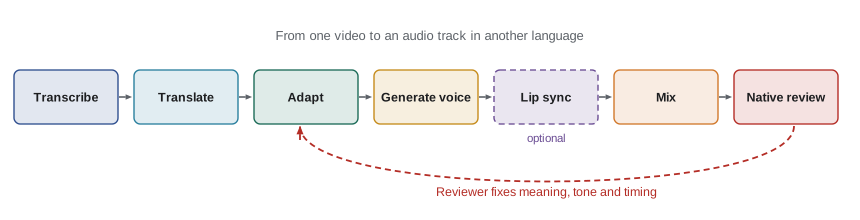
The final review step is the one most often skipped and the one that most often decides whether localization works. Machine translation is strong between widely used language pairs but still mistranslates idioms, humor, slang, technical terms and words with several meanings. A synthetic voice may mispronounce names or use the wrong level of formality, such as the familiar and polite forms of address that many languages distinguish.
Subtitles, dubbing or separate channels?
Creators have several ways to reach other-language audiences, each with different costs and results:
| Approach | Cost and effort | Pros | Cons |
|---|---|---|---|
| Translated subtitles | Low | Cheap, keeps the original voice, easy to correct | Many viewers prefer audio, especially on mobile |
| Multi-language audio tracks | Medium | One video gathers all views and engagement | Voice quality and review needed for each language |
| Separate language channels | High | Can tailor titles, thumbnails and community per market | Splits audience, needs separate management |
| Human dubbing studio | Highest | Best performance and cultural adaptation | Expensive and slower |
Multi-language audio tracks are attractive because views, likes and comments in every language all count toward one video. Separate channels let you adapt titles, thumbnails and community management for each market but split your efforts. Many creators start with subtitles, test audio dubbing on their best-performing videos, and expand to the languages that respond.
Estimating localization ROI
Before dubbing a back catalog into ten languages, estimate the return for each language. Return on investment depends on how many extra views the dub attracts and how much each view earns. Revenue per thousand views (RPM) varies widely by country and language, because advertisers pay different amounts in different markets.
Worked problem
ROI for three languages
A creator plans to dub 20 videos into Spanish, Portuguese and German. AI dubbing plus native review costs $90 per video per language. Expected extra views per video in the first year are 15,000 (Spanish), 10,000 (Portuguese) and 4,000 (German). Estimated RPMs are $1.60, $1.20 and $5.00. Which languages are worth it?
Show solution
- Cost per language: 20 × $90 = $1,800.
- Spanish: 20 × 15,000 = 300,000 views; 300 × $1.60 = $480.
- Portuguese: 200,000 views; 200 × $1.20 = $240.
- German: 80,000 views; 80 × $5.00 = $400.
- ROI: Spanish (480 − 1,800) ÷ 1,800 ≈ −73 %; Portuguese ≈ −87 %; German ≈ −78 %.
Answer: At these assumptions none of the three pays back from ad revenue alone in the first year. The creator would need cheaper production, more views per video, a longer time horizon or other revenue, such as sponsorships or products in those markets.
The example is deliberately sobering. Localization ROI depends heavily on view estimates, and dubs of videos that were already popular tend to perform best. Sponsorship and product revenue in a new market, and long-term growth of a new audience, may matter more than first-year ad revenue. A better approach is to test one language on a few top videos, measure actual views and revenue, and then decide.
Worked problem
Break-even views for a dub
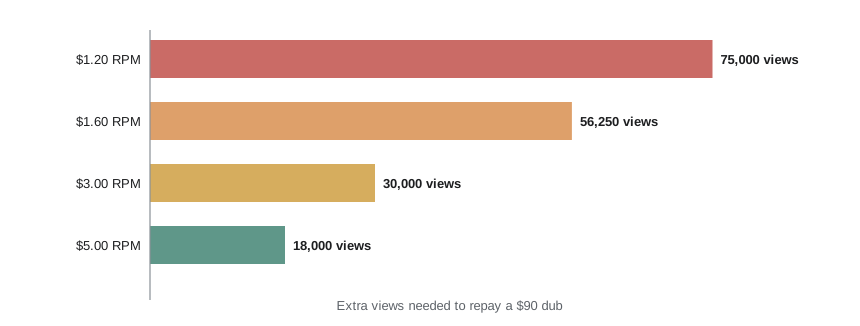
Dubbing one video into German costs $90. With an RPM of $5.00, how many extra German views does the dub need to break even? For Portuguese at $1.20?
Show solution
- German: $90 ÷ $5.00 × 1,000 = 18,000 views.
- Portuguese: $90 ÷ $1.20 × 1,000 = 75,000 views.
Answer: A German dub needs 18,000 extra views; a Portuguese dub needs 75,000. Higher-RPM markets need fewer views, but audience size and interest matter too.
Voice cloning and consent
Voice cloning lets your dubbed videos sound like you, which many audiences prefer to a stock voice. Cloning your own voice is generally your choice, though you should read the service's terms about who can use the voice model and whether it is used to train other systems. Cloning anyone else's voice, including a co-host, a guest, a voice actor or a public figure, requires their informed consent.
Informed consent for a voice clone should cover what the voice will be used for, in which languages and products, for how long, whether the person can withdraw consent, how they will be paid, and how the voice model will be stored and deleted. Get it in writing. Union performers may have specific protections: actors' unions in both countries have negotiated consent and payment rules for digital replicas, and voice actors have been among the workers most affected by synthetic voices. Lesson 10 explains the personality and publicity laws that protect voices.
Voice clones can also be misused against you. Scammers use cloned creator voices in fake giveaways, investment schemes and messages to fans. Protect your voice samples where you can, tell your audience how you will and will not contact them, and report impersonation quickly to platforms.
Quality and cultural adaptation
Good localization adapts, not just translates. A joke built on an English pun may need a different joke. A price in Canadian dollars may need converting or removing. Measurements may need changing between metric and imperial for different audiences. References to local celebrities, holidays, school systems or laws may confuse viewers elsewhere. Some topics, gestures or images can be offensive in particular cultures. Native-speaking reviewers catch these problems; machines often do not.
Quality checks for a dub should include: accurate meaning, natural phrasing, correct pronunciation of names and terms, appropriate formality, timing that matches on-screen action, consistent terminology across videos, and a mix in which the voice sits naturally with music and effects. Ask a sample of viewers in the target market for feedback, and watch comments for complaints about translation.
Canadian and US language contexts
For Canadian creators, French is an obvious first localization target, with a large audience in Quebec and francophone communities across the country. Quebec's Charter of the French Language sets rules for commercial content and advertising in Quebec, and Canadian French differs from European French in vocabulary and expression, so a translation tuned for France may sound odd to Quebec viewers. For US creators, Spanish is the largest second language market domestically, and Latin American and European Spanish differ in vocabulary and pronunciation. Both countries also have Indigenous languages whose speakers may be poorly served by mainstream AI tools, and where community involvement and respect for language protocols matter.
Captions and accessibility in other languages
Translated captions remain valuable even when you dub, because Deaf and hard-of-hearing viewers in each market need them, and some viewers prefer original audio with subtitles. Machine-translated captions should be reviewed just like dubs. Upload captions as proper caption files rather than burning them into the video, so viewers can turn them on and off and platforms can index them.
Running a localization pilot
A disciplined pilot reduces the risk of spending heavily on languages that do not respond. A typical pilot design: choose one target language based on audience data, such as existing viewers from that market, comments in that language or strong search interest; select five to ten videos that already perform well and are evergreen, meaning their content will stay relevant; dub them with native review; publish the audio tracks and translated titles and descriptions; and track views in that language, watch time, new subscribers from the market and any sponsorship enquiries for 90 days.
Set success criteria before starting, such as an average of 10,000 extra views per dubbed video or a sponsorship enquiry from the market. If the pilot meets them, expand gradually; if not, try a different language or stop. Record the costs of each step, including review and the creator's own time spent on coordination, so the comparison is honest.
Titles and descriptions matter as much as the audio. Viewers searching in another language need to find the video, so translate metadata too, with the same native review. Some platforms let you add translated titles and descriptions that display automatically to viewers in each language.
Working with voice actors and dubbing studios
AI dubbing does not have to replace human performers. Some creators use professional voice actors for flagship videos and AI for the back catalog. Others hire native-speaking voice actors to record a short sample that a licensed voice model then extends, with the actor's consent and payment. Where you work with performers, use written agreements that address AI explicitly, including whether any recording may be used to train or create a voice model.
Worked problem
Pilot success check
A pilot dubs 8 videos into French. Over 90 days they gain 46,000, 31,000, 22,000, 18,000, 12,000, 9,000, 6,000 and 4,000 extra views. The success criterion was an average of 15,000 extra views per video. Did the pilot succeed?
Show solution
- Total: 46 + 31 + 22 + 18 + 12 + 9 + 6 + 4 = 148 thousand views.
- Average: 148,000 ÷ 8 = 18,500 views.
Answer: Yes. The average of 18,500 exceeds the 15,000 target, although half the videos fell short, which suggests dubbing the strongest topics first.
Measuring dub quality
Beyond reviewer sign-off, simple measures help track dub quality across many videos. Ask reviewers to rate each dub from 1 to 5 on accuracy, naturalness and pronunciation, and record the number of corrections made. Compare retention on dubbed audio tracks with the original: if French viewers drop off much earlier than English viewers on the same video, the dub may be the problem. Read comments in the target language regularly, using machine translation if needed, and thank viewers who point out errors. Over time these measures show whether a voice model, translation engine or reviewer is working well, and give you evidence when choosing between vendors.
Common mistakes
MistakePublishing machine translations without a fluent reviewer.
InsteadHave a native speaker review meaning, tone, names and cultural fit.
MistakeCloning a co-host's or guest's voice without written consent.
InsteadGet informed, written consent covering use, duration, pay and withdrawal.
MistakeDubbing the whole back catalog before testing.
InsteadTest a few top videos in one language and measure results first.
MistakeTranslating jokes, prices and references literally.
InsteadAdapt examples, units and humor for the target culture.
MistakeAssuming one Spanish or French version suits every market.
InsteadConsider regional variants such as Quebec French or Latin American Spanish.
Summary and key terms
- AI localization combines transcription, translation, adaptation, voice generation, optional lip sync, mixing and review.
- Native-speaker review is the step that most often decides quality.
- Options range from subtitles to multi-language audio tracks, separate channels and human dubbing.
- Localization ROI depends on extra views, RPM by market and cost; test before scaling.
- Break-even views equal cost divided by RPM, times 1,000.
- Cloning anyone else's voice requires informed, written consent; your own voice can be misused by scammers.
- Good localization adapts humor, units, references and regional language variants.
- Localization
- Adapting content for another language and culture.
- Machine translation
- Automatic translation of text by software.
- Dubbing
- Replacing original speech with speech in another language.
- Multi-language audio track
- An alternative audio track on the same video in another language.
- Lip synchronization
- Matching mouth movements to new audio.
- RPM
- Revenue per thousand views, after the platform's share.
- Return on investment (ROI)
- Net gain divided by the cost of an investment.
- Voice model
- A trained model that reproduces a particular person's voice.
- Informed consent
- Agreement given with full understanding of how something will be used.
- Native-speaker review
- Checking a translation with someone who speaks the target language as a first language.
Practice problems
Work each problem on paper first, then reveal the answer to check.
A dub costs $120 and RPM is $4. Break-even views?
Show answer
30,000.
A dub earns $300 and costs $200. ROI?
Show answer
(300 − 200) ÷ 200 = 50 %.
Why do multi-language audio tracks help a video?
Show answer
All views and engagement count toward one video.
Name two things informed consent for a voice clone should cover.
Show answer
Use, languages, duration, withdrawal, pay, storage and deletion.
Why test one language before dubbing everything?
Show answer
Actual views and revenue vary and may not cover costs.
Give an example of cultural adaptation.
Show answer
Replacing a pun, converting units or prices, swapping local references.
Why may European French sound odd to Quebec viewers?
Show answer
Vocabulary and expressions differ between regional varieties.
Why keep captions when you dub?
Show answer
Deaf and hard-of-hearing viewers and some others still need them.
100,000 extra views at $2.50 RPM earn how much?
Show answer
$250.
How can creators reduce voice-clone scams against fans?
Show answer
Tell fans how you contact them, protect samples, report impersonation.
Lesson quiz · 5 questions
Score 60% or more to complete this lesson.
Create a free account to save your progress, take quizzes and earn a certificate.