
CRE-330 · Lesson 6 of 12 · 30 min
Invoicing, payment terms and collections
A deal is not finished when the content goes live; it is finished when the money is in your bank account. Creators often wait months to be paid, chase invoices that were lost in a brand's accounts payable system, or never get paid at all. Getting paid reliably is a skill and a system: clear invoices, sensible payment terms, smooth onboarding with clients' finance teams, careful tracking of what is owed and a polite but firm collections process. This lesson covers each part, along with currency, platform payouts and what to do when a client never pays.
What an invoice must contain
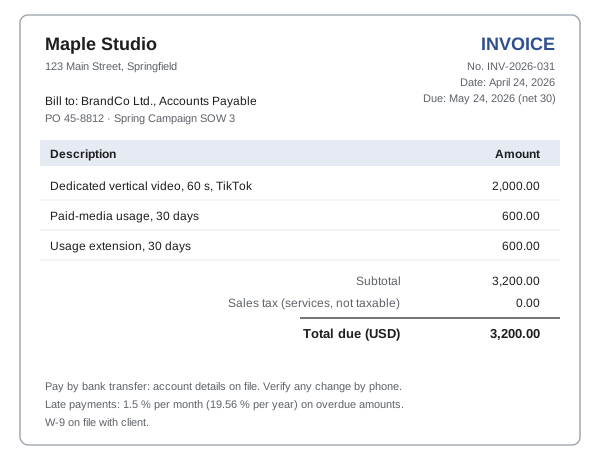
An invoice is a formal request for payment. It is also a key record for your bookkeeping and tax filings, and for the client's. A professional invoice includes:
- Your legal business name, address and contact details, and your logo if you have one.
- The client's legal name and address, and the name of the person or department responsible for payment.
- A unique, sequential invoice number, such as INV-2026-031.
- The invoice date and the payment due date, or the payment terms (for example, "net 30").
- The client's purchase order (PO) number or campaign reference, if they use one.
- A description of the work, matching the contract: deliverables, dates and usage rights.
- The amount, currency and any sales tax shown separately.
- Payment instructions: bank transfer details or a payment link.
- Late-payment terms, consistent with the contract.
There is no single federal rule for invoice contents in the US, but the client's accounts payable team will want your legal name and EIN on a Form W-9, which they use to issue Form 1099-NEC at year-end. Sales tax generally does not apply to services such as creating sponsored content, but if you sell taxable goods, such as merchandise, show any sales tax separately (lesson 10). Some states also tax certain digital products or advertising services, so check the rules where you sell.
Vendor onboarding
Large brands and agencies cannot pay you until you are set up in their accounts payable system as a vendor or supplier. Onboarding can involve supplier portals, banking forms, tax forms, insurance certificates and sometimes a review of your company. It can take weeks. Start it as soon as the contract is signed, ask what documents are needed and where invoices should be submitted, and confirm the PO number before invoicing. Many payment delays come from invoices sent to the wrong person or without a PO number, which the system then rejects silently.
Be alert to payment fraud. Criminals sometimes impersonate clients or creators by email and ask for bank details to be changed. Confirm any change in payment instructions by phone using a known number, and never change your own instructions by email alone.
Payment terms and their cost
Payment terms decide how long you wait for money. "Due on receipt," "net 15," "net 30," "net 60" and "net 90" are common, and large companies often push for longer terms. Slow payment has a real cost: while you wait, you may need to borrow, delay expenses or pass up opportunities.
Worked problem
The cost of net 90
A creator is offered $20,000 on net 90 terms instead of net 30. They carry a line of credit at 9 % a year that they draw on when cash is short. What is the approximate cost of waiting the extra 60 days?
Show solution
- Extra days: 90 − 30 = 60.
- Cost: $20,000 × 0.09 × 60 ÷ 365 ≈ $296.
Answer: About $296. That is small relative to the fee, so the creator might accept net 90 for a valuable client, but ask for a deposit or a modest increase in fee to offset it, especially if many clients pay slowly at once.
Some brands and platforms offer faster payment for a fee, such as "2/10, net 30" (a 2 % discount if paid within 10 days) or instant payout options in creator marketplaces. These are expensive when converted to an annual rate.
Worked problem
The true cost of early payment
A creator marketplace offers to pay a $5,000 invoice immediately for a 3 % fee instead of waiting 45 days. What is the approximate annual cost of this option?
Show solution
- Fee: 3 % × $5,000 = $150.
- Money received early: $5,000 − $150 = $4,850, received 45 days sooner.
- Rate for 45 days: $150 ÷ $4,850 ≈ 3.09 %.
- Approximate annual rate: 3.09 % × 365 ÷ 45 ≈ 25 %.
Answer: About 25 % a year, far more than most lines of credit. Early payout makes sense only in a genuine cash emergency.
Deposits are the simplest protection. Asking for 30 % to 50 % on signing reduces risk, funds production costs and filters out clients who are not serious. For new or small clients, a deposit is standard; for large brands that refuse deposits, insist on clear payment milestones.
When income counts: cash and accrual
In the US, most small sole proprietors use the cash method of accounting, recognizing income when it is actually or constructively received and deducting expenses when paid. An invoice issued in December but paid in January is generally income in the year it is paid. Businesses can instead use the accrual method, recognizing income when earned. The cash method makes cash and taxable income line up, but be careful near year-end: income is "constructively received" when it is credited to your account or made available to you, even if you have not withdrawn it, so a platform balance you could have paid out in December may count for that year.
Currencies and cross-border payments
Creators often work with brands in other countries. Payments may arrive in US dollars, Canadian dollars, euros or pounds. Currency affects both the amount you receive and your records.
- Agree the currency in the contract and on the invoice.
- Compare the cost of receiving payments: banks may charge for incoming wires and apply a conversion spread; specialist payment providers and multi-currency accounts are often cheaper.
- Exchange rates move between invoicing and payment. A 3 % move on a large invoice can matter.
- For tax purposes, amounts received in foreign currency must be reported in US dollars, generally using the exchange rate on the date received or a consistent yearly average where appropriate.
Worked problem
Currency on a Canadian-dollar invoice
A US creator invoices a Canadian brand for C$11,000 when the exchange rate is 0.73 US dollars per Canadian dollar. The brand pays 60 days later, when the rate is 0.71, and the bank charges a 1.5 % conversion spread. How many US dollars does the creator receive, compared with the value when invoiced?
Show solution
- Value when invoiced: 11,000 × 0.73 = US$8,030.
- Value at payment before the spread: 11,000 × 0.71 = US$7,810.
- Spread: 1.5 % × 7,810 ≈ US$117.
- Received: 7,810 − 117 = US$7,693.
- Difference from the invoice-date value: 8,030 − 7,693 = US$337.
Answer: About US$7,693, roughly US$340 less than expected. Invoicing in your own currency, using a cheaper conversion service or holding Canadian dollars until rates improve can reduce this risk.
Platform payouts
Platform revenue arrives on the platform's schedule, not yours. Most platforms pay monthly for earnings from an earlier period, apply minimum payout thresholds and may hold payments while they review invalid traffic or policy issues. Some deduct taxes at source or require tax forms before paying. Track platform income separately from brand income: download monthly statements, record the gross amount, any fees and withholding, and the net payment, and reconcile each payout to your bank account.
Tracking what you are owed
An accounts receivable aging report lists unpaid invoices grouped by how long they are overdue. Accounting software produces one automatically; a spreadsheet works too.
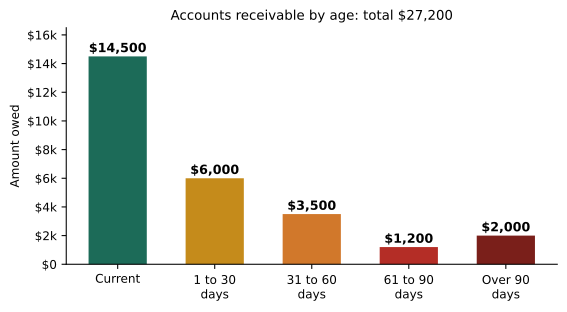
A useful summary measure is days sales outstanding (DSO), the average number of days it takes to collect revenue.
Worked problem
Calculating DSO
At the end of a quarter (90 days), a creator has $27,200 of unpaid invoices. Revenue invoiced in the quarter was $48,000. What is the DSO, and what does it suggest?
Show solution
- DSO = 27,200 ÷ 48,000 × 90.
- 27,200 ÷ 48,000 ≈ 0.567.
- 0.567 × 90 ≈ 51 days.
Answer: About 51 days. If most contracts are net 30, clients are paying about three weeks late on average, so the creator should tighten onboarding, invoicing and follow-up.
A collections process
Most late payments are caused by administrative problems, not bad intentions. A consistent, polite process resolves most of them quickly.
- Before the due date: confirm the invoice was received and approved, and that the PO number is correct.
- On the due date: send a friendly reminder with the invoice attached.
- 7 days overdue: follow up with your contact and accounts payable, asking for an expected payment date.
- 14 to 30 days overdue: escalate to a senior contact; mention late-payment interest under the contract.
- 30 to 60 days overdue: send a formal demand letter stating the amount, the contract clause, interest owed and a final deadline, and pause further work or posting if the contract allows.
- Beyond 60 days: consider small claims court, a lawyer's letter or a collection agency. Agencies often charge 25 % to 50 % of what they collect, so they suit older, smaller debts.
Keep records of every message. Stay professional: the person you are chasing may be your contact for the next campaign, and the problem may lie with their finance department.
Bad debts
Sometimes a client never pays, perhaps because it went out of business.
If you use the cash method, an unpaid invoice was never included in income, so there is nothing to deduct; you simply never received the money. If you use the accrual method, you can generally deduct a business bad debt when it becomes wholly or partly worthless. Keep evidence of your collection efforts. If you collected sales tax on goods that were never paid for, many states allow a refund or credit for bad debts.
Payment platforms and their costs
Many brands and agencies pay through third-party platforms, creator marketplaces or payroll-style services. Each has its own fees, payout schedules and requirements. Before agreeing to be paid through a platform, check who pays the fees, how long funds are held, which currencies are supported and whether a minimum balance applies. Compare the net amount you will actually receive with a direct bank transfer, and record the gross fee and the platform charge separately in your books so that the full fee appears as income and the charge as an expense.
Common mistakes
MistakeSending invoices without a PO number or to the wrong person.
InsteadConfirm onboarding, PO numbers and submission instructions before invoicing.
MistakeAccepting long payment terms without considering their cost.
InsteadPrice slow payment or ask for deposits and milestones.
MistakeTaking expensive early-payout offers routinely.
InsteadConvert the fee to an annual rate and use it only in emergencies.
MistakeChanging bank details because of an email.
InsteadVerify any payment change by phone using a known number.
MistakeChasing late invoices inconsistently or angrily.
InsteadFollow a polite, escalating collections schedule with written records.
Summary and key terms
- Invoices should match the contract and show numbers, dates, terms, tax, totals and payment instructions.
- Start vendor onboarding at signing; missing PO numbers cause many delays.
- Slow payment has a measurable cost; deposits and milestones reduce risk.
- Early-payout fees can equal very high annual interest rates.
- Most US sole proprietors use the cash method, recognizing income when received or constructively received.
- Currency movements and conversion spreads can reduce cross-border income; track platform payouts carefully.
- Use an aging report, DSO and a consistent collections process, and handle bad debts correctly for tax.
- Invoice
- A formal request for payment.
- Purchase order (PO)
- A client's internal authorization number for a purchase.
- Vendor onboarding
- Setting up a supplier in a client's payment system.
- Net 30
- Payment due 30 days after invoice.
- Deposit
- An upfront partial payment.
- Cash method
- Recognizing income when received and expenses when paid.
- Constructive receipt
- Income treated as received when made available to you.
- Aging report
- A list of unpaid invoices by how overdue they are.
- DSO
- Days sales outstanding: average days to collect revenue.
- Bad debt
- An amount owed that will not be collected.
Practice problems
Work each problem on paper first, then reveal the answer to check.
Cost of waiting an extra 30 days on $12,000 at 8 % a year?
Show answer
12,000 × 0.08 × 30 ÷ 365 ≈ $79.
A 2 % fee for payment 30 days early is roughly what annual rate?
Show answer
About 2.04 % × 365 ÷ 30 ≈ 25 %.
DSO with $15,000 receivables and $45,000 revenue over 90 days?
Show answer
30 days.
Name six items on a professional invoice.
Show answer
Names, invoice number, dates, PO, description, amount, tax, payment instructions, terms.
Why start vendor onboarding at signing?
Show answer
Onboarding can take weeks and blocks payment.
A 40 % deposit on a $7,500 deal is?
Show answer
$3,000.
What should you do if a client emails new bank details?
Show answer
Verify by phone using a known number.
When does a formal demand letter usually go out?
Show answer
Around 30 to 60 days overdue.
A collection agency charges 35 % on a $2,000 debt. What do you keep?
Show answer
$1,300.
US$5,000 at 1.36 less a 1 % spread is how many Canadian dollars?
Show answer
6,800 − 68 = C$6,732.
Lesson quiz · 5 questions
Score 60% or more to complete this lesson.
Create a free account to save your progress, take quizzes and earn a certificate.