
CRE-330 · Lesson 4 of 12 · 27 min
Rights clauses: licenses, assignments, exclusivity, morals and AI
For a creator, the most valuable asset is usually not equipment or cash but rights: the copyright in a library of content, the right to control the use of their name, face and voice, and the freedom to work with any brand they choose. Rights clauses decide how much of that value a contract gives away and for how long. CRE-310 explained how to price usage, whitelisting and exclusivity. This lesson explains the legal concepts behind those clauses and how to read and draft them: copyright ownership, licenses and assignments, name and likeness, exclusivity, morals clauses, confidentiality and the new clauses about artificial intelligence.
Who owns the content to begin with
Under the US Copyright Act, the author of a work is generally its first owner. The main exception is a "work made for hire." Work created by an employee within the scope of employment is owned by the employer. Work commissioned from an independent contractor is a work made for hire only if it falls within one of nine statutory categories, which include a contribution to a collective work and a part of a motion picture or other audiovisual work, and the parties sign a written agreement saying so. Otherwise, the contractor owns the copyright unless they assign it in a signed writing. Authors who assign copyright can, in many cases, terminate the transfer after 35 years, but works made for hire have no termination right. Registration with the US Copyright Office is generally required before suing for infringement of a US work and is needed to claim statutory damages and attorney's fees in many cases.
The practical point: unless you sign something that says otherwise, you probably own what you create. Every rights clause is therefore a decision to share or give away something you already own.
Licenses and assignments
There are two basic ways to let someone else use your work.
- A license is permission to use the work in specified ways while you keep ownership. Licenses can be exclusive or non-exclusive, limited or broad.
- An assignment transfers ownership of all or part of the copyright to someone else. A work-made-for-hire clause goes further: the commissioning party is treated as the author from the start. After either, you may need their permission to use your own content.
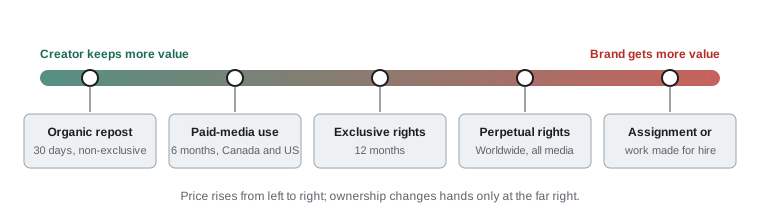
In most creator deals, a limited license is the right answer. The brand gets what it needs for the campaign, and the creator keeps the ability to use the content in a portfolio, license it again later and stop uses that were not paid for. When a brand asks for ownership, ask why. Often the real concern is that it wants to use the content in ads for a long time, which can be handled by a longer paid license rather than a transfer.
The parameters of a license
A license is defined by a set of parameters. Each one can be narrowed or broadened, and each change affects the price.
| Parameter | Narrow (creator-friendly) | Broad (brand-friendly) |
|---|---|---|
| Media and channels | Brand's organic social accounts | All media now known or later devised |
| Use | Reposting as published | Paid ads, edits, cut-downs, print, TV, packaging |
| Term | 30 or 90 days | Perpetual |
| Territory | Canada and the US | Worldwide |
| Exclusivity | Non-exclusive | Exclusive, even against the creator |
| Sublicensing | None | To agencies, retailers and affiliates |
| Modification | No edits without approval | Any edits, including with other content |
| Attribution | Credit the creator | No credit required |
Watch for phrases that silently broaden a license: "in perpetuity," "throughout the universe," "in all media now known or hereafter devised," "irrevocable," "royalty-free," "sublicensable" and "for any purpose." None is automatically wrong, but each should be deliberate and priced. A fair compromise for paid use is a fixed term with an option to extend for an agreed fee.
Worked problem
Pricing a license extension
A creator's agreement grants a brand 3 months of paid-media usage for one video with a base fee of $3,000. The contract lets the brand extend usage at 30 % of the base fee per month, or buy a 12-month extension for a 20 % discount on the monthly rate. The brand wants to extend for 12 months. Which option costs the brand less, and what should the creator invoice?
Show solution
- Monthly extension fee: 30 % × $3,000 = $900.
- Twelve monthly extensions: 12 × $900 = $10,800.
- Discounted rate: $900 × (1 − 0.20) = $720 per month.
- Twelve-month package: 12 × $720 = $8,640.
Answer: The 12-month package at $8,640 is cheaper for the brand and gives the creator certainty. Pre-agreed extension pricing turns a potential dispute into a simple invoice.
Name, likeness and voice
Brands want to use more than the content itself: the creator's name, image, voice, signature and biography in ads, on packaging or in press releases. These rights are separate from copyright.
In the US, most states recognize a right of publicity, by statute, common law or both, protecting against unauthorized commercial use of a person's name, likeness, voice or other identifying features. New York's Civil Rights Law sections 50 and 51 and California Civil Code section 3344 are well-known examples, and Tennessee's ELVIS Act of 2024 specifically protects voices against AI imitation. A contract should define exactly which identity elements the brand may use, where and for how long, and should require approval of any use beyond the agreed content.
A common creator-friendly clause allows the brand to use the creator's name and approved images only to identify the creator as the author of licensed content during the license term, and requires separate written approval and payment for endorsement-style uses such as "as seen on" packaging or a quote in a TV ad.
Exclusivity
Exclusivity restricts the creator from working with other brands. It is priced in CRE-310; here the focus is on drafting it precisely, because an imprecise exclusivity clause can block far more income than the creator intended.
- Category: define it narrowly ("sparkling water") rather than broadly ("beverages"), or attach a named list of competitors.
- Duration: state start and end dates. Many clauses run from the posting date, plus a period before it, so count the full window.
- Scope: does it cover all paid partnerships, organic mentions, affiliate links and existing deals? Existing agreements should be carved out.
- Platforms: does it cover every platform or only those in the campaign?
- Territory: does it apply worldwide or only in the campaign market?
- Remedies: what happens if the creator breaches; a refund of the exclusivity fee is more proportionate than repayment of the whole fee.
Worked problem
Counting an exclusivity window
An agreement says: "Creator shall not promote any competing energy drink from 14 days before the first post until 60 days after the last post." The campaign has posts on May 1 and June 15. How many days does exclusivity last, and does a competing deal posting on August 10 breach it?
Show solution
- Start: 14 days before May 1 is April 17.
- End: 60 days after June 15 is August 14.
- Days from April 17 to August 14 inclusive: 14 (April 17 to 30) + 31 (May) + 30 (June) + 31 (July) + 14 (August 1 to 14) = 120 days.
- August 10 falls inside the window.
Answer: Exclusivity lasts about 120 days, not the 74 days a quick reading might suggest, and an August 10 competing post would breach it. Always count from the last deliverable, and price the full window.
Morals clauses
A morals clause lets a brand terminate, and sometimes recover fees, if the creator does something that brings them into public disrepute or harms the brand's reputation. Brands have legitimate reasons for these clauses, but broad versions give the brand a unilateral exit for almost any reason.
- Narrow the trigger: refer to conduct that is criminal, or that a reasonable person would consider seriously offensive, rather than anything the brand "in its sole discretion" dislikes.
- Limit it to conduct during the term, not past content the brand reviewed before signing.
- Limit the remedy: termination and no further payments, not repayment of fees for work already delivered.
- Make it mutual: a reverse morals clause lets the creator exit if the brand becomes embroiled in a scandal, such as a product safety crisis.
- Add a process: notice and a chance to respond before termination.
Artificial intelligence clauses
Generative AI has created new rights questions. Brands may want to use a creator's content, face or voice to create new material, train models or produce synthetic versions of the creator. Creators may use AI tools in their own work and need to know what the contract allows.
- Synthetic use of identity: require express written consent, a separate fee and approval of each use before any brand creates AI-generated content using the creator's likeness or voice.
- Training: prohibit use of the creator's content or identity to train AI models unless separately agreed and paid.
- Scope of licenses: make sure "modify" or "create derivative works" does not quietly permit synthetic versions of the creator.
- Creator use of AI: check whether the brand requires disclosure of AI-generated elements, prohibits AI imagery, or asks for warranties that the content is original. Platforms and advertising rules may also require AI labels (see CRE-320).
- Ownership of AI output: copyright protection for purely machine-generated material is uncertain, so warranties that you "own all rights" in AI-generated elements may be hard to give. Qualify them.
Industry groups have responded. In the US, SAG-AFTRA's agreements address digital replicas, and several states have passed laws protecting voices and likenesses from unauthorized AI imitation. In Canada, the common-law and Quebec protections for personality and image apply to AI uses, and ACTRA has pressed for consent and payment rules for digital replicas in its agreements. These protections help, but a clear contract clause is the creator's first line of defense.
Confidentiality and non-disclosure
Brands often share launch dates, products and pricing before they are public. Confidentiality clauses and NDAs oblige the creator to keep that information secret. A fair clause defines confidential information, excludes information that is already public or independently known, lasts for a reasonable period, and applies to both sides, because the creator also shares information such as rates and audience data. Accidentally revealing a launch can be a costly breach, so manage embargo dates carefully.
Collaborations and jointly created content
When two creators make content together, ownership can become unclear. Joint authorship may arise when both contribute original expression intending to create a single work, giving each partial ownership. Without an agreement, each joint owner may, depending on the jurisdiction, be able to use or license the work, sometimes with a duty to share profits. A short collaboration agreement should state who owns the content, who can post it where, how revenue (platform payments, sponsorships, products) is split and what happens to the content if the collaboration ends.
Raw footage and brand assets
Brands sometimes ask for raw footage. Raw files reveal your process and let a brand create new edits you never approved, so price them separately and license them narrowly. In the other direction, the brand usually licenses its trademarks, logos and product images to you for the campaign; the contract should allow that use, and you should stop using the brand's marks when the license ends.
Common mistakes
MistakeAssigning copyright when the brand only needs a license.
InsteadOffer a limited license with priced extensions; reserve ownership.
MistakeAccepting "all media, worldwide, in perpetuity" for a standard fee.
InsteadNarrow media, term and territory, or price a buyout explicitly.
MistakeReading exclusivity as running only during the posting dates.
InsteadCount the full window, including periods before and after posting.
MistakeSigning a morals clause triggered by anything the brand dislikes.
InsteadUse an objective trigger, a fair remedy and a mutual clause.
MistakeAllowing "modifications" that could permit AI replicas of your face or voice.
InsteadRequire separate consent and payment for synthetic uses and training.
Summary and key terms
- The creator usually owns the copyright in their content unless a signed document transfers it.
- A license grants permission while the creator keeps ownership; an assignment transfers ownership.
- License parameters include media, use, term, territory, exclusivity, sublicensing, modification and attribution.
- Name, likeness and voice are protected separately and should be licensed narrowly.
- Exclusivity must be defined by category, duration, scope, platforms and territory, and counted carefully.
- Morals clauses should be objective, limited, mutual and fair in their remedies.
- AI clauses should require consent and payment for synthetic uses and prohibit unagreed training.
- Copyright
- Exclusive rights to reproduce, distribute, display and perform a work.
- License
- Permission to use a work while ownership stays with the owner.
- Assignment
- A transfer of ownership of rights, which must be in signed writing.
- Work made for hire
- A work whose author is legally the employer or commissioning party.
- Buyout
- Unlimited or perpetual rights for a single price.
- Right of publicity
- A state-law right against unauthorized commercial use of identity.
- Exclusivity window
- The full period during which competing work is barred.
- Morals clause
- A clause allowing termination for reputation-damaging conduct.
- Digital replica
- An AI-generated simulation of a real person's likeness or voice.
- Joint authorship
- Shared ownership of a work created together.
Practice problems
Work each problem on paper first, then reveal the answer to check.
Monthly paid usage at 25 % of a $2,400 base for 6 months?
Show answer
$3,600.
License or assignment: which keeps ownership with the creator?
Show answer
A license.
Name four license parameters.
Show answer
Media, use, term, territory, exclusivity, sublicensing, modification, attribution.
Exclusivity from 7 days before a June 1 post to 30 days after: how many days?
Show answer
May 25 to July 1: 38 days.
Name three phrases that broaden a license.
Show answer
In perpetuity, worldwide, all media now known or hereafter devised, irrevocable, sublicensable.
What is a reverse morals clause?
Show answer
A clause letting the creator exit if the brand causes a scandal.
Should a creator license raw footage for free?
Show answer
No; price and limit it separately.
Name two AI protections to request.
Show answer
Consent and payment for synthetic uses; no training without agreement.
What should a collaboration agreement cover?
Show answer
Ownership, posting rights, revenue split and what happens if it ends.
A 12-month extension at $800 a month with a 15 % discount costs?
Show answer
12 × 680 = $8,160.
Lesson quiz · 5 questions
Score 60% or more to complete this lesson.
Create a free account to save your progress, take quizzes and earn a certificate.